10 College Basketball Stats so Far in 2014-15 That Are Unsustainable
It won't last. It can't last. No way, no how.
Some of the statistics college basketball teams and players are posting so far this season jump off the page. Not necessarily for how impressive (or unimpressive) they are, but for how much different they are in comparison to others, or in contrast to what that player or team has produced in past seasons.
As good or bad as they are, these stats are at a level that just doesn't seem possible to sustain. Either the opponents will get tougher, the missed shots will start falling or law of averages will kick in.
Here are 10 current college basketball stats that just don't seem capable of being sustained.
Alabama's Free-Throw Shooting
1 of 10
The stat: 80.3 percent
Alabama is off to a 5-2 start, with its losses coming to Iowa State in the CBE Classic and at Xavier. Neither of those games were close enough to where one or two mistakes made a difference, but if they were it would not have been a result of free-throw shooting.
Through seven games, the Crimson Tide lead Division I at the foul line, making more than 80 percent of their free throws. Four starters are hitting better than 80 percent, led by senior guard Levi Randolph's 97.6 percent rate.
Randolph—who has made 41 of 42 foul shots this season—was a 69.4 percent foul-shooter during his first three seasons, none better than 71.6 percent.
The 2013-14 Crimson Tide shot 68.5 percent, led by the now-graduated Trevor Releford's 84.8 percent. But most of the returners have seen their foul shooting improve dramatically, with senior guard Rodney Cooper going from 74.2 to 85.7, and junior forward Shannon Hale upping his rate from 63.2 to 78.3.
The school record for foul shooting is 78.7 percent, set during the 1986-87 season when Alabama went 28-5 and reached the Sweet 16.
BYU's Scoring
2 of 10
The stat: 94.6 points per game
Prior to Wednesday night, the fewest points BYU had scored was 85 in an overtime contest against Purdue in the Maui Invitational. The Cougars' second-lowest total, 87, came in double overtime against San Diego State in the same tournament.
Then came the visit from Utah, a more methodical team that was more interested in playing at a slower pace than running and gunning with BYU.
The result? A 65-61 Utah win that dropped BYU's scoring average from 94.6 points per game to 91.2, which still tops in the nation. But that figure will likely continue to drop as more opponents look to control the tempo.
The Cougars had been shooting 49 percent from the field—helping to fuel their scoring punch—but made only 36.9 percent of its shots against Utah.
Chasson Randle's Free-Throw Perfection
3 of 10
The stat: 100 percent
Chasson Randle is a good player who will contend for all-conference honors in the Pac-12, but the Stanford senior is not perfect—no matter what his current free-throw shooting might indicate.
Randle has made all 27 of his foul shots this season, and he's made 31 consecutive dating back to the second half of the Cardinal's Sweet 16 loss to Dayton in March. But he did miss three of his first eight free throws in that same game, going 8-of-11 to cap a season in which he shot 76.7 percent from the line.
That's a good percentage, and it aligns with his rates as a freshman (76.1) and sophomore (78.4), but it's far from perfect. So as nice as Randle's current run at the line is, it's bound to end sooner rather than later.
The perfection is likely to end Saturday night when Stanford (4-2) hosts Denver in the Cardinal's first game in two weeks because of a academics-fueled hiatus.


Domantas Sabonis' Field-Goal Shooting
4 of 10
The stat: 75 percent
Gonzaga freshman forward Domantas Sabonis has made 50 percent of his shots in the Bulldogs' last two games, which has significantly dropped his accuracy rate.
So it goes when you fail to miss a shot in four of your first seven college games.
The 6'10" Sabonis has made 39 of his 52 field goals so far, using his size and Euro-style athleticism to make good shots from close range. But there's no way he'll keep up such a high rate, not with opponents putting more bodies on him to alter those shots.
That's what Arizona did Saturday, and Sabonis only attempted three shots and made just one.
In Wednesday's 81-66 win over Washington State, Sabonis made three of five shots, which dropped him from 76.6 percent to 75 percent. And with each miss from here on out, that efficiency will keep dropping.
Florida State's 3-Point Shooting
5 of 10
The stat: 20.4 percent
Chuck it up enough, and you're going to make some shots. That hasn't been the case yet for Florida State when it comes to 3-point shooting, but things should get better.
Through eight games, the Seminoles (4-4) have made barely above 1 in 5 outside shots, ranking dead last among 351 Division I teams. Granted, FSU has only attempted 98 3-pointers—tied for 14th-least in the country—but it has only made 20.
Only Grambling has made fewer, but it's hit 19 on 75 attempts for a somewhat better 25.3 percent.
Much of the problem is that several of Florida State's best outside shooters from last season, when it made 38 percent as a team, are no longer around. Okaro White and Ian Miller combined to shoot 39.2 percent from deep, and nobody has stepped up to replace that production.
Freshman Robbie Berwick, at 26.1 percent, is the team leader.
The Seminoles should see that number improve once Aaron Thomas and Devon Bookert get back on track. Thomas, a junior guard, is shooting 23.5 percent from outside after making 37.1 percent a year ago, while junior guard Bookert hit 43.1 percent last season but went 1-of-5 before missing the last four games with a foot injury.
Kentucky's Scoring Balance
6 of 10
The stat: Seven players averaging at least 7.3 points per game
Kentucky's platoon system might be an effective way of distributing minutes to a talented roster, but don't expect either the playing time or the scoring balance to continue.
Currently, seven players are scoring between 7.3 and 10.3 points per game, and nobody is averaging more than 24.1 minutes per game. But in Wednesday's 56-46 slugfest win over Columbia, guards Aaron and Andrew Harrison played 33 and 32 minutes, while forward Trey Lyles played 30 and forward Willie Cauley-Stein played 28 minutes.
That kind of distribution falls more in line with most teams, where the starters get the bulk of the minutes. In this game, it was partly because of the absence of injured guards Devin Booker and Tyler Ulis, but second-unit replacements Dominique Hawkins and Derek Willis didn't get nearly the same number of minutes as the regular rotation players.
As Kentucky moves closer to SEC play—as well as in upcoming challenges from North Carolina, UCLA and Louisville—the platoon concept figures to keep dwindling away, and coach John Calipari will have a seven- or eight-player rotation handling the bulk of the minutes and scoring the lion's share of the points.
Louisville's Scoring Margin
7 of 10
The stat: 25.9 points per game
It's been an impressive start for Louisville (8-0), which is coming off a 20-point win over Indiana on Tuesday in the Jimmy V Classic in New York City.
At this point in the season, the Cardinals are outscoring their opponents by nearly 26 points—the closest game being a 64-55 victory Dec. 2 against then-unbeaten Ohio State.
Don't expect this margin to remain so big, especially when the Cardinals begin playing actual road games.
So far, Louisville has played seven games at the KFC Yum! Center and traveled to Madison Square Garden on Tuesday. The first true road game doesn't come until Dec. 20 (at Western Kentucky), but the real road tests start in January when the Cardinals begin their first season of ACC play.
That means trips to North Carolina, Pittsburgh, Miami, Virginia (those two within four days of each other) and Syracuse. The Cardinals also have home games scheduled against Kentucky—which itself is winning by 29.6 points per game—as well as Duke, Miami, North Carolina, Notre Dame, Pittsburgh and Virginia.
Mike Scott's Assist-to-Turnover Ratio
8 of 10
The stat: 12-to-1
Don't beat yourself up if you've never heard of Idaho guard Mike Scott, because few have.
The 6'0" senior from Los Angeles spent two seasons in junior college before joining the Vandals last year. He averaged 8.7 points and 2.2 assists in 2013-14, but his assist-to-turnover ratio was less than 2-to-1.
Not so this season.
Through seven games, he's dished out 36 assists and only committed three turnovers. He's gone without a giveaway in four games, an accomplishment that stands out even more when you see he's also Idaho's leading scorer at 17.1 points per game.
Scott has the ball in his hands a lot, pouring in 31 points with five assists (and no turnovers) in a loss to Boise State and going for 19 points, six assists and one turnover in a win at Washington State.
As involved as Scott is in the offense, his turnovers are likely to increase.
Notre Dame's Shooting Percentage
9 of 10
The stat: 56.2 percent
It stood to reason that electric scorer Jerian Grant's return to the lineup would lead to good things for Notre Dame's offense, but what the Fighting Irish have done with the ball goes far beyond one player.
A year after shooting a respectable 45.5 percent, Notre Dame (9-1) heads into Saturday's ACC opener against Florida State leading the nation in field-goal shooting. And it's not just because of Grant, a senior guard who missed more than half of last season after being suspended for academic deficiencies in mid-December.
Grant is shooting 58.1 percent this season, but that's only second-best on the team.
Junior Zach Auguste is hitting 64 percent of his shots, up from 50.9 percent a year ago, bringing the 6'10" forward's scoring rate from 6.7 points per game last season to 14.1 this season.
All five of Notre Dame's starters are shooting at least 52.2 percent from the field.
Because of the hot shooting, Notre Dame is averaging 85.1 points per game, up from 72 last year. That includes a 46.4 percent performance in an overtime win over a Michigan State team that is holding opponents to 37.7 percent from the field this season.
Pittsburgh's Offensive-Rebounding Percentage
10 of 10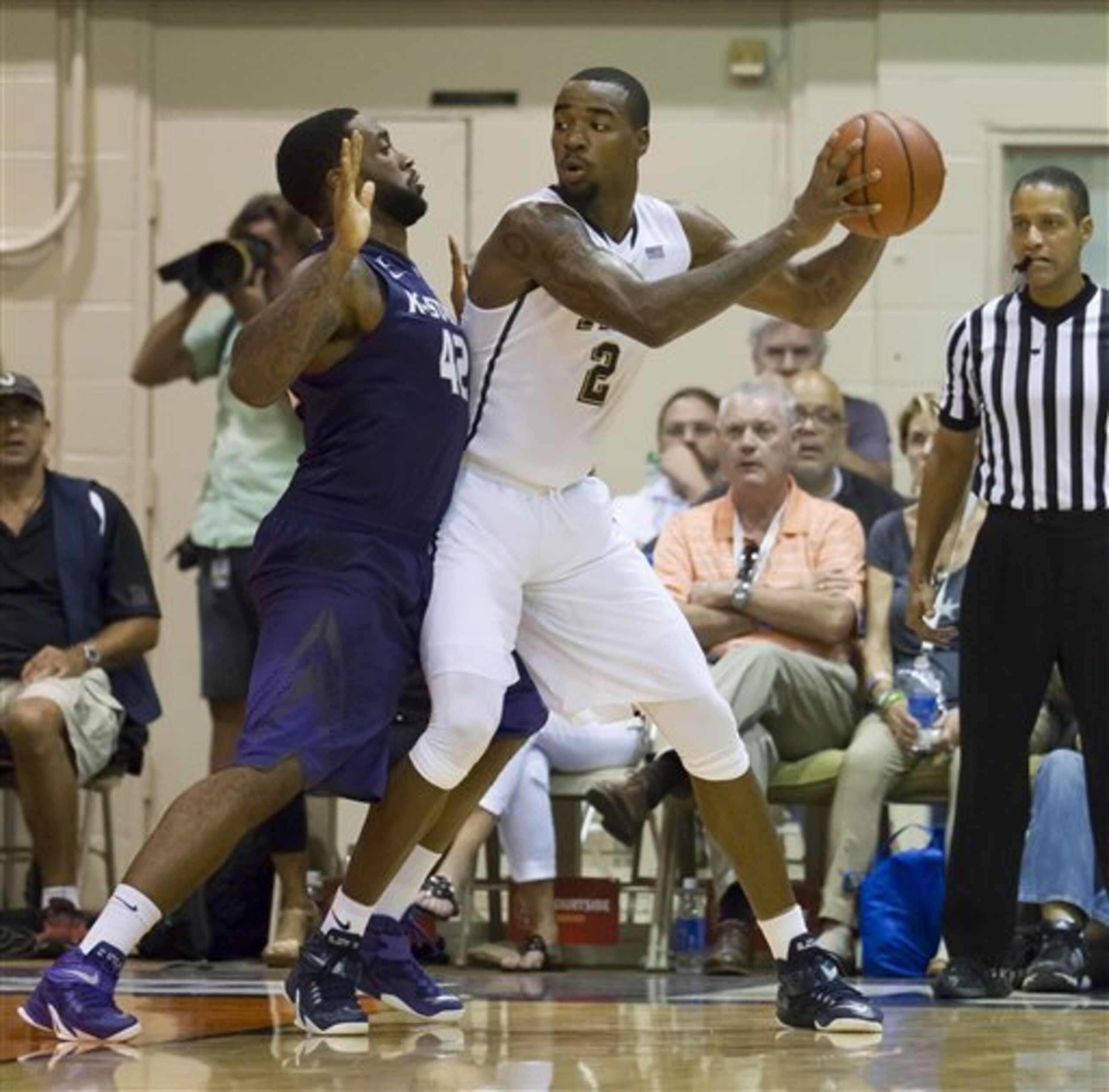
The stat: 45.5 percent
Pittsburgh's challenging nonconference schedule has already resulted in three losses: Hawaii, Indiana and San Diego State.
A loss of leadership and size from last season's team made it likely the Panthers would struggle, and the suspension of junior forward Durand Johnson right before the opener dramatically increased the chances of early ups-and-downs. But despite having no player taller than 6'9" average double-digit minutes, Pitt is dominating on the offensive glass.
The Panthers have rebounded 45.5 percent of their own misses, which entering Wednesday was tied with Kentucky for the best rate in Division I. Last year, Pitt rebounded 37.2 percent of its misses, and that was with a team that featured inside force Talib Zanna, who has graduated.
Sophomore forward Michael Young and senior forward Derrick Randall are doing most of the work, combining for 53 offensive boards compared to only 51 defensive rebounds.
Despite the tough schedule, the Panthers haven't faced particularly strong rebounding teams—they rebounded 51.8 percent of their misses in the losses—but that will change once the ACC slate begins.
Follow Brian J. Pedersen on Twitter at @realBJP.
.jpg?w=2560 "NBA Gambling Charges")
.jpg?w=2560 "Aikman Blasts Cowboys WR 🫣")

.jpg?w=2560 "Jonathan Taylor Landing Spots")