The Best Teams, the Best Matchups: Fixing the NFL Playoffs
In the 2014 NFL playoffs, an NFC South team with a losing record might host a double-digit win NFC wild card. This has made some football lovers very upset.
It's no wonder: Playoff byes, seeding, and home-field advantage are rewards for regular-season performances. It's bad enough a sub-.500 team can even make the playoffs in the current system; it shouldn't ever be given a leg up on a team that clearly outplayed them.
The system is broken, and it needs to be fixed.
.jpg?w=2560 "Commanders 49ers Football")
.jpg?w=2560 "Colts Football")
.jpg?w=2560 "DOLPHINS-AIKMAN")
Since the NFL can't physically play a double round robin of 32 teams in one season, there has to be a shortened regular season, paired with playoffs designed to match the best against the best. As we look at possible fixes to the NFL playoffs, let's start from a set of guiding principles:
- The primary goal of the NFL playoffs is to determine the league's champion.
- The secondary goal of the NFL playoffs is to drive fan interest with premier matchups.
- The playoffs must reward great regular-season performances.
- The playoffs must balance admitting enough teams to keep most fans engaged for most of the season against letting poor teams into the playoffs.
The current system mostly achieves most of these goals, most of the time.
The NFL's best regular-season teams get every opportunity to make it to the mountaintop. Between skipping the first-round playoff bye and having home-field advantage, the top two seeds in each conference only need to win one home game to make their conference-title game.
Fan interest? You bet. The AFC and NFC Championship games of 2013 featured the two matchups everyone wanted to see: The Denver Broncos against the New England Patriots and the Seattle Seahawks against the San Francisco 49ers. No complaints there.
Since the 2002 realignment, only one sub-.500 team has ever made the playoffs; only one 11-win team has ever been frozen out. Here's the likelihood a n-win team has of making the playoffs in the current system:
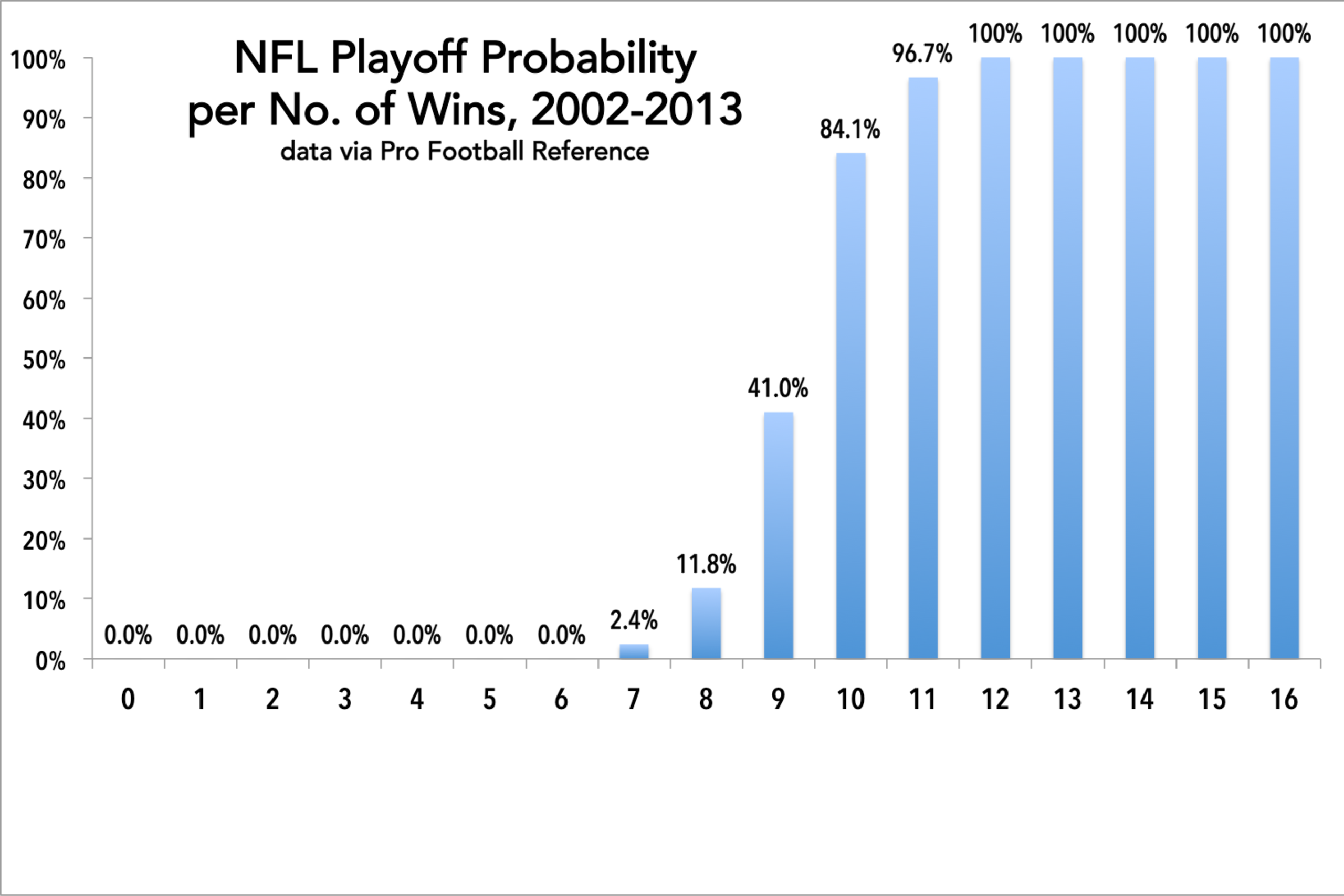
Balancing the chance for most of the NFL to stay playoff-eligible for most of the season against letting in poor teams? That's where the current format falls down.
There have been a few questionably worthy champions in the mid-to-late 2000s; most fans agree a team with a losing record has no business in the postseason at all. With the NFL looking to expand the field to 14 teams in 2015, per NFL.com's Gregg Rosenthal, more of these middling squads will make the playoffs—where they can trip up worthier contenders.
Just Fix the Problem
The NFL's competition committee recently solved the problem of teams winning sudden-death overtime games with an opening-drive field goal by, well, disallowing that.
Matt Krivanek of SportsRants.com proposed a playoff change that would keep losing teams out of the playoffs and stop slating the seeding toward (potentially weak) division winners. In his model, each conference would take the top six records, regardless of division, and seed them in record order. Current bracket structure and tiebreakers would remain the same.
Here's how that would look if the season ended today:
| New England Patriots (1) | 0.750 | Arizona Cardinals (1) | 0.750 |
| Denver Broncos (2) | 0.750 | Green Bay Packers (2) | 0.750 |
| Cincinnati Bengals (3) | 0.708 | Philadelphia Eagles (3) | 0.750 |
| Indianapolis Colts (4) | 0.667 | Dallas Cowboys (4) | 0.667 |
| San Diego Chargers (5) | 0.667 | Detroit Lions (5) | 0.667 |
| Miami Dolphins (6) | 0.583 | Seattle Seahawks (6) | 0.667 |
There are a few issues with this.
First, three-eighths of every NFL team's schedule is a home-and-home double round robin against their division rivals; division champions are the "true"-est champions the NFL crowns.
The Atlanta Falcons, should they win their two remaining division games and lose the others, will have won the woeful NFC South with a 7-9 record—but they'll be 6-0 in division. Why spend so much effort determining, with absolute confidence, the Falcons are the best team in the NFC South if that title means nothing?
If winning a division championship doesn't guarantee you a playoff berth, there isn't much point to having divisions.
Second, this format doesn't punish weak divisions; it punishes close divisions. An AFC team like the Indianapolis Colts, with a stranglehold on a weaker division, would be seeded above a team like the Baltimore Ravens—stronger by nearly any metric other than winning percentage.
This hints at two bigger problems: Divisions aren't the only barriers to picking the 12 best teams, and winning percentage isn't a perfect measure of team strength.
The Dominant Dozen

The Super Bowl wasn't always played to decide a champion.
Originally, the Super Bowl was played between two champions: the winners of rival leagues, the AFL and NFL. Since the 1970 merger, the remnants of that rivalry have slowly disappeared; relocation, expansion, and realignment have made the history of the AFC and NFC irrelevant. Most modern fans are barely aware of it.
As a result, being the AFC or NFC "champion" doesn't mean a whole lot. Peyton Manning doesn't keep coming back to win more AFC Championships; he's trying to win another Super Bowl ring!
If we're trying to get the 12 best teams, we can't recognize that some divisions are weaker than others without also recognizing one conference is usually stronger than the other. Right now, the AFC seems to have a stranglehold on the league, with 11 winning teams (compared to just seven for the NFC).
However, if we go by overall winning percentage, this is what the playoff field looks like:
| New England Patriots (1) | 0.750 | 125 |
| Green Bay Packers (2) | 0.750 | 113 |
| Philadelphia Eagles (3) | 0.750 | 90 |
| Denver Broncos (4) | 0.750 | 85 |
| Arizona Cardinals (5) | 0.750 | 34 |
| Cincinnati Bengals (6) | 0.708 | 13 |
| Indianapolis Colts (7) | 0.667 | 99 |
| Seattle Seahawks (8) | 0.667 | 77 |
| San Diego Chargers (9) | 0.667 | 30 |
| Dallas Cowboys (10) | 0.667 | 29 |
| Detroit Lions (11) | 0.667 | 24 |
| Baltimore Ravens (12) | 0.583 | 86 |
This time, it just so happens to be a 50-50 split between the conferences. For seeding tiebreakers, I used point differential (as conference record, division record, etc. no longer apply, and head-to-head throws out the whole rest of the season).
Now, we have something that looks like the NCAA basketball tournament, but starting at the Sweet 16: Everyone in the field is a legitimate title contender, and no legitimate contenders have been left out.
If we really want to get to the heart of the matter, we could use a better overall metric, like Football Outsiders DVOA, or a BCS-like weighted formula of winning percentage and advanced stats—but the likelihood of the NFL officially adopting a "BCS-like" system is somewhere between zero and negative zero.
The Campbell's World Cup of Chunky Souper Bowl
The NFL wants more playoff games, so it can show more games on TV, sell more ads for those games and make more money. But expanding the playoff field means letting in more mediocre (or flat-out poor) teams, and making the playoffs worse on two fronts.
But instead of 12 teams playing 11 games, or 14 teams playing 13 games, what if we expand that out to 16 teams playing a whopping 27 games—more than doubling the playoff-game revenue? What if we kept half of the NFL's fanbases on the hook for an extra month?
What if we could do all that while preserving advantages earned in the regular season, and adding only one week to the schedule?
What if we took a page from soccer?
Let's take all eight division winners, plus the next-best eight teams by winning percentage (tiebroken by point differential). After we seed them 1-16, we sort them into four groups of four, like this:
| New England Patriots (1) | 0.750 | 125 | Green Bay Packers (2) | 0.750 | 113 |
| Seattle Seahawks (8) | 0.667 | 77 | Indianapolis Colts (7) | 0.667 | 99 |
| San Diego Chargers (9) | 0.667 | 30 | Dallas Cowboys (10) | 0.667 | 29 |
| Atlanta Falcons (16) | 0.417 | -8 | Buffalo Bills (15) | 0.583 | 47 |
| Philadelphia Eagles (3) | 0.750 | 90 | Denver Broncos (4) | 0.750 | 85 |
| Cincinnati Bengals (6) | 0.708 | 13 | Arizona Cardinals (5) | 0.750 | 34 |
| Detroit Lions (11) | 0.667 | 24 | Baltimore Ravens (12) | 0.583 | 86 |
| Kansas City Chiefs (14) | 0.583 | 53 | Miami Dolphins (13) | 0.583 | 69 |
Then, just like in the World Cup, Champions League or any other major soccer tournament, all four groups play a round robin, with the higher seed always hosting. After three weeks, the winner of each group, tiebroken by point differential, would populate a 1-4, 2-3 semifinal; the winners of those two games would meet in the Super Bowl.
In Group A, for example, the Patriots would host the Seahawks, Chargers and Falcons; they'd be expected to win at least two of those three. The Seahawks would have a fighting chance, the Chargers would need a miracle and the Falcons...well, they're in the field. They're not hosting a game, and would be lucky to win one, but it's three more big-time games for their fans.
If all the top seeds were to win their groups, in this example, the semifinal would feature the Patriots hosting the Broncos and the Packers hosting the Eagles; the winners would play for the Lombardi Trophy.
Instead of having dull playoff weekend featuring just four, four and two games before the Super Bowl, we'd have a playoff smorgasbord of eight, eight and eight games before the semifinals and then the Super Bowl.
The NFL would make a mint, practically no teams would be eliminated until the regular season is almost over, half the NFL fans on Earth would get an extra month to keep cheering and there'd be zero lingering doubt about any team being excluded or unworthy.
"But wait," I hear you saying. "What about the players?" The players have steadfastly campaigned against a longer regular season—partly because of the additional wear and tear on their bodies and partly because many of those games would be meaningless add-ons at the end of the year.
Instead of adding 32 regular-season games that would be mostly pointless, this setup would add 16 playoff games—more excitement, more revenue and more top-level competition players would get hyped for.
This solution would infuse meaning into nearly every game of the regular season. All but the most awful teams would be mathematically alive until the bitter end, and even they would likely be able to play spoiler. The players would get more per-diem playoff checks, and the bigger revenue pie would pump up the salary cap (and floor!).
Everybody wins.
K.I.S.S.
Or, we could keep everything exactly the same way it is now and just change the seeding.
Separately for each conference, take all four division champs, two wild cards based on winning percentage and seed them 1-6 based purely on winning percentage. It'd solve the problem of the 7-9 Falcons hosting the 11-5 Seahawks, at least, even if it doesn't solve anything else.
If the owners really are going to expand to 14 teams for 2015, they've got to do something about this problem—and if they're going to turn down the free money, fairer competition and incredible sponsorshp and titling opportunities of "The Campbell's World Cup of Chunky Souper Bowl," this is a quick and easy something to do.
.jpg?w=2560)
.jpg?w=2560 "NFL Paris Football")

.jpg?w=2560 "Malik Beasley Negotiating Plea Deal (AP)")