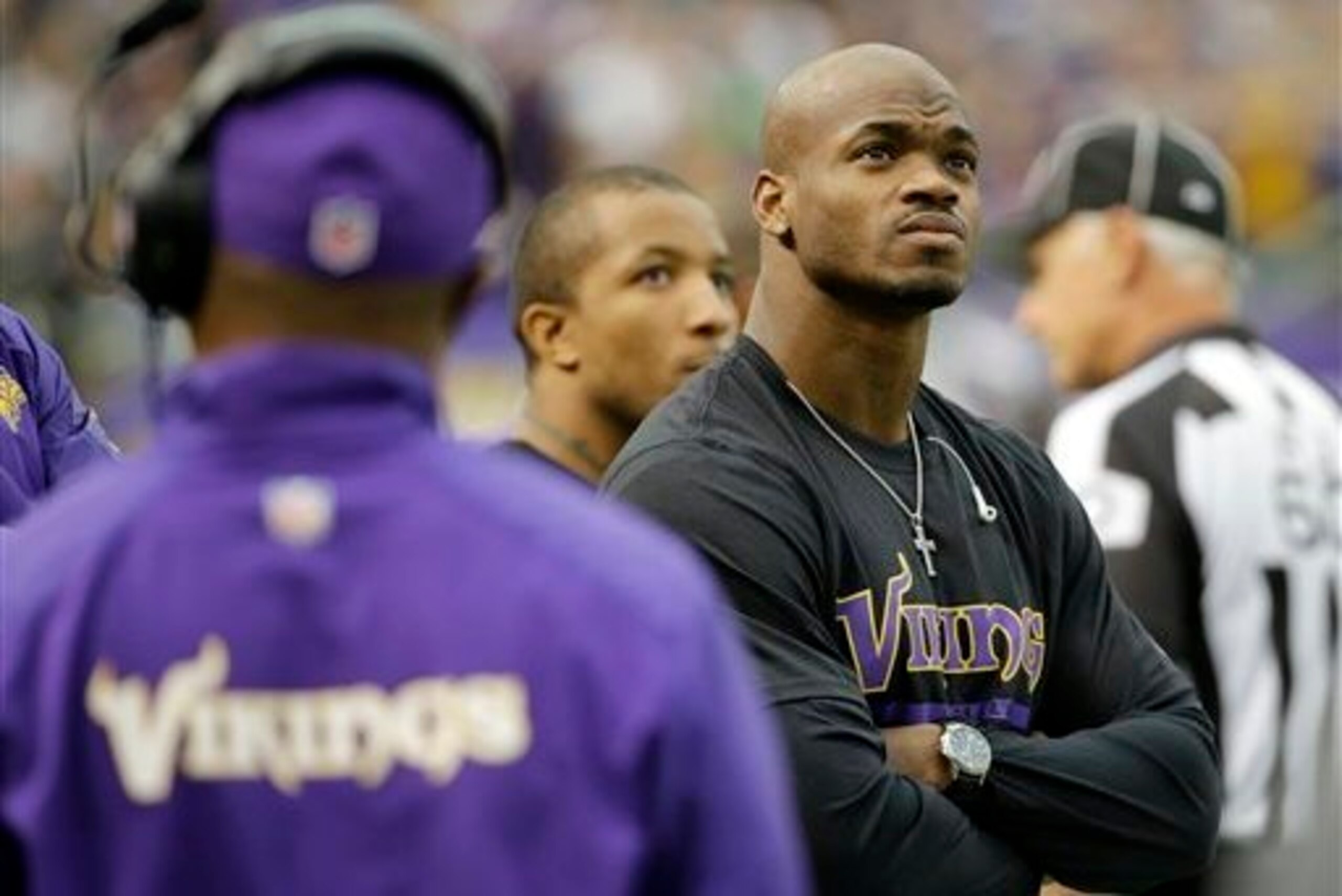
Peterson Suspension Keeps Vikings Building New Identity, Casts Doubt on Future
The suspension levied by the NFL on running back Adrian Peterson—which will last at least the rest of this season, per Adam Schefter of ESPN—doesn't change the fact that the Minnesota Vikings will likely move on from Peterson this offseason and continue their building of a new identity in the post-Peterson era.
The NFL suspended the Vikings' all-time leading rusher under the personal conduct policy. Peterson will appeal the league's decision, but, under the current guidelines put forth by commissioner Roger Goodell, reinstatement will not even be an option until mid-April of 2015.
The Vikings will likely receive just a single game out of Peterson this season. But the league's unflinching decision has granted the club an opportunity to truly forge a new identity—without Peterson's return clouding the process. Barring a successful appeal to return in 2014, Peterson appears unlikely to play another down for Minnesota.
TOP NEWS
Bears' Santos Wanted to Kick 58-Yarder
Picking Each NFL Division Winner 🔮
.jpg?w=2560)
B/R's Expert Week 7 NFL Picks 🔮
He will turn 30 years old next March, roughly a month before he's first eligible for reinstatement. More importantly, Peterson is due to count $15.4 million against the cap in 2015, per Over the Cap, with a base salary of almost $13 million. Minnesota can save roughly $13 million by releasing or trading Peterson, with a manageable dead-money hit of only $2.4 million.
His six-year, $86.3 million contract contains no remaining guaranteed money, but a prorated portion of his signing bonus—equaling $2.4 million—accounts for the cap charge. Peterson is due $15 million in 2016 and $17 million in 2017.
The contract was set up to give an eventual out for the Vikings, regardless of Peterson's transgressions off the field. The NFL's suspension—which would keep Peterson out of the league through a significant portion of the offseason, including most of free agency—all but guarantees the Vikings will exercise their option to move on.
The Vikings' official statement Tuesday said very little:
"The NFL has informed the Vikings of today’s decision regarding Adrian Peterson. We respect the league’s decision and will have no further comment at this time."
More than likely, Minnesota's decision to cut ties will come before it knows whether or not Peterson has been reinstated in mid-April. There's simply no reason to wait around and hope Peterson is back by next spring while also bypassing the $13 million in freed up cap space. The Vikings are in a position to start over, with more assets for next year's free agency and a more focused approach to reconfiguring the offense.
Setting up a future sans Peterson will include rebuilding the running back position and committing to rookie quarterback Teddy Bridgewater, two goals already in process.

The Vikings are high on first-year running back Jerick McKinnon, a freak athlete with two 100-yard rushing games already this season.
A former college option quarterback at 5'9" and 208 pounds, McKinnon doesn't perfectly fit the mold of a No. 1 NFL running back. But he's also tougher than he looks between the tackles, shifty in the open field and a dependable receiver out of the backfield. The flashes have been evident while he's transitioned to the NFL and a new position.
Matt Asiata, a 234-pound plodder, has seven touchdowns this season, including six on the ground. The Vikings like his dependability, both near the goal line and as a receiver (25 catches). But he will also be a restricted free agent this coming offseason, and his ceiling as a featured player is low.
Together, McKinnon and Asiata have been serviceable in place of the explosive, talented Peterson. Over 10 games, the duo has rushed for 763 yards on 183 carries and caught 49 passes for 337—good for 1,100 yards on 232 touches.
The Vikings may end up deeming McKinnon more of complementary player. His best usage could be as one half of a legitimate one-two punch, with his role centered more on the change-of-pace option. If that's the case, the 2015 NFL draft may hold a solution for filling Peterson's shoes.
The upcoming class of running backs is one of the most talented at the top in recent memory, with Wisconsin's Melvin Gordon, Georgia's Todd Gurley, Nebraksa's Ameer Abdullah, Alabama's T.J. Yeldon, Indiana's Tevin Coleman, Miami's Duke Johnson and Minnesota's David Cobb all representing future NFL starters at the position. The Vikings used a third-round pick on McKinnon last May, and another top-three selection could be used to find his running mate this coming April.
Combining McKinnon with any of the above backs—especially one with game-breaking ability on early downs, such as Gordon or Gurley—would give the Vikings more than enough at the position Peterson is likely to vacate. Then again, taking one of the top backs might require a first- or second-round pick, which is a high price to pay for a position that continues to devalue in the NFL landscape.
Free agency is another option.
DeMarco Murray, Ryan Mathews, Mark Ingram, Knowshon Moreno, Frank Gore and Darren McFadden are among the running backs currently scheduled to become unrestricted free agents next spring. The market for backs may end up as a cheap one, especially given the college talent at the position available in the draft. The Vikings could then save millions by releasing Peterson and signing one of the above names, while also ensuring maximum draft capital available to address the offensive line and other problem areas.
| DeMarco Murray | DAL | 26 |
| Ryan Mathews | SD | 27 |
| Mark Ingram | NO | 24 |
| Darren McFadden | OAK | 27 |
| Frank Gore | SF | 31 |
| Knowshon Moreno | MIA | 27 |
While rebuilding at running back has options, rebranding the Vikings' identity falls directly in the lap of Bridgewater.
Peterson was one of the few modern running backs capable of transcending average quarterback play. He was a weekly showcase and yearly Pro Bowl lock regardless of who the Vikings put under center. Without him, the Vikings will transition to a system that demands more out of the quarterback position.
Drafted in the first round of May's draft, the 22-year-old Bridgewater has since dealt with his share of ups (three come-from-behind wins) and downs (major struggles vs. Detroit, at Buffalo and at Chicago). The Vikings didn't plan for Bridgewater to start a significant number of games as a rookie, but a season-ending foot injury to original starter Matt Cassel forced the first-round pick into the fire.
The Vikings are slowly building a base of talent around him.
On offense, McKinnon, receiver Cordarrelle Patterson and tight end Kyle Rudolph are in place as building blocks. Meanwhile, head coach Mike Zimmer has transformed the league's worst defense from a year ago into a middle-of-the-road but ascending group. There are still roster holes—especially along the offensive line and in the back seven of the defense—but the Vikings' talent arrow is pointing up.
Yet the transformation will ultimately be a failure if Bridgewater doesn't progress into an upper-tier quarterback. He's the key to everything moving forward.
One thing is clear: Bridgewater isn't likely to have the help of Peterson, regardless of whether it's this year or the next.
Tuesday morning's suspension announcement is just one major step in the larger process. Peterson's appeal is the next hurdle, but all signs still point to the Vikings moving on from him this offseason and focusing the team's progressing rebuild around Bridgewater.
*All contract information provided by Over the Cap.
Zach Kruse covers the NFC North for Bleacher Report.