Why the Colorado Avalanche Have Become One of the NHL's Worst Teams in 2014-15
NEW YORK — Matt Duchene considered the question, one he has no doubt heard multiple times this season, about why this year’s Colorado’s Avalanche have been losing so many more games compared to last season.
He immediately referenced a pivotal play in Thursday night’s game against the New York Rangers.
With the teams skating four-on-four, Duchene, Ryan O’Reilly and Erik Johnson looked as dangerous as a blow dryer near a bathtub on a three-on-two. With Duchene carrying the puck, he backed down the Rangers and dropped the puck for a wide-open O’Reilly.


The pass slid off O’Reilly’s stick and onto the blade of the Rangers’ Derek Stepan. Seconds later, Stepan scored on a two-on-one, and the Avs’ lead was gone.
“That play there, if you go back and watch it,” Duchene said, “if O’Reilly and I connect on that shot, it’s probably a goal for us, because he would’ve been by himself at the hash marks with a wide-open shot, and he’s a great goal scorer.
“That’s the kind of stuff that’s been happening to us a lot.”
It didn’t cost the Avalanche two points, as they left Madison Square Garden with a 4-3 shootout victory, but the good bounces that seemingly followed them everywhere last season have abandoned them this season.
And it’s hard to say this wasn’t inevitable.
This year’s club, not unlike last year’s club, has been decimated in possession metrics.
The 2014-15 Avalanche are hovering around 44 percent in Fenwick, which ranks 29th in the league, and it’s translated into a 5-8-5 start.
| 2013-14 | 2.99 | 3.17 | 28.7 | 35.6 | 46.7 | 101.8 |
| 2014-15 | 2.33 | 2.63 | 29.5 | 32.7 | 43.9 | 99.4 |
The 2013-14 Avalanche finished the season around 47 percent in Fenwick, which ranked 26th in the league, yet that team finished with 112 points and opened the season 14-2-0.
Fourteen. Two. And oh.
Duchene compared the two starts and offered an honest assessment of last year’s first six weeks.
“Last year, everything that went right, did,” Duchene said. “We should have lost more games in the early going than we did. We had timely goals, big goaltending.
“This year, it’s been the opposite. Not that we haven’t had great goaltending, but we haven’t been able to score. Games where we’re not great defensively and Varly’s getting peppered and Varly lets in three or four, we were winning those games 4-3 or 5-4 last year. This year, scoring’s been hard to come by.”
Instead of Semyon Varlamov making the big save on Stepan to preserve the lead and mask the mistake of Duchene’s turnover, the puck squirted past the goaltender and into the net.
It’s the type of moment that doesn’t tell you everything you need to know about fancy stats, but it highlights the subtle difference between this year and last year and how living on the edge isn’t a recipe for success over the long haul.

Ask Duchene or any player about his Corsi, Fenwick or anything about those types of analytics, and you’re likely to hear about how he doesn’t think about that stuff—as he shouldn’t—but his words echo what those statistics have shown for more than a year about the Avs.
Varlamov, who finished fifth in Hart Trophy voting last season, earned every vote he received. In 63 games, Varlamov went 41-14-6 with a 2.41 goals-against average and .927 save percentage, the latter ranking him third in the league.
During that 14-2-0 start, Varlamov went 9-2 (backup Jean-Sebastien Giguere was 5-0) with a .936 save percentage. Varlamov was stopping practically everything he could see and a lot of the shots he couldn’t see.
This season, Varlamov hasn’t been at that level, but he hasn’t been dragging down his teammates, either. He is 3-5-4 with a 3.03 goals-against average but an above-average .918 save percentage, which is a tick above his career average. It’s the type of GAA/save percentage mismatch that’s the result of the leaky Avalanche allowing 36 shots per game.
If Varlamov had a .936 save percentage this season, he’d have allowed eight or nine fewer goals.
Varlamov’s allowing more goals and the Avs are, as Duchene explained, scoring fewer.
The Avs had the second-best five-on-five shooting percentage last season, according to stats.hockeyanalysis.com, posting an 8.77 over 82 games; this season, the number has dropped to 7.59 percent.
A little more than one percent? How much of a difference can that make?
The Avs have 28 goals at five-on-five this season; if they were shooting at last year’s 8.77 percent, they’d have three more five-on-five goals.
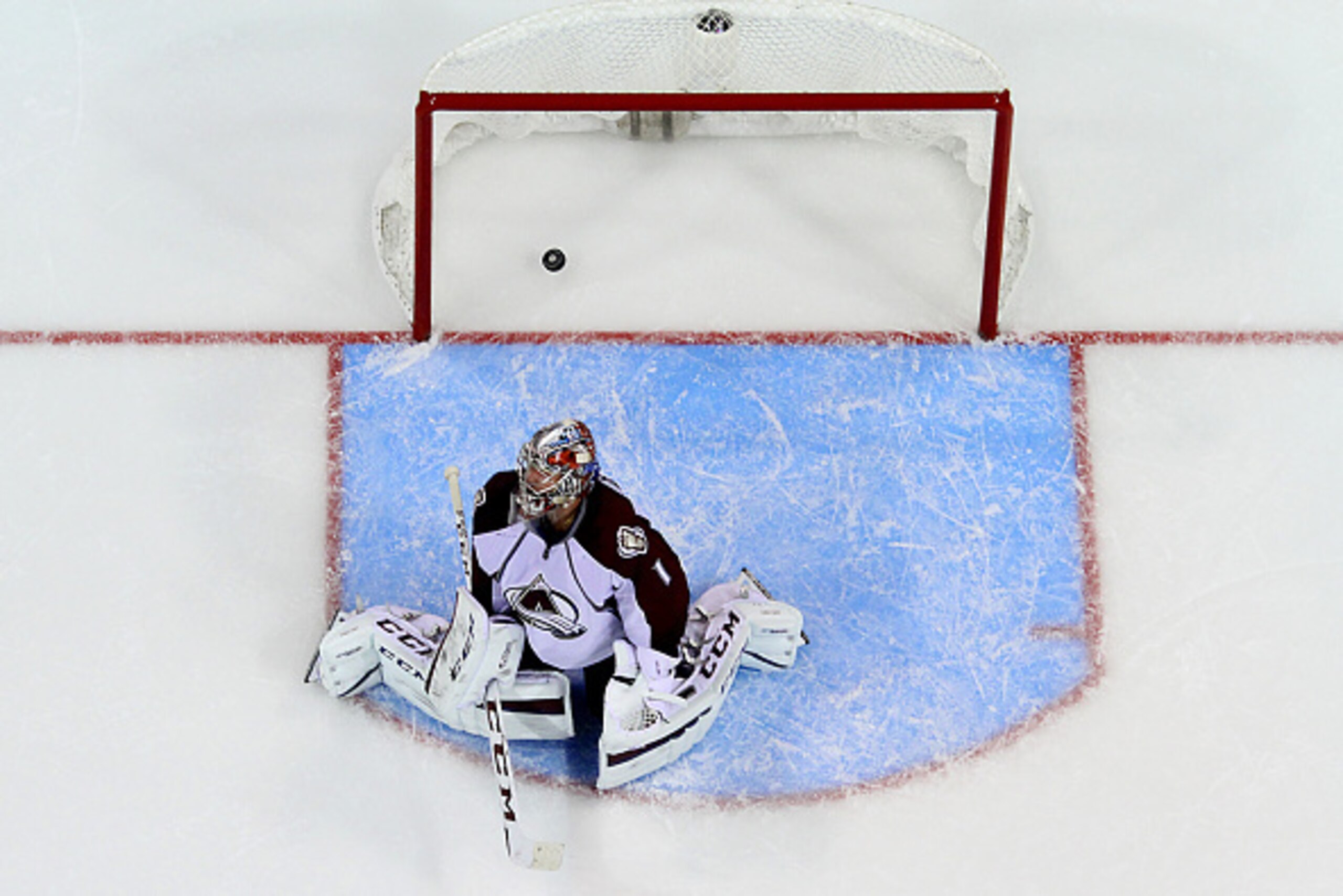
Last year’s power play, which was fifth at 19.8 percent, is sitting at 14.1 percent. The Avs had a power-play shooting percentage of 13.04 percent; this year, that’s dropped to 8.97 percent, eighth-worst in the league.
What does that five percent mean? It means that if the Avs were scoring five-on-four goals this season at the same rate they were last season, they’d have 10 power-play goals instead of nine.
That's a difference of four goals scored and eight or nine goals allowed, a 13-goal swing for a team that has a minus-15 goal differential.
It has all conspired to leave the Avs with a 3-3-5 record in one-goal games, the worst mark in the league.
Last season, the Avs were 28-4-8 in one-goal games, best mark in the league.
Welcome to Regression Town, USA, population Avs.
The wonderful luck that was so prevalent and working so often in the favor of the Avs last season has relocated, seemingly splitting time between Ottawa and Calgary.
“You’ve gotta create your own luck,” budding superstar Nathan MacKinnon said. “When you’re not playing well, you’re not going to get very lucky.”
And that’s the heart of any and all possession metrics: When you’re throwing the puck at the other team’s net more often than they are throwing the puck at your own, there’s a better chance of having luck on your side.
The Avs are minus-137 in Fenwick events in 2014-15; only the Buffalo Sabres, who barely resemble an NHL team at this point, are worse at minus-314.
At this point last year, the Avs were minus-63 in Fenwick events, according to war-on-ice, which is not great by any stretch but is twice as good as this year’s club.
That doesn’t seem like an impactful difference, minus-74 over 17 games, an average of about four more per game, but the Avs have lived far more dangerously this season and have paid for it at an average rate, as evidenced by their 99.4 PDO.
Think about it: The Avs, a bad possession team a year ago, are twice as worse this season and aren't getting as many bounces as they did in 2013-14, when their PDO was 101.8.
If only they paid for Paul Stastny and retained P.A. Parenteau, perhaps they could have minimized some of this damage.

The Avalanche made several decisions during the offseason that altered the lineup in negative ways. Instead of re-signing Stastny, they let him walk to the St. Louis Blues on a four-year, $28 million deal. They signed the aging Jarome Iginla to a three-year, $16 million in an attempt to replace Stastny’s production in a cost-effective manner, but it hasn't worked.
Parenteau was also dealt to the Montreal Canadiens in exchange for Daniel Briere, a move that will baffle anthropologists for centuries after our planet is drowned by melting polar ice caps. Briere has been a healthy scratch seven times this season and a non-factor when in the lineup.
The Avs replaced Stastny and Parenteau with Iginla and Briere. The results should not be a surprise to anyone.
Stastny and Parenteau were Nos. 1 and 3 on the Avs last season in Fenwick at 51.1 percent and 49.9 percent, respectively. They weren’t dominating opponents, clearly, but they were the one-eyed men in the land of the shot-attempt blind.
Iginla was at 52.9 percent with the Boston Bruins last season, a nice number but one that was slightly negative relative to his teammates, somewhat of a red flag. Some wondered if going from a slower Bruins team that feasted off the cycle to a faster Avs team that did a lot of damage off the rush would hinder Iginla, and perhaps it has—Iginla’s Fenwick is an abysmal 43.2 percent.
Briere is even more putrid but was also more predictable; he’s at 41 percent this season after he was at 47.2 percent last season and healthy scratched at times with the Canadiens.
The Avalanche ignored the numbers. They spoke of shot quality and timely scoring and clutch saves and assumed it would all continue this season even if they made moves to ship out talented possession players and replaced them with inferior players.
Teams can make their own luck, no doubt about it. But teams need players who can consistently create the situations that can lead to good luck, and the Avs, who had so few of those players last season, let two of their best go in the offseason and suddenly find themselves lamenting the bounces that aren’t going their way.
Duchene said it best when asked if the team is playing that much worse this season or if it’s that the bounces aren’t coming as frequently: “It’s a bit of both.”
If only someone in the Avalanche front office could have made that connection over the summer.
All statistics via NHL.com and stats.hockeyanaysls.com.
Dave Lozo covers the NHL for Bleacher Report. You can follow him on Twitter: @DaveLozo.




.jpg?w=2560 "Reported Details of Seahawks-K9 Split ⛓️💥")