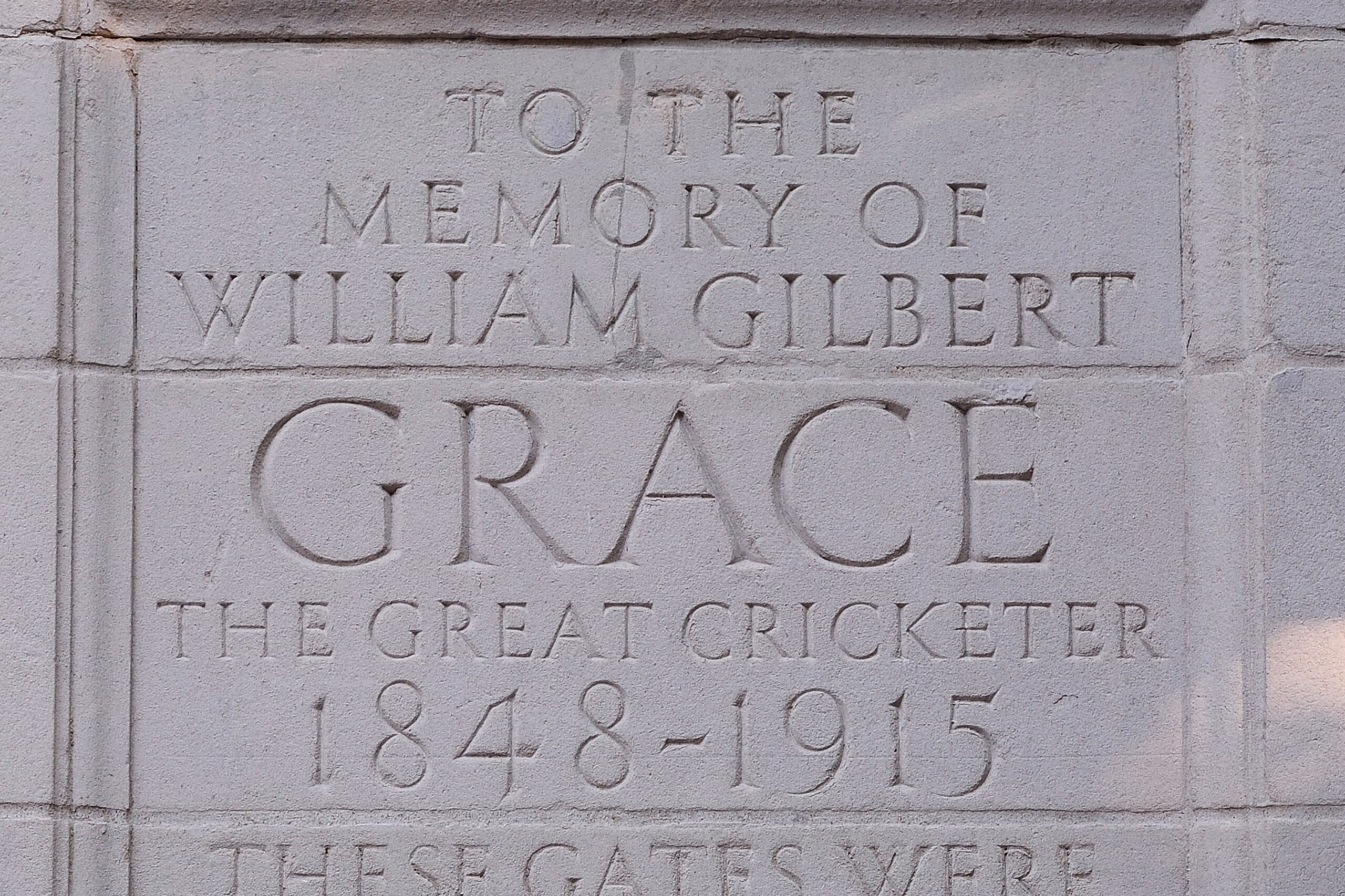

Predicting WG Grace's Record If He Played in the Modern Era
WG Grace was England's first superstar from a bygone era unrecognisable from the modern game, and predicting his record if he were to be playing today is difficult to achieve with any degree of certainty.
Nevertheless, reconsidering Grace's record through the prism of the modern game does provide a fascinating insight into how the game has changed in more than a century that has passed since he played Test cricket.
In this context, we take a look at each of his key statistics in turn and consider how they might look were his talent to be transposed to today based on what we know of his character and his approach to the game.
TOP NEWS
.jpg?w=2560 "Chargers Mack")
Every Trade's Best Trade Asset 🔁
.jpg?w=2560 "Green Bay Steelers Football")
Insiders: Cowboys Overpaid for Porter

Houston's Space Helmets 🧑🚀
From this we will draw conclusions around how his Test match record might look if he played Test cricket in the modern game, drawing parallels with modern-day England players who displayed similar characteristics over the past 30 years.
Matches
The most striking thing about Grace's career is his longevity, the likes of which is simply unimaginable in the modern era.
The incredible career Grace enjoyed is highlighted in a statistical analysis by ESPN Cricinfo: "Grace began his first-class career when he was 16, and finished at 60, for a remarkable career that stretched 44 years—a time span that is mind-boggling in today's age."
In Grace's age, however, Test cricket was not so well established as the pinnacle of the game, and the first recognised Test took place fully 12 years after he made his first-class bow.
As bemoaned in BBC Sport's Ashes Legends XI, it was "a shame his myriad of skills were on the wane by the time he made his Test debut at the age of 32."
Were Grace to play in the modern game, such longevity would surely place him among the most capped England players. Alec Stewart heads the list, as per ESPN Cricinfo, with 133 Tests to his name.
Stewart is the England player most associated with longevity in the modern game. His first-class career spanned 22 years and his Test career 13 years, but most remarkable was the fact he was still playing Test cricket at the age of 40.
Stewart, like Grace, was made to wait for his Test debut, something remarked upon by Michael Jones in his blog for CNN's IBN Live, who noted "he had played nine seasons for Surrey before finally earning his international call-up just short of his 27th birthday."
Jones also recalled upon Stewart's 50th birthday that "it stands as a testimony to the level of fitness he maintained throughout his career that he remains the only player in the 21st century to appear in a Test after his 40th birthday."
It is difficult to deduce how well Grace might have adjusted to the physical demands of the modern game. He certainly did not share Stewart's dedication to fitness, albeit in an age where there was no such expectation.
In Brian Maye's profile of Grace for The Irish Times, one anecdote referred to Grace's voracious appetite for alcohol:
"Although a non-smoker, he liked his food and drink. Discussing the costs incurred during Lord Sheffield’s profitless tour of Australia in 1891-92, a fellow player commented: “I told you what wine would be drunk by the amateurs; Grace himself would drink enough to swim a ship.”
"
It is impossible to gauge how much Grace might have forsaken his penchant for a hearty meal and a drink were he to be around in the modern era.
However, his appetite for the game and the opportunity to flaunt his obvious talent at the highest level from an early age suggest that were he around 100 years later, Grace could have played significantly more than his 22 Tests, arriving at something approaching Stewart's record.
Runs, High Score and Number of Test Centuries
Beyond doubt is that Grace had an unquenchable thirst for compiling runs, frequently outstripping the achievements of any of his contemporaries. In his compilation of statistics from Grace's career for ESPN Cricinfo, S Rajesh highlighted some astonishing achievements from his first-class career.
In 1871, he scored 2,739 runs with 10 centuries and averaged 78.25, more than double the next best performer, who averaged 37.66.
Five years later, Grace became the first man to hit a triple-hundred in first-class cricket, a feat he achieved twice in eight days in a remarkable purple patch where he racked up 839 runs in eight days. Only one other player reached 1,000 runs in the season.
In the decade between 1871 and 1880, Grace average 49 in a period when nobody else averaged more than 26.
In this period of astounding dominance with the bat, Grace did not play Test cricket. If any player were to flay first-class attacks in such a way in the modern game, they would surely be afforded the opportunity to translate this form to the Test match arena early on in their career.
One English player from the modern game shared Grace's relentless hunger for first-class runs and his capacity for notching double and triple hundreds, and that was Graham Gooch. He was able to convert that talent successfully to Test cricket, providing a yardstick for what Grace might have achieved.
Though Mark Ramprakash and Graham Hick sit above Gooch on the list with 17 and 16 first-class double-hundreds respectively, it seems fair to assume that Grace would make a better fist of Test cricket in the modern era than this underachieving pair based on his success in his short career.
This is reflected upon in S Rajesh's ESPN Cricinfo article, which notes that Grace retired as one of six men to pass 1,000 runs in Test cricket and was only the second batsman to score a Test century on debut.
Gooch sits alongside Grace in equal 11th on the list of all-time double-century makers in first-class cricket with 13 each, as per Cricket Archive. He also places one spot above Grace in 10th on the list of batsmen registering the most first-class hundreds, with 128 to Grace's 124, as listed on ESPN Cricinfo.
Unlike Grace, Graham Gooch had a lengthy Test career, making 118 appearances, and registered 20 hundreds in England whites. On eight occasions, Gooch went on to pass 150, making one double and one triple century.
Gooch's 333 against India at Lord's in 1990 remains the high watermark for English batsman of the past 30 years, with only Alastair Cook passing 250 in making 294 against the same opposition at Edgbaston in 2011, as per ESPN Cricinfo.
Were Grace to bring the prolific form of his 1870s prime to the modern era, it is feasible that he could have matched Gooch in reaching 300 and even surpassed Gooch in terms of centuries for England.
In the modern era, Kevin Pietersen is the leading England batsman in terms of double hundreds at Test level, having passed 200 three times, as per ESPN Cricinfo, and with Grace showing the patience for long innings across the course of a lengthy first-class career, he may well have done so more often.
Indeed, Kevin Pietersen appears an appropriate comparison for the modern era given the box-office appeal that the two shared. In The Irish Times profile of Grace, his greatness was deemed pivotal to large crowds:
"Standing at six foot two and with a flowing black beard, he revolutionised batting, brought cricket to the masses and made it the most popular spectator sport of the summer in England. Such was his popularity that in cricket grounds notices were displayed: “Admission threepence. If Dr WG Grace plays, admission sixpence.”
"
Gooch ended his career as England's leading run-scorer, with 8,900 to his name from 118 Tests, and the enforced end to Pietersen's Test career leaves him on 8,181 runs. This is the sort of territory a modern-day Grace would expect to occupy.
Batting Average
Grace's average of 39.45 in first-class cricket and 32.29 in his 22 Tests is unremarkable by modern standards, but having established that he was frequently averaging double that of his peers in first-class cricket during his prime, it is expected that with modern pitches and the practice that comes with the professional era, it would be far higher, as per S Rajesh's article on ESPN Cricinfo:
"If his overall batting average doesn't seem as impressive as some of the more recent batsmen, remember that he played his entire cricket on pitches that were hardly as well laid out as the tracks we're used to.
"
The Guardian's obituary in 1915 referred to "the length of years during which he stood far above all rivals" and noted how his "stupendous total output hopelessly outdistanced all rivals," and Geoffrey Moorhouse, in the 1988 Wisden Cricketers Almanack extract reproduced by ESPN Cricinfo, notes that "the cricketing Grace totally dominated his own era."
It seems reasonable, therefore, to imagine that Grace's talent transposed to the modern era, with a professional approach and pitches that would favour batsmen far more than those he plied his trade on, would see him outstrip his England peers in a way that Gooch or Pietersen did not.
For all his achievements, Gooch's Test average of 42.58, compiled during a golden era for fast bowling where the likes of Malcolm Marshall, Curtley Ambrose, Waqar Younis and Wasim Akram would be bounding in, was below that of leading contemporaries Robin Smith (43.67) and David Gower (44.25).
Similarly, Kevin Pietersen may have registered more double hundreds than his teammates, but his average of 47.28 was only marginally better than top-order colleagues Jonathan Trott (46.45), Alastair Cook (46.02) and Ian Bell (45).
To predict Grace's record in the modern game and to reflect a sublime talent above and beyond anyone from the same era, Grace's predicted average should be placed higher than any of the above.
Counter to this, there are clearly a number of unknown factors that make it that much harder to estimate a world-beating average for Grace in today's game. While the quality of pitches would likely propel his average north, other factors specific to the modern era are harder to judge.
Firstly, there is the question of how well Grace would have coped with the variety of conditions that modern Test players face, ranging from fast and bouncy tracks commonly found at grounds in Perth, Durban and Johannesburg to the dusty turners found on the subcontinental pitches in India, Pakistan and Sri Lanka.
Grace only played Test cricket against Australia, and all but three of these were on home soil, leaving little evidence on which to judge how he would have coped in the variety of conditions that a modern international is faced with, both in terms of the 22 yards in the middle and the different conditions of foreign climes, with heat and humidity offering different challenges.
Secondly, it is hard to determine how Grace might have coped with short-pitched bowling that was not par for the course in the 19th century, and also the modern greats of spin bowling, particularly the genius of cricket's most prolific wicket takers, Shane Warne and Muttiah Muralitharan.
All we can deduce from what is know about Grace is that he had an orthodox technique and a straight bat that would have put him in good stead. His obituary in The Guardian noted that "it was with a remarkably straight bat that the ball was played."
His revolutionary approach to batting revolved around a previously unheard of repertoire of strokes, playing shots around the ground off the front of back foot, described in a profile on Fox Sports which suggests an ability to adapt to foreign conditions if he played in the modern era:
"Grace is widely held to have invented the modern art of batting, with cricket historians noting that he played shots off both front and back foot, playing only the shot he deemed appropriate to the ball delivered. If this now describes a prerequisite for batsmen, remember they previously played either forward or back and made a speciality of a certain stroke; the batsman who scored to all parts of the ground was previously only the figment of a fertile imagination.
"
Though his style and character points toward the necessary adaptability to thrive in the modern era, how well Grace might have coped with short-pitched bowling at express pace and high-class spin propelled from the fingers of Muralitharan and the wrist of Warne is impossible to tell.
For this reason, it seems fair to predict an average for a modern-day Grace that, while in excess of other English batsmen who honed their craft on better pitches in the same English conditions more than a century later, falls short of the modern greats of world cricket found in the upper echelons of the all-time highest Test averages recorded on ESPN Cricinfo.
This would place Grace's average above the 47.28 of Kevin Pietersen but short of the marks registered by the likes of Ricky Ponting (average 51.85), Brian Lara (52.88), Sachin Tendulkar (53.78), Jaques Kallis (55.37) and the remarkable Kumar Sangakkara, who averages more than any Test cricketer to have played more than 20 Tests in the last 30 years with 58.76.
| Matches | Runs | High Score | Batting Average | Centuries | |
| First-Class (1865-1908) | 870 | 54,211 | 344 | 39.45 | 124 |
| Test Matches (1880-1899) | 22 | 1,098 | 170 | 32.29 | 2 |
| Predicted Test Record (Modern Era) | 122 | 9,150 | 324 | 49.5 | 26 |
This is, of course, pure speculation, and the game Grace would find himself playing were he in his prime today would only resemble the game he knew and loved in the most basic of ways.
What cannot be doubted is that Grace is a legend of the game and a modern-day equivalent who could achieve anything like the record predicted above would become one of England's finest-ever batsmen in the modern game, impacting on the national consciousness in a way that the man recognisable by only his initials would be proud.


.jpg?w=2560 "Top NFL Trade Targets")