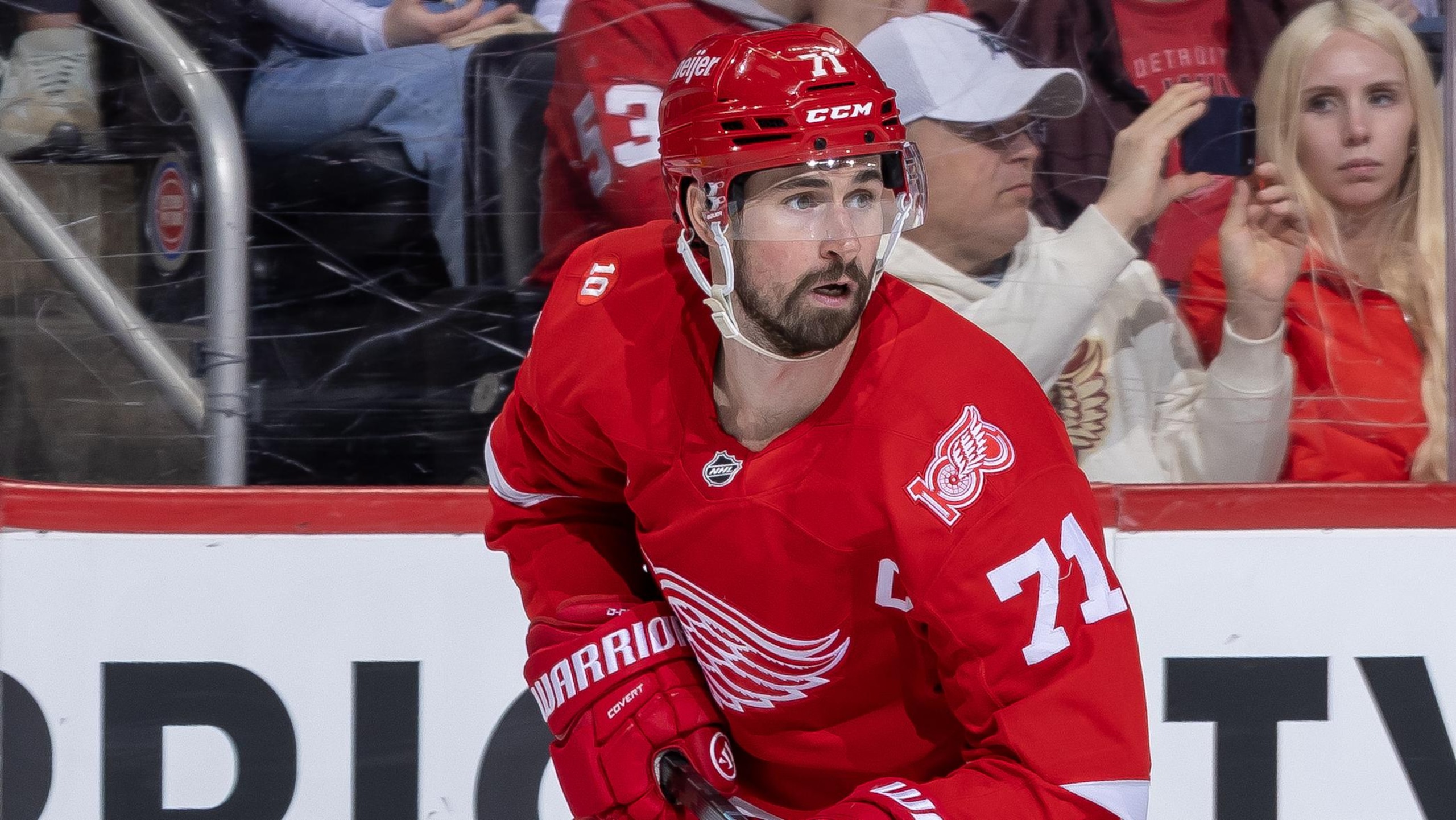
Gustav Nyquist Is Poster Child for Detroit Red Wings' Onboarding of Prospects
The Detroit Red Wings have been a gold standard in the NHL when it comes to the integration of prospects. It was made abundantly clear by Jonathan Willis of Bleacher Report in a piece about how each NHL team built its roster.
Of the 23 players on the roster, 66.7 percent came through the draft, and that just speaks to general manager Ken Holland's philosophy of building a team with youngsters. The one constant that has been a fixture of the Red Wings has been the speed in which prospects are developed, and it ultimately has made a huge difference for the franchise.
TOP NEWS
NHL Star Booed Amid Trade Request
Mark Scheifele Landing Spots 📍

Every Team's Odds to Win the Cup 🏆
Like a fine wine, or bourbon if that's your cup of tea, the Wings let players marinate until they are overly ready for the NHL.
Gustav Nyquist's success this year has been amazing, and his story makes him the poster child for the Wings' influx of prospects. Before Nyquist, there was Jimmy Howard, Justin Abdelkader, Joakim Andersson, Valtteri Filppula, Darren Helm, Jiri Hudler, Tomas Jurco, Jakub Kindl, Niklas Kronwall, and the list goes on.
Each has his own success story, but Nyquist's is one that has been in the public eye for the last few seasons.
For years, fans had been crying for Nyquist to become a fixture on the roster, and last year the Wings wanted him up but couldn't recall him. The team was in a situation in which there were too many players on the roster when you also factored in players on injured reserve.
Ultimately, Nyquist was recalled, and he set the NHL ablaze during his 57 games. But before that, he toiled in the AHL waiting for an opportunity. Nyquist spent a total of 137 games over four seasons with the Grand Rapids Griffins, and this was the first year in which his spot on the roster was guaranteed.
Despite the fact that Nyquist tallied 58 points in 56 games with the Griffins in 2011-12, the Wings felt it was best to keep him in the AHL instead of letting him find himself in the NHL. He spent only 18 games in the NHL that year, and he was back to Grand Rapids the following season.
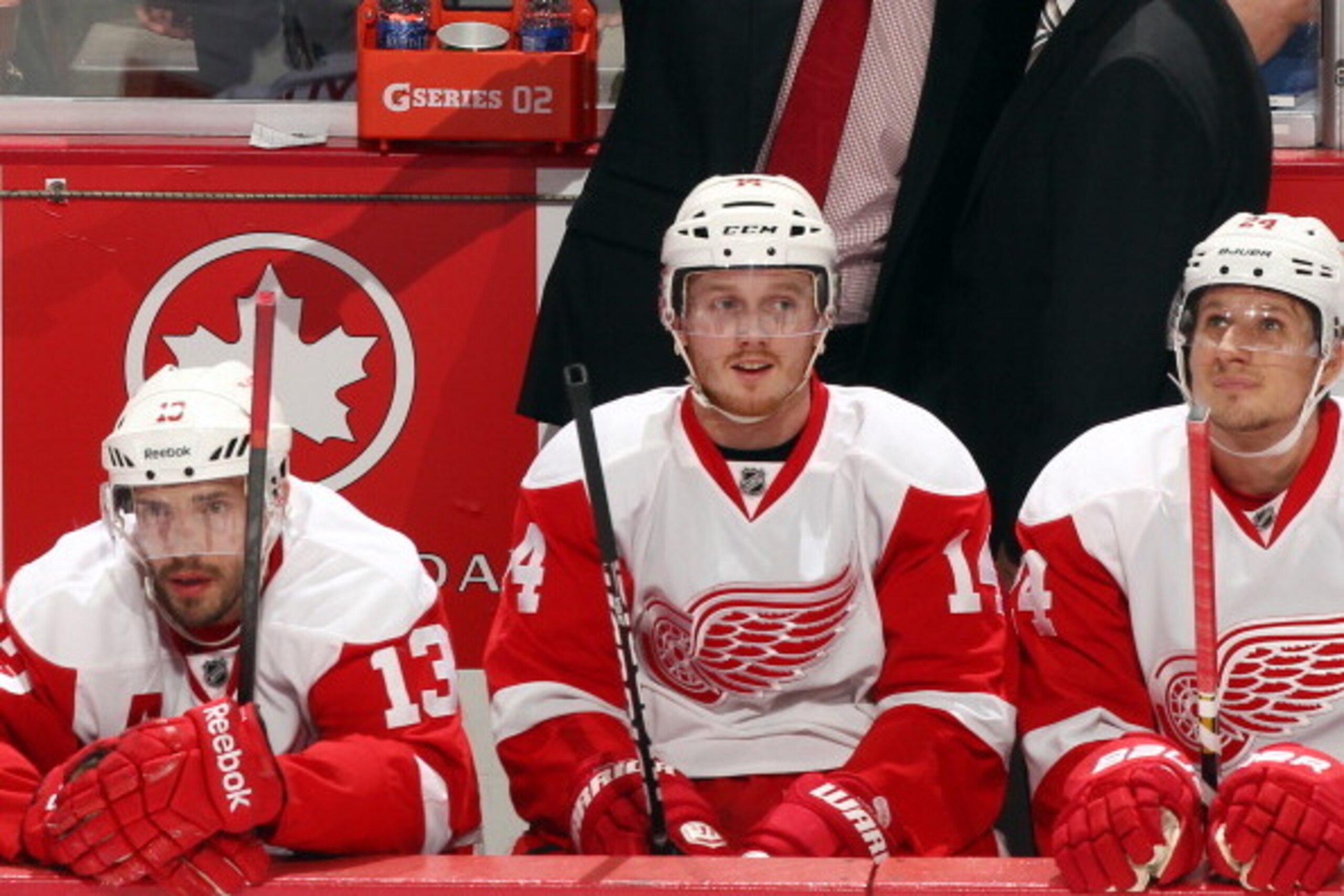
During his time with the team during his first stint, he turned some heads, and head coach Mike Babcock compared him to Pavel Datsyuk:
"In training camp, Babcock likened the speedy Nyquist to Pavel Datsyuk, saying that he was an even better skater with the puck. 'He wants the puck and he’s a skilled play who doesn’t scare you to death,' Babcock said. 'He’s good without the puck and he’s been great in the American League, and the ball is in his court now, and he’ll come up and we’ll see what he can do.'
"
Despite the fact that Nyquist looked like he was going to be the real deal and he was likened to Datsyuk, he was still sent down and relegated to first-line AHL duty. Nyquist probably could have remained on the team in a bottom-six role, but the Wings decided to remain patient.
There becomes a point in which players stop developing in the AHL, and sometimes players even regress. If a player becomes too good for the league, it is very easy to start developing bad habits, because the player will starting toying with the competition by trying moves that would never work in the NHL.
While it may be fun to make a highlight-worthy behind-the-back pass across the ice, that risky play gets picked off often unless the distributor is an elite player.
This never happened with Nyquist, but after multiple years of playing against inferior competition, it was a realistic concern. The Red Wings' top prospect was able to keep playing his game, and circumstances outside of his control delayed his rise to the NHL. It is fair to say that Nyquist would have been good enough to make the 2012-13 starting lineup, but the lockout delayed the start of the season to January.
This gave Nyquist time to play stress-free hockey because there wouldn't be the pressure of the NHL looming over his head. During that season, he tallied 60 points in 58 games, and he earned an NHL stint after the league started doing business again.
Despite showing promise, he went back to the minors again, and his determination and some bad luck on the part of the Wings led to his eventual rise to stardom.
In many ways, it appeared that the 2013-14 Wings were going to be doomed. With Henrik Zetterberg, Johan Franzen and Pavel Datsyuk sidelined, the Wings turned into the Griffins overnight. As mentioned earlier, the Wings were at the point in which they wanted Nyquist, but they couldn't recall him.
By the time they had the space, Nyquist had 21 points in 15 games, and he was really ready. When I look at the development and maturation of Nyquist, I think back to Malcolm Gladwell and the 10,000-hour rule.
In short, Gladwell elaborates on the theory that it takes 10,000 hours of practice to become a master in your field.
There are a number of examples of this rule in real life, such as Paul Allen and Bill Gates learning to code on a private computer terminal in the late 1960s, which set them up to launch Microsoft in 1975. The theory also held true for the Beatles, one of history's greatest bands.
During the early 1960s, the Beatles developed their sound in dimly lit, drug-and-booze-filled strip clubs in Hamburg, playing eight hours a day, seven nights a week. By the time they came to America, they had their sound, and all of their practice paid off.
In many ways, it could be said the Wings take this approach with prospects, and Nyquist is a prominent one who fits the build. If you add all the hours spent back home in Sweden, his time at the University of Maine and his time in Grand Rapids, it is safe to say that he had enough practice until he was truly ready for NHL action.
While there will always be cases of players with pure talent and ability who defy this concept, there will always be outliers like Nyquist. While his maturation and development may have been longer than most would have liked, I am willing to bet that Gustav will end up being a better NHL player for it.
The Red Wings' budding star was given time to make his mistakes and get better, and now he is finally starting to dominate. Through 15 games, Nyquist has scored eight goals, and he's on pace to surpass his total from last season.
As Gladwell says, “practice isn't the thing you do once you're good. It's the thing you do that makes you good.” This is a philosophy the Red Wings live by with their prospects, and Nyquist is tangible proof that it's a viable system for success.
Stats in this piece via NHL.com and hockey-reference.com. Information on the 10,000-hour rule via Malcolm Gladwell's New York Times best-seller Outliers: The Story of Success.

.jpg?w=2560 "Every Trade's Best Trade Asset 🔁")
.jpg?w=2560 "Insiders: Cowboys Overpaid for Porter")


.jpg?w=2560 "Top NFL Trade Targets")