Building the Ideal College Basketball Starting 5 for the 2014-15 Season
Let’s indulge in a moment of fantasy, shall we? Imagine building a college basketball team with every player in the nation available to choose from—which ones would you put on your squad? Before you do so, however, let me tell you about mine first.
In my mind, an “ideal” starting lineup does not necessarily have to feature the best players at each position. For me, I want to find players who fit in a certain system and, more importantly, fit in with each other.
This means I don’t want two players with similar playing styles or mindsets (like a Carmelo Anthony and a Kobe Bryant) on the same team.
Basketball is a game of touches, and I want every one of my starters to be able to showcase his unique strengths without having to worry about getting more or less of the ball.
Before I start breaking down my lineup position by position, take a look at some of the players who did not make the cut for my starting five.
The Snubs
1 of 7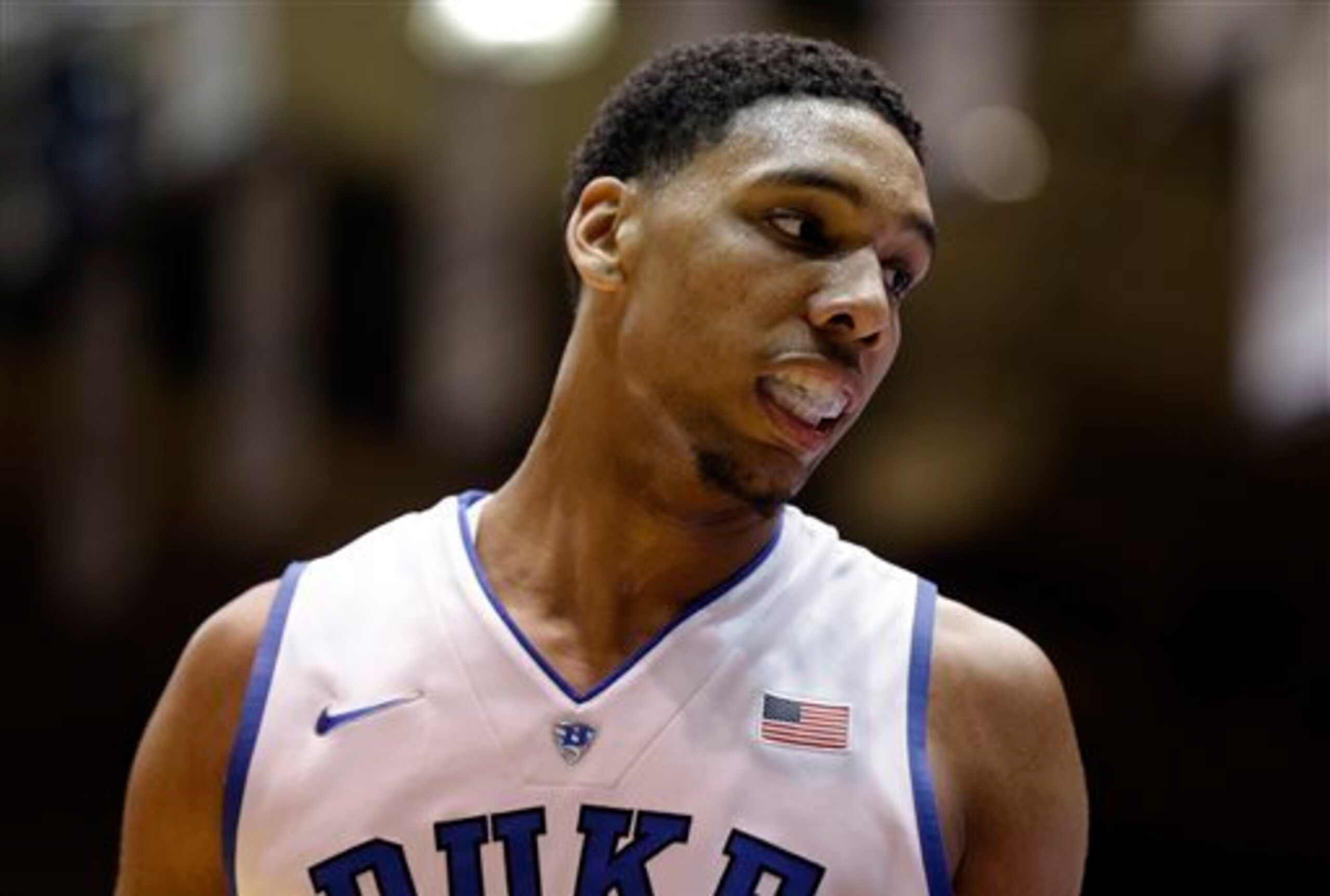
Point Guard
Andrew Harrison – Kentucky
Harrison is coming off a subpar freshman season, but everyone—including me—knows he has the potential to be the best point guard in the country. I would just rather take someone who has already proved he can play at a high level, so I’m keeping Harrison off the list for now.
Delon Wright – Utah
Wright has one of the most complete games in college basketball and is a great two-way point guard who can fill up the stat sheet night-in and night-out. However, his shooting touch still needs to improve a bit in order for me to take him over all the other candidates.
Shooting Guard
Caris LeVert – Michigan
People often draw a comparison between LeVert and his former Wolverines teammate Nik Stauskas, which is quite accurate since LeVert’s game mostly revolves around his ability to shoot the ball as well. I’m not choosing him to be my starting shoot guard, though, because I’m looking for someone who is just a bit more versatile.
Ron Baker – Wichita State
Baker is one of the few prototypical shooting guards in the country because of his ability to, well, shoot the ball. However, the reason I’m leaving him off my starting five is the same as the one I had for LeVert.
Small Forward
Rondae Hollis-Jefferson – Arizona
Despite the fact that Hollis-Jefferson logged just a little over 25 minutes per game last season, he made the time he spent on the court count (he averaged 9.1 PPG, 5.7 RPG and 1.1 BPG). The only knock I had against Hollis-Jefferson was his three-point shooting, as he went just 2-for-10 last season for the Wildcats.
Treveon Graham – VCU
Graham was the leading scorer and one of the top rebounders for the Rams last season with 15.8 PPG and 7.0 RPG. His offensive game is quite gifted, but he lacked the defense I desired out of the wing, so I ended up keeping him off my lineup.
Power Forward
Georges Niang – Iowa State
A healthy Niang should be the catalyst for everything the Cyclones do this season—and being a point forward is not a bad thing at all. However, in the ideal lineup I envisioned, I already have enough versatility from the other players, so I’m looking for more of a role player at this position.
Brandon Ashley – Arizona
Similar to Niang, a rejuvenated Ashley has the potential to be one of the top forwards this season. His strengths are obviously on the offensive end, as his 11.5 PPG and 52.2 shooting percentage last season show just how effect he can be when he gets his touches. The downside in Ashley’s game, though, is his defense and the constant foul troubles.
Center
Jahlil Okafor – Duke
Okafor is arguably the best freshman of his class and one of the best players in the country, but I’m omitting him from my starting lineup because I already have a post player in mind and I wanted a big man who can stretch the floor for me to create a balanced act. Okafor isn’t exactly that type of player.
Willie Cauley-Stein – Kentucky
Cauley-Stein, who averaged 2.9 BPG last season, gives me everything I would need in a defensive anchor in the frontcourt. However, since I’m being picky with my lineup, I decided to go with a player who can hold his own defensively, while giving me a little more offense than the 6.8 PPG Cauley-Stein put up.
Point Guard: Fred VanVleet, Wichita State
2 of 7
I know what you might be asking: Why is VanVleet here instead of someone like Marcus Paige? Well, my answer for that is that I need a pure point guard first in order to make everything else click—and, for me, VanVleet fits in that mold more than Paige at this position.
In the 36 games he played for Wichita State last season, VanVleet averaged 11.6 points and 5.4 assists per game while shooting over 40 percent from three-point range.
VanVleet possesses high basketball IQ and is a reliable ball-handler and defender. In 22 of those 36 games, VanVleet did not commit more than one turnover. At the same time, the 6’0” guard also averaged nearly two steals per game.
VanVleet gives me the security blanket I need before I can explore into the other offensive options for my lineup. Because of that, he’s my pick at the point guard position.
Shooting Guard: Marcus Paige, North Carolina
3 of 7
Just because I didn’t want Marcus Paige to be my point guard doesn’t mean I don’t want this talented junior in my lineup altogether. Paige is arguably the best player in college basketball this season, and he will fit in nicely in my lineup alongside VanVleet.
Paige is a natural scorer, as evident from his 17.5 PPG from last season. However, he does not possess a score-first mentality, as he was often forced into putting up the points when one of UNC’s top offensive weapons, P.J. Hairston, was suspended from the team last season.
When I decided to take VanVleet over Paige at the point guard position, it wasn’t a knock on either Paige’s passing or defending abilities. He is as good a ball distributor and on-ball defender as anyone else in the country with 4.2 APG and 1.5 SPG last year.
The main reason I’m putting Paige at the 2-guard on my team is simply because I want to utilize his scoring abilities more.
I realize the disadvantage I may have (when it comes to height mismatches) by putting a 6’1” player at this spot, but for Paige’s versatility, it’s a trade-off I’m willing to make.

Small Forward: Sam Dekker, Wisconsin
4 of 7
With the backcourt now taken care of, I’m looking for a sizable wing player who can provide me with a combination of outside shooting and ability to get to the basket. Wisconsin’s Sam Dekker is the player who fits those criteria best for me.
After a late growth spurt and a breakout performance at the Nike Skills Academy over the summer, Sam Dekker is poised to be the most improved player in college basketball this season.
Dekker averaged 12.4 PPG and 6.1 RPG last season for the Badgers, but the two-inch growth in his height (listed at 6’9” now) gives me reason to believe those numbers can only improve this time around.
Dekker moves extremely well without the ball and has a knack for knowing when to cut to the basket. That kind of skill can come in handy when I have two great passers in VanVleet and Paige.
Dekker could be even more dangerous if he manages to regain his shooting touch back, as his numbers from last year (46.9 percent from the field and 32.6 percent from three-point range) decreased slightly in comparison to his freshman season (47.8 percent and 39.1 percent).
When you put Dekker up against the likes of Rondae Hollis-Jefferson of Arizona or Treveon Graham of VCU, the difference may not be distinct. However, Dekker is more versatile than the other two and is a better fit with the other players in my lineup.
Power Forward: Montrezl Harrell, Louisville
5 of 7
Louisville’s Montrezl Harrell could have easily been playing in the NBA by now if he had chosen to enter the draft after last year. Instead, he’s back for a junior season, and I’m not going to pass up on him at the power forward position.
At 6’8” and 240 pounds, Harrell is a physical specimen and a mismatch for almost every opponent he goes up against.
Last season, he averaged 14.0 PPG, 8.4 RPG and 1.3 BPG while recording a double-double in 12 of the 37 games he played. Those numbers are great complements to my team that already features plenty of offensive firepower.
One thing that should be pointed out is that Harrell’s offensive numbers can be somewhat deceiving, as many of his baskets were scored by way of dunks and alley-oops. However, down the stretch last season, we saw signs of a mid-range jumper developing (and that is a scary combination if he can put it all together).
If Harrell’s offense can indeed improve this season, then it’s even more of a blessing. But if not, at least I’ll have the comfort knowing he can be that defensive anchor and rebounding machine I need in the frontcourt.
Center: Frank Kaminsky, Wisconsin
6 of 7
Much like Paige, Frank Kaminsky’s true position can be debated. The way I look at it, though, is that if I have a seven-footer on my team, I’m putting him at the center.
Kaminsky burst onto the college basket scene last season and was the main engine for the Badgers’ run to the Final Four. His averages of 13.9 PPG, 6.3 RPG and 1.7 BPG may not blow you away, but he is one of the most versatile big men in the country—and a difference maker in any lineup.
Kaminsky can beat his opponent anywhere on the floor. He has a polished post game and an excellent shooting touch (38 percent from three-point range) for a player of his size.
The reason why Kaminsky fits in my lineup is because of his ability to stretch the floor. Harrell is a post threat who likes to be fed the ball down low. So, in order to create the space for Harrell to work, Kaminsky needs to be able to move away from the basket while remaining an effective player on the floor.
Kaminsky can be a little more aggressive on both ends of the floor, but Harrell alone brings an intensity that is hard for anyone to match. Therefore, Kaminsky’s finesse style of playing can serve as a good balance to that.
He is the last piece in the puzzle that is my ideal starting lineup. Together, all five of my choices can coexist on the floor and bring their own playing styles to the table to give me the best chance of winning each time they take the court.
Conclusion
7 of 7
There is no right or wrong way to make an ideal starting lineup in basketball. Everything is based on personal preferences concerning what kind of team one would like to have. Some people like to tally up as many points as possible to outscore opponents, while others want sound defense to grind out win after win.
For me, I tried to find the the middle ground between the two and get the players who I think would suit each other and create a good balance when they are all out on the floor at the same time.
VanVleet and Paige give me a dual guard system that I can mix and match according to the opponents. Dekker can provide me with a legitimate No. 2 scoring option when my guards draw in all the defensive attention.
Harrell is my defensive anchor, rim protector and post player who can just focus on fulfilling those roles. Kaminsky gives me that versatility I need in the frontcourt to stretch the floor and create mismatches.
What kind of lineup would you come up with?


.jpg?w=2560 "Reported Details of Seahawks-K9 Split ⛓️💥")