10 NBA Players Already Deserving of Larger Roles During 2014-15 Season
NBA teams spend the entire offseason figuring out rotations and divvying up playing time, only to see those plans change when discarded or unsung reserves outplay their starting counterparts in the regular season.
Yes, it's early. And yes, we're treading dangerously into the reactionary waters of the Small Sample Size Sea.
But a handful of cases around the league need to be addressed. Minutes are going to the wrong players, and in some cases, it's hard to defend the logic behind the playing-time mismanagement. Ed Davis, still stuck on the bench behind Carlos Boozer, knows that pain all too well.
He's not alone, though. We've pulled together 10 NBA players who have used the early stages of the 2014-15 campaign to make cases for minutes. In some instances, there's hope for expanded roles. In others, a glut of talent at a specific position means the only path to liberation might be a trade.
Sorry, John Henson—you'll find a home somewhere, big guy.
Aaron Brooks, Chicago Bulls
1 of 10
Tom Thibodeau's love affair with Kirk Hinrich is understandable; the veteran point guard runs the offense, moves the ball and never, ever plays outside himself. Thibs seems like the kind of guy who believes the only thing that makes a 15-hour work day any better is a hearty draught of castor oil before bed, so it's easy to see why Hinrich's predictable blue-collar grit might appeal.
Aaron Brooks, in contrast, is a freelancer who traffics in speed and confidence. Some of his best plays are broken ones—in which his waterbug quickness and slight frame allow him to cause trouble in the lane or sneak off for open threes.
This is a tough case to make because Hinrich hasn't been at all bad to start the season, and you'd happily take his 39.1 percent shooting from long distance for the rest of the year. But Brooks has been better, particularly in terms of efficiency.
His 11.0 points per game have come via 50.0 shooting from the field and 61.5 percent from beyond the arc. Those aren't sustainable numbers (neither are Hinrich's for that matter), but Brooks' attack-mode style and ability to put pressure on the defense will stick around.
The Chicago Bulls will always be in search of offense, and Brooks' ability to dart into the lane could open up opportunities for shooters like Doug McDermott and Nikola Mirotic. Hinrich hasn't beaten anyone off the dribble since 2006.
Maybe there's concern about Brooks' defensive limitations, but with so much size and rim protection behind him, that shouldn't be an issue.
When Derrick Rose eventually gets healthy enough to log consistent minutes (fingers crossed), it'll be decision time for Thibs. He can't give heavy playing time to three point guards.
Hinrich has played about five more minutes per game than Brooks. That probably needs to change.
Caron Butler, Detroit Pistons
2 of 10
The Detroit Pistons don't have any good wings. They just don't.
We know this because head coach Stan Van Gundy—in just the fourth game of the season—has already grown desperate enough to give Josh Smith, he of the epically misplaced jump-shot confidence, a start at small forward.
Kentavious Caldwell-Pope has been horrendous, mixing volume and inefficiency at alarming rates. In his first three games, the second-year guard attempted an average of 14 shots (second most on the team), making just 26.2 percent of them. He recovered to knock down 8-of-14 shots from the field in Detroit's Nov. 5 win over the New York Knicks, but KCP's broader body of work suggests one good night is merely an outlier.
Small forward Kyle Singler has been nearly as bad.
We all know Caron Butler's best days are behind him, and maybe it's unwise to ask a 34-year-old vet to play a bigger role. But this team needs a live body it can count on to log some wing minutes, and Butler is the best of some not-so-hot options.
He's earned a bigger role by default.
Look, the Pistons' personnel are a mess. Greg Monroe is playing on a qualifying offer, which means he has one foot out the door. And we saw a massive sample of minutes last year that proved the Smith-Monroe-Andre Drummond front line doesn't work. Playing J-Smoove at the 3 is not a solution; it's an invitation for even bigger problems.
Like a 2-of-17 shooting night against the Knicks, for example.
Why not give Butler, who's had games of 18 and 24 points in the early going, more than the 23 minutes per contest he's been logging?
It's not like things could get much worse.
Kostas Papanikolaou, Houston Rockets
3 of 10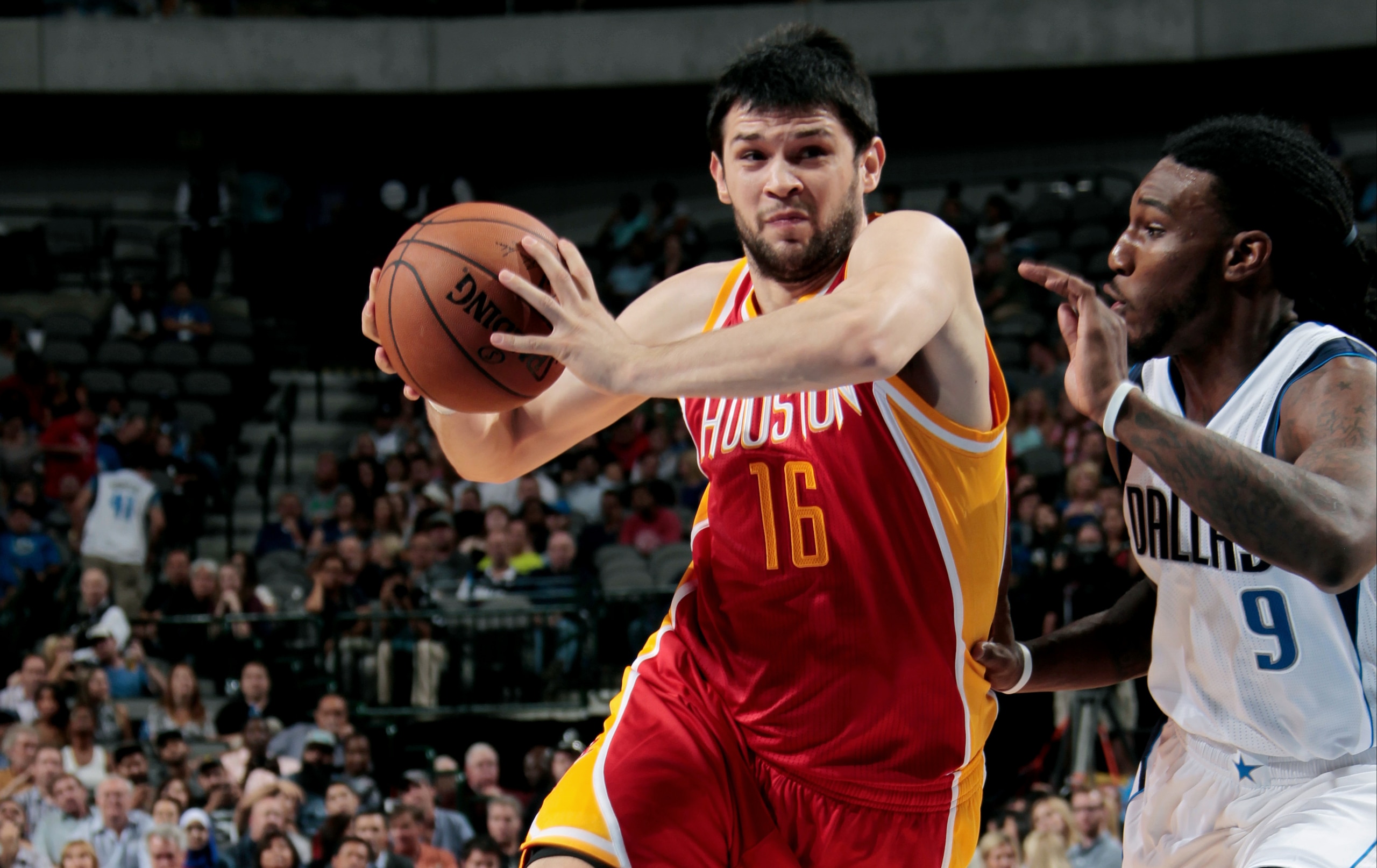
It's tough to argue Terrence Jones should be playing fewer minutes. The bouncy forward has been fantastic in the Rockets' unbeaten start, taking over games for quarters at a time and generally looking like a player in the process of making a leap in his third season.
But he missed the Houston Rockets' win over the Miami Heat on Nov. 4 with a bad knee, and perhaps coach Kevin McHale should take a cautious approach to reintegrating his power forward back into the lineup—seeing as he's become so valuable.
And if that means more minutes for lefty Greek import Kostas Papanikolaou, all the better.
The shooting stroke hasn't been there for the 6'8" rookie (he's shooting just 35.5 percent through five games), but Papanikolaou does something the Rockets desperately need.
He passes the ball.
Papanikolaou is creative, sees angles and willingly moves the rock. For a Houston attack that too often sees the ball stick, there's huge value in a player who gets things moving again. Despite playing the sixth-most minutes per game on the Rockets, Papanikolaou is second on the team in assists with an average of 3.6 per contest.
Houston has a lot of guys who end plays; even point guard Patrick Beverley is primarily a shooter. Papanikolaou's ability (and willingness) to move the rock is rare—on the Rockets and for a player at his position.
Besides, the Rockets need more lefties getting big minutes.

Reggie Bullock, Los Angeles Clippers
4 of 10
Where did all the good shooting guards and small forwards go?
It's getting easier and easier to understand why Gordon Hayward, Chandler Parsons and Klay Thompson all got paid; we're living through a wing drought, and the Los Angeles Clippers know that all too well.
J.J. Redick is still a quality option at the 2, but he hasn't found his stroke yet. The same goes for Matt Barnes, who was abysmal during the preseason and may be plummeting down the aging curve before our eyes.
That's where Reggie Bullock comes in, a second-year guard out of North Carolina who simply wasn't ready to contribute last season. He's ready now.
"I see it as a do-over,” Bullock told Ben Bolch of the Los Angeles Times. “But at the same time, I grew a lot when I was a rookie. I learned from a lot of players that were ahead of me, so it was good for me to get that year under my belt.”
Bullock finally saw game action against the Utah Jazz on Nov. 3, and he delivered four made triples in 18 minutes, equaling Barnes' triple total for the season entering that game. There's no doubt Bullock will make a few mistakes, and he doesn't defend like Redick or Barnes.
But for crying out loud, the guy can shoot.
Something needs to change for the Clips, who have been sluggish to start the season—not a great sign for a would-be contender. Bullock, whose third-year option LA just picked up, could provide what the Clippers have been missing—even if it's only until the veterans get going.
Ed Davis, Los Angeles Lakers
5 of 10
We have a collision of the obvious on our hands in Los Angeles.
When the Lakers inked Davis to a two-year, $2 million deal in the offseason, almost everybody agreed it was one of the best bargains of the summer. A rangy left-handed forward who always put up impressive per-minute numbers, Davis figured to drastically outperform his meager contract.
Similarly, it was a foregone conclusion that Carlos Boozer, claimed off the amnesty scrap heap, would offer little more than head sheen and the occasional top-of-the-lungs "and-1" shout.
Both of those foreseeable things have come to pass, which makes the Lakers' insistence on giving Boozer minutes ahead of Davis all the more perplexing. With Julius Randle sidelined for the season, you could make the case that Davis is not only Los Angeles' best non-Kobe player, but that he's actually the one with the strongest chance to be part of the franchise's long-term future.
Through five games, Boozer has started five times. Davis has come off the bench in every contest, logging about four fewer minutes per tilt—despite statistically crushing Boozer across the board in per-minute production. Davis averages 16.4 points and 11.4 rebounds per 36 minutes; Boozer is at 14.2 points and 7.6 rebounds.
And Davis' 66.7 percent accuracy rate from the field blows away Boozer's figure of 44 percent.
Davis can get lost on defense, and he's not a bulky interior force. But Boozer isn't exactly Dikembe Mutombo on D, so the Lakers have nothing to lose by planting C-Booze on the pine and giving Davis as many minutes as he can handle.
On Oct. 30, Eric Pincus of the Los Angeles Times wrote, "Davis' combination of athleticism, mobility and overall court awareness might be valuable enough to eventually promote the 25-year-old to the starting lineup—especially if the Lakers continue to struggle."
Well, the Lakers are 0-5, and Davis has outplayed every forward and center on the roster. I'd say a promotion is in order.
John Henson, Milwaukee Bucks
6 of 10
Like Davis, John Henson is another rangy big man who can't seem to find consistent minutes.
Unlike Davis, Henson is stuck in a limited role because his team actually has capable NBA players—some of whom have bright futures—playing ahead of him.
The Milwaukee Bucks are in the midst of rebuilding, and they're committed to giving as much playing time to potential cornerstones as they can. That means rookie Jabari Parker and formerly dominant rim-protector Larry Sanders won't hurt for minutes this year.
Milwaukee needs to figure out what it has in those two.
There are also Giannis Antetokounmpo and Ersan Ilyasova—the team's only floor-stretching bigs—to consider. Henson seems to be stuck, averaging fewer minutes than any of the aforementioned frontcourt players, despite blocking shots at Sanders-esque rates.
Of all the situations we've touched on so far, this is the one that calls out loudest for a trade. The Bucks have too many bigs, and Henson is too good to leave languishing on the bench.
Gorgui Dieng, Minnesota Timberwolves
7 of 10
I get it: You pay Nikola Pekovic $60 million, he plays.
It's not rocket science. The Minnesota Timberwolves have to give the hulking Montenegrin ample minutes because even if he's not a definite part of their future, they can't afford to depress his value by sitting him. This isn't a disastrous predicament; Pekovic is a load inside, and he can score in one-on-one situations or dominate the offensive boards.
But Gorgui Dieng is the future, and the Wolves really can't play him alongside Pek.
The second-year center is a terrific rebounder and elite shot-blocker and boasts an effective mid-range jumper. Basically, he's the kind of defense-first big man every smart team should want to build around, especially because it seems Dieng is only getting better.
After blocking 2.2 shots per 36 minutes last season, he's bumped that number up to 3.7 through three games.
It won't be easy to get Dieng more playing time, especially because the process might involve someone telling Pekovic his minutes are going to get cut. That's a scary proposition, but not as scary as letting Dieng's considerable potential go to waste behind a good-but-not-great known commodity.
K.J. McDaniels, Philadelphia 76ers
8 of 10This isn't complicated.
Maybe Hollis Thompson can be a 40 percent three-point shooter going forward. He was last year, and there's value in a wing who can knock down perimeter shots. But Thompson isn't an airborne three-ring circus with utter disdain for gravity and a penchant for highlights.
Shooting guard K.J. McDaniels is.
The Philadelphia 76ers are barely an NBA team right now, and they're difficult to watch. McDaniels' highlight blocks and slams make Philly easier on the eyes.
So he should play.
The good news is that McDaniels is getting longer and longer looks. The bad news is that there are still five Sixers with more minutes than him on the season. There's no reason not to play him 48 minutes or until he fouls out (whichever comes first) every night.
There's nothing else to watch in Philly.
Carl Landry, Sacramento Kings
9 of 10
Jason Thompson, like so many Sacramento Kings draftees in recent years, hasn't developed as expected.
It's possible he's a victim of the same organizational poison that stunted the growth of Jimmer Fredette, Thomas Robinson and Ben McLemore (among others). But Isaiah Thomas and DeMarcus Cousins sorted themselves out, so it may be that Thompson simply isn't a starting-caliber big man.
That's a long way of getting to the point: The Kings appear to be a not terrible team this season. They've notched quality wins over the Portland Trail Blazers, Clippers and Denver Nuggets on the road. As such, they need to be giving minutes to quality players.
Carl Landry, a career 53.6 percent shooter, is an efficient, bruising forward who can hit a mid-range jumper and do damage on the block. He's not flashy, and his ceiling isn't all that high; he's also struggled with injuries throughout his career.
But he's a better option than Thompson, who has played 121 minutes to Landry's 87 through Sacramento's first five games.
If the Kings are serious about competing, Landry is the better option.
Rudy Gobert, Utah Jazz
10 of 10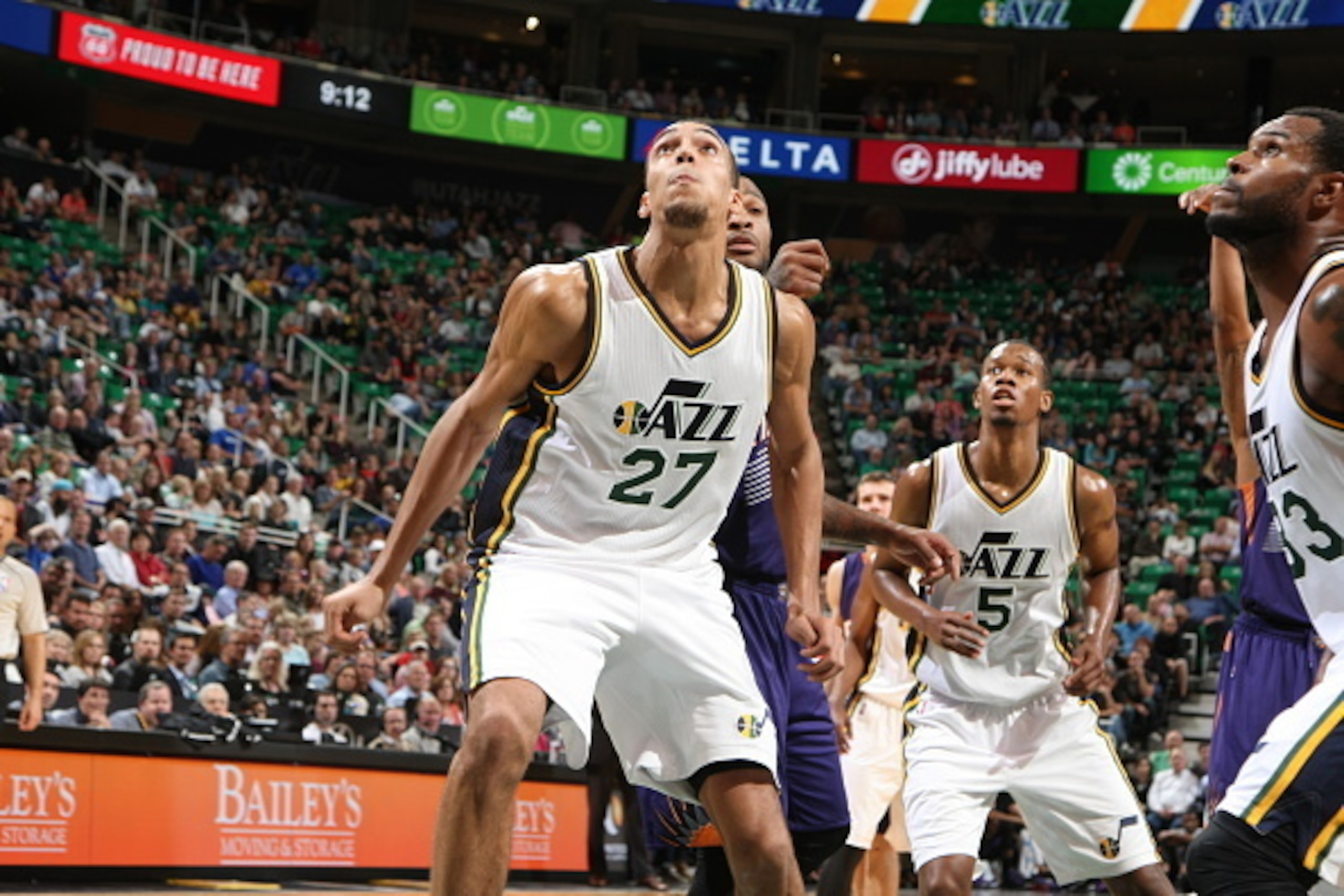
This honor (such as it is) could easily have gone to Trevor Booker, whose newfound three-point range and boundless energy have given the Utah Jazz a whole lot of what they hoped to get from Enes Kanter.
Speaking of Kanter, he's been playing ahead of both Booker and Rudy Gobert. And with the latter being Utah's center of the future, it's a little hard to justify the former No. 3 overall pick continuing to log such significant playing time.
Granted, it's tricky to create offensive space with Gobert and Favors on the floor together, but the Frenchman's absurd length and rebounding prowess make him a phenomenally valuable defensive prospect. He's raw, though, and needs to play to smooth out some rough edges.
Kanter is the starter now, but Booker has already pulled ahead of him in total minutes this season. If the Jazz are at all concerned with developing a potential defensive anchor in Gobert, they'll soon bleed off a few more minutes from Kanter.
The Jazz have the beginnings of a viable core. Favors, Gordon Hayward and Alec Burks are locked into long-term deals, and Dante Exum is the point guard of the future. Gobert figures prominently into this picture, and he's been rebounding and swatting shots like mad in his limited role so far.
It's time to expand that role.
Stats accurate through games played Nov. 5.
.jpg?w=2560 "Every Trade's Best Trade Asset 🔁")
.jpg?w=2560 "Insiders: Cowboys Overpaid for Porter")
.jpg?w=2560 "Top NFL Trade Targets")