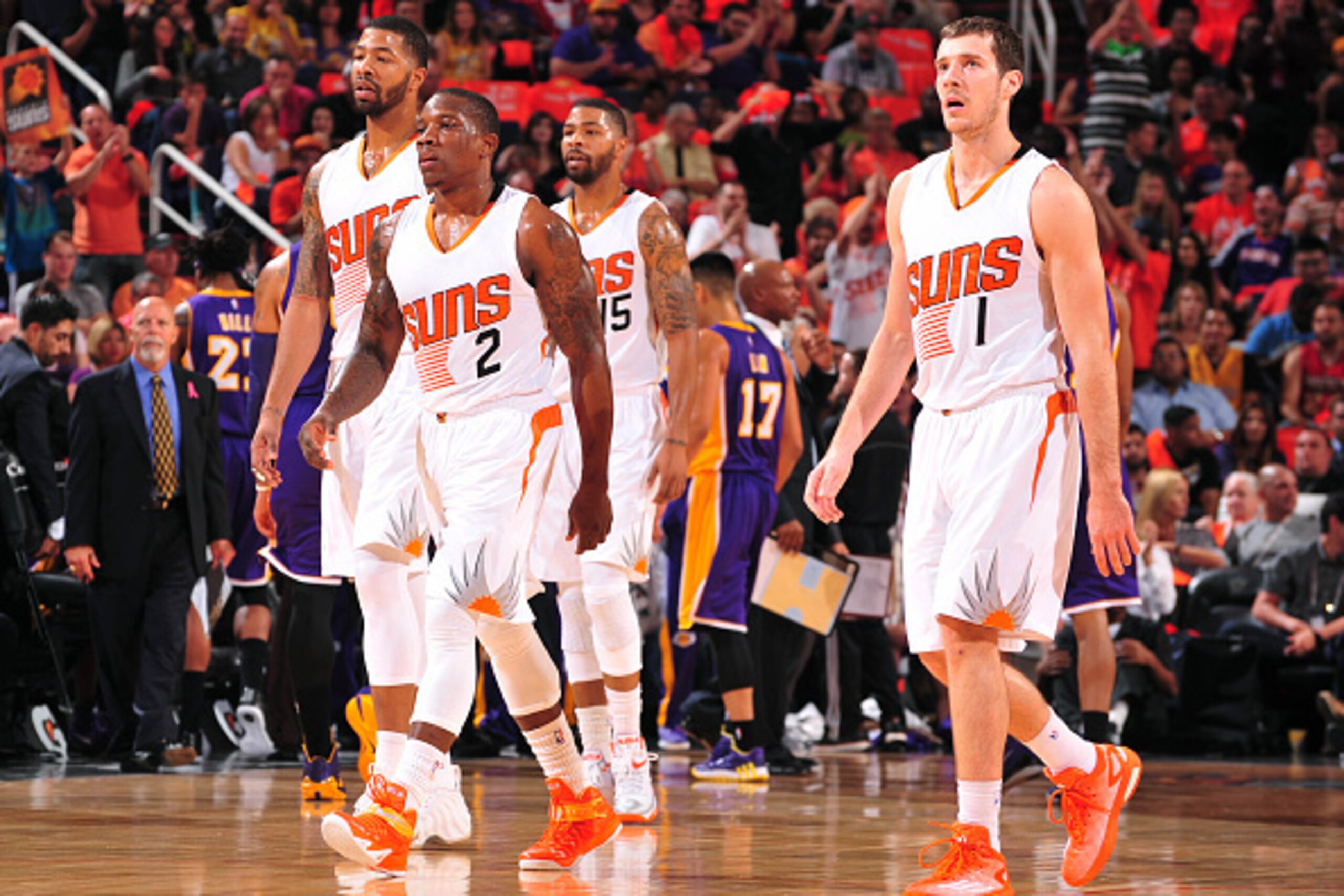


Forty-eight regular-season wins wasn't quite enough to propel the Phoenix Suns into the postseason in 2013-14.
Now, they enter the 2014-15 season with an improved roster and a goal to make the playoffs for the first time since 2010.
Former Sacramento Kings starting point guard Isaiah Thomas was brought in, a move that gives the Suns one of the deepest backcourts in the league. Anthony Tolliver was signed to try and replace some of Channing Frye's spot-up shooting, and T.J. Warren and Tyler Ennis were drafted in the first round.
The team still lacks a superstar, but it seems ready to play a fast-paced, team-oriented style of basketball. Now, it's time to grade the strength of each position.
To elaborate on the grading system, an A would only be given to a few teams that have the strongest players and depth at a respective position. A team that is average relative to other rosters would likely receive a C. And only one team, the absolute worst in the league at a specific position, would receive an F.
Point Guard
1 of 5
First string: Eric Bledsoe
Second string: Isaiah Thomas
Third string: Tyler Ennis
These three almost undoubtedly make up the deepest point guard trio in the NBA. Perhaps not the greatest, as the group lacks a true established superstar, but the Suns certainly have plenty of depth in the backcourt.
Let's start with second-year starter Eric Bledsoe, who will now try to live up to his new five-year, $70 million contract.
Bledsoe is one of the more versatile guards in the NBA, as he is able to drive, shoot, pass, rebound and defend at an elite level. Last season, the now 24-year-old guard averaged 17.7 points, 4.7 rebounds and 5.5 assists per game, and his perimeter defense made the Suns' starting lineup among the best defensive units in the league.
Now, expect him to make another leap forward. In three games so far, Bledsoe is averaging 14.4 points, 7.2 rebounds and 7.6 assists per 36 minutes. He's also able to rack up steals and blocks on the defensive end and is shooting 36 percent from three-point range.
Though his playing time may decrease due to the arrival of Isaiah Thomas, Bledsoe looks poised for an efficient and productive season as one of the team's main scoring options.
Speaking of Isaiah Thomas, the former Sacramento Kings guard has already established himself as a Sixth Man of the Year candidate. After the first week, he is averaging 18.7 points in only 23.7 minutes per game. Best of all, he's shooting with phenomenal efficiency, connecting on 56 percent of his field-goal attempts.
Though Thomas is no longer a starter, he will play an integral role in the Suns offense as a spark plug. With head coach Jeff Hornacek placing so much emphasis on increasing the team's pace, Thomas could receive close to 30 minutes per game in order to put pressure on opposing defenses when the starters are out.
Finally, 18th overall pick Tyler Ennis may find some playing time in blowout wins and losses. But for the most part, the rookie out of Syracuse is there as insurance in case one player sustains a major injury. The team will continue to focus on developing prospects such as Ennis and Archie Goodwin for the future.
Grade: A
Shooting Guard
2 of 5
First string: Goran Dragic
Second string: Gerald Green
Third string: Archie Goodwin
The point guard position is filled with three players under the age of 25 who are expected to improve with experience.
But at shooting guard, the Suns have 28-year-old Goran Dragic and 28-year-old Gerald Green. For those two, who both broke out for the first time only last season, improvement is not a given. In fact, their main struggle this season might be the fight against regression.
That is no knock on Dragic, who scored 20.3 points per game last year on 51 percent shooting from the field and 41 percent shooting from deep. Nor is it an insult to Green, who stepped up with Eric Bledsoe out and shot 40 percent from three-point range for the first time in his seven-year career.
It simply means that sustaining that level of efficiency will prove extremely difficult, especially now that those two players are no secret to opposing defenses.
They have already struggled throughout the first three games. The two have shot a combined 26-of-68 from the field (38 percent), and neither one is averaging more than 13 points per game.
And yet, three games is not a great enough sample size to come to any rash conclusions. Between their shooting and slashing ability, Green and Dragic make up one of the deadliest shooting guard duos in the league. Add in Archie Goodwin, a sophomore prospect and fantastic finisher at the rim, and you have even more depth in the second unit.
Grade: A-
Small Forward
3 of 5
First string: P.J. Tucker
Second string: T.J. Warren
Third string: Zoran Dragic
For now, Marcus Morris has been starting at small forward for the Suns. But once P.J. Tucker is back in the next game after serving a three-game suspension for a DUI, expect Morris to start logging more minutes at power forward.
The Suns could really use Tucker right now. He adds tenacious defense, rebounding and hustle that players such as Green and Morris aren't able to replicate.
Tucker is always matched against the opposing team's best offensive wing player, and he is also one of the better rebounders on the roster despite being only 6'5". Last season, he developed his game even further by adding a consistent corner three-point shot, increasing his three-point percentage to 39 percent.
But after Tucker, there is a significant drop-off at the small forward position (not counting Green and Marcus, who can play there in some lineups).
Tucker's backups are rookies T.J. Warren and Zoran Dragic, neither of whom have played a single game yet. Warren suffered a fractured thumb that will keep him sidelined indefinitely, and Dragic only recently rejoined the team after experiencing some issues with his American visa.
Even when healthy, those two prospects may struggle to find playing time for a team that is focused on making the playoffs. Predicting the production of rookies is always difficult, but theoretically, Warren is an offensive-minded pure scorer who can put up points in a hurry, while Dragic is an above-average perimeter defender who can guard most wing players.
It isn't as deep of a position, but Tucker's elite perimeter defense should keep the group in the middle of the pack relative to other teams.
Grade: C
Power Forward
4 of 5
First string: Markieff Morris
Second string: Marcus Morris
Third string: Anthony Tolliver
Replace Channing Frye? No problem.
Through the first few games, the Suns' three power forwards have shot a combined 11-of-30 from three-point range, which is equivalent to 37 percent. That is also exactly how well Channing Frye shot from behind the arc last season.
Spacing is not going to be a problem with these three. Already, both Morris twins and Tolliver have all shown the capability to set screens and then hover around the perimeter and wait for an open shot attempt. And they're versatile, too, as Tolliver and Marcus can play small forward, while Markieff can spend time at center.
Plus, fresh off their extensions, the Morris twins look ready to make a big impact on this Phoenix roster. If the team needs scoring from its frontcourt players, those two will be relied on first. So far, the Morris twins are averaging a combined 36.2 points per 36 minutes (Markieff 18.0 and Marcus 18.2). Markieff is also averaging 8.4 rebounds per 36 minutes, making him one of the better rebounders on the team.
Though none of these forwards are great defenders, their offensive prowess is enough to keep the Suns from relying too heavily on the backcourt players for talent and scoring. Both Morris twins have great mid-range and three-point jump shots, and Markieff is even starting to develop an arsenal of post moves as well. It isn't a stretch to say that he could be considered an above-average starter in the league soon.
Grade: B-
Center
5 of 5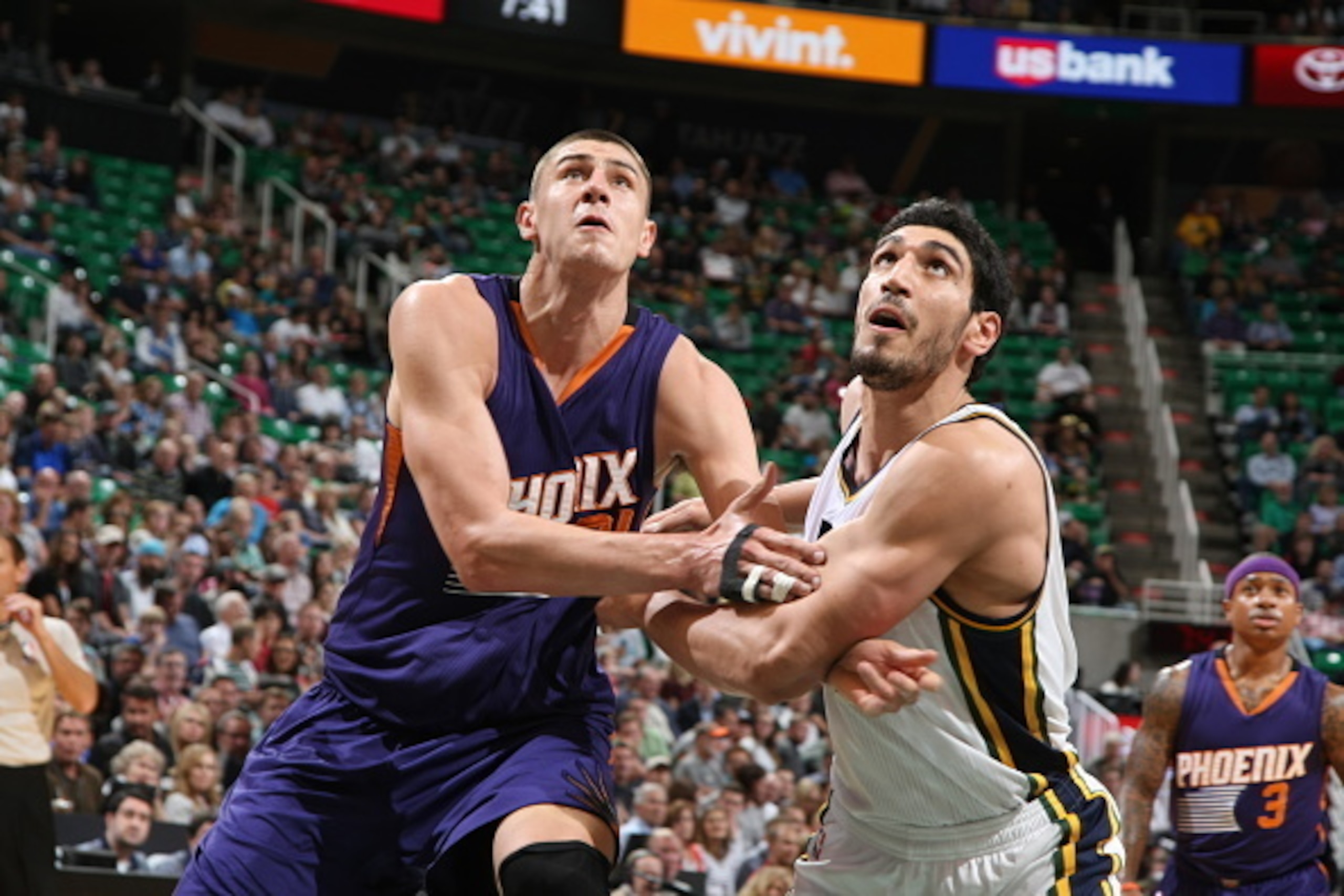
First string: Miles Plumlee
Second string: Alex Len
Third string: Shavlik Randolph
This trio should not instill confidence in Suns fans.
Miles Plumlee has played decently, but he doesn't look like he will take another leap forward after breaking out last season. Plumlee is averaging 11.4 points, 6.9 rebounds and 1.7 blocks per 36 minutes, but he sometimes struggles rebounding the ball and isn't capable of scoring unless he is fed underneath the basket. He has almost no jump shot, and his post moves are wildly inconsistent.
On the bright side, 21-year-old sophomore Alex Len is finally starting to live up to expectations. He still has a long way to go, but fans should be pleased with the 7'1" Ukrainian big man's production in the opening week.
Len is shooting 58 percent from the field while averaging nine points, 10.1 rebounds and 3.2 blocks per 36 minutes. He looks more mobile and less ungainly running up and down the court and has learned to use his length to his advantage on defense.
Finally, Shavlik Randolph is no defensive anchor, but the 30-year-old veteran will see playing time whenever Hornacek wants extra rebounding. He won't log heavy minutes, but Randolph has collected six rebounds in 18 minutes of playing time so far.
Unfortunately, even with Len stepping up, this is not a promising frontcourt. If the Suns want to contend for a championship within the next few years, they will likely need an upgrade at center. What they have now is barely sufficient.
Grade: D

.jpg?w=2560 "B/R's Expert Week 7 NFL Picks 🔮")