NFL Invades London: 'American Rugby League' Fans Inhale Lions vs. Falcons
Detroit vs. Atlanta in London: welcome to the weirdest cross-section of sports fans you can imagine. It's a source of entertainment unlike any other, even for a group of people that boast some of the most dedicated sports fans in the world.
For you Americans interested in British sport, let me help you with these common sport lexicons: Soccer (football), football (American football) and football (Rugby Union/Rugby League). Super straightforward, I know.
Soccer, due to its worldwide popularity, is often compared to the NFL in America. Both games capture the hearts and minds of everyone from the poor to the working class to the aristocrats. They're played in front of similar-sized crowds (a generalization, indeed)—typically once a week, and they're susceptible to the same corruptions, scandals and public-relations nightmares.
TOP NEWS
.jpg?w=2560 "NFL Paris Football")
NFL House in Paris Closes for Protests
.jpg?w=2560 "Seahawks Chiefs Football")
Trevon Diggs Cut by Seahawks
.jpg?w=2560)
B/R's Expert Week 7 NFL Picks 🔮
There's another game, though, less popular in the UK, that deserves a comparison.

The Wembley Roar
Wembley stadium holds 90,000 people, according to its website. The legendary stadium is home to all kinds of events, most of them unique to the European sports landscape (notably, it's home of the English national football team, who've struggled mightily of late to get anywhere near 90,000 people in the building).
Last year, I had my first Wembley experience for the League Cup (recently rebranded the Capital One Cup) Final between Sunderland and Manchester City. Rowdy Sunderland fans filled the pubs and bars near the Baker Street tube station, eager to see their club raise a much-needed trophy. Man City fans, already vying for the Premier League title (and eventually winning it a few months later), were just as rambunctious.
For all the excitement during today's NFL game, there's absolutely nothing on Earth that compares to English fans celebrating a trophy (even if it's of a relatively less prestigious caliber, like the League Cup). Managers are hired and sacked on their trophy-winning abilities, partially due to the elation and never-ending memories produced with the lifting of a trophy.
As an American living in London, it's beyond surreal to watch so many Europeans (and many traveling Americans) flip out for NFL players. After all, before 2007, when the Giants beat the Dolphins in the NFL's first-ever London game, the only similar game most of these Brits recognized was Rugby League—a less-popular version of what most Americans know as "Rugby."

(Bleacher Report's lead National writer, Michael Schottey, recently broke down Jarryd Hayne's chances of making it in the NFL. Hayne recently left National Rugby League, Australia's domestic Rugby League competition.)
Rugby League—Not a Union
I can't help but compare Rugby League—long known for its raucous crowds, cheerleaders and blistering pace of play—to the absurd excitement of an NFL game. Teams only have a certain number of tackles to get down the field, which makes for desperate, last-ditch efforts comparable to trying to punch the ball in on 4th-and-goal.
Today's first touchdown of the game featured an excellent one-handed catch by Falcons Florida State rookie Devonta Freeman. The crowd responded in kind, happy to see a score so quickly during the game.
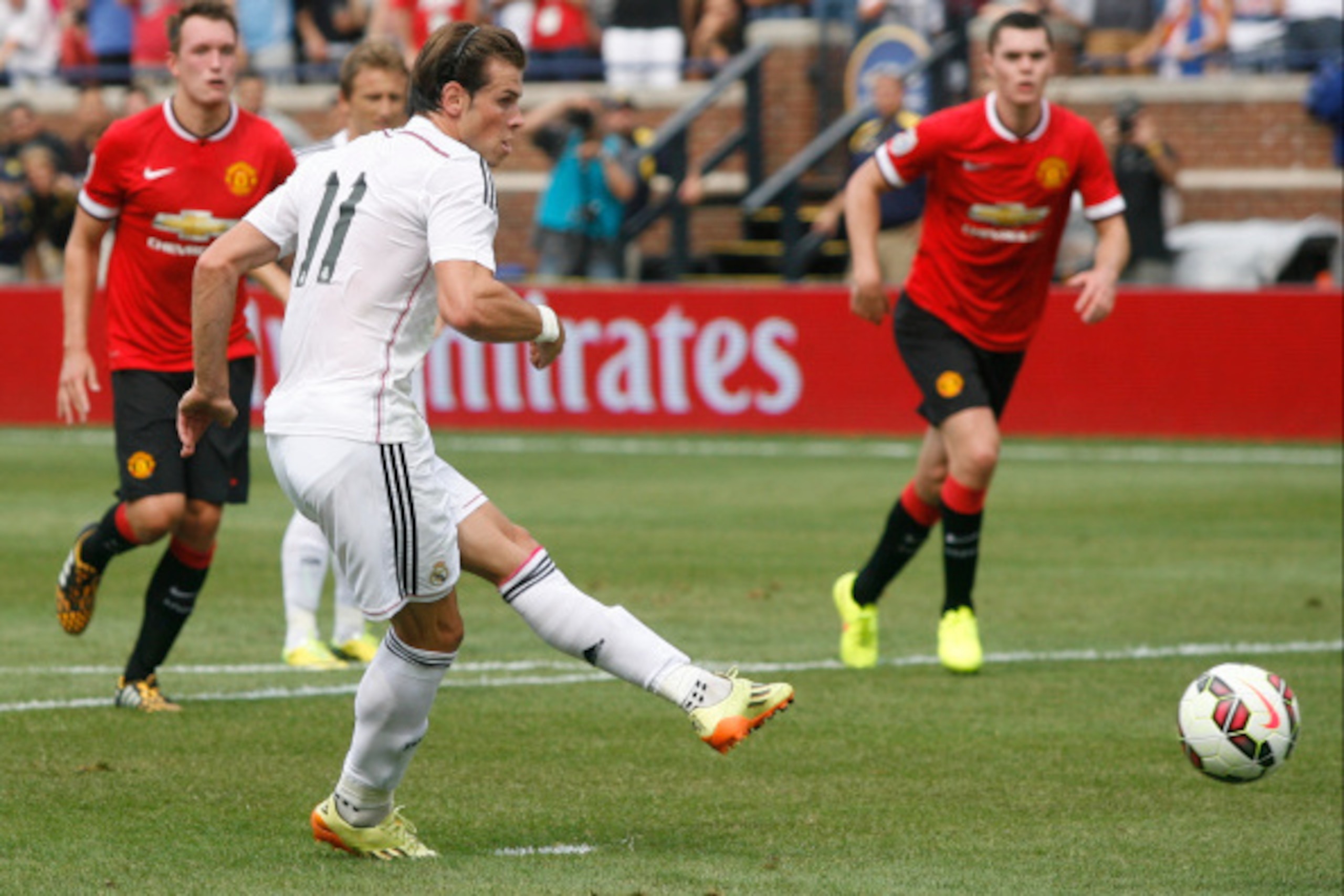
Atlanta turned it on right from the beginning, which turned the crowd into massive Falcons fans—today's home team. The same thing happened when Matt Ryan threw what looked like a 101-yard pick-six to Detroit's Rashean Mathis. "Home" fans cheered Mathis all the way to the other end zone on his circuitous and ultimately called-back interception for a TD. Hell, it's exactly what I would've done had Gareth Bale scored on Manchester United at the Big House—and I had a Man United kit on.
With three NFL games in London this year, there's plenty of opportunity for Londoners to see "American Rugby League" here in the capital. Rugby League is a fairly marginalised sport here in Britain—most folks who choose to watch any format of Rugby go for Rugby Union.
The All Blacks (New Zealand's national Rugby Union squad) sport Rugby Union's most recognized brand. There's nothing more intimidating than sleek black uniforms charging at you with no blockers. With excellent marketing and an incredibly rich history, it's no wonder Rugby Union trumps Rugby League worldwide.
A Refreshing and Blissfully Unaware Fanbase
For the most part, Lions vs. Falcons contained all the typical glitz and glamour that you'd expect to see at a stateside contest between these two teams. An ostentatious reading of teams' starting lineups, cheerleaders distracting everyone in sight and Wembley's impressive sound system on display.
Of course, the red, white and blue (of both flags, what a stunning scene) were everywhere during this game, and you can't help but feel the tug on your heartstrings. I (perhaps somewhat controversially) didn't stand up during "The Star-Spangled Banner" or "God Save the Queen." I was typing—do I need to explain myself?
Most remarkably, however, is the fact that while the Falcons were designated the home team, it's impossible to ignore the lack of home-field advantage. American sports fans are accustomed to games (and series, to a greater extent) undergoing gigantic mood swings based on the veracity of a crowd. At Wembley, fans are just as fired up for a great play as any other NFL fanbase—but the stadium itself isn't an entity to be reckoned with.
There's a noticeable lack of buzz in this massive building, and frankly, it's refreshing. These are "pure fans" with nothing to enjoy but the enjoyment of the sport itself. No messy histories to contend with, no allegiances to players or coaches or cities or franchises. Just a bunch of people entering a legendary building with the sole intent of watching American football.
Australian Opportunity
Rugby League, long pushed out of the consciousness of most British and American sports fans, suffers from the same issues that cricket does in the USA—there's a similar game (Rugby Union), forever entrenched in our minds.
Rugby League is most popular on the eastern side of Australia—Queensland, New South Wales and Australian Capital Territory. This is the portion of the country we're most familiar with in the states: Sydney, Melbourne and Canberra. Generally, Rugby Union takes a second or third position to the AFL (Australian Rules Football, I won't go there for now) in terms of popularity.

In the UK, the Super League struggles to grab hold of a larger audience as Rugby Union remains the more popular code. Fortunately, there are glimpses of hope in the UK. At halftime during today's game, Sky Sports interviewed Leeds Rhinos star Rob Burrow, who was unabashedly sporting a Seattle Seahawks hoodie. He's been at Leeds since 2001 and provides a shining example of a sport that's much more popular in the north of England than here in the south.
This begs the question: How soon will the NFL play games in Australia? There's obvious logistical questions that must be tackled, but it's not without American precedent. MLB did it last March—an early start in Australia. Do I smell a trip to Sydney for the NFL? Maybe Jarryd Hayne's eventual break into the NFL will open doors, and before you know it, you'll hear Matt Ryan excited about playing in Sydney.
The NFL undoubtedly has explored other worldwide options. If they really think they'll have five games in London next season (according to the Daily Mail), NRL matches in America and NFL games in Sydney are surely right around the corner.
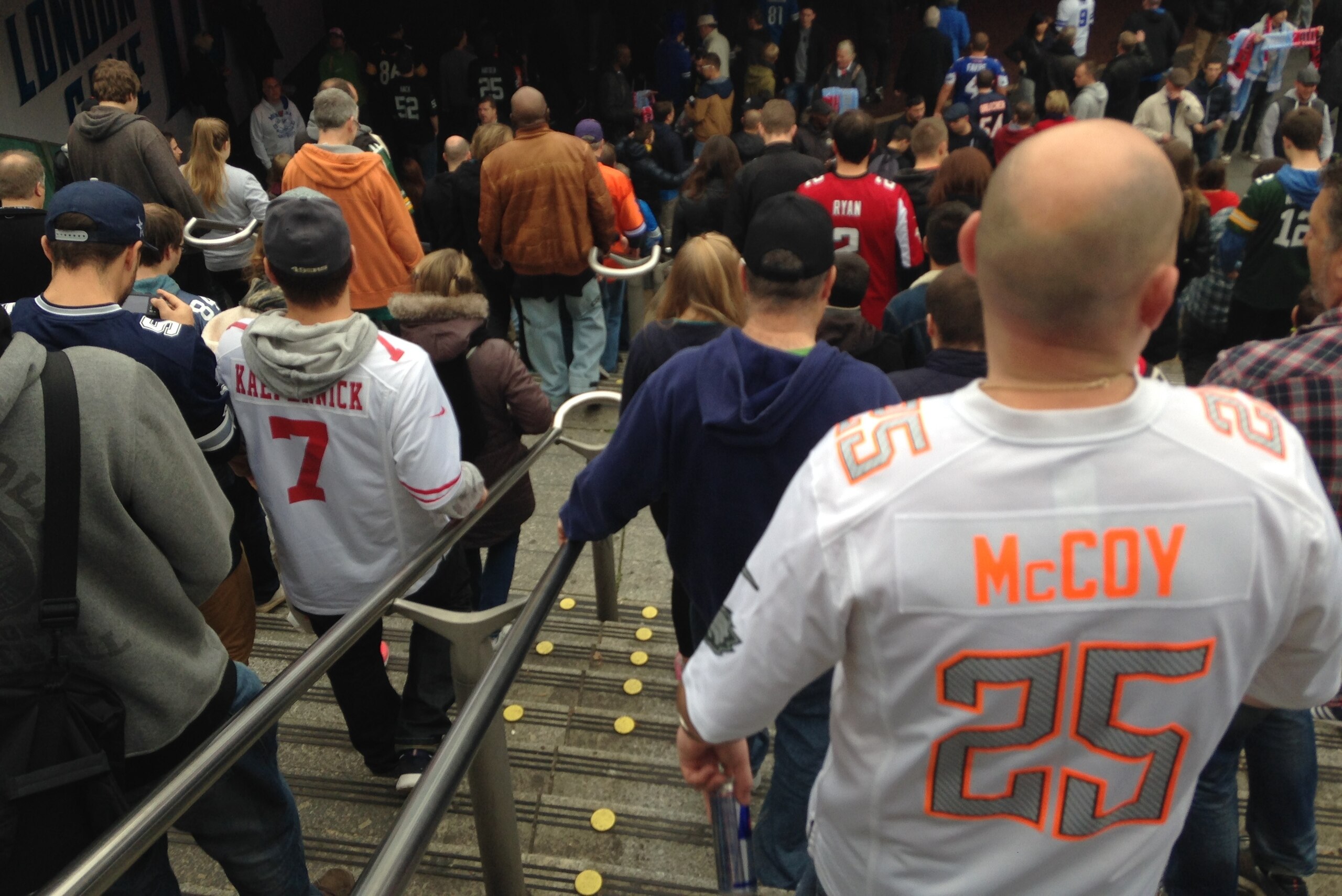
With hardly any home fans and a group of fans sporting jerseys this eclectic, how can they say no? A neon orange LeSean McCoy Pro Bowl jersey at a Lions-Falcons game on the outskirts of London says globalization will take the NFL elsewhere in the next few years.
I hear the Jaguars are looking for a new fanbase.
Comments, questions or just want to tell me I'm wrong? You can follow me on Twitter @ericdrobny.
.jpg?w=2560 "Titans Colts Football")