
Wisconsin Football: Adjustments Badgers Must Make During Bye Week
Going into their second bye week of the season, the Wisconsin football team finds itself at 4-2 with a 1-1 record in Big Ten play with a bevy of questions at a number of key spots.
Uncertainty abounds at the quarterback position. Though the return of Joel Stave provides more stability under center, he has yet to look particularly comfortable as the signal-caller. With that being said, the threat of the deep pass has helped running backs Melvin Gordon and Corey Clement immeasurably.
Speaking of their two running backs, Gordon has cemented himself as a bona fide Heisman candidate after rushing for more than 1,000 yards in his first six games to go with 13 touchdowns on the ground and another one as a receiver.
One slightly troubling note about Gordon is the team's reliance on him. Gordon has notched 27 or more carries in each of his last three games. While in those games, he's rushed for at least 175 yards and a score, Gordon is on pace to exceed his career high in carries by 80, including the bowl game if they make one.
Clement has been used fairly sparingly thus far this year; however, he broke out for a huge game last week against Illinois to the tune of 13 carries for 164 yards and a score on a 72-yard scamper, which displayed his strength and speed.
Lost in the quarterback shuffle is Tanner McEvoy, who started the first five games before being replaced just before halftime against Northwestern and saw only one series against Illinois.
On defense, the Badgers have vacillated between looking great and extremely pedestrian, missing tackles left and right and taking a variety of drive-extending penalties.
Furthermore, their secondary, seen as a strength coming into the season, has been exposed for their inability to cover the deep pass. While safety Michael Caputo has been nothing but outstanding in run support and underneath in the passing game, he along with the rest of the secondary has struggled with deep throws.
Finally, after hitting a 51-yard field goal in the opener against LSU, Rafael Gaglianone is 5-of-8 on field-goal attempts and has a missed extra point to boot. Furthermore, punter Drew Meyer is averaging only 39.0 yards per punt, which is good for 113th-best in the country.
With all of that being said, let's take a more in-depth look at each of the five areas where the Badgers should make adjustments during this week off before they take on the meat of their Big Ten schedule.
Get Joel Stave Comfortable
1 of 5
Coming into his redshirt junior year, there was a lot of clamor among fans for Tanner McEvoy to be given the starting quarterback job due to his athleticism over Joel Stave, who had a penchant for throwing untimely interceptions and missing wide-open receivers.
With 19 career starts and a 14-3 record when it came to games he both started and finished, Stave was a proven commodity with a big enough arm, a prototypical frame for a quarterback and two years of eligibility remaining.
But Stave lost the quarterback competition in fall camp, which may or may not have been the cause of his "yips," which held him out of the team's first four contests before making an appearance in relief of McEvoy at the end of the first half of the team's game against Northwestern.
Against Northwestern, Stave was unmistakably rusty, going 8-of-19 for 114 yards, a touchdown and three interceptions while getting sacked once. Stave's interception in the end zone was one he definitely would want back, as it killed a goal-to-go drive at the 3-yard line on first down.
Given the starting nod the following week against Illinois, Stave was unremarkable, going 7-of-14 for 73 yards, no touchdowns but also no turnovers. Stave's first pass of the day was horrible, spiking the ball into the ground near the vicinity of Corey Clement, but eventually settled in to do just enough to keep the chains moving.
Having Stave under center softens up the eight-, nine- and 10-man boxes Melvin Gordon and Clement have been seeing. Still, he has yet to connect on a long pass, alternating between under- and over-throwing the long bombs he is privy to throwing, particularly on play action.
Stave doesn't have Jared Abbrederis to throw to anymore, who became an expert at adjusting to Stave's wobbly deep balls to have a career year last season, hauling in 78 passes for 1,081 yards and seven touchdowns.
Stave has started picking up where McEvoy left off when it comes to finding Alex Erickson as a favorite target. Erickson has 27 receptions for 319 yards and a touchdown despite the inconsistency and general ineptitude of the quarterback play this season.
But Erickson is no Abbrederis, as he doesn't have the same kind of track speed or precision route running Abbrederis had. With that being said, he is a great security blanket and is good for hauling in all of the short and intermediate routes necessary to soften up the top of the defense.
A key for Stave will be making him comfortable playing in the pocket by using the run game to set up the long play-action passes Stave once knew how to throw. Furthermore, using short bubble screens and quick slants to boost his confidence and build momentum will be necessary for the long-term success of the offense and to keep Gordon in one piece by the end of the season.
Develop a Package for Tanner McEvoy
2 of 5
While Joel Stave is and should be the starting quarterback, there is no reason to panic and move Tanner McEvoy to wide receiver or safety or anything like that. McEvoy was not very good as a pocket passer, and that may be putting it lightly, but he is a phenomenal athlete.
McEvoy had one drive as quarterback against Illinois, and in that drive, he went 3-of-4 for 24 yards through the air and had one carry for 12 yards. If offensive coordinator Andy Ludwig is able to work in a drive or two a game with McEvoy playing quarterback, the Badgers will have another wrinkle to the playbook to keep defenses on their toes.
When McEvoy was the starting quarterback, Ludwig tried to use him as a traditional quarterback, having him run three- and five-step drops and work through his progressions. That won't work with McEvoy, who's biggest attribute is his athleticism and not his arm strength.
Running read-option plays where McEvoy reads the defensive end to decide whether to hand the ball off or keep it himself should be a staple of the offense when he's in, something which rarely saw an appearance when he was QB1.
Furthermore, if you cut the number of progressions McEvoy needs to make as a quarterback, trusting him to use his legs wisely if need be and rolling him out to one side to cut the field in half, McEvoy can be an effective, accurate (enough) passer to keep defenses honest.
Using McEvoy more than one or two drives a half would be a mistake, particularly with the stable of running backs the Badgers have, but if used sparingly yet properly, it can give them a totally different look that will help them establish an offense the coaching staff really wants to implement with D.J. Gillins and Austin Kafentzis coming down the recruiting pipeline.
Relearn How to Tackle
3 of 5
Playing on natural grass in sloppy conditions, the Badgers looked woefully inept at doing the little, fundamental things properly against a resurgent Northwestern team looking for a statement win.
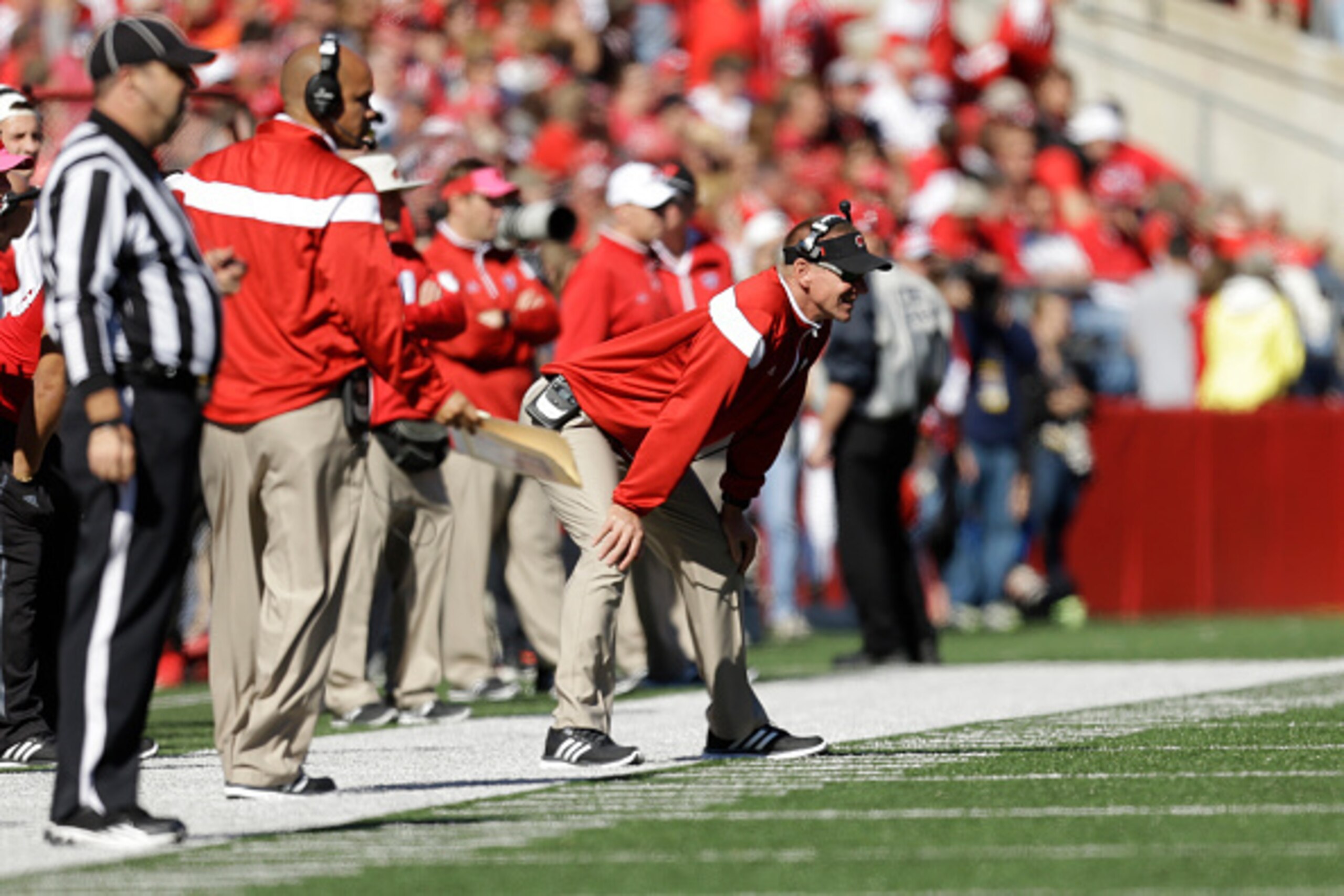
In the weekly Big Ten coaches teleconference, head coach Gary Andersen did not mince words when it came to the team's poor tackling performance.
"I think it was the positioning," Andersen said. "A lot goes into tackling. If you miss 15 tackles, there's going to be some fundamental flaws. If you miss 15 tackles, there's some young men that are approaching a tackle in an abnormal position. You've got to get the kid down on the ground."
The team's poor tackling came to light once again against Illinois, as once the Fighting Illini put in Aaron Bailey at quarterback, he ran wild, toting the ball 12 times for 75 yards and a score despite playing less than a half.
The Badgers front seven was going to be a work in progress coming into the season, and losing senior Warren Herring in Week 1 really hurt, but injuries can't be used as an excuse, as every team goes through them and even when you lose eight contributors in the front seven to graduation, you still need to make plays.
This bye week should be used to go back to basics, as safety Michael Caputo looks like the only person who is confident in making a tackle without help. Outside linebackers Vince Biegel and Joe Schobert have been disruptive in the backfield but are shaky in making open-field tackles, forcing Caputo to clean up the mess.
A week of work on the fundamentals of tackling will do wonders for the Badgers as they prepare to face off against the top running backs in the conference in each of the last three weeks in Ameer Abdullah (Nebraska), Mark Weisman (Iowa) and David Cobb (Minnesota).
While all three are different types of running backs, in the words of coach Andersen, "You've got to get the kid down on the ground."

.jpg?w=2560)
Cover the Deep Pass
4 of 5
Right now, the Badgers' biggest weapon against the big passing play is their pass rush. With 19 sacks on the season in six games, including a team-high four from Derek Landisch, the Badgers have been able to generate more pressure on the quarterback this season through a variety of blitz schemes.
But when you blitz, it leaves your cornerbacks on islands, and if teams can block long enough, they are exposing one of the biggest weaknesses on the Badgers defense: the secondary's inability to cover the deep pass.
Safety Michael Caputo has been as sure a tackler as the team has in a post-Chris Borland world, and his 45 tackles this season leads the team by a wide margin—Landisch is second with 33. But when Caputo is matched up against slot receivers and tight ends, his coverage skills, or lack thereof, are exposed.
But Caputo has done as much as he can for a strong safety, and picking on him would be unfair for just how good he's been playing in the hybrid F-side linebacker/safety position. He's got instincts akin to Borland, as he always seems to be around the ball and hardly misses a tackle.
The rest of the cornerbacks have not been nearly as stellar in run support, nor have they been good in coverage. That has been a problem, as teams are able to throw over the top of the defense. Luckily, the Badgers have faced a litany of weak quarterbacks this season who have been unable to make the Badgers pay as often as they should.
Let's start with the best of the bunch, Darius Hillary. Hillary, a redshirt junior, has 12 tackles, is tied for the team lead with three pass breakups and is also tied for the team lead in pass deflections with three. Hillary has typically drawn the second receiver and has done a very good job limiting the damage done by them, keeping the penalties to a minimum and keeping everything in front of him.
The same cannot be said for his partner across the field, Sojourn Shelton, who has been tasked with covering the best receiver for the opponent. He has struggled mightily.
Shelton has racked up the penalties, committing what seems like multiple pass-interference penalties a game while also still getting beaten over the top. Shelton's size—he's 5'9"—has been a real hindrance to him, though last season, when he was the team's best corner with four interceptions, he was the same size.
Chalk it up to a sophomore slump, increased expectations and more tape on him or some sort of voodoo magic; the Badgers will need Shelton to be better if they are to beat the Nebraskas, Iowas and Minnesotas of the world, which they play in successive weeks to close the season.
Work on Special Teams
5 of 5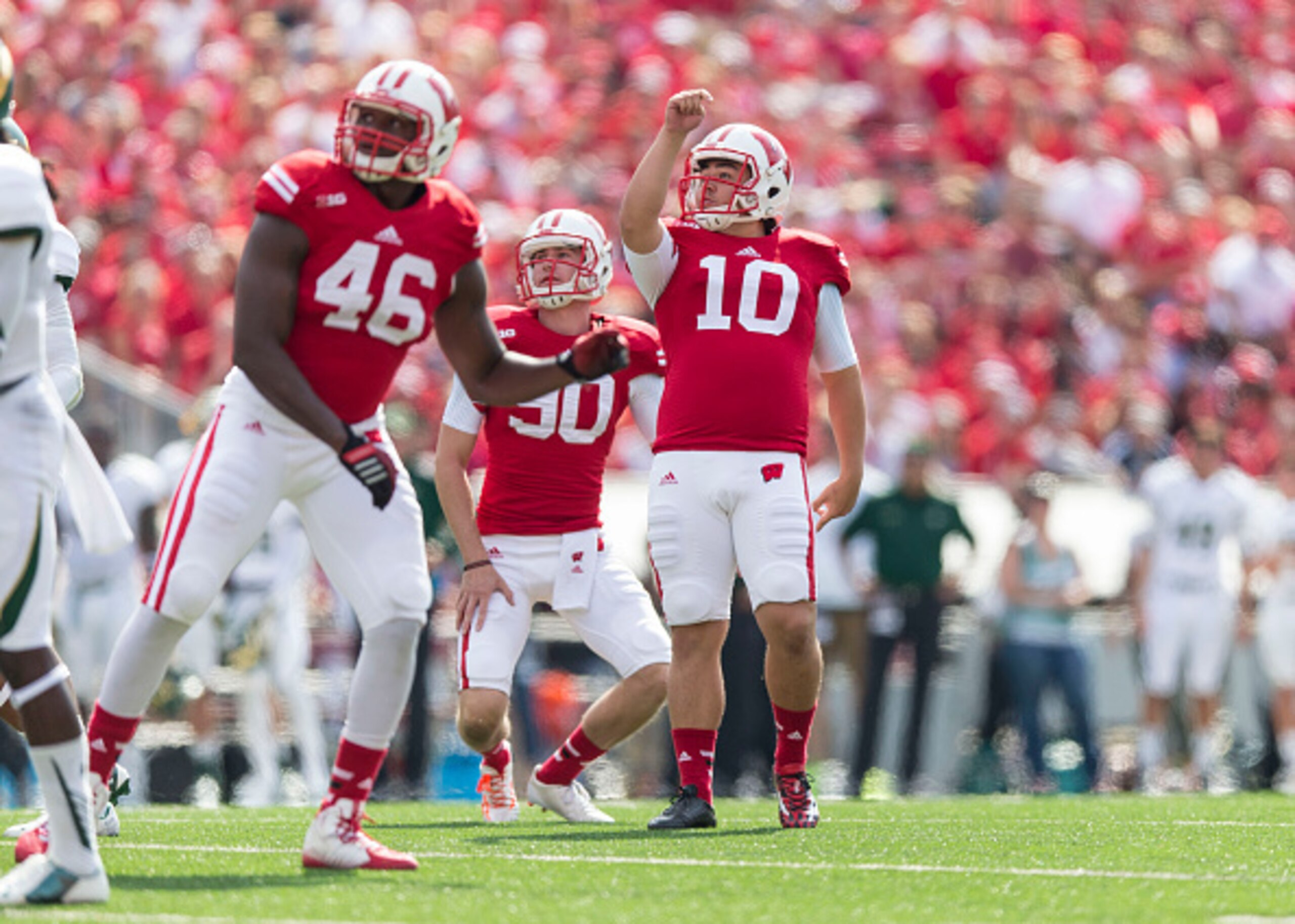
After losing to LSU, it seemed like nothing was going right. The defense had collapsed in the second half, the offense sputtered heavily, something was wrong with Melvin Gordon that wasn't being shared with the rest of the world and the team was 0-1 to start the year.
The lone bright spot was a 231-pound kicker from Sao Paulo, Brazil named Rafael Gaglianone, who brought back more memories of Phillip Welch than Kyle French. Gaglianone drilled a 51-yard attempt, his only kick of the day, did a little salsa dance and drilled all three of his point-after tries.
Since then, Gaglianone has been more French than Welch, missing three of his eight field-goal attempts including a 33-yard try and an ugly miss against Northwestern.
The miss against Northwestern highlighted Gaglianone's inexperience kicking in cold weather and in the elements as the temperature dipped into the mid-40s with bursts of rain coming through, all while kicking on natural grass. That led to an ugly miss from 50 yards out.
Gaglianone has the leg to hit any field goal he wants, but he's missing the accuracy needed to be a consistent kicker at the FBS level. Few have a leg like his, and accuracy could come with time, though it will be on special teams coach Bill Busch to help him become more accurate.
In terms of punting, the Badgers are a mess. Something doesn't appear to be right with punter Drew Meyer, who looks to be injured or just unable to cleanly strike the ball off his foot.
Meyer is averaging 39.0 yards per punt this season, good for 113th in the country and 10th in the Big Ten. Furthermore, his numbers are just a shade higher than the 38.4 yards per punt he averaged last season, which was good for 11th of the 12 punters in the Big Ten last season.
The week off could help Meyer heal up or work out the kinks in his kicking motion with coach Busch, as the only other punter on the roster is freshman P.J. Rosowski, whom I'm sure the coaching staff would love to redshirt this season.
Meyer has proven that he's capable, as in 2012, he averaged 41.5 yards per punt, good for sixth in the Big Ten on a conference-high 80 punts and a return to form would be much needed for the occasionally inconsistent Badgers offense.

.jpg?w=2560 "NFL House in Paris Closes for Protests")

.jpg?w=2560 "Trevon Diggs Cut by Seahawks")