
Tale of the Tape for NFL Week 6
Throughout the 2014 regular season, former NFL defensive back Matt Bowen will bring you an X's-and-O's look at the pro game. Here are his five key plays from the Week 6 Sunday NFL schedule.
DeMarco Murray, Cowboys Run Game Produces the Game-Winner vs. Seahawks
With a balanced call sheet and physical offensive line play, the Dallas Cowboys controlled the tempo versus the Seattle Seahawks and were in a position to take the lead late in the fourth quarter.
TOP NEWS
.jpg?w=2560 "NFL Paris Football")
NFL House in Paris Closes for Protests
.jpg?w=2560 "Seahawks Chiefs Football")
Trevon Diggs Cut by Seahawks
.jpg?w=2560 "Colts Football")
Jonathan Taylor Landing Spots
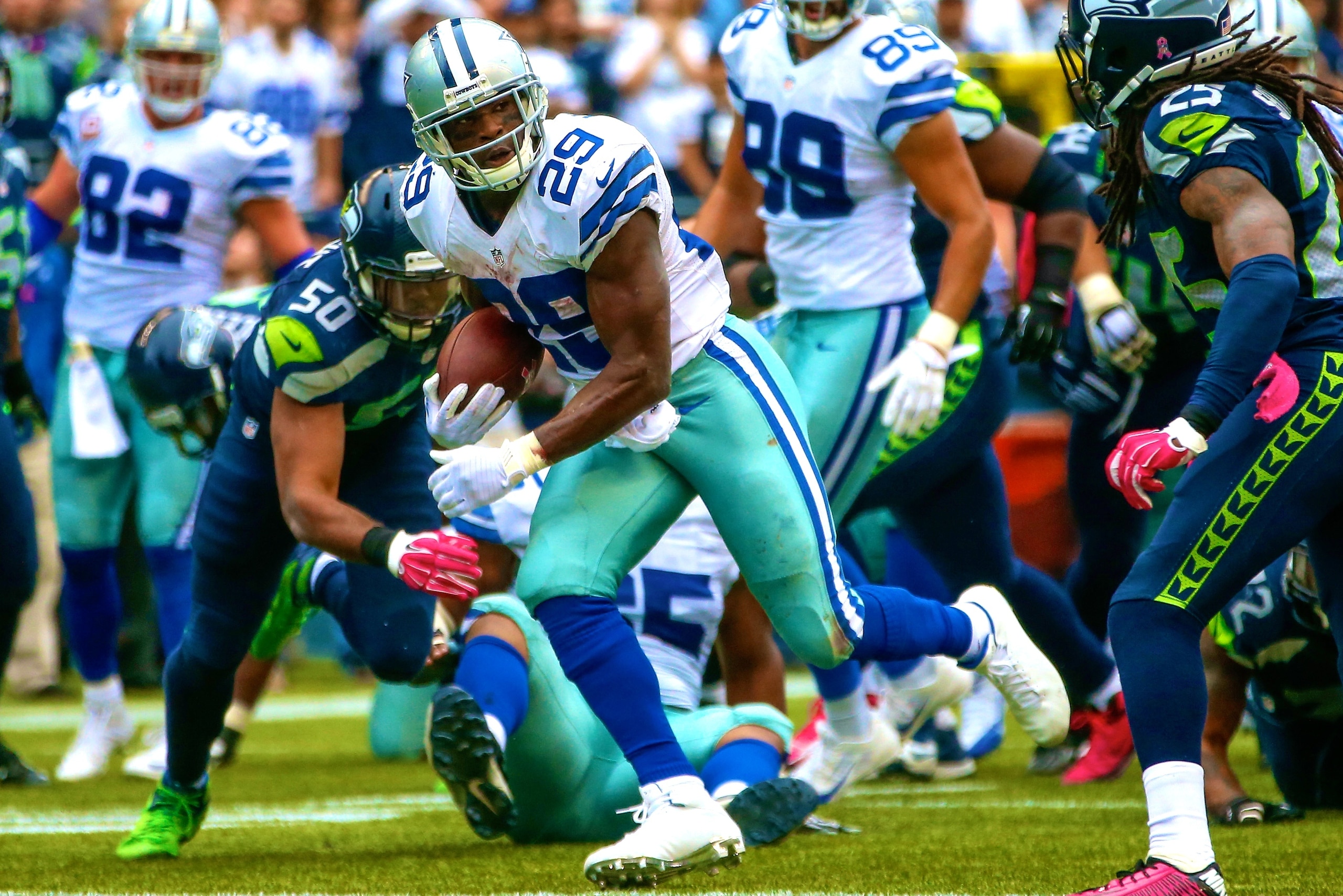
Let’s break down Murray’s touchdown run on the two-back stretch (outside zone) to highlight the running back’s ability to find a cutback lane versus defensive pursuit in the Cowboys' 30-23 win out in Seattle.
Personnel: Tank/22 (1WR-2TE-2RB)
Formation: I Tight
Offensive Concept: Stretch (Outside Zone)
Defensive Scheme: Cover 1

As we talked about last week, the Cowboys lean on their zone running schemes (inside zone, stretch, split-zone) out of a variety of personnel groupings because of the talent up front and Murray's skill set.
Here, the Cowboys bring Tank/22 personnel on the field with the Seahawks playing Cover 1 out of their "Under" front.
With base zone blocking at the point of attack (“zone step”) along the offensive line and the fullback leading to the closed side of the formation, Murray presses the ball to the edge.
This forces the second-level defenders ("Mike" linebacker, strong safety) to flow play side, with left tackle Tyron Smith and tight end Jason Witten accounting for the open side defensive tackle and defensive end.
That creates an inside cutback lane for Murray, as left guard Ronald Leary works to the second level versus the "Will" ‘backer scraping to the ball.
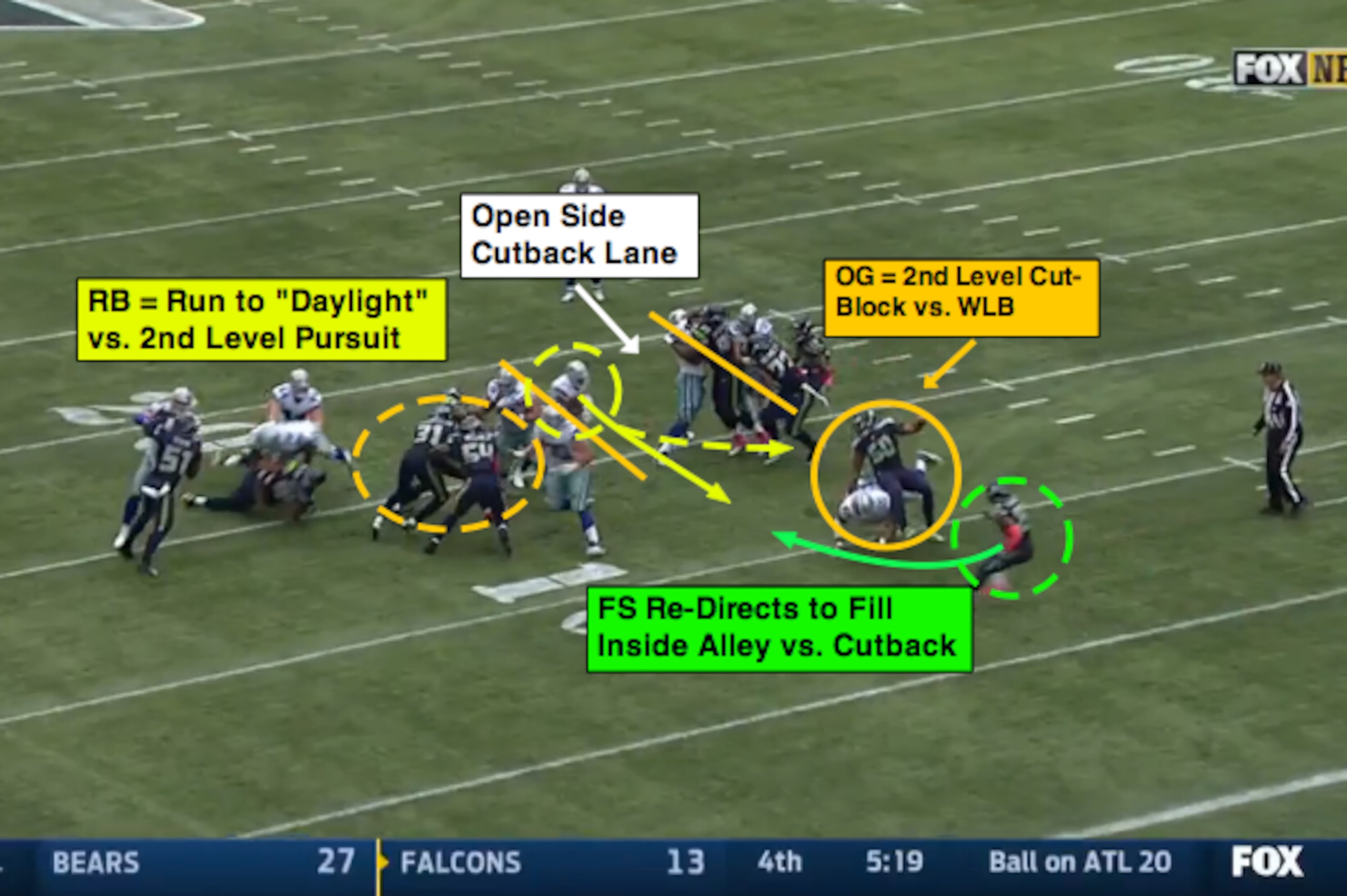
Looking at the cutback lane, Murray can attack to the open side of the formation after the running back uses his vision to find “daylight,” with Leary now in a position to cut down the Will ‘backer at the second level.
That forces Earl Thomas to redirect and enter downhill to the run front (alley fill) once Murray cuts this ball back.

With Leary chopping down the Will ‘backer—and Murray cutting off the second-level block—Thomas has to adjust his angle in the downhill alley fill and lunge (leave his feet) at the point of attack.
Murray can now square his pads and push this ball up the field with an opportunity to get six points if he can run through the tackle from cornerback Richard Sherman pursuing inside to the play.
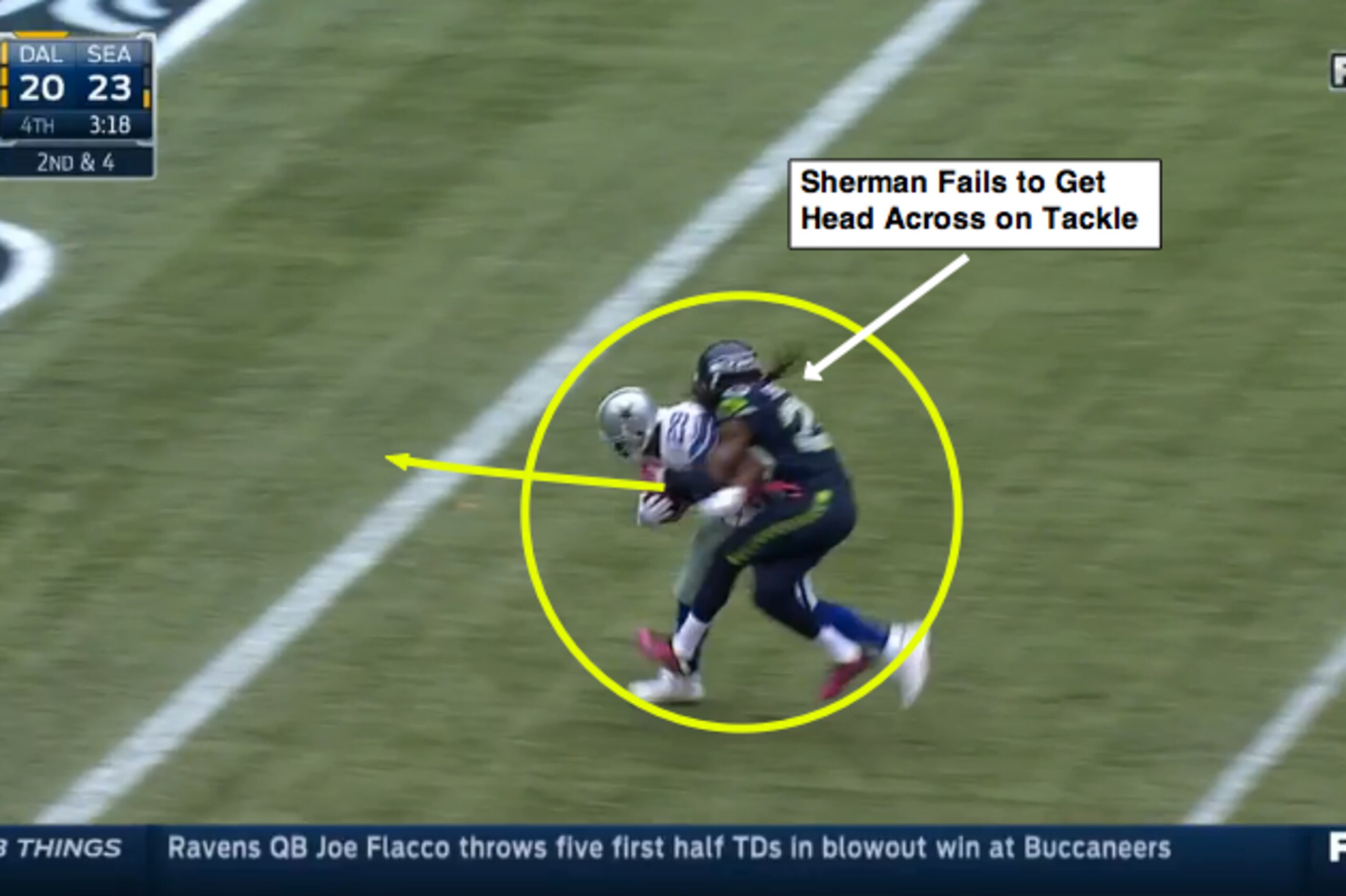
Sherman takes the proper pursuit angle inside; however, the Seahawks cornerback fails to get his head across on contact. Murray runs through this tackle and carries Sherman into the end zone for the game-winner.
The Cowboys running back produced over 100 yards for the sixth-straight game (115) and finished off the Seahawks on a zone scheme that has shown up on tape all season.
Aaron Rodgers Throws the Back-Shoulder Fade to Beat the Dolphins
With the ball in the deep red zone after the Green Bay Packers executed the fake spike, Rodgers identified the matchup he wanted (tight end versus a linebacker) and showcased his ability to put the ball away from the defender’s leverage on the fade route to beat the Dolphins.
Let’s talk about the coverage scheme, the “solo” matchup outside of the numbers and focus on the back-shoulder throw to Andrew Quarless that gave the Packers the road win during the final seconds in Miami.
Personnel: Posse/11 (3WR-1TE-1RB)
Formation: Doubles “Orange” Gun Far
Offensive Concept: Fade
Defensive Scheme: Cover 7 “Slice” (Inside Bracket)
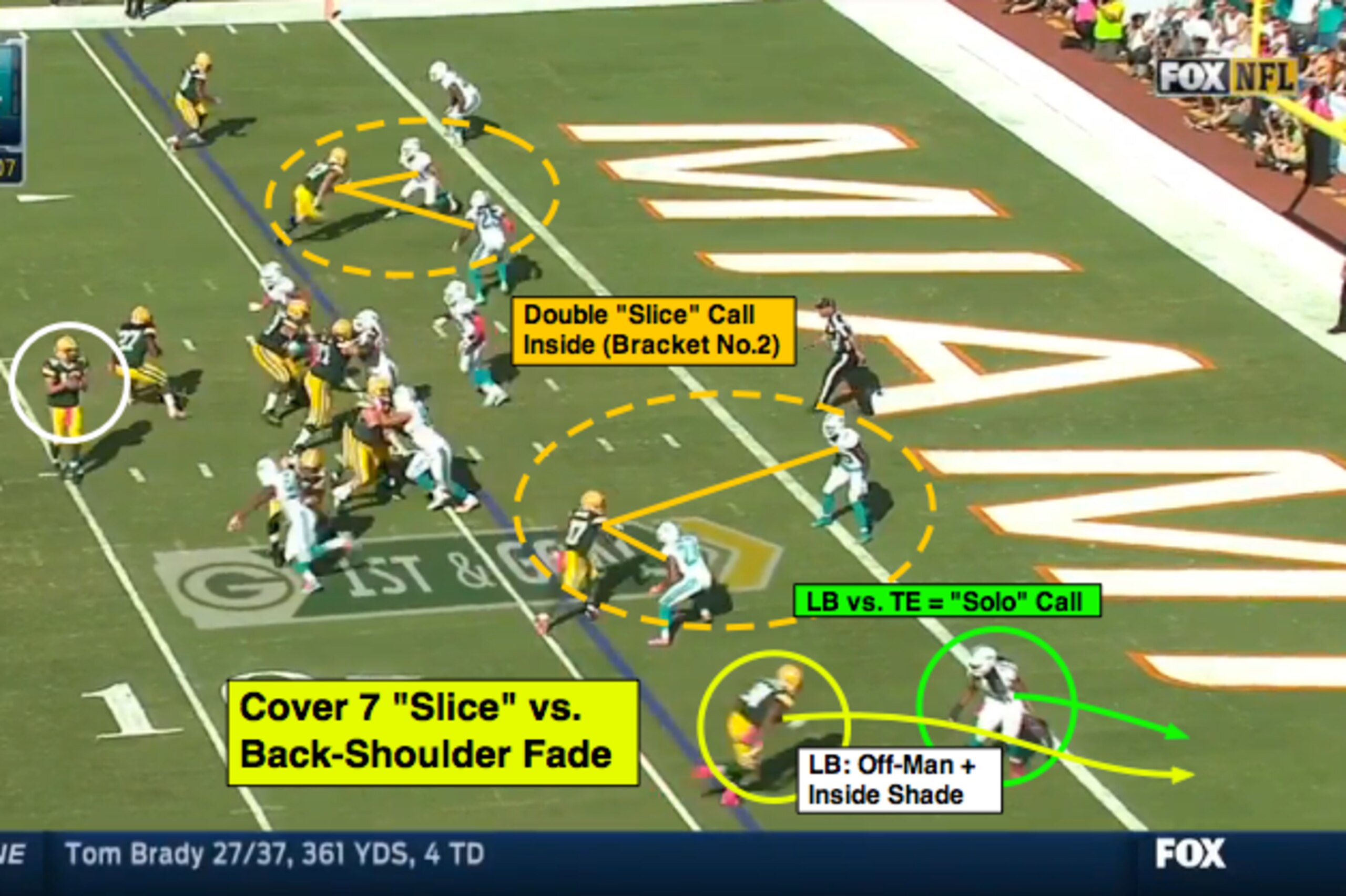
The Dolphins show pressure in their pre-snap alignment, but they drop to a Cover 7 look (combo-man) with both safeties playing a “slice” technique. That allows the Dolphins to bracket the No. 2 (or slot) receivers while taking away the middle-of-the-field route concepts.
However, with both safeties occupied, the Dolphins have to play “solo” coverage outside of the numbers (no help).
That puts Quarless in a true one-on-one matchup versus linebacker Philip Wheeler in a crucial game situation.
With Wheeler playing off (four-yard cushion) and using a heavy inside shade (take away the slant by alignment), Rodgers identifies this matchup as his primary target.
At the snap, Quarless takes a vertical release up the field and then stems outside to play off the initial leverage from Wheeler on the fade route.

Wheeler stacks on top of Quarless to put himself in a position to play the traditional fade. That gives the linebacker an opportunity to create an angle on the throw and find the ball with his eyes back inside to the quarterback.
However, with Wheeler stacking, Rodgers can target the back shoulder of his tight end on the throw.
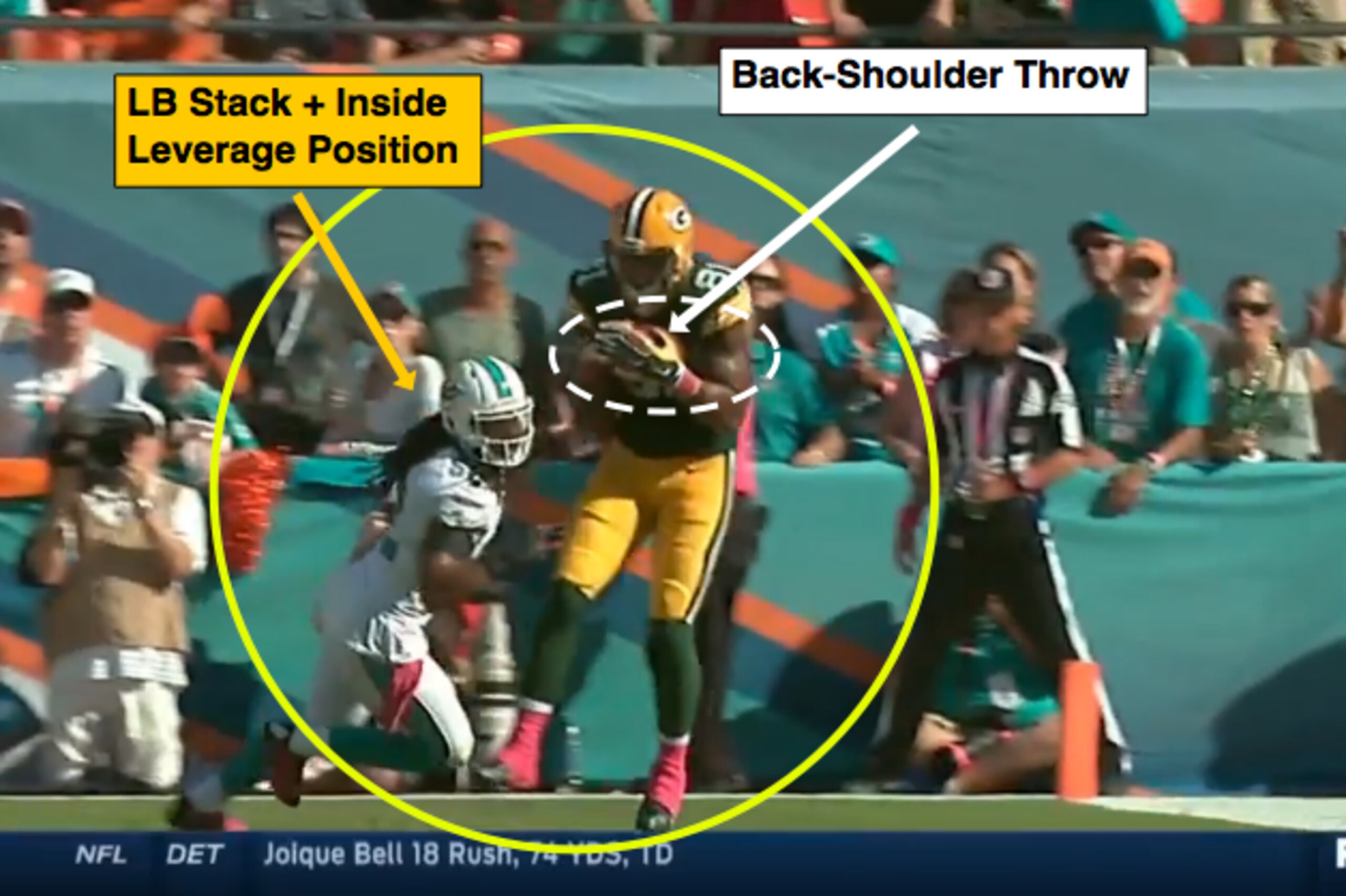
Look at the ball placement from Rodgers. The Packers quarterback puts this throw on the back shoulder of Quarless (away from the defender’s leverage) and gives his tight end an opportunity to finish the play for a touchdown.
I like the coverage call from the Dolphins to use the “slice” technique inside. That takes away the option route, the seam and the 7 (corner) with a defender sitting outside to play the break.
However, when you use bracket calls in the red zone, that means there will be defenders playing “solo” technique. And that created a positive matchup for Rodgers and the Packers.
Brian Hoyer, Jordan Cameron Use Play Action to Expose the Steelers Secondary
The Cleveland Browns and offensive coordinator Kyle Shanahan did an excellent job setting up the Steelers secondary with play action out of their Heavy/13 personnel (1WR-3TE-1TB) to create opportunities down the field for Cameron.
Here’s a look at the Hoyer’s 51-yard touchdown pass to Cameron off the split-zone run action that targeted the top of the Steelers secondary during the Browns' 31-10 win in Cleveland.
Personnel: Heavy/13 (1WR-3TE-1RB)
Formation: Unit Big Wing
Offensive Concept: TE Post (Play Action)
Defensive Scheme: Cover 1
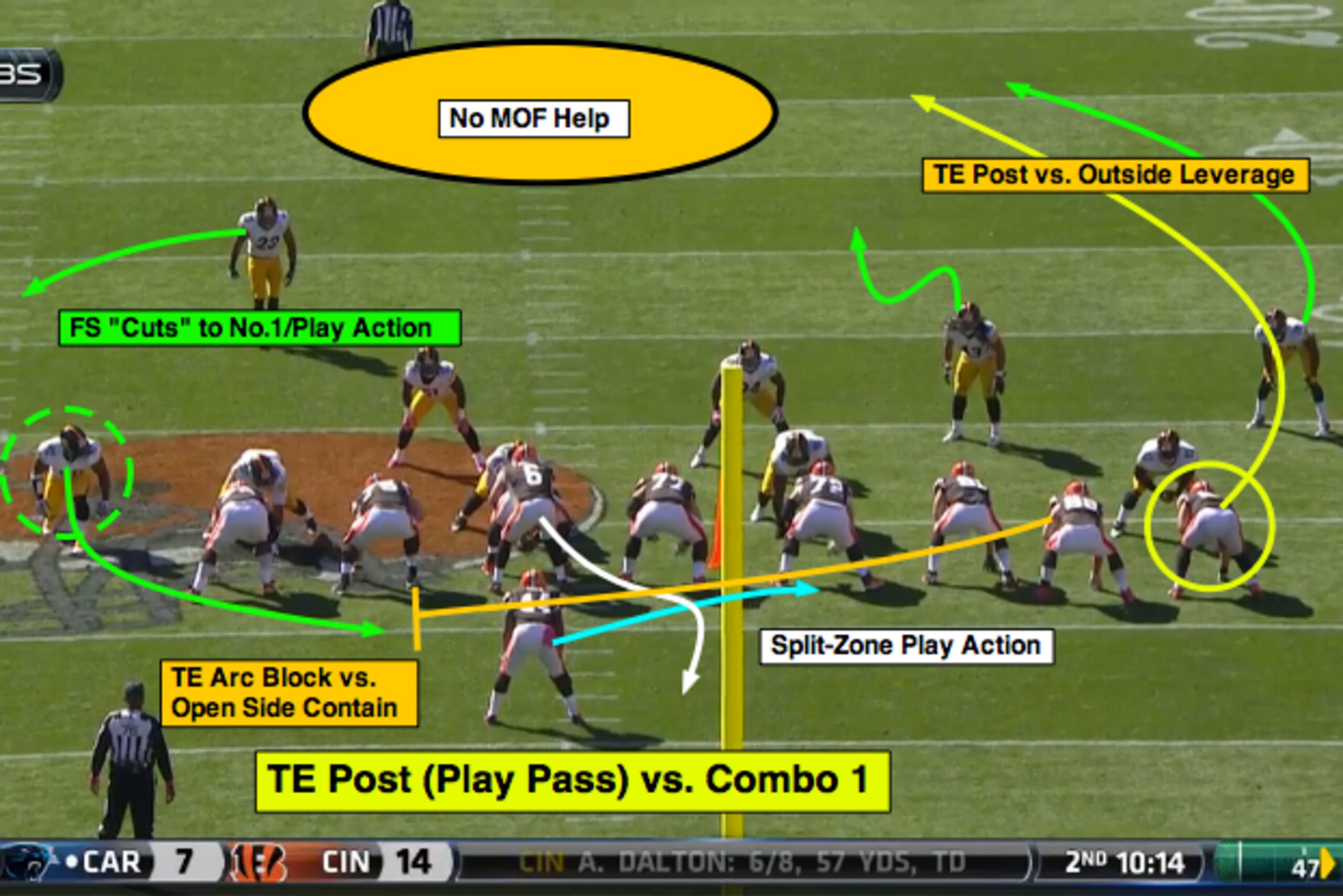
With a "big wing” alignment to the closed side of the formation, the Browns show the split-zone scheme (tight end blocks to open side on arc block) in a 3rd-and-2 situation versus the Steelers' man-coverage defense.
That removes the second-level linebackers, with the free safety cutting the No. 1 receiver (removed from core of the formation) on the inside break.
This opens the middle of the field (no help over the top) and creates a one-on-one matchup for Cameron versus cornerback Cortez Allen playing from an off-man position.
Hoyer shows the ball on the run action and has time for Cameron to release down the field with the arc block securing the open side of the formation versus linebacker James Harrison.

Allen pedals versus the vertical release of Cameron, but plays this head-up through the route stem with tight end pushing up the field.
That forces Allen to weave outside as Cameron eats up the cushion and slows the transition at the break point. This puts Allen in a trail position (low to the outside hip) when Cameron works inside.
And with no help over the top, the tight end can stem this route back to hash marks to give Hoyer a clear target down the field.
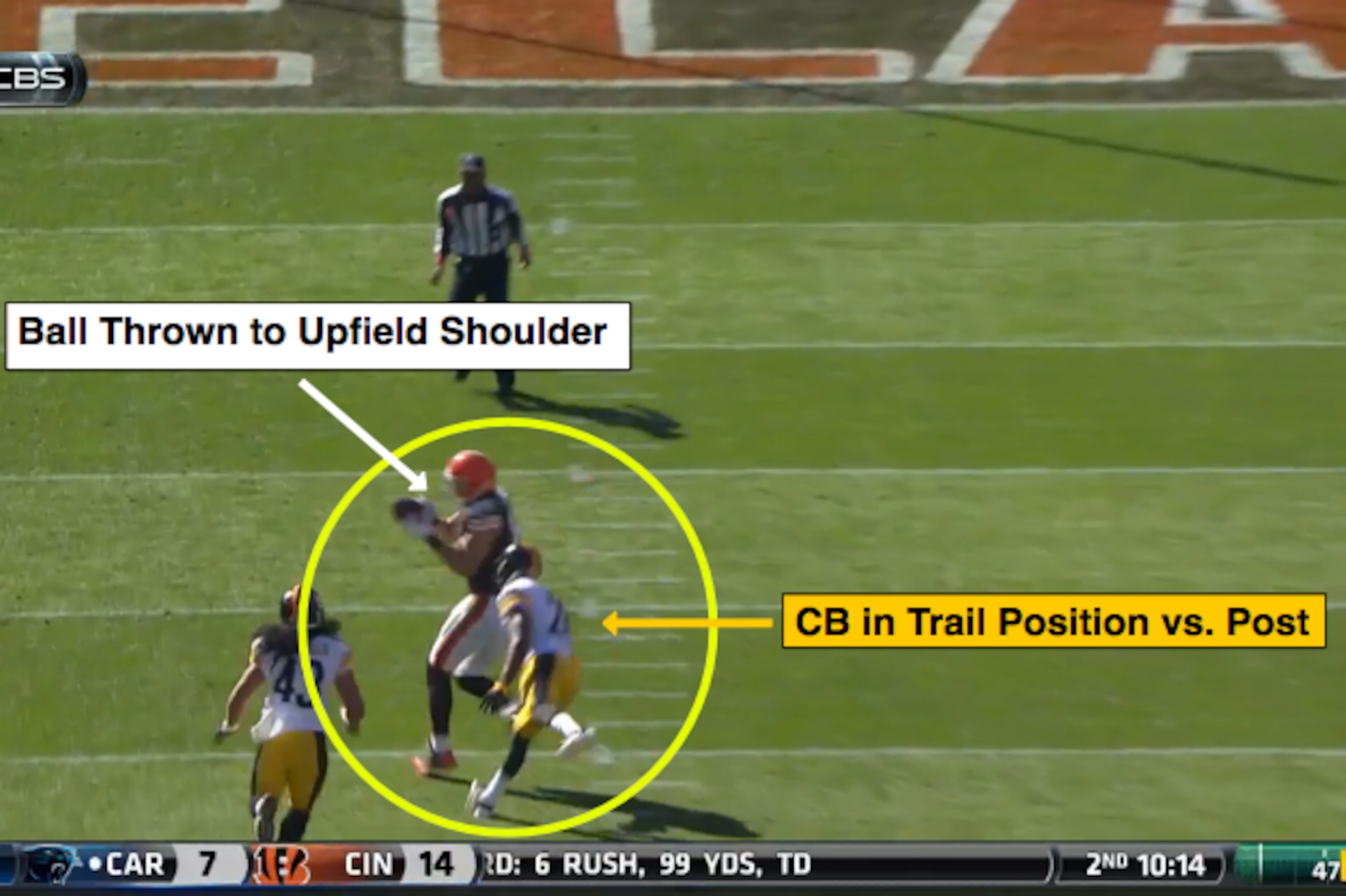
This is a nice ball from Hoyer as the quarterback drops this throw over the upfield shoulder of Cameron (away from the outside-leverage position of the defender) with Allen trailing the play.
The result is a explosive play for the Browns, but it started with the personnel on the field plus the down and distance situation. That presented an opportunity for Hoyer to sell the play action and target his tight end in a one-on-one matchup for the score.
Matt Forte, Bears Execute the Trap Scheme in the Red Zone
Protecting a six-point lead in the fourth quarter, Marc Trestman and the Bears caught the Falcons in a soft run box when they ran the inside trap on a 3rd-and-9 situation to produce a touchdown in the red zone.
Let’s break down the trap scheme and discuss how the Chicago Bears were able to put this ball in the end zone with the Atlanta Falcons dropping seven into coverage versus Posse/11 personnel (3WR-1TE-1RB).
Personnel: Posse/11 (3WR-1TE-1RB)
Formation: Doubles Gun Far
Offensive Concept: Inside Trap
Defensive Scheme: Cover 2 (Tent)

In this situation, the Falcons are only showing a five-man box with the Mike ‘backer deep off the ball, the nickelback sinking before the snap to gain depth in his coverage drop and both safeties removed from the front.
This gives the Bears the opportunity to run the inside-trap scheme with the center blocking down on the nose, the left guard working up to the Mike ‘backer and the right guard (Kyle Long) “trapping” the closed-side defensive tackle to create an inside running lane for Forte.
And because of the extremely soft (or light) run box from the Falcons (with the closed side defensive end removed in a “Wide 9” technique), both the left tackle and tight end can release down the field to block the secondary support.

Here’s the trap block from Long as he washes the defensive tackle up the field, with the center fitting up on the nose and the left guard generating an angle to the Mike ‘backer.
This scheme produces a clean running lane when executed properly versus four-man nickel fronts, as the defensive tackle rushes up the field with the running back getting downhill on the inside handoff.

Because of the “Wide 9” alignment from the closed-side defensive end and the depth the nickelback gets at the snap (drops to the goal line), this plays out like a screen pass for the Bears, with the left tackle and tight end getting down the field.
The left guard accounts for the Mike ‘backer, and Forte makes one cut to accelerate up the field with blockers out in front.
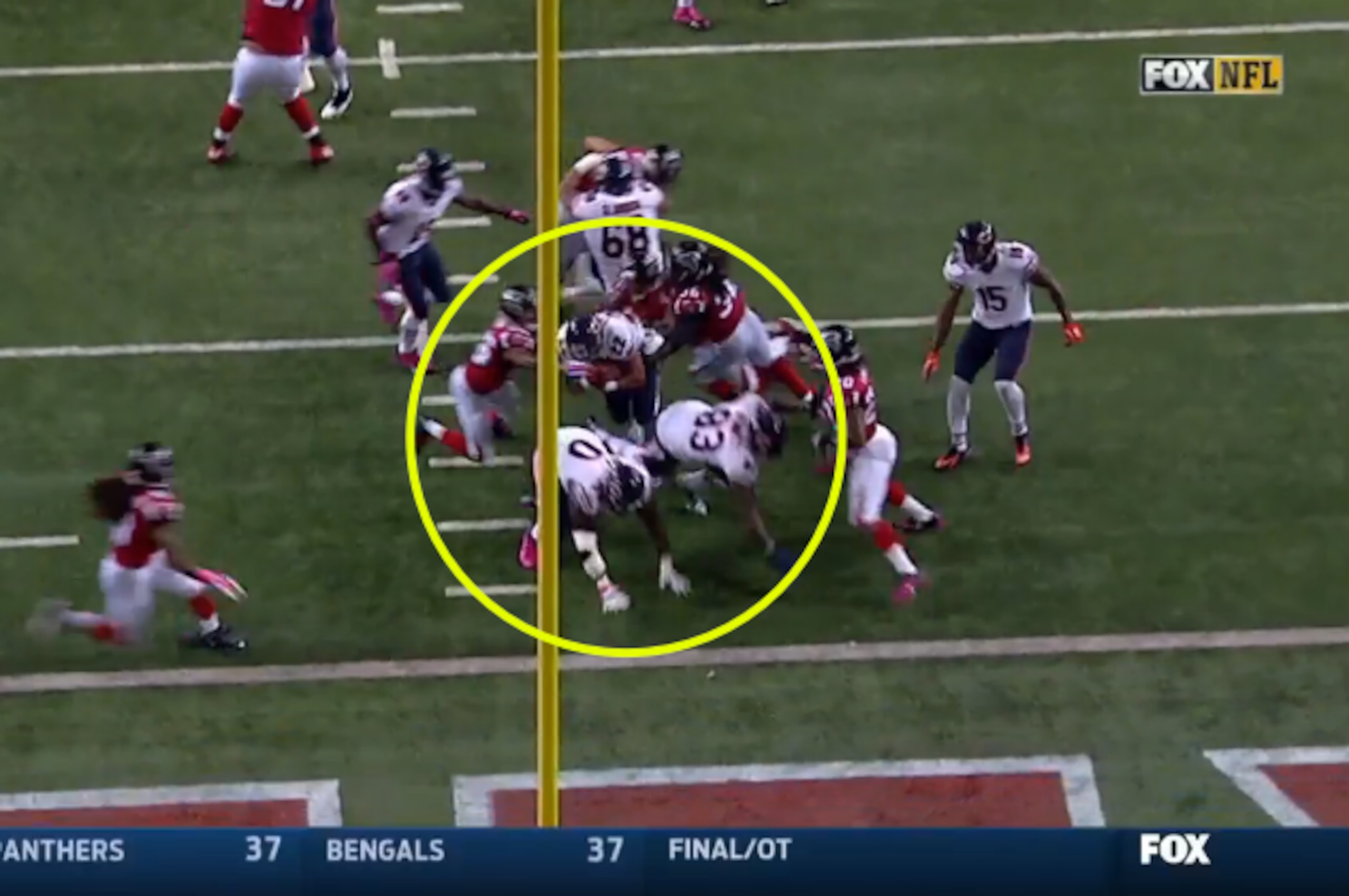
This is a quick look at the finish with Forte dropping his pad level to push through the late support from the Falcons secondary as it reacts to the run.
The nickel run game is productive at the NFL level because it creates a numbers advantage in the box for the offense to run the trap, zone or one-back power.
That’s what we saw here from Trestman’s team when it caught the Falcons in a five-man front to produce a two-score lead on the trap scheme.
Lions Produce a Red-Zone INT vs. Teddy Bridgewater
The Minnesota Vikings' rookie quarterback threw three interceptions on Sunday in the 17-3 loss to the Detroit Lions with his first turnover coming on a route concept that showed his lack of experience in the pro game.
With the Vikings running the “dino” double post versus a single-high safety look, Bridgewater had an opportunity to move the free safety or target the inside post in a classic three-deep beater.
Let’s break down the route and discuss why Lions safety Glover Quin was able to jump this route versus Bridgewater.
Personnel: Ace/12 (2WR-2TE-1RB)
Formation: Pro Slot (Strong I)
Offensive Concept: “Dino” Double Post
Defensive Scheme: Cover 3
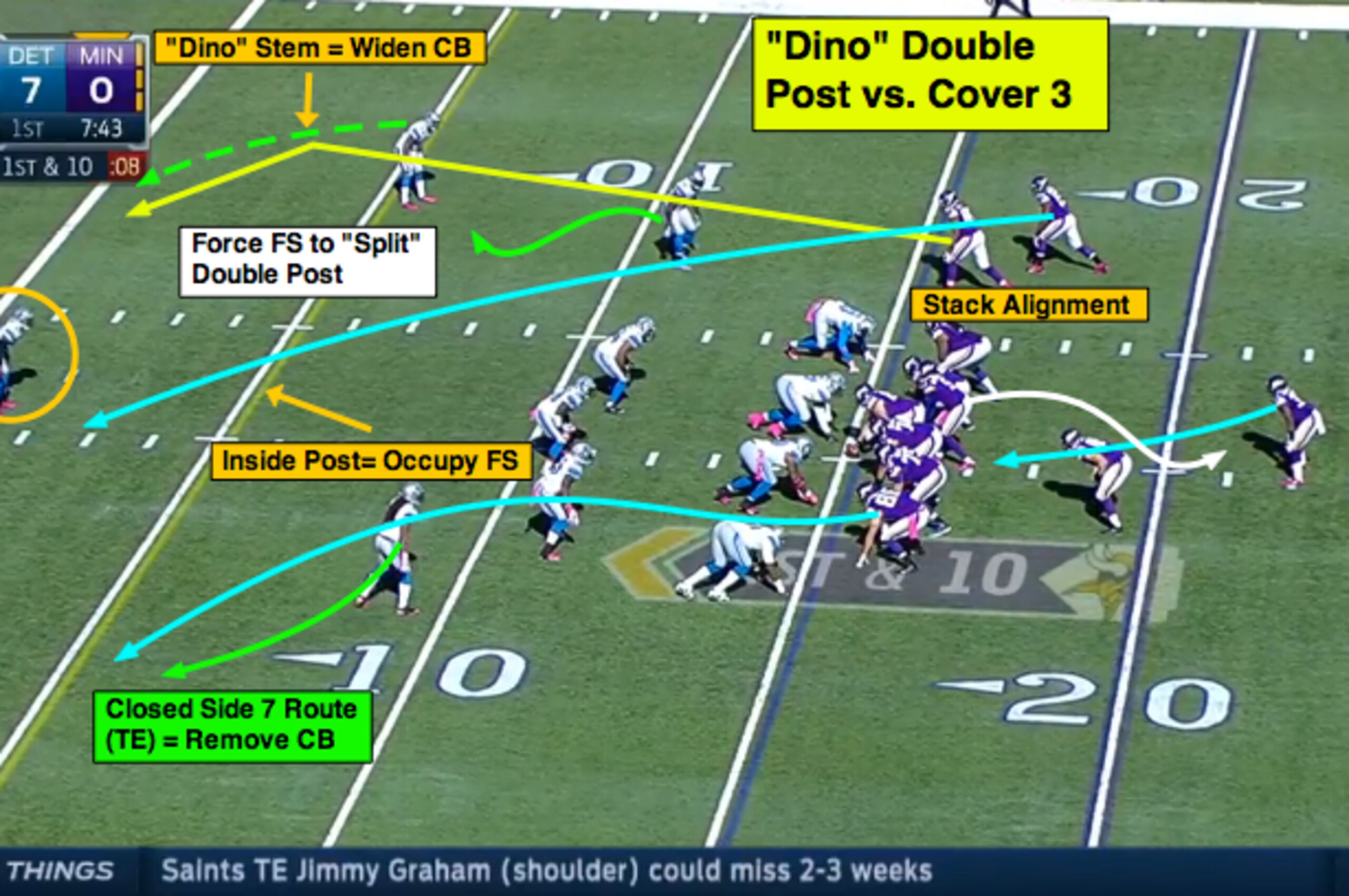
The “dino” double post is a Cover 1/Cover 3 beater inside the red zone, as it widens the cornerback, while forcing the free safety to play two inside breaking concepts.
With Cordarrelle Patterson taking a hard, outside release on the “dino” stem (stem to corner, break back to the post) and Greg Jennings running the inside post, the Vikings can widen the open-side corner while occupying the free safety in the middle of the field.
That would create an opportunity for Bridgewater to target Patterson (separation inside on the “dino’ stem versus outside leverage) with the free safety jumping the underneath post.

This is where Bridgewater gets into trouble as he fails to “move” Quin from the middle of the field.
Instead of looking inside to Jennings on the underneath post, the rookie locks on to Patterson outside on the “dino” stem. That allows the free safety to stay high the middle of the field in a position to drive downhill on the throw.
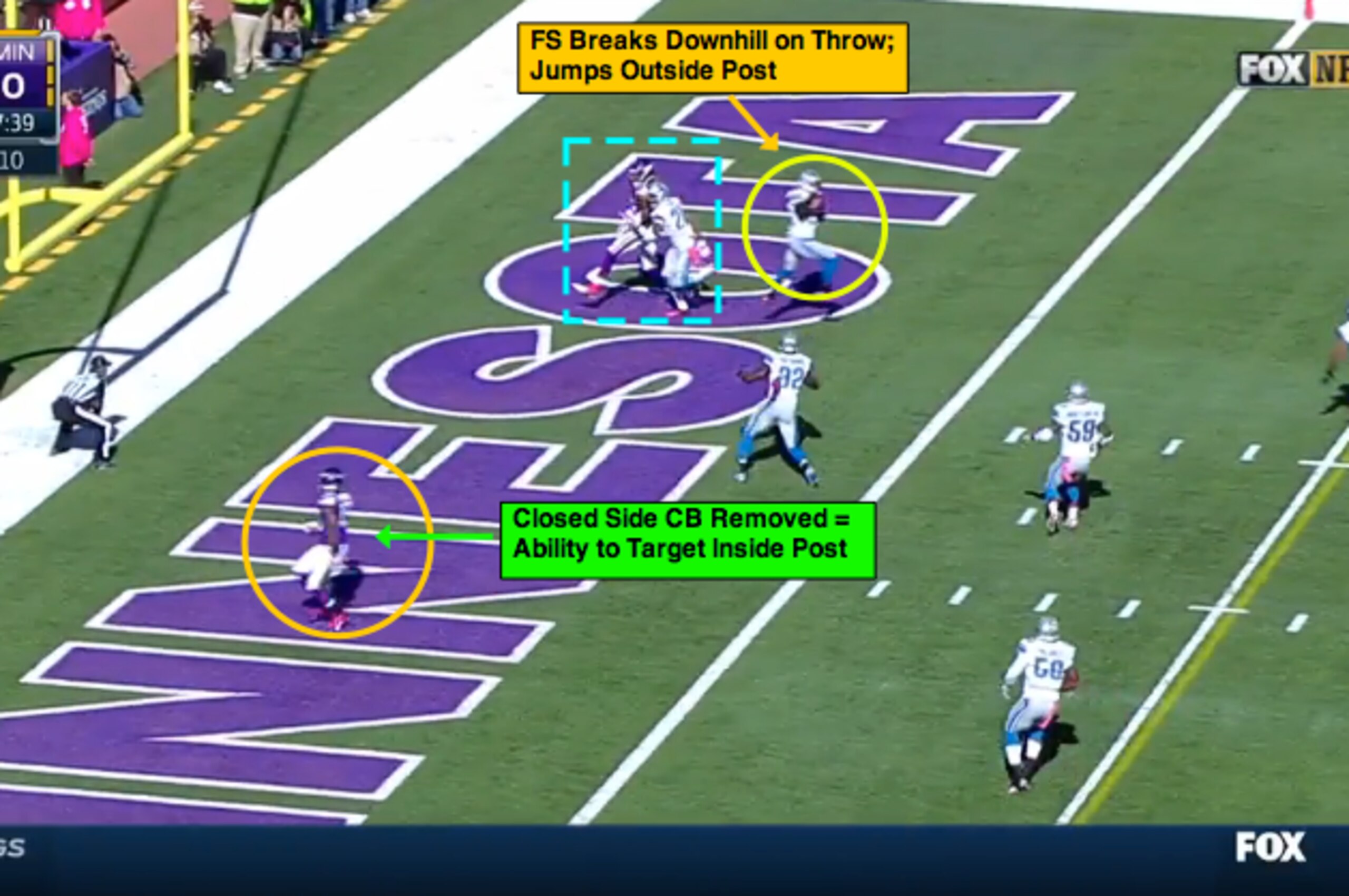
Quin reads the quarterback, breaks on this ball and steps right in front of Patterson to produce the red-zone interception.
As we look closer at this play, Bridgewater had an opportunity to come off his No. 1 read (Patterson) and target Jennings on the inside post with the closed-side cornerback playing over the top of the 7 route from the tight end.
However, because Bridgewater locked on to Patterson at the top of the drop, he brought Quin right to the ball. That’s a rookie mistake (easily correctable), but it cost the Vikings a chance at points on Sunday.
Seven-year NFL veteran Matt Bowen is an NFL National Lead Writer for Bleacher Report.
.jpg?w=2560)