How the Bengals Are Dominating with Average Quarterback Play from Andy Dalton
Two touchdown passes and one interception.
Those are somewhat-typical game statistics for any quarterback in the NFL, win or lose.
In this instance, these are season numbers. They are stats for a player who has started all three games in 2014, with his team coming up a winner each time.


.jpg?w=2560 "Commanders Eagles Football")
Ladies and gentlemen, I give you Cincinnati Bengals fourth-year quarterback Andy Dalton, who has led his team to a 3-0 start for the first time since 2006.
Of course, Dalton has done more than that to date. The Bengals have reached the playoffs each of his three years with the former second-round pick at the helm. Three straight postseason appearances is a franchise record and Marvin Lewis' club is off to a great start in 2014.
In a quarterback-driven league, Dalton has more often driven his fans and observers crazy with his up-and-down play and woeful performances in the playoffs. That’s another matter for another time.
The question here is not how the Bengals are only the lone team in the AFC that has not lost a game to date, but how Lewis and Co. are making it look somewhat easy without a dominating performance from their man behind center.
Let us count the ways.
Defense
Defense has been the calling card of this Cincinnati squad in recent seasons. After three weeks of play this year, things have not changed.
In 2013, the Bengals not only gave up the third-fewest total yards in the NFL; they were the only team in the league to finish ranked in the top five versus the run and the pass.
This season to date, the numbers haven’t been awe-inspiring, but the results have been spectacular. Cincinnati has given up just 33 points and four touchdowns in three games. Defensive coordinator Paul Guenther’s unit has totaled seven sacks while the Bengals have forced seven turnovers, including six interceptions. Defensive ends Carlos Dunlap (3.0) and Wallace Gilberry (1.5) have combined for 4.5 sacks, with the rest coming from free safety Reggie Nelson (1.5) and rookie cornerback Darqueze Dennard (1.0).
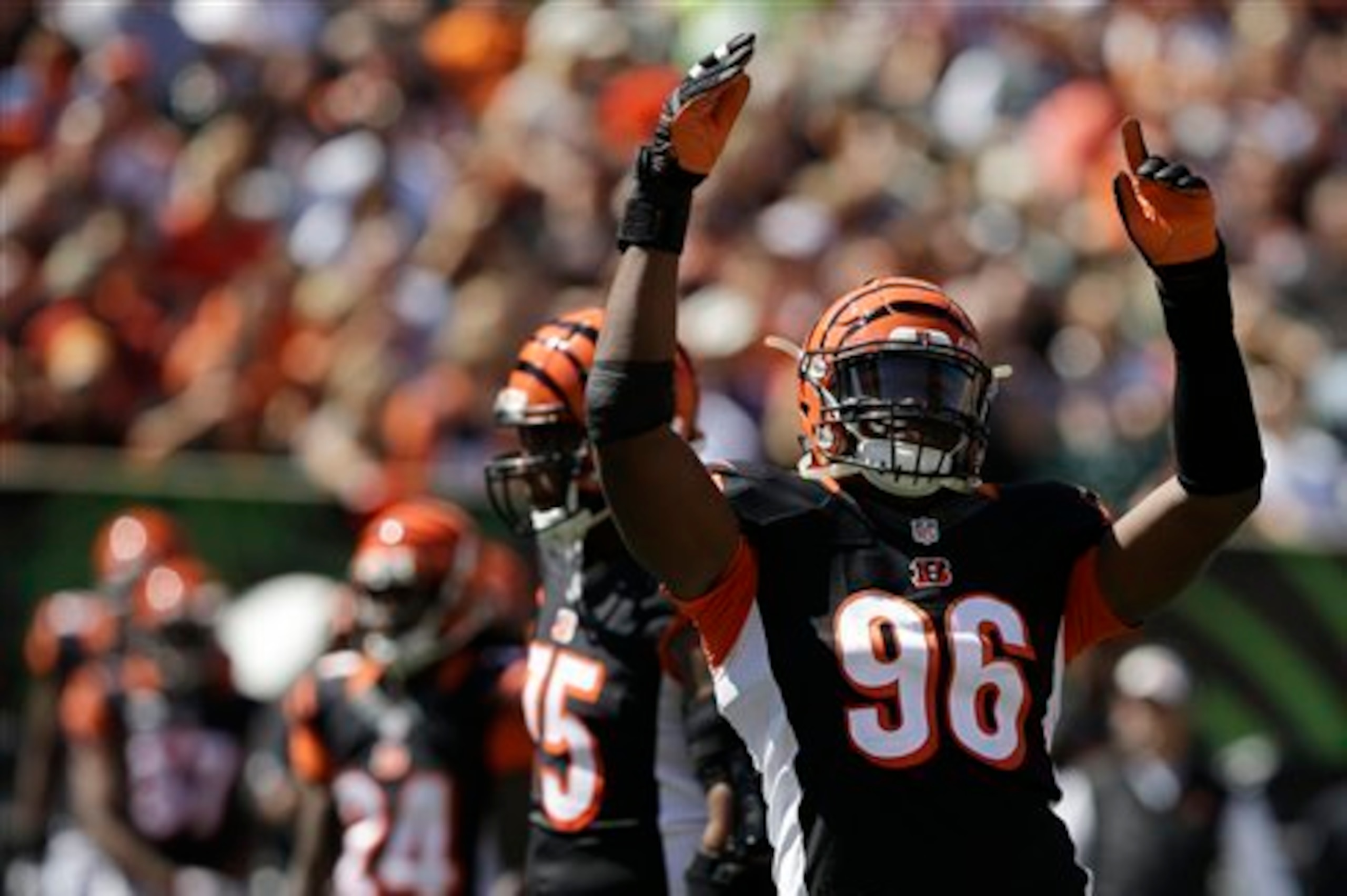
Through three games in 2014, the Bengals are allowing 352.7 yards per contest, up substantially from last season’s performance (305.5 yards per game). However, Lewis’ team has allowed just 10 points and one touchdown in the first three quarters to date.
Balance
How can you not like what you see from this team in terms of attacking the opposition?
New offensive coordinator Hue Jackson is stressing the running game even more in Cincinnati these days. A year ago, led by veteran BenJarvus Green-Ellis and then-rookie Giovani Bernard, the Bengals ranked just 18th in the NFL with only 109.7 yards per game on the ground. The team ran the ball 43.8 percent of the time last season.
In three games with Jackson at the controls, Cincinnati has run 190 offensive plays, 102 of which have been on the ground (a tidy 53.7 percent). The new 1-2 punch in the Queen City of Bernard (185 yards, three touchdowns) and rookie Jeremy Hill (132 yards, two touchdowns) have combined for 317 of the team’s 365 rushing yards and all five of Cincinnati's touchdowns on the ground.

That has certainly made life easier for Dalton, as well as Cincinnati’s talented pass-catching corps of wide receivers A.J. Green and Mohamed Sanu—who, along with Bernard, all lead the team with a dozen receptions—as well as speedy Brandon Tate and tight ends Jermaine Gresham and Tyler Eifert. (Eifert, who dislocated his elbow in Week 1, is currently on the short-term injured reserve list, and won't return until November at the earliest.)
Wide receiver Marvin Jones, who's been sidelined with a broken foot for the first three weeks of the season, will also soon be healthy and back on the field. It’s quite a set of weapons for Dalton to utilize.
Offensive Efficiency
Make no mistake. While Dalton’s touchdown-to-interception numbers are less than inspiring, it’s not like he is playing poorly. He’s completing 65.5 percent of his passes and has thrown for 722 yards in three weeks.
In 2013, the Bengals quarterback connected on 61.9 percent of his throws and threw 33 touchdown passes compared to 20 interceptions. It’s those picks that left Lewis and Dalton's teammates scratching their headsets and helmets, respectively. And Dalton’s passing numbers in three playoff games in three years—one touchdown compared to six interceptions—have been dismal, to say the least.
But look at what we have seen so far in 2014. Cincinnati has scored 80 points and eight touchdowns. Just before halftime on Sunday against the Tennessee Titans, Dalton had a pass deflected and picked off by safety George Wilson. It was not only Dalton’s first interception of 2014, but the team’s only turnover this season to date.
Let’s take it a step further. The Bengals have not only failed to lose a fumble this season, no one on the team has fumbled in three games. In 88 pass plays, Cincinnati has not allowed a sack. This kind of effective performance will win you a lot of football games…and to date, it has.
Conclusion
So where do the Bengals go from here? There’s a long way to go, but a fourth straight playoff appearance is certainly highly realistic. Cincinnati has become a very tough place to play as the team has won its last 11 regular-season home games to date.
And what about Dalton, one of the league’s more maligned quarterbacks despite his successes? Do we need to see more from him in terms of numbers? While he’s thrown for only two scores in three contests, he did catch a touchdown pass in Sunday’s 33-7 win over Tennessee.
But let’s keep something else in mind. A ton of touchdown passes in the regular season doesn’t add up to a Super Bowl title. Just ask Peyton Manning, Tom Brady, Dan Marino or Aaron Rodgers. Only once has a quarterback thrown for at least 40 scores and won the Super Bowl the same season (St. Louis Rams and Kurt Warner in 1999).
So can Andy Dalton lead Cincinnati to its first Super Bowl title five months from now? Winning at least one playoff game is essential to the cause.
While the young signal-caller doesn’t have to carry the team on his back, he just needs to make sure what he’s carrying doesn’t wind up in another team’s hands.
.jpg?w=2560 "Chiefs Dolphins Football")



.jpg?w=2560 "Love's Body Already 'Tired'")