

Breaking Down the NHL's Rule Changes for the 2014-15 Season
The NHL announced a host of rule changes on Thursday ranging from the major (no more spin-o-ramas in shootouts) to the minor (more game-misconduct penalties) to the seemingly big but largely inconsequential (supplemental discipline for diving infractions).
Here's a look at some of the changes and what they will mean in game situations for the upcoming season.
Rule 1.8—Rink—Goalkeeper's Restricted Area
TOP NEWS
3-Way Trade Ideas for Hellebuyck 💡
Mark Scheifele Landing Spots 📍

Ovechkin's Greatest Moments 🎱
"The trapezoid will be expanded by two feet from the goal post on both sides of the net.
"
Translation: The Martin Brodeur Rule that has limited goaltenders from playing the puck has been relaxed a bit, and it's probably not a coincidence that this is happening with Martin Brodeur (probably) heading toward retirement. The obvious change here will be that goaltenders who are excellent at playing the puck (Mike Smith of the Arizona Coyotes is probably the best) will now have more of an opportunity to act as a third defenseman by slowing forechecks and starting breakouts.
The flip side of this change is that goaltenders who are clearly bad at playing the puck (Cory Schneider of the New Jersey Devils is a nightmare in this regard) will have more chances to turn the puck over. Since there are way more goaltenders in the NHL who skew toward the Schneider level of skill in this regard, this has the potential to create a few more goals.
Rule 24—Penalty Shot
"The "spin-o-rama" move, as described in Section 24.2 of the 2013-14 NHL Rule Book, will no longer be permitted either in penalty situations or in the shootout.
"
Translation: The sound you heard this afternoon was the wild cheers of goaltenders throughout the NHL who are no longer subjected to players using the "spin-o-rama" move. Spin-o-rama is in quotes there because what players were using in shootouts wasn't ever a spin-o-rama, while goaltenders sprawled in the wrong direction.
The best part of this move being banned is we don't have to hear the NHL tell everyone that the puck was moving in those situations, even though six pounds of snow was sprayed into a goaltender's face due to the force of the complete stop by the skater.
The playing field is leveled a bit, as only the best of the best were able to pull off this move anyway.
Rule 38—Video Goal Judge
"Video review will be expanded in the following areas:
*Rule 38.4 (viii) has been modified to allow broader discretion to Hockey Operations to assist the referees in determining the legitimacy of all potential goals (e.g., to ensure they are "good hockey goals"). The revised Rule will allow Hockey Operations to correct a broader array of situations where video review clearly establishes that a "goal" or "no goal" call on the ice has been made in error. The new expanded rule will also allow Hockey Operations to provide guidance to referees on goal and potential goal plays where the referee has blown his whistle (or intended to blow his whistle) after having lost sight of the puck.
*In reviewing "Kicked in Goals," Hockey Operations will require more demonstrable video evidence of a "distinct kicking motion" in order to overrule a "goal" call on the ice or to uphold a "no goal" call on the ice.
"
Translation: These changes will help, but they will very likely fail to alleviate frustration from missed calls. Hockey ops will have more leeway to fix blown calls on the ice due to referees losing sight of pucks on plays that lead to goals that would have been scored anyway. In other words, referees intending to blow their whistles should no longer be an excuse for goals being disallowed.
It's unclear how the league will react to goals where the whistle blows before a goal is scored, but nothing will probably change there. In the NFL, if there is a fumble and a clear recovery by the opposing team, the fact a whistle blew during the course of the recovery doesn't matter; possession still changes. In the NHL, if a goal is scored in a similar manner, where players are still reacting to seeing the puck the referees do not see, it doesn't sound like that will be a goal in 2014-15.
As for the "distinct kicking motion" segment of the rule changes, requiring more evidence to overturn calls on the ice seems like a bad idea. Each distinct-kicking-motion situation seems to have its own interpretation, which is the real problem with the rule. Until the league gets on board with all pucks off skates counting as goals, there will be always be a problem.
Rule 64—Diving/Embellishment
"The supplementary discipline penalties associated with Rule 64.3 (Diving/Embellishment) will be revised to bring attention to and more seriously penalize players (and teams) who repeatedly dive and embellish in an attempt to draw penalties. Fines will be assessed to players and head coaches on a graduated scale outlined below.
"
| 1 | Warning | N/A |
| 2 | $2,000 | N/A |
| 3 | $3,000 | N/A |
| 4 | $4,000 | $2,000 |
| 5 | $5,000 | $3,000 |
| 6 | $5,000 | $4,000 |
| 7 | $5,000 | $5,000 |
| 8 | $5,000 | $5,000 |
Translation: This will prevent nothing. It's all about risk/reward when it comes to diving. Players making truckloads of money won't be deterred by $2,000 or $3,000 or $4,000 or $5,000 fines. Coaches certainly aren't worried about a $2,000 fine if one of their players is punished for diving a fourth time. Four times! Maybe that affects two coaches this season, tops. And the first infraction is a freebie? Come on.
Until the league gains the power to dish out larger fines or begins suspending chronic divers, nothing will change.
Rule 76—Faceoffs
"To curb delay tactics on faceoffs after icing infractions, in situations where the defending team is guilty of a faceoff violation, following an icing, the defending player who is initially lined up for the faceoff will be given a warning, but will be required to remain in the circle to take the faceoff. A second faceoff violation by the defending team in such situation will result in a two-minute minor bench penalty.
"
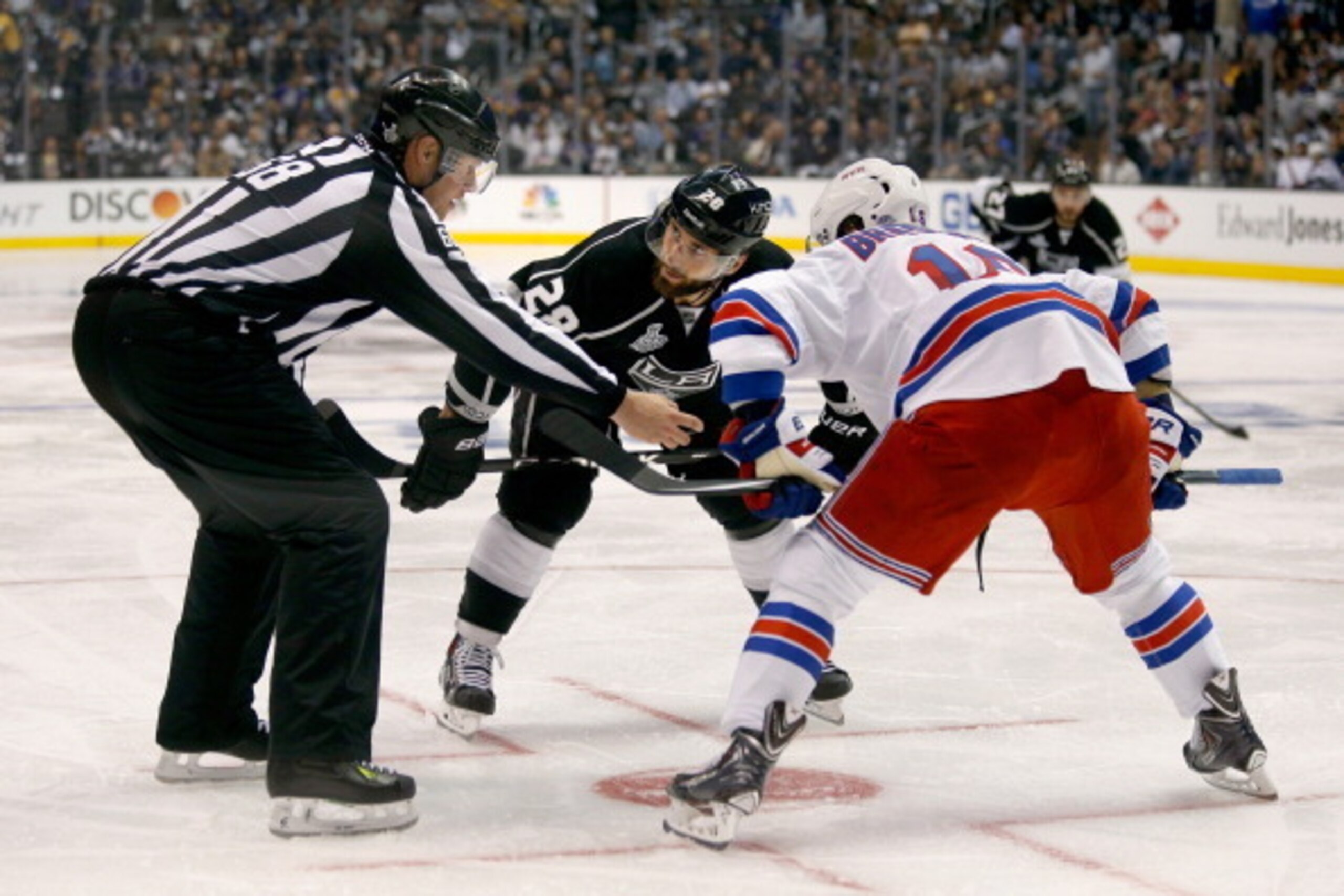
Translation: Teams figured out a long time ago that after an icing, with tired players on the ice, the best move to buy some breathing time is to send a stiff into the faceoff circle so he can get tossed. That's no longer an option, as the stiff has to stay at the dot and take the draw, and if he futzes around again it's a two-minute penalty.
This new rule is a little silly, as teams will still stall, only they will do it with the player who should be taking a draw. He will simply line up, commit an infraction, get warned, argue about it, then take the faceoff on the second try. It's the smallest of improvements over the current situation.
Rule 84—Overtime
"*Teams will switch ends prior to the start of overtime in the regular season.
*The entire ice surface will undergo a "dry scrape" prior to the start of overtime in the regular season.
*The procedure requiring the head coach to submit a list of the first three shooters in the shootout has been eliminated.
"
Translation: The dry scrape is great, and I'm sure coaches are ecstatic about no longer having to partake in the immense chore that is writing three names on a piece of paper, but it's the fact that teams will now switch ends to start overtime that is oh so wonderful.
More goals are scored during the second periods of games, as teams have switched ends and have a longer distance to travel in order to change. It leaves teams more vulnerable to well-timed counterattacks and will lead to more overtime goals and fewer shootouts, the worst thing the NHL has unleashed on mankind besides The Guardian Project.
In lieu of finding a specific goal that highlights this scenario, watch a bunch of playoff overtime goals from last season.
The NHL is banking on a lot of small changes to result in more offense, and these tweaks should produce the desired effect.
Dave Lozo covers the NHL for Bleacher Report. You can follow him on Twitter: @DaveLozo.


.jpg?w=2560 "Grading WWE Raw 🔠")
.jpg?w=2560 "Viral Rams Coach Vid 🖕")
.jpg?w=2560 "Injury-stricken Seahawks signing veteran RB")

.jpg?w=2560 "2 NFL Officials Suspended")

.jpg?w=2560 "Mahomes' Wife Trolls Kubiak 💀")
