

Social Media's Role in Making NASCAR's Changes for 2014
NASCAR fans have been at the forefront of the rush to embrace the use of online social platforms. So much so, that it has become a significant avenue of communication between themselves and the sport. For most fans, it simply means exchanging messages directly with drivers, which up until now was nearly impossible, except at special events. It also gives fans a way to talk to NASCAR directly, and they in turn can respond.
Feedback through social media and from the sport’s Fan Council has been instrumental as a catalyst for changes in the sport, including the changes to the Chase and qualifying format announced this year.

As a regular reader of Bleacher Report, it’s likely that you are a regular user of social platforms such as Twitter, Facebook, Instagram, Google+, Pinterest, Tumblr, Flickr, or Myspace. Why are these sites so popular? They satisfy two basic human needs: to meet new people and to strengthen existing relationships.
In the past five years, NASCAR’s social media outreach has done both. NASCAR fans across the country and around the world have discovered that they have a way with which to interact with one another on race weekends and beyond. Eventually, that interaction with one another became interaction with NASCAR itself.
Everything changed at the 2012 Daytona 500. Team Penske’s Brad Keselowski had tweeted photographs of a burning jet dryer during the lengthy red flag stoppage of the race (it gained Keselowski over 100,000 new followers within hours) and it helped catapult NASCAR’s social media footprint into national prominence.
Sean Doherty, NASCAR’s director of digital and social media engagement, acknowledges their success, but believes they’ve just scratched the surface in terms of fan involvement with the sport.
“We have seen engagement levels increase over time, as well as our total audience,” said Doherty, “so we believe we’re making progress, but there are still a lot of fans who are not active on various social platforms and a lot of potential fans who aren’t yet interacting with us.”
Of all the social media platforms NASCAR’s fans use, it’s easy to see why Twitter has emerged as the vehicle of choice. Its 140-word text messaging format appears to work best when there’s a need to establish a real-time dialog between fan and driver or fan and NASCAR or between fan and fan. Alternatives like Facebook or Google+ are both used but not to the extent of Twitter.

“They all work, but in different ways,” continued Doherty. “There is no question that each social platform has its defining characteristics, and we put significant emphasis on treating each platform as unique.
“For instance, we feel that Twitter is a medium that’s very in the moment, so we post much more frequently to that platform than others. Content on Instagram, on the other hand, has a longer “shelf life.”
Last year Twitter partnered with NASCAR to offer a “one-stop shop” for information, using the URL http://twitter.com/#nascar.
On race day, Twitter is the place to be for a NASCAR fan. Everyone involved with the event, from drivers to crew chiefs, spotters, media and fans at the track, offers a nonstop stream of information—much of it not available elsewhere.
On race day, the center of NASCAR’s social media universe is the Fan and Media Engagement Center (FMEC) at its offices in Charlotte, N.C. Originally the brainchild of NASCAR chairman Brian France, it was envisioned as a control-room-like facility that could track online social media activity and trends. It was built last year in cooperation with Hewlett-Packard using their latest in high-tech gear.
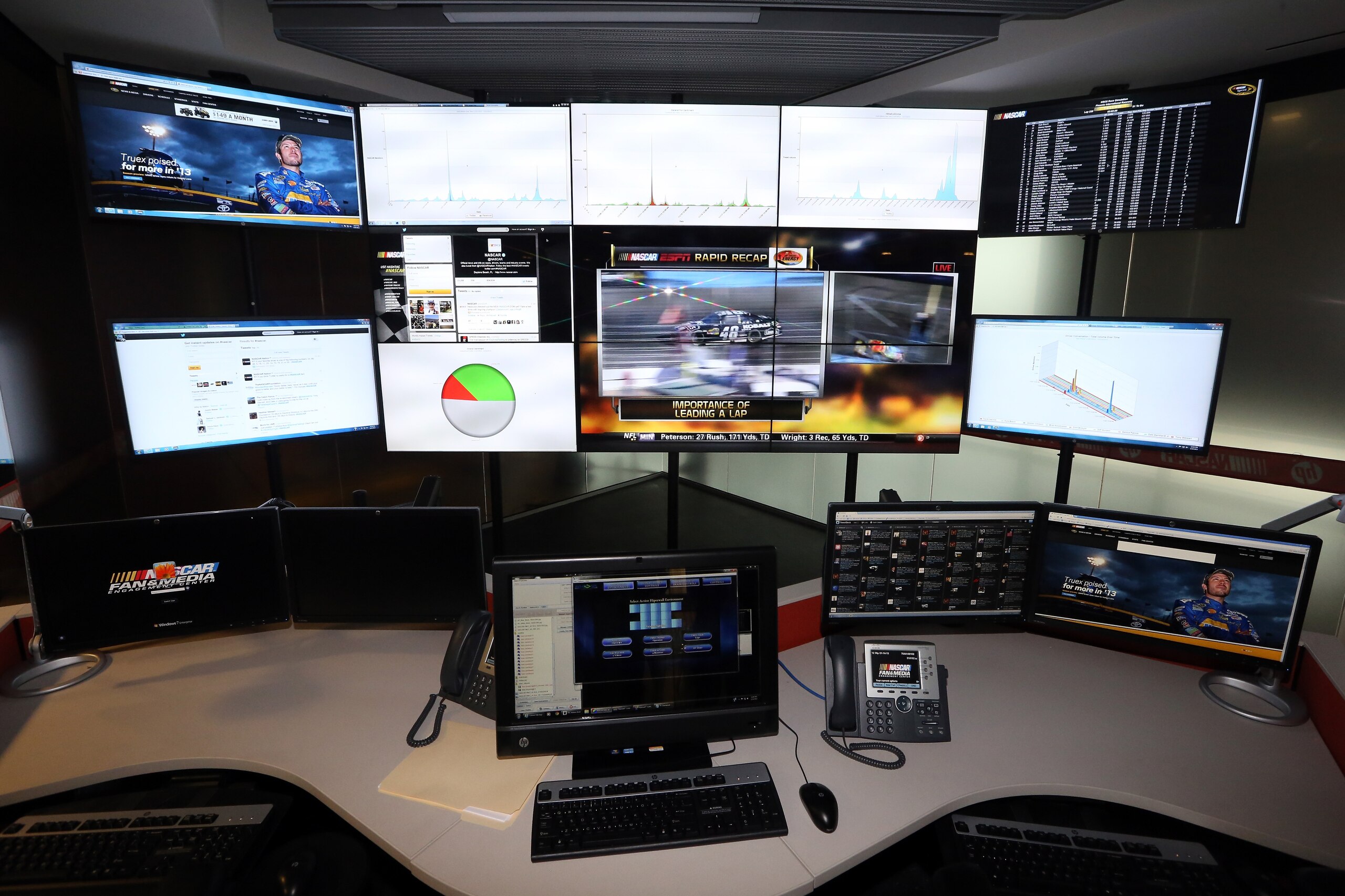
The FMEC follows true to France’s wishes. It is specifically designed to track and analyze trending topics during the week. On race day, it is plugged into every social media site, gauging fan interest on every topic imaginable before, during and after the race. It is also an important asset for sponsors who can use it at any time to analyze the impact of their investment in both the sport and the team that they are partnering with. Teams use the FMEC, too.
NASCAR’s Doherty says new platforms and applications are always being introduced and his group at NASCAR is commissioned to stay ahead of the curve in developments in the social space. Doherty says in the not-too-distant future he sees social media becoming a vital interactive component of the television broadcast.
“Social media is a key means of how people connect and communicate with each other around TV programming,” he said, “and there is a direct correlation between social media conversation and people watching your programs.”
The addition of Dale Earnhardt Jr. to Twitter (@DaleJr), means that the sport’s most popular driver is now just a mouse click away for his enormous fan base. It is obviously an immeasurable plus for NASCAR social media. In a little more than a week, Junior gained more than half a million followers.
“Clearly, having the sport’s 11-time most popular driver on Twitter has been great for the sport,” said NASCAR’s Doherty. “He has done an incredible job right from the beginning of embracing what makes Twitter so popular with our fans—he’s sharing behind-the-scenes photos, engaging with other drivers and answering fan questions on a regular basis.”
A direct line of communication between drivers and fans has proven to have its downside, as well. Brad Keselowski and Denny Hamlin were hit with sanctions after comments they made on Twitter were deemed detrimental to the sport by NASCAR officials. These penalties, along with making each driver’s wallet a bit lighter, served to set boundaries for the rest of the Cup garage as to what could and should not be discussed on a forum like Twitter.
“Our drivers, in particular, do a wonderful job on Twitter—they’re constantly responding to fans, sharing unique photos and, generally, just having a blast,” said Doherty. “It’s fun to watch. [And] they all know the parameters for engagement.”
While Twitter is preferred by fans, the platform offered by Facebook is better suited for sponsors and drivers. It’s full-page layout is ideal when the presentation landscape requires a graphic layout and more text than 140 characters. Race tracks also find Facebook’s design offers a wider array of options for communicating with fans.
NASCAR treats each platform differently. While they find that similar content performs well on each platform, NASCAR’s Doherty says he wants the fans who follow the sport to feel that they’re seeing things a little bit differently on one site than they might see elsewhere.
“Very rarely will you see the same content across each one of our platforms—we’ll share a different photo on Twitter versus the one we share on Instagram or Facebook,” he added.
NASCAR isn’t alone in the development and activation of a successful social media platform. But, in doing so, it has pulled back the curtain on its operations, much of which before now had remained generally out of the public’s eye. But even more importantly, it’s helped to make a stronger connection between the fans and its drivers, something that helps make the sport grow.
NASCAR knows more now about its fans and what they want from the sport than ever before, all because of the increased integration of social media into the sport.
“We’re focused on increasing direct one-to-one engagement with our fans across platforms, keeping tabs on real-time trends to communicate with our industry partners, and creating social engagement campaigns that give our fans unique opportunities to participate and have fun during the course of the season,” said Doherty.
What started out as a plan to engage and entertain existing fans using social media has evolved into something that has helped to change the sport.
And it’s attracting a whole new legion of social media savvy fans.
*Unless otherwise noted, all quotes were obtained first-hand.
.jpg?w=2560 "Commanders OL HEATED After Tie ▶️")
.jpg?w=2560 "WWE Raw Live Grades 🔠")
.jpg?w=2560 "49ers LB Suspended for Headbutt")
.jpg?w=2560 "Harbaugh's Jameis Comps 🤨")