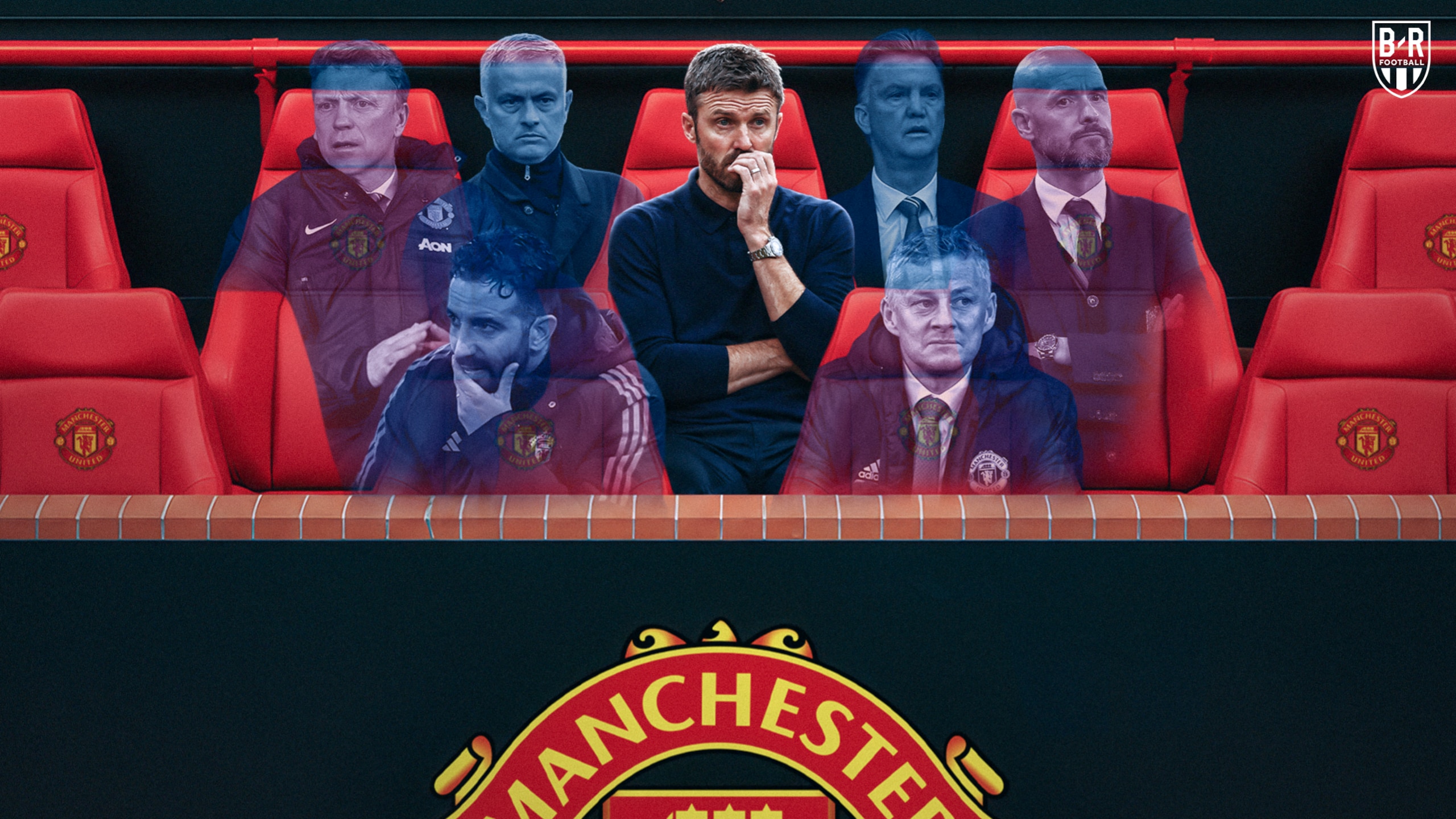
Where Does Wayne Rooney Stand in Terms of Manchester United Greats?
On the evening of May 13, 2010, all was well in Wayne Rooney’s world as he sat on the top table at the annual football writers’ Footballer of the Year dinner in front of a room of over 700 people.
Rooney had just completed the finest season of his career so far, fulfilling all the promise he had shown as a teenager by scoring a record 34 goals and proving Manchester United were now his side.
His fellow professionals had already anointed him their Player of the Year, he had swept the board at United’s own awards night, and now he was at the Royal Lancaster Hotel in the centre of London to accept the Footballer of the Year trophy, which he had won by one of the largest margins in the award’s 62-year history.

On the four walls of the vast banqueting room hang the pictures of the former winners of the most prestigious individual award in English football, including Sir Stanley Matthews, George Best, Bobby Charlton, Bobby Moore, Thierry Henry and Cristiano Ronaldo.
Rooney was in a relaxed mood, his natural guard lowered slightly, he was amongst colleagues and admirers, and in his acceptance speech he spoke fluidly and graciously, prompting those in the room to speak in hushed tones about his new stature and maturity.
In just three weeks' time, Rooney would leave with the rest of the England squad for the World Cup finals in South Africa carrying the expectations of a cautiously optimistic nation on his shoulders.
Back in 2010 it seemed perfectly credible to class Rooney alongside Lionel Messi and Cristiano Ronaldo as one of the best players in the world. He appeared to belong in their company.
In the month before the tournament, Rooney’s sponsors, Nike, ran an advertising campaign that offered a glimpse of his future. The ad showed the England striker lifting the World Cup and being knighted by the Queen, and entire hospital wards of babies being named after him.
At the time, it didn’t seem so outlandish. Boasting one of the world’s best players in the form of his life, and guided by one of the game’s greatest managers in Fabio Capello, England felt they might be on the verge of winning their first World Cup since 1966.
Of course, it didn’t quite work out like that. England were embarrassingly bad, and Rooney was anonymous.
Those heady award-laden days of 2010 would ultimately prove to be the high point of Rooney’s career so far.
In the three years since, Rooney has scored plenty more goals and won two more Premier League titles, but he has never recaptured the individual form he showed back then.
As confusion reigns about his future at Old Trafford this summer, where does he now stand as a Manchester United great?
In 2011 when I was compiling my book Manchester United’s Best XI, an all-time team selected from the club’s entire history, I opted for a forward line of Eric Cantona and Denis Law.
I fleetingly considered the merits of both Wayne Rooney and Ruud van Nistelrooy up front, but decided the records and aura of Cantona and Law comfortably trumped them both.
On pure statistics Rooney has earned his status as a United great.
Since arriving at the start of the 2004-05 season, Rooney has scored 197 goals in 360 games, and he's won five Premier League titles, two League Cups, one Champions League and one club World Cup.
Rooney is currently fourth in the list of all-time scorers in all competitions for United with those 197 goals, behind Jack Rowley, Denis Law and Bobby Charlton, who is top with 249 goals.
Rooney turns 28 in October, and so has more than enough time to surpass Charlton as United’s all-time leading goal scorer.
"“[Sir Bobby Charlton] is a legend and is such a presence around the club,” Wayne Rooney told Shortlist last year. “If I could break his record as Manchester United’s top goalscorer and maybe even England’s… wow! That is such a great incentive.”
"
But will Rooney remain at Old Trafford to break this record, and will United fans celebrate him as one of the club’s greats?
United fans have never felt the same way about Rooney since October 2010, when he told the club he wanted to leave and issued a statement that openly questioned their ambition.
This was a huge mistake, which changed the way United fans felt about him. He had previously been hailed as a noble figure in a sullied age, a throwback, only interested in the glory of football.
Sir Alex Ferguson had previously called Rooney in The Guardian, “a one-off in terms of the modern type of fragile player we’re getting today, cocooned by their agents, mothers and fathers, psychologists, welfare officers. Rooney’s a cut to the old days.”
But the former United manager’s words were made to look hollow as Rooney proved to be a very modern animal.
His public questioning of his manager and team-mates was a spectacularly ill-conceived move.
While Rooney had been raised as an Evertonian, United fans had come to believe he was now one of them, worthy of being hailed alongside George Best, Eric Cantona, Bryan Robson and Ryan Giggs. But to many United fans, this was now unforgivable.
Rooney would change his mind as Ferguson deftly guided him back to the negotiating table, persuading him to sign a new five-year contract to make him the best-paid player in the history of the club.
But Rooney had damaged his reputation, and once loved by United fans, there was now a cooling in the relationship.
He knew it too and told the BBC: “I am sure the fans have felt let down by what they have read and seen…it’s up to me through my performances to win them over again.”
Up to a point, he did win most of them back by helping to win another two Premier League titles.
But the revelation from Sir Alex Ferguson, as reported by the BBC, that Rooney had again asked to leave the club at the end of last season has dealt further damage to his status as a Manchester United great.
As reported in the Daily Mirror, at the parade to celebrate United’s Premier League title triumph in May this year some fans even booed a sheepish-looking Rooney on the open-top bus.
Rooney had endured an indifferent season, forced to play in the shadow of the rampant Robin van Persie, Ferguson substituted him 10 times during the season and famously omitted him from his starting lineup to face Real Madrid in the Champions League at Old Trafford.
United fans can tolerate dips in form, but asking to leave the club twice in two and a half years is not as easy to overlook.
There can be little doubt Rooney deserves to be hailed as a United great for all he has produced on the pitch these last nine years, but by agitating for these moves away from the club, and certainly if he leaves this summer, he may not be remembered as fondly as he might have been.

.jpg?w=2560)
.png?w=2560 "Allen's BRUTAL 1H Stats 🫤")
.jpg?w=2560 "Monday Night Raw Blog 🔴")