
Armchair Quarterbacking Baseball America's Top 20 Prospects
For example, one of the few prospects the Yankees have on the list is 23-year old pitcher Andrew Brackman, ranked No. 92. His key number?
"0: Number of official professional innings he has pitched since signing with the Yankees in 2007."
TOP NEWS

Bold MLB Predictions For 2026-27 Offseason 🔮
MLB Testing Fielding Rule 🤔

Best Free-Agent Hitters 💥
No. 1 Matt Wieters Catcher, Baltimore Orioles
1.054: His on-base plus slugging percentage in 2008 between two minor league levels.
Opening Day Age: 22
ETA: 2009
Wieters looks every bit like the real deal, a player with so much talent that even the inept Baltimore organization cannot screw him up. He hit .355 with power and patience at two levels last year, with more walks than strikeouts. He'll start the year in AAA, which is a big jump from high A and AA, where he spent 2008.
The Orioles' likely catching corps includes some combination of Greg Zaun and Chad Moeller, aged 37 and 34, respectively, who both hit in the .230's last season, and aren't likely to improve on that much. They've also got a bunch of younger guys—some only slightly younger—who can't hit either, so it's just a matter of time before Wieters gets a shot.
No. 2 David Price LHP, Tampa Bay Rays
109: Strikeouts, in 110 minor league innings, between three levels last season.
Opening Day Age: 23
ETA: 2009
Price has also struck out 20 batters in 19.2 innings at the major league level, including eight whiffs in 5.2 innings in the playoffs. He's a 6'6" lefty who throws a sharp slider, a cutter, and a fastball that hovers between 92 and 96 mph. He's expected to replace Edwin Jackson in the rotation, and though there will be some growing pains as he learns to pitch to major league hitters, he should be very, very good.

No. 3 Colby Rasmus OF, St. Louis Cardinals
2005: Year he led Russell County High to Alabama and national championships, when he also was a first-round pick.
Opening Day Age: 22
ETA: 2009
Wow, a high school national champion three years ago? That sure told us a lot, huh? Rasmus is a toolsy outfield prospect who has shown tremendous power potential (29 homers as a 20-year old in AA in 2007, for example) but who struggled a bit last year upon a promotion to AAA. He still walked at the same rate, which is encouraging. However, his homers and doubles dropped to about half their previous rate, despite the fact that power comes cheap in the Pacific Coast League.
In any case, as one of the youngest players in a league of seasoned veterans trying to get back to the Show, he didn't embarrass himself. The Cards will want him to prove himself in AAA before giving him a call up to the majors, I presume, but with Tony LaRussa's penchant for utility players and his leeriness of youngsters, Colby's best bet will be to either learn to play multiple positions or to invest in a fake mustache.

No. 4 Tommy Hanson RHP, Atlanta Braves
49: Strikeouts in just 29 innings in the Arizona Fall League, when he became the first pitcher to win the league MVP award.
Opening Day Age: 22
ETA: 2009
The AFL is a pretty small sample size and the level of competition is only around that of Double A, but hits are very cheap in the thin, desert air. Forty-one players hit .290 or better for the season, in a league of just six teams. Four of them hit over .400, so Hanson's 49 K's and 0.63 ERA are very impressive.
He hasn't pitched above AA yet, so the Braves should give him a little seasoning at Richmond before calling him up. Only 22, and in the system of a team that's not expected to compete this year, he's got some time to make sure he's ready.
No. 5 Jason Heyward OF, Atlanta Braves
14: Overall pick in the 2007 draft where the Braves nabbed Heyward, who wasn't expected to fall that far.
Opening Day Age: 19
ETA: 2010
14: Another meaningless number for a Braves farmhand. Who cares where he was drafted?
Heyward was very impressive in his first extended chance in pro ball, hitting .323/.388/.483 in 120 games at low-A Rome last year before a brief and forgettable call up to High-A Myrtle Beach. He won't turn 20 until August, so he's got time, and the Braves will likely start him at High-A and then bump him up to Mississippi if he stays the course.
His plate discipline is already pretty good, with 49 walks in 120 games last year, but he'll have to guard against the temptation to try to hit everything out of the park—as high school standouts who jump right to the minors often do.
No. 6 Travis Snider OF, Toronto Blue Jays
50: Minor league homers in 305 career games.
Opening Day Age: 21
ETA: 2009
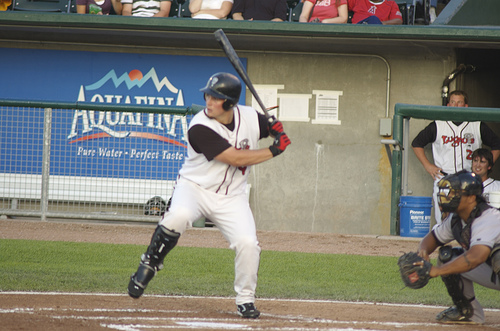
A short, stocky guy with a quick, power stroke, Snider is expected to play right field for Toronto this year after he held his own in a September call up (.301/.338/.466 in 24 games). He probably won't hit for much average, as guys who strike out more than once a game in the minors rarely do in the majors, but he should hit some homers.
Baseball Prospectus compared him to Brian Giles in their comments last year, but Giles struck out about 1/3 less often than Snider by this point in his career, and walked more. He had the bat control thing down first, and developed the power later on (when, coincidentally, everyone was developing power, if you know what I mean).
Anybody want to guess how many guys in history who were under six feet tall but over 240 lbs have hit 20 homers in a major league season? None. For that matter, nobody listed as 5'11" and over 215 has ever done that. Snider could be the first, but don't expect him to have a long career.
No. 7 Brett Anderson LHP, Oakland Athletics
10.11: Strikeouts per nine innings he compiled in 2008 between two levels.
Opening Day Age: 21
ETA: 2009
The big southpaw (6'4", 215) isn't a classic power lefty, but he has impressive control for such a young kid, keeping walks and homers in check while fanning more than a batter an inning throughout his two year minor league career.
No. 8 Cameron Maybin OF, Florida Marlins
8/18/07: Date when he hit his first big league homer—off Roger Clemens.
Opening Day Age: 22
ETA: 2009
I remember watching that game, the second of Maybin's career, and it scared the crap out of me—a kid that good. In the mean time, he's mostly been in the minors, where's he's hit for average (.298 in his career), modest power (36 homers in 300 games), and stolen bases successfully and often (73 for 93 in his career). He takes a few walks, with 161 of them in 300 games, but also strikes out a lot, the result of his lanky frame and his youth, I suppose.
He projects as a superstar, 5-tool centerfielder, but I'm not sure that will start this year. He's got the tools, but not the skills to keep from flailing away at big league sliders and curveballs.
Plus, it's not like there's a lot of pressure to succeed in Florida. Though they had a winning record in 2008, the team's perennially rebuilding, it seems, and they have the lowest average attendance in the majors by a large margin. Nobody will mind if he strikes out 175 times, because nobody will see him.
No. 9 Madison Bumgarner LHP, San Francisco Giants
1.46: His minor league-best ERA last season at low Class A Augusta.
Opening Day Age: 19
ETA: 2010
Against their better judgment, the Giants seem to have acquired themselves a prospect!
Other than having a girl's first name, Bumgarner has a lot going for him. He went 15-3 in the Sally League as an 18-year old, and it was no smoke-and-mirrors job. He fanned 164 batters in 142 innings while allowing only 21 walks and three homers. Granted, Augusta is a pitcher's park in a pitcher-friendly league, but it's not that friendly.
The book on Bumgarner is that he only started throwing offspeed stuff recently, so he's mostly been surviving (thriving, really) on his excellent fastball, which touches the mid to low 90's, with late movement, and has the potential to get into the high 90's as his frame fills out. Even if it never does, improving the quality of his slurve and changeup should be plenty to keep hitters off balance.
My one concern with him, other than his extreme youth—and it's more of a longevity concern than one of pitching quality—is that his mechanics look a little untidy. His pitching arm lags way behind him, pointing straight out to left field (see below), with a big, looping motion as he swings it up into position to deliver the ball.

Besides the possibility that this might lead to him tipping his pitches, it also places a lot of pressure on the shoulder, especially the rotator cuff, to have to whip the whole arm forward like that. He also has a rather short stride for such a tall pitcher, and probably strains his elbow and shoulder more than is really necessary because his legs don't generate as much power as they should.
Bumgarner is still very young, and a long way from the majors (I would give him at least another year on Baseball America's ETA, given that he's never pitched above low-A ball) but I would hate to see all that talent wasted by a carelessness about his mechanics.
No. 10 Neftali Feliz RHP, Texas Rangers
3: Home runs allowed last season in 127 innings.
Opening Day Age: 20
ETA: 2009
There is an appalling lack of players with good, obscure, Biblical names in the major leagues. Sure, you get lots of Marks and Peters and Johns, an occasional Jonah, or Jacob or Benjamin, but how often do you get a good Zebulun or Neftali (Naphtali)?
Feliz is still only 20, but he dominated both the Midwest League (Single A) and the Texas League (AA) last year, with a 2.69 ERA and 153 strikeouts in 127 innings. The Baseball Cube and MLB.com both list him as 6'3", 180 lbs, so he's a little on the skinny side, but then so are lots of pitchers, especially ones that are not yet allowed to drink legally.
His Achilles' heel is the number of walks he gives up, which tends to be a lot. He's averaged four walks per nine innings throughout his minor league career, the kind of number that keeps some prospects from ever getting an extended look in the majors.
This isn't an insurmountable problem by any stretch. Young pitchers with blazing fastballs often are more prone to allowing walks, knowing that they can probably strike the next guy out. With a full season at AAA expected, or maybe even some more time at AA first, he should have plenty of opportunities to work on his control.
No.11 Trevor Cahill RHP, Oakland Athletics
2.25: ERA for Team USA in two Olympic starts last season en route to a bronze medal
Opening Day Age: 21
ETA: 2009
I'm not sure why his performance against a bunch of green amateurs and washed up pros, in two lousy starts, should matter. If you want to quote an impressive number, point to Cahill's 2.19 ERA in 37 innings in Double A last year, or his 22-9 career record in the minors overall, or the 264 K's in 239 career innings.
John Sickels commented on him last year:
"However, the lack of a big-time massive plus velocity heater causes some to project him as more of a Jeff Suppan control, inning-eating type than a true future ace. Others point out that not every great pitcher has great velocity, and Cahill's intelligence and guile are huge assets. The sabermetric case points to the combination of strikeouts and ground balls as a big positive."
The analogy with Suppan isn't perfect. For one thing, Cahill is a little behind Suppan's pace—by this age, Suppan was already getting his feet wet in AAA—and he walks a few more batters, but he also allows fewer hits, fewer homers, and gets more strikeouts, which are all indicators of long-term success.
The fact that his nasty (if not super-fast) sinking fastball generates so many groundballs also bodes well for him, but he needs to work on his control and his secondary and tertiary pitches to keep major league hitters honest. He'll probably be 23 or 24 before he has a regular job in the majors.
No. 12 Pedro Alvarez 3B, Pittsburgh Pirates
9/24: Date he signed with the Pirates—more than a month after the Aug. 15 deadline—after the union's grievance on his behalf.
Opening Day Age: 22
ETA: 2009
Alvarez, you may recall, was embroiled in a controversy over his signing with the Pirates last summer and fall, but there's no controversy over his talent. He hit .349/.455/.658 in two and a half seasons at Vanderbilt, helping to lead them to an SEC championship.
He'll probably start 2009 around A or high-A ball, as he missed any chance at a pro debut with the holdout squabble last year, but he could move up through the ranks quickly with his complete hitter's package of patience, power and hitting for average.
No. 13 Mike Moustakas 3B, Kansas City Royals
1992: The last time a teenager led the Midwest League in homers, before he did it with 22 in 2008.
Opening Day Age: 20
ETA: 2010
Wow, 1992, eh? Anyone want to hazard a guess who that was? What future superstar led the 1992 Midwest League in home runs? What wunderkind posted such numbers, a harbinger of eventual major league greatness? Was it Jim Thome? Manny Ramirez? Chipper Jones? Nope, not even close! It was the one, the only, the Immortal...
Steve Gibralter.
Yes, that's right, the same Steve Gibralter who got exactly five at-bats at the major leagues, and almost got a hit in more than one of them. Almost. Gibralter did lead the Midwest League with 19 homers at age 19, but then hit .237 at AA. He improved at AA the next year and hit well enough at AAA in 1995 that he was eventually ranked as the Reds' No. 2 prospect (behind Pokey Reese, if you can believe that) in 1996.

But over the long haul, his inability to hit for anything other than power—and modest power, at that—kept him mired in the minors and led him inextricably to a life as a real estate agent. He was out of baseball by age 28.
Since 1992, Midwest League Home Run title has gone to such non-legendary players as:
Joe Biasucci, Matt Raleigh, Jesse Ibarra, Larry Barnes, Joe Frietas, Bucky Jacobsen, Aaron McNeal, Austin Kearns, Samone Peters, Jason Stokes, Jason Drobiak, Brian Dopirak, Ryan Harvey, Jordan Renz, Juan Francisco, and Moustakas.
Among them, only Kearns has had a MLB career of any length, and even that career is generally seen as a disappointment compared to his potential. To find a Midwest League HR champ who had a good MLB career, you have to go back more than 20 years, to 1987: Greg Vaughn at age 20. But Vaughn hit .305/.425/.593 with 33 homers and 102 walks, not .272 with 22 bombs and 43 walks.
Talk to me when Moustakas posts a .500 slugging percentage. Or .470, even. His reputation rests mostly on his impressive work in high school, where he set a California prep school record with 24 homers, while hitting .577 his senior year.
No. 14 Buster Posey C, San Francisco Giants
.879: Division I-best slugging percentage for Florida State last spring, when he won BA's College Player of the Year award.
Opening Day Age: 22
ETA: 2010
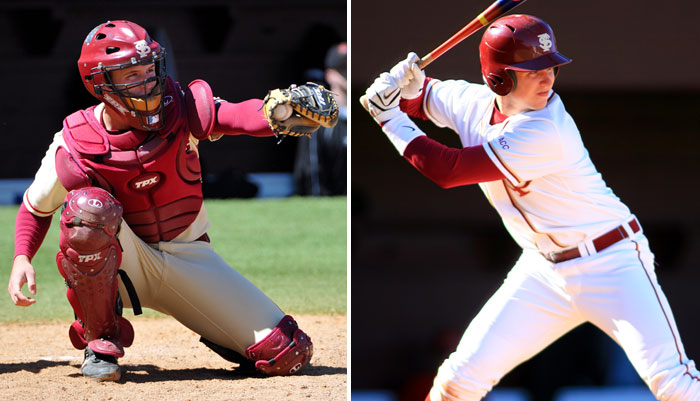 Posey always hit for average in college (Florida State), but suddenly last season he started hitting for power, too, with a .463/.566/.879 line that looks more like stats compiled in a video game than in the competitive ACC.
He has only a handful of pro at-bats, hitting for average and with patience in Rookie Ball, Class A Short Season, and then in the Hawaiian Winter League. His power has so far not been seen, as he has only one homer, nine doubles, and a triple in 111 at-bats among those three, low levels, but that may come back.
He did lead his HWB team with a .338 batting average, but the power deficit may be due to adjusting to wooden bats, an issue with many college players. Whether the power ever comes back or not, he's still a great prospect, though not one you should expect to see with a regular MLB job for another couple of years.
14: Round in which he was drafted; he signed for $925,000, turning down a Miami scholarship.
Opening Day Age: 23
He'll likely start the season at AAA Colorado Springs, where his numbers will get some help from the thin mountain air (even more than they got from the Texas League) and he may even hit some homers. If Carlos Gonzalez continues to disappoint and Scott Podsednik continues to be, well, Scott Podsednik, Fowler could be playing regularly in Denver by June. Whether he deserves it or not.
.988: OPS away from Greensboro's cozy NewBridge Bank Park; it was .996 at home.
Opening Day Age: 19
ETA: 2010
Unlike his long-lived but largely un-exciting namesake pitcher, the hitter Mike Stanton is extreme in almost every respect.
He's extremely young, having just turned 19 in November. He's extremely tall, 6'5" to be precise, with 210 lbs of muscle on his frame. He swings extremely hard, it seems, as evidenced by his 153 whiffs in 125 games, and also his having led the Sally League in homers (39), slugging (.611) and total bases (286). He also got hit by 11 pitches, not far off the league lead of 17, which suggests that he positions himself extremely close to the plate.
But lest you think he's just a hacker, he also walked 58 times in 468 at-bats for a respectable .389 OBP, very impressive for an 18-year old in his first long look in pro ball. His defense seems a little sketchy at first glance (five errors and only six assists in 107 games last season at Greensboro), but he'll probably be fine in left or right field.
The Marlins may skip High A ball and move him all the way up to AA to start the 2009 season, though it may be worth it to send him to the pitcher-friendly Florida State League (High A ball) first, to see how he does.
The main thing will be trying to keep the strikeouts in check. Right now his stats look an awful lot like those of Russell Branyan at this age, so if he can't tone down the extreme nature of his game just a bit, he'll never last in the big leagues.
No. 17 Lars Anderson 1B, Boston Red Sox
.404: Career OBP in 252 career minor league games.
Opening Day Age: 22
ETA: 2009
Does anybody else think of Metallica every time they hear the name "Lars"? Maybe that's just me.
As though the Red Sox needed another one of these, Anderson is a DH waiting to happen. He's already a first baseman, at the bottom of the defensive spectrum, and he isn't much to look at there. But with a bat like his, that might not matter.
An extremely patient hitter, Lars has walked more than once every six at-bats throughout his two years and three different teams. He doesn't show any real power yet, as most of the handful of homers he has hit are due to the hitter's parks he frequented in Lancaster (CA) and Portland (Maine). Kevin Youkilis got the same criticisms at this stage in his career, and he turned out OK.
The Sawx could bump Anderson up to AAA—he's certainly ready—but they had a lot of 1B/DH types there last year, and the majors are obviously blocked by Big Papi and Youk, so they may give him a little more time in AA just to keep him playing every day.
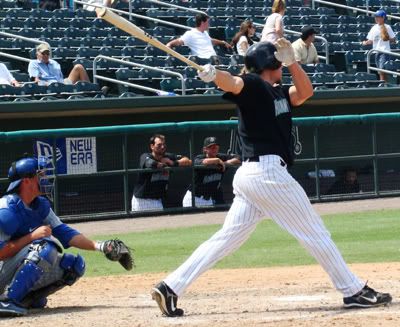
In the Southern League, Morrison will be a boy among men, most of whom are 24 or 25—many older than that. Many organizations' top prospects are at this level, as are a lot of major league pitchers on rehab assignments. This is a big jump for a 21-year old to make and will be a good test of his status as a top prospect.
No. 19 Alcides Escobar SS, Milwaukee Brewers
5.44: His range factor last season—best among shortstops in BA's Prospect Handbook, and another way to say he's an elite defender.
Opening Day Age: 22
ETA: 2009
The only prospect in the top 20 based predominantly on his defense, Escobar's place on this list may not last long. He led the Southern League in at-bats and hits, and missed the batting title by 0.001 to Huntsville teammate 3B Mat Gamel.
He's shown improvement upon a second tour at a level twice in the last two years now, hitting .257 in High A ball in 2006, then .325 in part of 2007. His promotion to AA Huntsville in 2007 saw him hit only a modest .283, but his 2008 encore brought a .328 average.
Escobar has some speed, having stolen 20-30 bases several times, with decent-but-not-spectacular success rates. He swiped 34-of-42 this year at AA, which is quite good. On the other hand, you can't steal first base, and Escobar only walks about once every five games, so unless he hits well over .300, he's basically an out machine.
In short, Escobar could grow up to be a Gold Glove caliber shortstop who hits .300ish and steals bases with aplomb—Omar Vizquel without the walks, if you will. More likely he'll hit just enough to keep himself in the No. 7 or No. 8 hole in the lineup, or end up as a late inning pinch-runner/defensive sub.
No. 20 Gordon Beckham SS, Chicago White Sox
28: Home runs he hit for Georgia last season, tied for the NCAA Division I lead.
Opening Day Age: 22
ETA: 2009
A young shortstop prospect with three years of college experience in which he showed improvements each year, Beckham was the eighth overall pick in last year's draft. The ChiSox put him at Single A Kannapolis, and he adjusted well enough to wooden bats, hitting .310/.365/.500 in about three weeks' worth of games.
The Sox don't have another shortstop prospect around that level, so they could either put him back in A ball or bump him to High A to start the 2009 season, but how the gurus at Baseball America imagine he'll make it to the Show by the end of 2009 is beyond me. For one thing, Alexei Ramirez is eminently capable of holding the short-fort in Chicago for the time being.
For another, Beckham has exaxtly 14 games of professional experience, all in single A, so there are three levels between him and the majors. Mastering High-A, AA and AAA in a single season is all but unheard of, so you South Side fans shouldn't get you hopes up until at least June of next year.




.jpg?w=2560 "Latest Peyton-Colts Rumors")


.jpg?w=2560 "Landing Spots for Trade Candidates 📍")
.jpg?w=2560 "Ugly Jets Scoring Stat 😳")