
EA Sports PGA Tour Review: Gameplay Videos, Modes and Impressions for Golf Video Game

It isn't often a new licensed effort disrupts the cozy sports video game landscape, but that's exactly what EA Sports PGA Tour from developer EA Tiburon has a chance to do.
This effort from the EA Sports side of the sports realm is the first entry in the series since Rory McIlroy PGA Tour in 2015 and the first not to feature a golfer's name in the title since PGA Tour 98.
In reappearing on the market, EA Sports' flagship golf title enters into direct competition with the PGA Tour effort from 2K sports.
.jpg?w=2560 "Cardinals Giants Football")
.jpg?w=2560 "Saints Giants Football")
And while that series attempts to hit its peak, EA Sports PGA Tour comes out of the proviral gates swinging with awesome presentation and familiar-feeling gameplay that makes it a serious threat to be a problem right as its "rookie" season starts.
Gameplay
EA Sports PGA Tour doesn't have the benefit of its competitors that enjoy the fact players have been learning its systems for years, making little tweaks easier to endure.
Still, the game feels plenty familiar. There is a standard swing meter controlled by an analog stick (same for putting), with the power and accuracy of a shot decided by length of the backswing, the speed of the follow-through and the swing plane (direction of launch).
Dubbed the Pure Strike system, the game boasts 20 shot types and each of those feel unique. That's both intimidating and a good thing, as players can toy around with different shots until they find one they really like.
Each shot feels quite different beyond the mere swing itself too, given with how each impacts how the ball physics behaves once it hits the ground.
Trackman ball physics play a role in that too, as the simulation-heavy chronicling of physics behavior across different surfaces and courses plays a part. Close observers will note different ball behavior at courses with drastically different elevation levels and weather scenarios like firmness of the ground.
At its core, the game asks much of players yet remains fun. Adjusting shots for a fade or draw, picking the right club and reading the surrounding details such as wind, slants and more create a rewarding experience, even on the lesser difficulties. Striking true and getting a Big Hit Moment complete with a dramatic, slow presentation of the shot is super satisfying.
There is a tough adjustment period for new players because there seems to be a slight delay between a button press and the actual on-screen swing. It's not bad once a player adjusts, but something players might encounter that makes the game initially seem less fluid than others.
But upon release, it seems players might fall into two camps on this one. Those who don't frequent courses in real life might find some of the overshoots and physics behavior random. That seems to be the tradeoff for the simulation aspect of the gameplay, especially one that has used things like drone footage to virtually recreate even the smallest imperfections in a course.
That's not to say the game isn't pick-up-and-play friendly because it is. But it isn't often players need to learn an entirely new sports game and EA Sports' effort has its own vibe in approach to gameplay. That just so happens to provide a steady uphill climb, albeit one that creates one of the more rewarding investments of time in skill improvement we've seen lately.
Luckily for players, the game comes with very helpful tutorial challenges to ease some of this burden. Arcade, Pro, Tour and Simulation difficulties are diverse enough to help players of all skill ranges, too.
As a whole, gameplay is fun after an adjustment period, though mileage will vary on a player-to-player basis. The game running at 30 frames-per-second (FPS) isn't a major hindrance, which says a lot about the gameplay experience in this era when FPS counters mean so much in marketing and to players overall.
Graphics and Presentation
EA Sports' big return to golf is blatantly a game without its hands tied behind its back by accommodating last-console-generation entries.
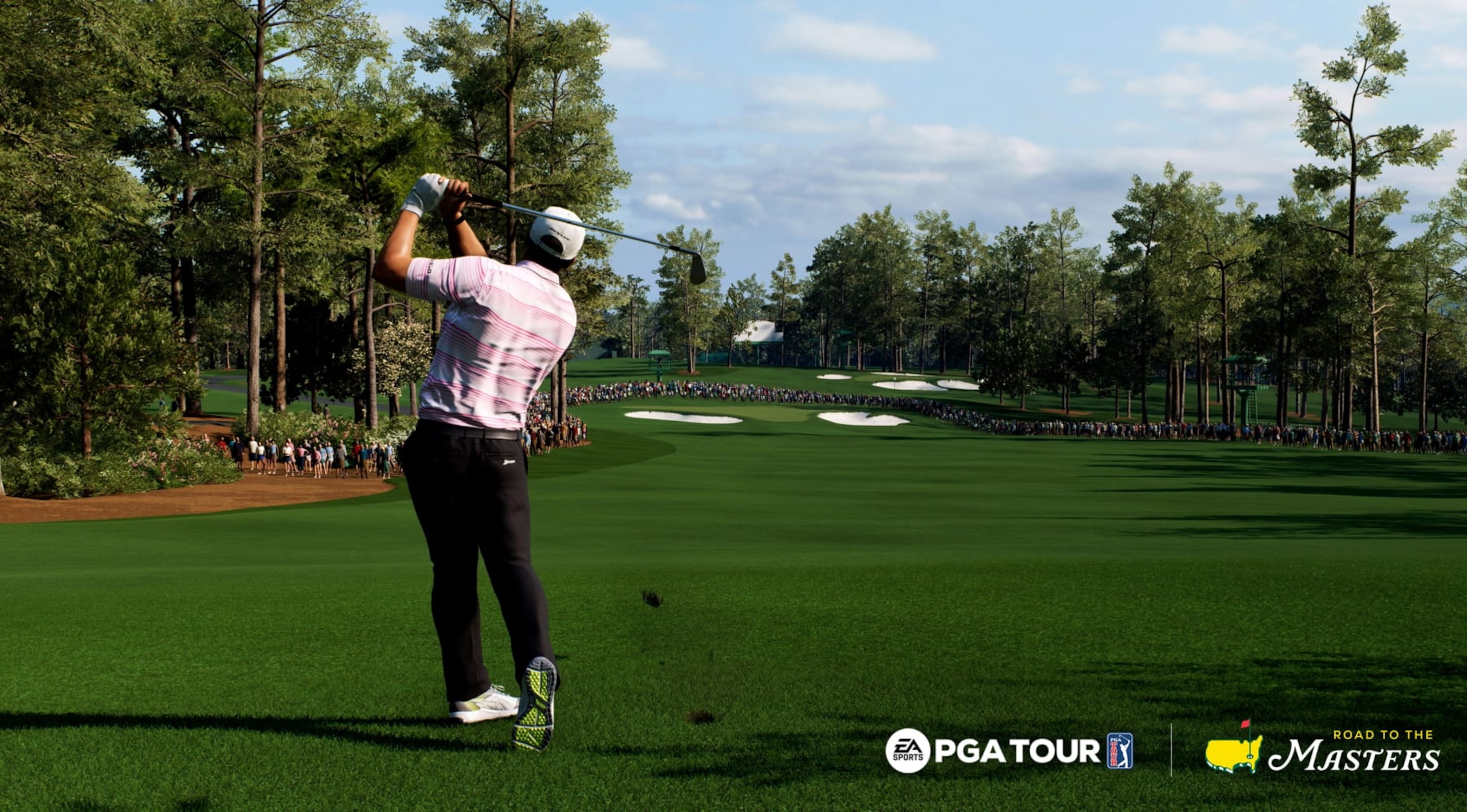
The game is downright impressive, seemingly squeezing every bit of horsepower possible out of next-generation consoles while achieving a near-photorealistic look.
Loading into a course gives off a very broadcast feel, with announcers overlaying the sweeping camera angles and montage that highlights all of the key points.
Even the flyover for each hole is jaw-dropping in most instances, just a splendid marriage of approach, angles and helpful tips-based commentary.
The presentation of a shot is refreshing, too. The actual shot meter is a fun curving line that follows the actual swing pattern. Down the course, the white triangle is where the ball will land, while the blue line is where wind might impact the trajectory.
Like its competitors, PGA Tour smartly weaves in droves of data and information into the gameplay experience. ShotLink, which has tracked every pro golf shot since 2001, offers feedback to players and is a nice touch. It blatantly plays a role in how A.I. golfers perform, too.
There is a very good level of immersion through sheer crowd behavior, too. There's the expected buzz before a player lines up, then things fall silent.
Most character models look great, with the real men's and LPGA golfers looking true to form. Their mannerisms are expressive and mesh well, not often standing out as strange in an otherwise super-realistic setting.
The initial load of the game reveals a pro golfer creator with pre-made faces to select from before players have a chance to edit basics like hair color.
Unfortunately, this is another super-limited creation suite found in many EA Sports games. Maybe it's a limitation of the Frostbite engine, but at a time when other games allow face scans and things like WWE 2K go off the deep end in creation suites, it sticks out—likely as something getting fleshed out as the series continues.
If there is a big drawback in the presentation department, it is clunky-feeling menus. But again, that's also something sure to get refined in future iterations and isn't an experience-ruiner.
Career Mode and More
The Road to the Masters mode is one of the big talking points of this re-debut for the series.
As expected, it features all four majors in men's golf, asking players to juggle those competitions and completing big moments from throughout the sport's history.
Along the way, players handle real-world sponsorships via performance and the mode actually leans into its asks of players with the strong Coaching Academy.
Road to the Masters isn't something fans have never seen before in a sports game by any means. But even if it's a little limited, it does the job well—marching through the game's gaudy 30 courses while jockeying with others on the leaderboard and finding nice immersion in real-world licensing of sponsorships and the like is fun.
In the expected career mode, there's what could be an underrated, underlying RPG system to the whole thing that truly gives players control over how their created pros turn out. Players will have to make tough calls when it comes to skill investment, giving created golfers strengths in one area at the detriement of others.
One way players increase skill is through quests, which include all manner of challenges that unlock upgrade points for key attributes. Besides the obvious like power and accuracy, recovery is an important one to know—it dictates how well a created golfer can reduce penalties in bad situations like rough and sand.
While it would be concerning if it didn't make the cut, it's still nice to see this effort following the likes of The Show, letting players choose whether they want to start on amateur circuits, on a developmental tour or in the PGA Tour itself. It's fun to start as a prospect working up the ranks, with tournament wins opening up much bigger opportunities in a way that encourages a player to keep improving.
Notably, players can control a rivalry system of sorts with "AI Pairings," which lets the player trade shots with an A.I.-controlled opponent. It slows things down, but is a nice option to have.
Beyond the headline item, there are nine game modes in quick play, including Stroke Play, Skins, etc. It's a nice-feeling number of modes to dive into, ranging from very serious to a more arcade-style feel.
Taking the game online is a fun option, too. There, players will find more relaxed unranked play, but also tournaments and private matches.
One nice overarching feature to this re-debuting package is the rankings attached to each course that stress Power, Driving, Approach, Short Game and Putting categories.
No matter the game mode, it's a useful tool to have to see how difficult a course might be for a pro golfer or a player's created character.
If there's one major thing the game gets right, it's giving players full control over how they play it. While selecting a course, players can narrow down which of the 18 they actually play, even dialing it down to only Par 3s or something similar.
Despite the hiatus, the game isn't barebones given the droves of options in the menus, especially when it comes to presentation such as turning on or off putting grids, lie effects, wind gusts and more.
Conclusion
EA Sports PGA Tour is an incredible first step for the franchise.
That it prioritizes presentation, licensing and other basic features to attract as wide of an audience as possible for a "new" game, with gameplay and items like creations suites lagging behind, isn't shocking as the series establishes new footing.
The game isn't shy about what's next, either. There's still a promised three-click swing system on the way and potential performance optimizations to push FPS, plus new golfers, challenges and other post-launch support planned.
As it stands at launch, though, EA Sports PGA Tour's stunning realism is a feat in the sporting space. It has managed to muscle itself into being an instant contender already with nothing but the upside of a series that can take over as the dominant force of its niche in time.
.jpg?w=2560 "Chargers Fall to 0-6 📉")
.jpg?w=2560 "Packers Beat Cowboys on SNF 🧀")
.jpg?w=2560 "Bills Safety Ejected for Spitting")
.jpg?w=2560 "49ers FB Slams CJGJ 😳")