
Jalen Hurts' Ascension Provides Bears with Blueprint to Maximize Justin Fields

The Chicago Bears are set to be arguably the NFL's most interesting team of the 2023 offseason. They lead the league with $97.8 million in projected cap space, have the No. 1 overall pick in April's draft and have a quarterback with tremendous upside in Justin Fields.
Publicly, head coach Matt Eberflus and general manager Ryan Poles may try to downplay Fields' potential. They should have a chance to flip the draft's top selection for even more capital, and they could maximize their return by presenting the idea that they could draft a quarterback—a potential smokescreen that may already be working.
According to Audacy's Jason La Canfora, multiple NFL general managers are "fairly convinced" Fields will be traded.
TOP NEWS
.jpg?w=2560 "Raiders Saints Football")
Every Team's Biggest Surprise So Far 😲
.jpg?w=2560 "Broncos Chargers Football")
Harbaugh Not in Hot Seat
.jpg?w=2560 "Patriots 49ers Football")
Aiyuk Slammed by Ex-Teammates 😬
Privately, though, the Bears should maximize the third-year signal-caller's talents and attempt to develop him into one of the most dangerous dual-threat signal-callers in the league. Fields has the tools needed to be great, and the Philadelphia Eagles have provided a perfect blueprint for how Chicago can help him on his way to greatness.
Why Hurts Is the Perfect QB for Fields to Emulate
There was a time when everyone in the NFL wondered which young quarterback would be the next Tom Brady. The recently retired champion of champions provided the model of consistency, efficiency and determination. Brady dominated the league for more than two decades despite lacking an elite physical toolbox.
While Father Time may never have truly caught up with Brady—there's no shame in going out with over 4,600 passing yards and a division title—the NFL eventually did. As the league has become more in line with the wide-open offensive play of the college game, pure pocket passers like Brady are a relic of a past era.
In recent years, teams have been searching for the next Patrick Mahomes, an athletic signal-caller with uncanny field vision and jaw-dropping arm talent who can also move in the pocket and burn defenses with his legs.
The Kansas City Chiefs quarterback is the epitome of greatness in the modern NFL, and his two regular-season MVPs and two Lombardi Trophies stand as proof. This past Sunday, though, Jalen Hurts outplayed even the incomparable Mahomes.
Hurts finished Super Bowl LVII 27-of-38 for 304 yards and a touchdown. He also had 70 rushing yards a Super Bowl-record-tying three rushing touchdowns. An argument could be made that Hurts deserved to beat out Mahomes for Super Bowl MVP despite the loss—it wouldn't be unprecedented, as newly minted Hall of Famer Chuck Howley did it in Super Bowl V.
The Eagles quarterback was truly the best player on the biggest stage in Super Bowl LVII, and not just because of his legs. Though Hurts did impress on the ground, his accuracy, timing and ball placement were also at an elite level.
That performance, and really, Hurts' 2022 campaign as a whole, should have franchises looking to uncover the next Hurts. He's shown that he can go throw for throw with a quarterback like Mahomes while also decimating a defense on the ground like Lamar Jackson.
Hurts finished the season with 3,701 passing yards, 22 touchdown passes, only six interceptions, 760 rushing yards, 13 rushing scores and a 101.5 passer rating.
Only Tua Tagovailoa, Jimmy Garoppolo and Mahomes finished with a higher rating among qualifying quarterbacks. Detroit Lions running back Jamaal Williams was the only player at any position to finish with more rushing touchdowns, while Fields and Lamar Jackson were the only quarterbacks to rush for more yards per game.
In short, Hurts has become the dominant dual-threat quarterback that Josh Allen was touted to be over the past few seasons—and his ascension has been rapid.
Largely viewed as a run-first quarterback and a project when he was a 2020 second-round selection, Hurts became an elite quarterback by the end of his third year and second full season as a starter.
Fields may be further behind in his development than Hurts was after his second season, but he also hasn't benefited from the sort of top-tier roster that has surrounded his Eagles counterpart. Given its cap and draft capital, Chicago can change that in 2023.
Why Fields Can Follow the Same Path as Hurts
Before we dive into what the Bears need to do to support Fields, we should examine why the Ohio State product is worth building around.
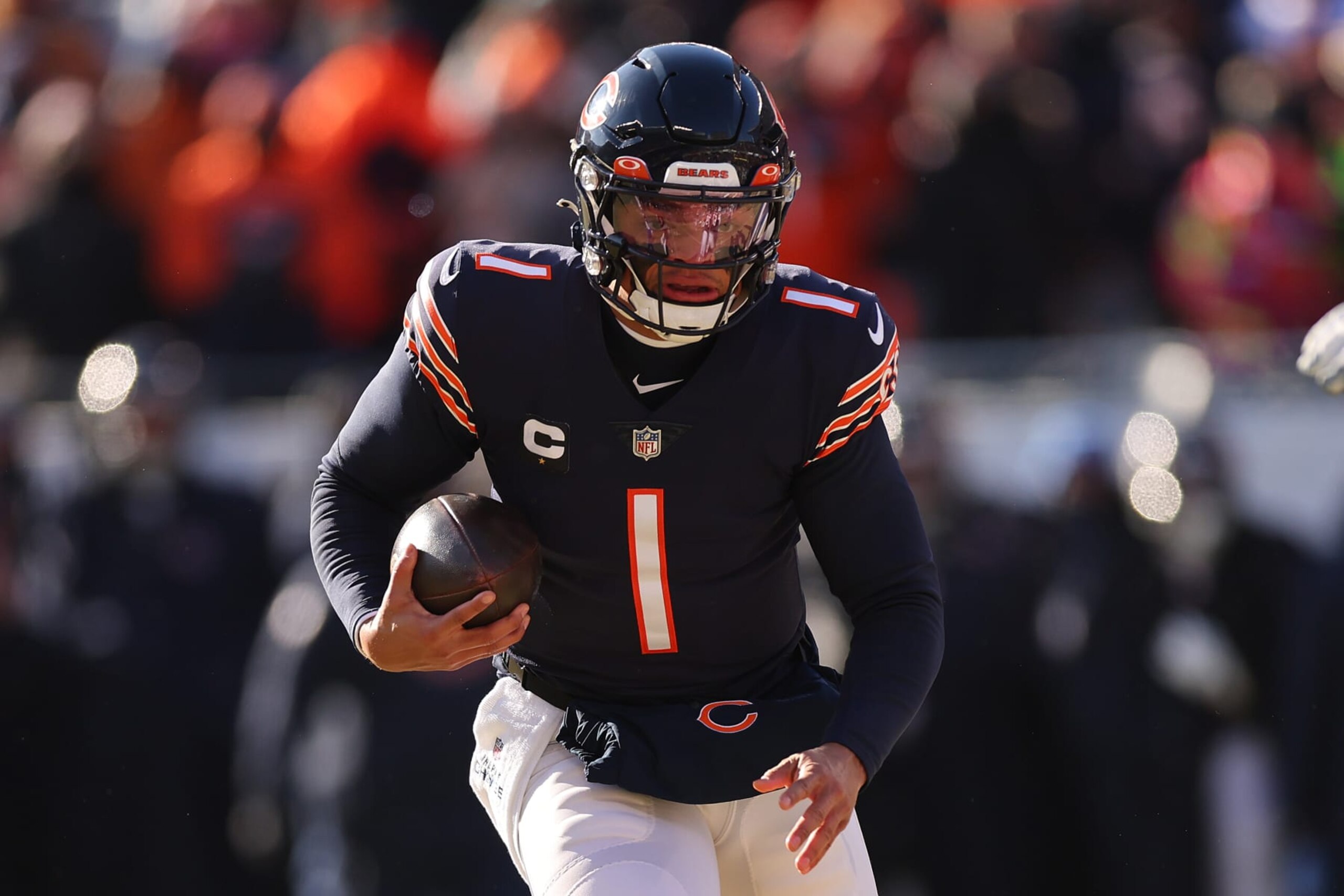
Let's start with the obvious and discuss Fields' prowess as a runner. The 23-year-old was simply sublime on the move this past season, racking up a whopping 1,143 rushing yards—making him only the third quarterback, along with Jackson and Michael Vick, to eclipse the 1,000-yard mark—and eight touchdowns.
Now, Fields and Hurts have differing run styles. Hurts is quick enough but brings a bit more power to his ground game, while Fields is quicker and shiftier in space. Nevertheless, his scrambling ability is something Chicago can lean into, much like the Eagles did with Hurts.
Fields also possesses better arm strength and accuracy than he's likely to get credit for—and than raw numbers might show. He has completed just 59.7 percent of his passes as a pro, but he can make the difficult deep ball look routine.
What has to be pointed out is Chicago's absence of receiving talent. Darnell Mooney led Chicago wideouts with just 493 receiving yards despite missing five games with an ankle injury. Tight end Cole Kmet was the Bears' only other reliable target in 2022, and he and Fields established an impressive amount of chemistry.
Kmet finished with 50 catches, 544 receiving yards and seven touchdowns.
When Fields last enjoyed a quality supporting cast—with the Buckeyes in 2020—he was much more consistent as a passer. In eight games that season, he completed 70.2 percent of his passes for 2,100 yards, 22 touchdowns and six picks.
And it's not as if Fields didn't show progress this past season. His completion rate only jumped from 58.9 percent to 60.4 percent, but his passer rating improved from 73.2 to 85.2. Fields' second-year numbers weren't that far off Hurts' 2021 numbers.
Hurts finished his second season with a 61.3 percent completion rate and an 87.2 rating while rushing for 784 yards and 10 touchdowns. Like Fields in 2022, Hurts was in his first year under a new offensive coordinator. Hurts made a significant leap under Shane Steichen—who was just hired to be the Indianapolis Colts' head coach—and Fields could do the same in his second year with Luke Getsy.
"It's going to make a big difference," Fields told Bleacher Report's Scott Polacek. "Just the fact that last offseason I had to work on changing my footwork while not really knowing the routes we were going to throw and not really knowing anything in the offense. Now, I've got a good idea of what we're going to run, the route concepts we're going to run and the different actions that we're going to run."
Instead of trying to force his quarterback into a rigid offensive system, Steichen helped build an offense around the things Hurts does well. Run-pass options (RPOs), play-action and designed quarterback runs have helped to give Hurts open looks and easier throws.
Getsy—who has utilized RPO concepts since his time with the Green Bay Packers—must use a similar approach as he and Fields enter their second offseason together.
Having a little continuity will help Fields continue to grow, but if the Bears hope to see him make the sort of monumental leap that Hurts did over the last year, they should pay close attention to the other factors surrounding Hurts' rise.
A part of Fields' continued growth will be somewhat out of Chicago's control, of course. While he may have the physical tools needed to match Hurts' success, he won't achieve it if he's not willing to put in the work.
"I can tell you inside that building, talking to some people inside that organization last night, they feel like the fundamental tenets there is the offensive line, is Jalen Hurts and ... how much he's driven to be great, and not just during the season, but year-round in the same way of Tom Brady or a Russell Wilson have been," La Canfora said on the In the Huddle podcast (h/t Audacy's Ryan Gilbert).
Fields must want to be great, and the Bears cannot exactly force that. What they can do is put all of the other pieces in place, starting with the offensive roster.
The Blueprint Chicago Must Follow
Heading into 2021, Hurts already had an edge over where Fields is now. Philadelphia featured one of the league's best offensive lines, an emerging star at tight end in Dallas Goedert and a new go-to receiver in rookie first-round pick DeVonta Smith.
Chicago has Kmet, and while its line wasn't atrocious in 2022, it was nowhere near Philadelphia's level. Part of that is on Fields, who needs to improve his pocket awareness. He was sacked a league-high-tying 55 times despite missing two games.
Yet Fields was under pressure on 26.9 percent of his dropbacks, and there's certainly room for improvement along the line.
Philadelphia also supported Hurts with a terrific run game, headlined by 2022 Pro Bowler Miles Sanders. While Chicago has some nice complementary pieces in Khalil Herbert and Darrynton Evans, David Montgomery is a middling starter who has averaged just 3.9 yards per carry in his four years.
The Eagles then got another elite receiver to pair with Smith by trading for A.J. Brown. This helped Hurts tremendously, as Brown provided a passer rating of 112.3 when targeted in 2022.
Adding Brown isn't the sole reason Hurts became an elite quarterback, but it was the final piece of the offensive puzzle.
Philadelphia also made moves to bolster its defense, adding the likes of James Bradberry, C.J. Gardner-Johnson, Haason Reddick, Robert Quinn and Ndamukong Suh in free agency and trades.
The Eagles finished the 2022 season ranked second in total defense and eighth in points allowed—up from 18th in points allowed in 2021. Chicago ranked 29th and 32nd in those categories, respectively. Fields constantly faced the pressure of having to play catch-up, while Hurts did not.
How can Chicago follow suit? It can start by buying into Fields and his skill set, as the Eagles did with Hurts. The Bears can work to improve Fields as a passer while not taking away his biggest established asset—his rushing ability.
Next, the Bears can get a better offensive line. Quality veterans like Orlando Brown Jr., Nate Davis, Ben Powers, Mike McGlinchey and Dalton Risner are scheduled to enter free agency, and Chicago has a glut of cap space available.
Five offensive linemen are also ranked among the top 32 prospects on the Bleacher Report Scouting Department's latest draft board.
The Bears could get a Pro Bowl running back like Josh Jacobs, Saquon Barkley, Tony Pollard or even Sanders if one of them reaches the open market. This would help bring balance to the offense, which was too often the Justin Fields Show in 2022.
An improved defense would also help significantly, as Fields would be asked less frequently to overcome Chicago's inability to keep points off the board.
Chicago could start by adding a veteran or two from a free-agent pool that includes Bradberry, Brandon Graham, Arden Key, Daron Payne, Dre'Mont Jones, Tremaine Edmunds and Drue Tranquill.
The Bears could land a defensive difference-maker in the draft too, like Alabama's Will Anderson Jr. or Georgia's Jalen Carter, the top two prospects on the B/R board.
Lastly, Chicago must find Fields a true No. 1 receiver. Kmet has the potential to be a star, and Mooney is a fine complementary piece, but neither can take over a game or bail out a quarterback quite like Smith or Brown can in Philadelphia.
Unfortunately for the Bears, this might be the trickiest piece of the equation. The free-agent receiver class is headlined by the likes of JuJu Smith-Schuster, Jakobi Meyers and Odell Beckham Jr. Even if Chicago adds one of them, it may have to look to the trade market—the Arizona Cardinals, for example, will explore moving DeAndre Hopkins, according to The Score's Jordan Schultz—or the draft to find that true No. 1 target.
If the Bears eschew an impact defender at the top of the draft, a receiver like TCU's Quentin Johnston or USC's Jordan Addison would make plenty of sense.
Can the Bears build the sort of complete team that the Eagles fielded in 2022 in a single offseason? Perhaps not, but they have the capital needed to put many of the key building blocks in place.
They already have the most important piece in Fields. If Chicago can provide the proper coaching, and if he's willing to put in the work to be truly special, then it could soon find itself where Philadelphia currently is—wondering how quickly it can lock up its superstar quarterback for the foreseeable future.
Salary-cap information via Spotrac. Advanced statistics from Pro Football Reference.