
8 Prospects Who Should Hear Names Called During 2023 NFL Draft After Combine Snubs
The NFL invited 319 prospects to participate in the 2023 draft combine from February 26 through March 6. A handful of other players will still end up being drafted despite not attending.
Last year, 38 draftees weren't invited to the combine, according to The Athletic's Dane Brugler. In other words, 15 percent of those who heard their names called weren't at the league's annual convergence upon Indianapolis for scouts and talent evaluators to take notice of their skill sets.
Despite gathering input from around the league on who they want to see during the event, some prospects still fall through the cracks. Therein lies the beauty of talent evaluation and why it's such an inexact science.
Prospects who don't grace Lucas Oil Stadium in three weeks time can continue to work and eventually show they're worthy of draft consideration. Their path to the NFL may be a little more difficult, but each can still impress based on their collegiate career and all-star film, pro-day workouts and future meetings with teams.
The following eight prospects are currently carrying draftable grades in Bleacher Report's scouting database, but they won't be at the combine. More will surely make the grade.
DL Karl Brooks, Bowling Green
1 of 8
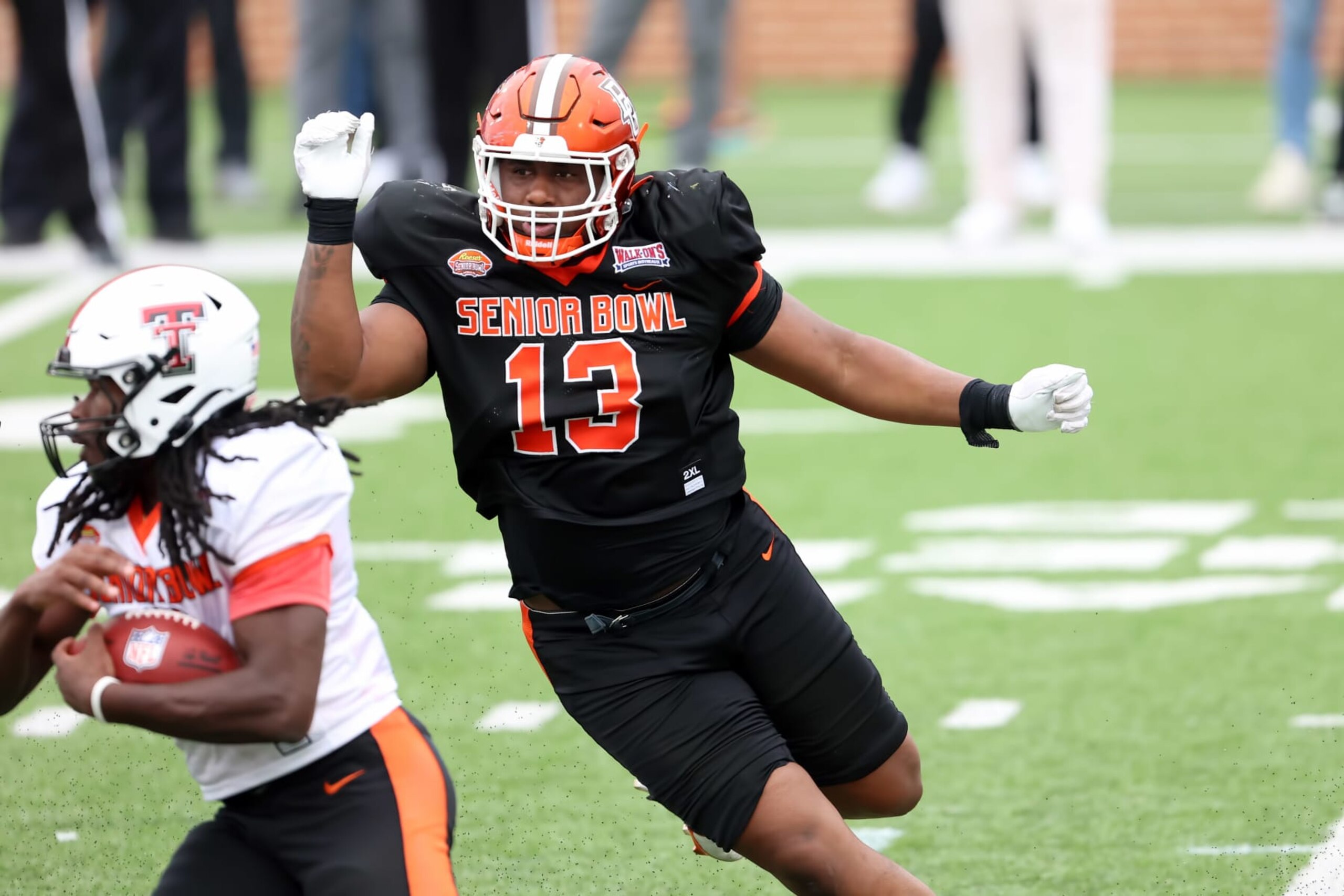
Coming out of the Senior Bowl, Bowling Green's Karl Brooks holds a second-round grade on the B/R's Scouting Department's latest draft board.
The 6'3", 303-pound defender often played out of position for the Falcons as an edge defender or 5-technique. Despite racking up 17.5 sacks and 30.5 tackles for loss over the last two season, the first-team All-MAC performer lacks the explosiveness and length (32¼" arms) to consistently win when working on head-up or outside offensive tackles.
Despite not playing to his strengths, Brooks still received an elite regular-season grade from Pro Football Focus while working against inferior competition.
Brooks spent far more time aligning as a 3-technique and along the interior during his time at the Senior Bowl, where he thrived. His limitations aren't as problematic when he's working over guards and centers. Instead, Brooks looked far quicker and difficult to lock on to when isolated in tighter spaces.
Brooks has the requisition production and skill set to be a solid Day 2 addition as long as he's primarily projected as an interior defender. However, he can easily play anywhere from 1- to 5-technique depending on situation.
DL Kobie Turner, Wake Forest
2 of 8
Some players aren't on the NFL draft radar for most of their careers and get overlooked. Kobie Turner is one such example.
While NFL scouts surely know the top performers at the lower levels of college football, they aren't given the same attention as prospects at pipeline programs. That approach makes sense since the majority of NFL talent comes from Power 5 schools and FBS programs.
But some prospects deserve similar consideration despite taking less-traditional routes.
Turner walked on at Richmond and became a four-year contributor with 33.5 tackles for loss and 16 sacks in 38 games. He then transferred to Wake Forest prior to this past season and played well, racking up 10 tackles for loss. In fact, Turner received the highest run-defense grade of any Power Five interior defender during the 2022 campaign, according to Pro Football Focus' Max Chadwick.
"The whole transfer was about playing against better competition, about doing whatever it took to put myself in the best position to be able to make it to the league, so it was a complete business decision," Turner told B/R scout Matt Holder.
The plan worked. Although Turner's skill set won't be an ideal fit for some NFL teams since he's undersized for an interior defender at 6'2" and 288 pounds with 32-inch arms, his natural quickness and leverage still make him difficult for any blocker to handle.
TE Daniel Barker, Michigan State
3 of 8
Michigan State tight end Daniel Barker rounded out B/R's latest big board at No. 150. He's an athletic receiving threat with significant upside as a detached tight end, although his receiving numbers never reflected his potential in the passing game.
In five seasons as part of two Big Ten programs, Barker never managed more than 21 receptions or 273 receiving yards in a single year. However, he was pretty consistent over the last four seasons, with at least 18 catches and 202 yards each year.
The problem stemmed from where Barker chose to play. In four seasons with Illinois and one with the Spartans, his squads never finished better than 58th in passing offense. The aerial attacks at Illinois never even cracked the top 100.
Baker shouldn't be slighted because he played in marginal offenses with mostly poor quarterback play. Instead, some NFL team could capitalize on a naturally gifted weapon in the passing game, one who can work from multiple spots on the field.
.jpg?w=2560 "Texans Titans Football")
.jpg?w=2560)
OT Trevor Reid, Louisville
4 of 8
The value of quality offensive line prospects increases each year. Most NFL teams struggle to field a quality starting five, let alone build excellent depth in the trenches.
The offensive line pipeline has started to dry up due to collegiate practice limitations and number of systems that directly correlate to everything an NFL blocker is asked to do. That's why it's surprising when a notable offensive tackle from a Power Five conference isn't asked to participate in the combine.
Trevor Reid was a two-year starter at left tackle for Louisville. He's a junior college transfer who made the most of his time playing in the ACC, where he blocked for the program's all-time leader in total touchdowns (Malik Cunningham).
Reid is a work in progress, which is to be expected of a late-round possibility. He's 6'4" and 297 pounds with good athleticism, and he tends to excel when asked to zone-block or attack second-level assignments.
The upperclassman still needs to develop physically, because his functional play strength is questionable. However, NFL offensive line coaches will likely seen the potential in his long frame with 34½" arms and an 84¼" wingspan.
A developmental tackle prospect is a good investment in the latter rounds, as Chicago Bears fifth-rounder Braxton Jones proved in this past year's draft.
LB Mohamoud Diabate, Utah
5 of 8
Last season, Utah linebacker Mohamoud Diabate led one of the nation's most consistent defenses with 13.5 tackles for loss. Over the previous two years, he started in the SEC and led the Florida Gators with 158 total tackles.
What more does a prospect need to do to get NFL scouts to notice him?
The combine isn't just a one-stop event that allows teams to poke, prod and break down its incoming crop of talent. The event serves as validation for years or hard work and excellent performance. It's a moment that many prospects dream of experiencing.
Diabate's biggest obstacles aren't necessarily his physical tools. He's a 6'3", 229-pound versatile athlete who's capable of covering ground, defending the run well and playing multiple positions. However, he can be late to diagnose and trigger and has some questions about his coverage skills.
If anything, the combine would have been the perfect opportunity to get Diabate on the board to discuss concepts and break down film during team interviews. Diabate didn't necessarily benefit from switching to a different system for his final season on campus.
Edge BJ Thompson, Stephen F. Austin
6 of 8
Stephen F. Austin edge-rusher BJ Thompson is too skinny and has never pieced together an entire dominant season. That might explain why NFL teams aren't crawling over one another to see him work out on a national stage despite his natural inclination to create pressure off the edge.
The 6'5" Thompson weighed 238 pounds at the Shrine Bowl after Baylor listed him at 222 pounds before transferring. He's four years removed from his time with the Bears, but he hasn't produced quite to the level expected of a top FCS defender.
In three seasons with the Lumberjacks, he accumulated 25.5 tackles for loss and 18.5 sacks. Those are respectable numbers, but they aren't eye-opening at a lower level of competition.
Thompson's physical traits are what set him apart as an immediate sub-package defender. He boasts explosive first-step quickness, good bend and edge-shortening length. The last part is crucial, because Thompson tied for the longest arms among fellow edge-rushers at either the Senior or Shrine Bowl.
His 34¾" arms should help offset potential issues created by his slight frame to keep offensive linemen at a distance. Even if his pass-rushing plan gets shut down, Thompson can use his long levers to affect passing lanes.
IOL Atonio Mafi, UCLA
7 of 8
Big and nasty tends to be a good combination for an interior offensive line prospect. For UCLA's Atonio Mafi, attitude is what gives him a legitimate chance to be an NFL draft pick.
Mafi wasn't on the NFL's radar entering this past season because he wasn't a full-time starter in 2021 and lacked the discipline to get into professional playing shape. That has since changed.
"Coach [Chip Kelly] told me that if I dropped the weight, I'd have a chance at playing in the NFL," Mafi wrote for the Los Angeles Times. "So I radically changed my diet, came in for extra workouts before practice and went from 377 pounds to 340, after having peaked at 411 earlier in my career. So many people helped, from the strength coaches to our team nutritionist, Ross Shumway. Even teammates who kidded by saying they missed the old 'Nio kept me going."
The one-time defensive tackle convert started all 13 games at left guard. He showed he's capable of constantly looking for work and finishing blocks, and he earned second-team All-Pac-12 honors.
More importantly, Mafi's weight has held in check. At the Shrine Bowl, he weighed in at 338 pounds. He has the size and power to uproot defenders in the run game and decleat pass-rushers when cleaning the pocket. While his strengths still revolve around his prowess as a run blocker, the new-look guard continues to evolve.
LB Marte Mapu, Sacramento State
8 of 8
Sacramento State linebacker Marte Mapu opened eyes during Senior Bowl week. As a late invite after participating in the NFPA Collegiate Bowl, Mapu wasn't on the field to start the week's festivities, but he made the most of his opportunity during his time in Mobile, Alabama.
One particular play stuck out. During an inside drill (a nine-on-seven running game session), the 6'3", 217-pound Mapu came flying downhill, blew up a fullback and tackled the tailback for a loss. Later in the same practice, he dropped into space, got into a passing lane and broke up a pass.
Mapu isn't a true linebacker. He's still learning the position. Sacramento State's official site listed the reigning Big Sky Defensive Player of the Year as a nickelback.
"He can play linebacker, the nickel spot, anywhere, and in the NFL, they love that," Hornets head coach Andy Thompson told the Sacramento Bee's Joe Davidson. "I really think he has a great future. He's a true student of the game. He's a great athlete. He makes plays."
Mapu is a modern three-down defender with the flexibility to contribute in a variety of roles. It may have taken a few plays for people to take notice of his ability, but he's known now.
.jpg?w=2560 "Broncos Chargers Football")
.jpg?w=2560 "Cardinals Giants Football")

.jpg?w=2560 "MHJ Bought Own Jugs Machine")