
Kevin Kolb? Kyle Orton? Seattle Seahawks Can't Afford a New Quarterback
Fans and media have been rumbling for three years about replacing Matt Hasselbeck.
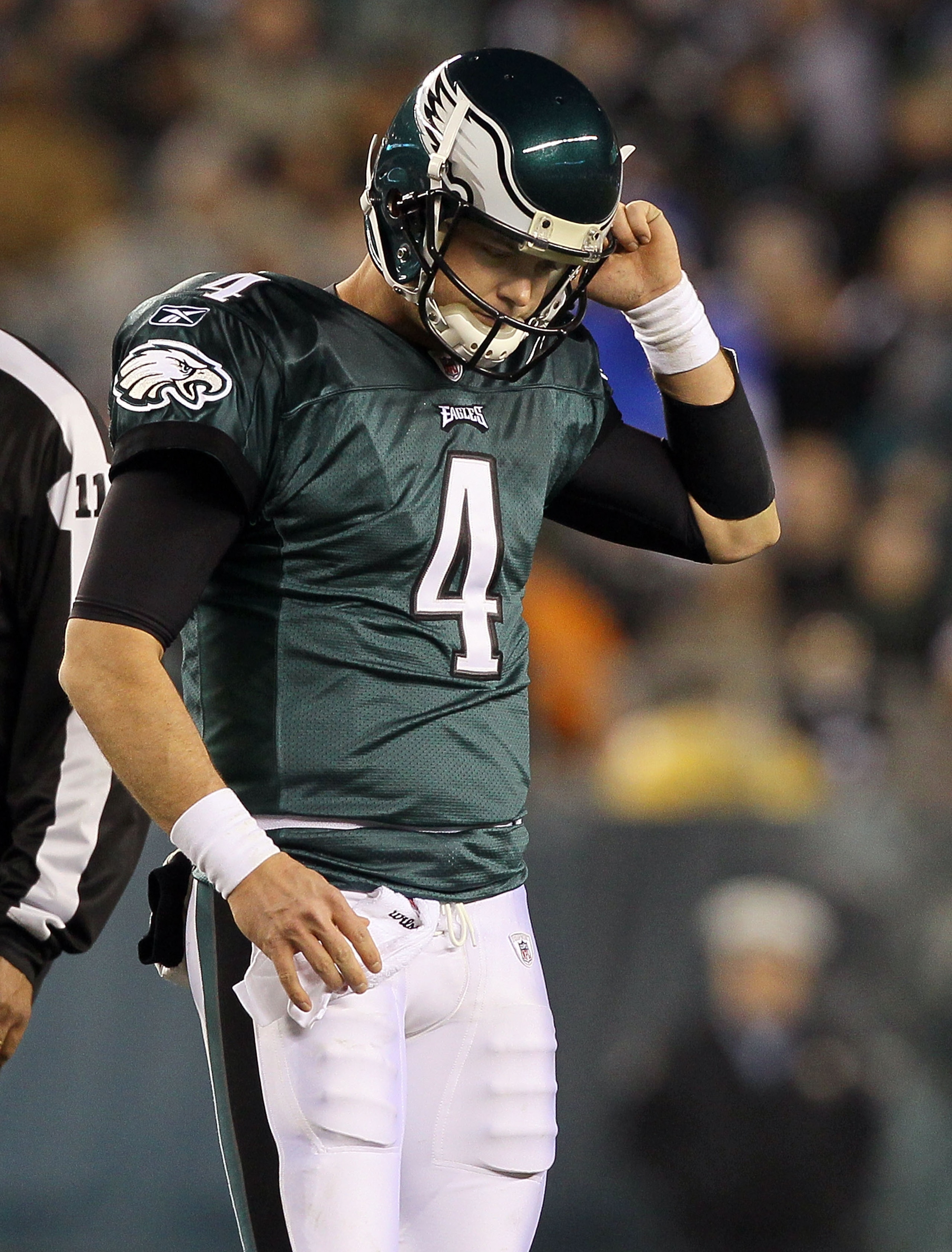
This year, the rumblers are calling for the Seahawks to draft hometown hero Jake Locker or trade for Carson Palmer, Kevin Kolb, Vince Young or Kyle Orton.
Bringing in a new quarterback would be a great idea if the Seahawks could find the right guy and could afford to do it. But the Hawks really need to focus on rebuilding their offensive line and improving their defense, and Hasselbeck, 35, has a good three years left in him anyway, so quarterback is just not very high on the needs list.
We’ve already talked about why drafting Locker – or any quarterback – in the first round is a major gamble. Even in the best draft years for QBs, there’s a 50 percent chance of ending up with a bust. This year, you’re looking at a 75 percent chance of picking a bust in the first round.
Among the veteran quarterbacks mentioned above, Kolb and Orton would be the best options, but neither would come cheaply.
Kolb, 26, definitely has a lot of upside, but the Eagles will want at least a first-rounder and a third-rounder for him. And that’s on top of the contract you’d have to pay him. The Hawks could afford the money but not the picks. Not this year.
Orton, 28, had a great 2010 season and really has been good for three straight (in two offensive systems), so the five-year veteran seems to have come into his own. New Broncos coach John Fox just named Orton the starter, which might be a ploy to bump the price tag – assuming the Broncos are willing to go with 2010 first-rounder Tim Tebow as the starter.
The Broncos probably would give up Orton for a second-rounder and a later pick, but even that seems to be too much for a Seattle team that needs as many players as it can get (and is already short a third-rounder, which it gave up for quarterback Charlie Whitehurst last year).
Palmer wants out of Cincinnati, but the Bengals won’t let him go cheaply if they do end up trying to accommodate him. Palmer, 31, is only four years younger than Hasselbeck, so it’s not like he would be the quarterback of the future. Besides, he has a lot of mileage on his oft-busted body.
As for Young, any fool who thinks this guy is capable of leading an NFL team either is from Texas or loves slamming Patron shirtless. Young is a typical youngster of his generation – narcissistic and selfish. He’s immature and a horrible teammate – certainly not the kind of guy you want running your team – unless you want to run your coach out of town a la Jeff Fisher.
Of those quarterbacks, Kolb and Orton certainly have some merit – because of age and talent – but the Seahawks just can’t afford to do it this year.
Build a Line Before Inserting a New QB
1 of 4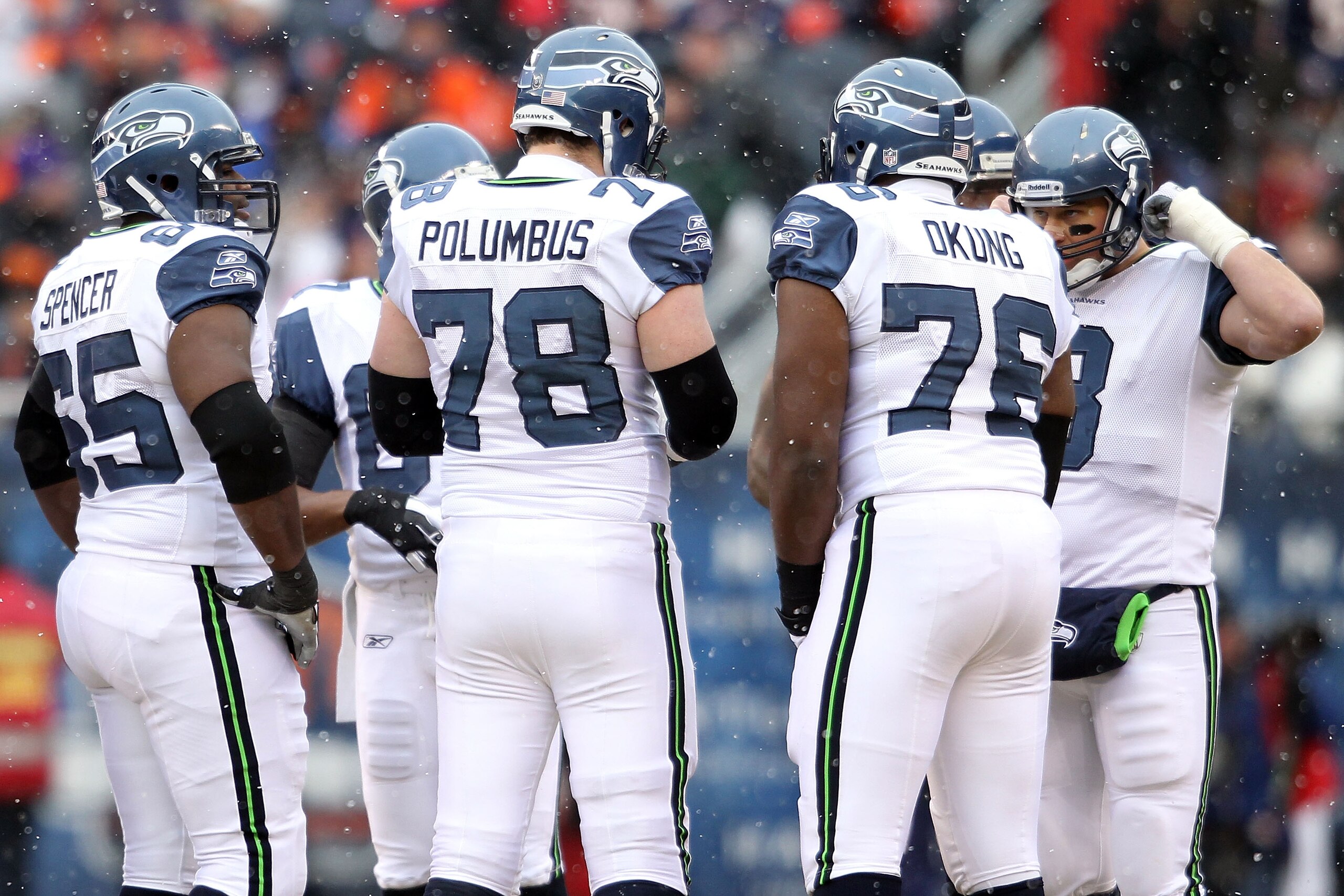
Any inexperienced quarterback is going to struggle until the Seahawks build up a good line again. Even if they draft a quarterback, it would be unfair to make him the starter until the Seahawks can run the ball again.
One of the primary things that ruin a young quarterback is playing behind a horrible line that can’t protect him consistently and can’t create a strong running game to take the pressure off.
Just look at Whitehurst, who could barely wait to get out of the pocket in his two starts last season. As soon as things broke down (or even when they didn’t), he was on the run.
The Hawks ideally will add two or three new starting linemen this year and start to put together a good unit under Tom Cable’s direction. That unit could grow the way the 2001-05 group did, with Russell Okung playing the part of Walter Jones and some yet-to-be determined guys playing the roles of Steve Hutchinson, Robbie Tobeck, Chris Gray and the right tackle.
Meanwhile, the Seahawks can take another year to evaluate Whitehurst. If he isn’t the guy to eventually replace Hasselbeck, the Seahawks can be more aggressive about finding a quarterback next year, when they can better afford it.
Hasselbeck surely can start for the next two or three years, and by that fourth year the Hawks hopefully can put in a new QB behind a nicely rebuilt line.
If they can run it and play some defense, that quarterback will succeed – just like Ben Roethlisberger, Joe Flacco, Matt Ryan and Mark Sanchez did right off the bat.
The Hasselbeck Dialogue
2 of 4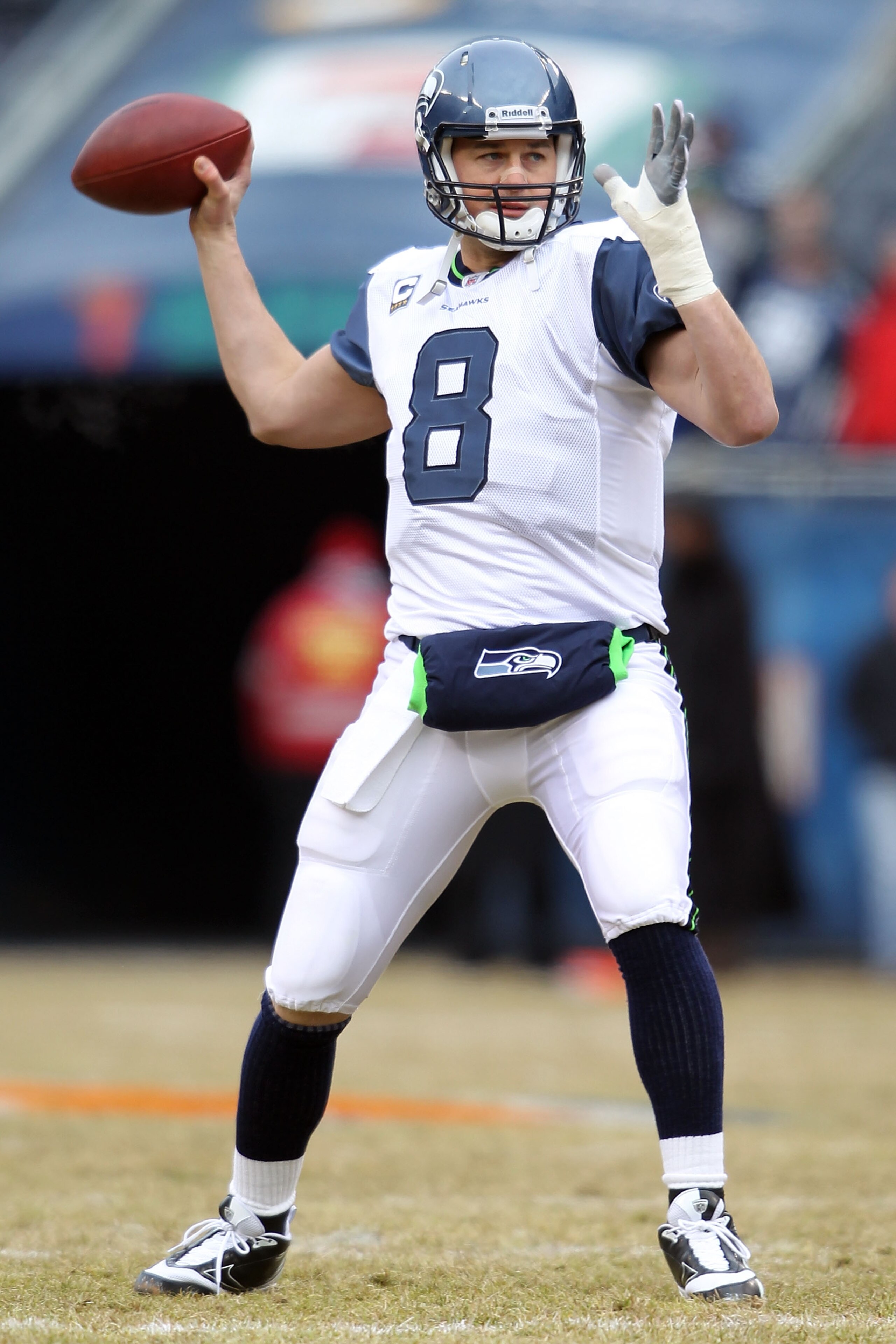
Even if you don’t like any of the reasoning for bringing back Hasselbeck, it doesn’t really matter because Pete Carroll has made it clear he wants to re-sign the quarterback.
It’s just a matter of when.
If the Hawks don’t sign him by March 3, they will have to wait until a new CBA is signed by the owners and union. But they are talking.
On KJR-AM last week, Carroll said, “There’s plenty of time to do something. Our conversations have moved ahead. …Knowing that Matt is the farthest along, most experienced and a guy that can make plays for us, we would still like to get that done. We’ll just keep moving in, seeing how our talks go and see what happens here in the next few weeks.”
At the Combine in Indianapolis on Friday, general manager John Schneider told reporters, “We’re having great dialogue. Matt is Mr. Seattle, and he has done a ton of great things for the city, on and off the field. We’ve had good dialogue.”
During the season, we proposed a way to structure a contract that would pay Hasselbeck according to his performance.
Sign him for four years at a “middling” base salary of $6 million a year as long as he is the starter, with potential bumps like these:
**$1 million for a 3,200-yard passing season (he hasn’t done that since 2007)
**$1 million for 24 TD passes (he has done this thrice in his career)
**$1 million for fewer than 10 interceptions (he has done this once in a 16-game season)
**$1 million for 62 completion percentage (he has done this thrice)
**$1 million for a division title
**$1 million per playoff win
By those standards, he would have been paid $8 million last season (the bonuses coming from the division title and playoff win).
If he achieved the individual incentives and the Hawks won the Super Bowl, he would make $15 million.
If he ended up backing up Whitehurst or some other quarterback at some point over the four-year deal, the Seahawks could lower his salary.
It shouldn’t be hard to re-sign Hasselbeck, who surely will settle for a little less to remain the Seahawks starting quarterback.
Asked about the possibility of the Seahawks signing Carroll’s former USC QB Matt Leinart, ESPN’s John Clayton raised an option that shouldn’t be discounted, as ridiculous as it would be: The Seahawks could release Whitehurst rather than pay him $4 million.
Wrote Clayton: “If Hasselbeck is signed, Carroll could decide whether Leinart is a better option than Whitehurst and his $4 million salary.”
As asinine as it would be to give up on Whitehurst after just one year – thus truly wasting that third-round pick they gave up for him – it certainly wouldn’t be out of character for Carroll and Schneider. After all, they cut T.J. Houshmandzadeh last year despite owing him a guaranteed $7 million. Whitehurst’s salary is not guaranteed, so if they were willing to take a lot of heat for that third-rounder, they could save $4 million by replacing him.
It sounds like they are not sold on Whitehurst.
“We’re always going to be trying to find those guys to compete at that position,” Schneider told reporters. “It’s the most important position on the team.”
Giving the Tag the Boot
3 of 4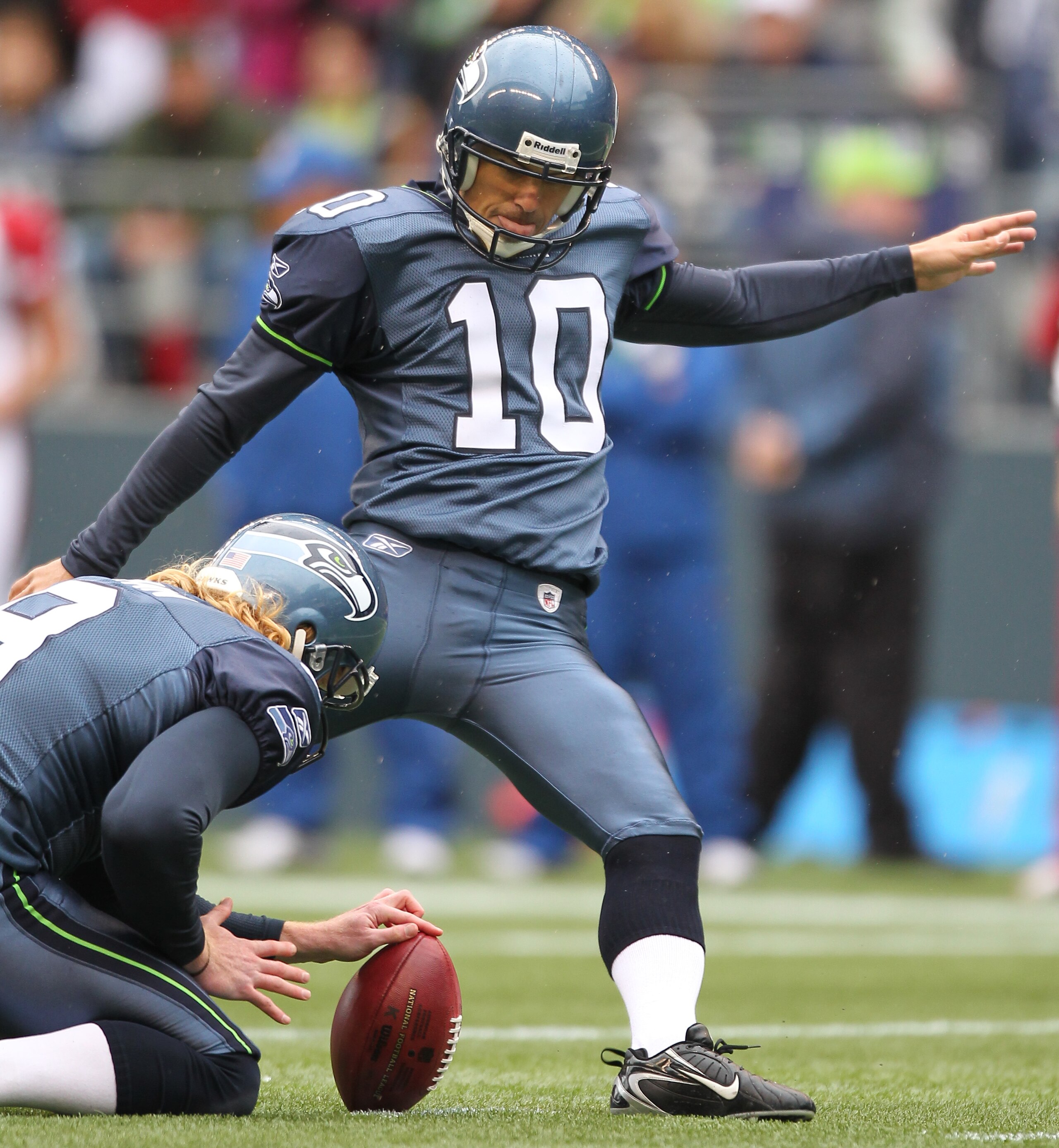
It certainly came as no surprise that the Seahawks were not among the 14 teams who declared franchise players by Thursday’s deadline.
The Seahawks had no reason to use the designation, unless they wanted to tag kicker Olindo Mare again.
Their top pending free agents are Hasselbeck and defensive tackle Brandon Mebane. But the cost to franchise either is ridiculously prohibitive – reportedly $16 million for the quarterback and $12.5 million for the defensive tackle (the average of the top five salaries for those positions last season).
The Seahawks also chose not to use the less restrictive transition tag (average of the top 10 salaries). Those numbers would have been equally unwieldy; in 2010, they were $14.6 million for QBs and $6.4 million for DTs.
Hasselbeck made $5.75 million in 2010 and had an even worse season statistically than 2009 (though it was far from his fault entirely, as his two excellent playoff games showed). The Seahawks certainly are not going to triple his salary, particularly at age 35.
Even without Washington’s insane $21 million payday to Albert Haynesworth ratcheting up the franchise value for D-tackles, the top five were averaging $7 million in 2009. Even that’s way too much to pay a good player who doesn’t rush the passer and hasn’t played the full 16 games since 2008.
Mebane has been a pleasant third-round pick (2007), and the Seahawks surely should re-sign him. But don’t overvalue him. He missed one game in 2009 and four games last season, and he has just 2.5 sacks in the last two years. Pay him like fellow tackle Colin Cole, who in 2009 signed for $21 million over five years.
Schneider told reporters he has been “having good discussion” with Mebane’s representatives.
Some people think it’s foolish to use the franchise tag on a kicker, but quite the contrary: It’s one of the most fiscally savvy moves a team can make, if it has no other player who merits the tender.
If the Seahawks were going to use the franchise tag, it would have made sense to use it on Mare – just like last year. They have done it before, using it on Josh Brown in 2007.
Others do it too. The Browns franchised Phil Dawson this month, and the Eagles used their transition tag on David Akers.
Mare’s tag value reportedly would have been $3.1 million, which is only $300,000 more than he made as the franchise player last year.
The Hawks have paid him $6.3 million over the last three years, and he has not let them down. He has made 73 of 83 kicks, an 88 percent conversion rate that is the best three-year stretch of his 14-year career – even better than the 87.8 percent (86 of 98) he made for Miami from 1999 to 2001. The 88 percent is also the best percentage in Seahawks history (Todd Peterson hit 81.8 percent and Brown hit 80 percent, each over five years).
Mare will be 38 in June, but he certainly has earned another year in Seattle.
Seahawks’ tag history
This is the first time since 2001 that the Seahawks have not tagged a player. Here is the history since 2000, all but Steve Hutchinson being franchise players.
2010: K Olindo Mare, $2,814,000
2009: *LB Leroy Hill, $8,304,000
2008: **CB Marcus Trufant $9,465,000
2007: K Josh Brown $2,078,000
2006: LG Steve Hutchinson $6,390,000
2005: RB Shaun Alexander $8,080,000
2004: LT Walter Jones $7,080,000
2003: LT Walter Jones $5,734,000
2002: LT Walter Jones $4,920,000
2000: ***WR Joey Galloway $4,100,000
*Later rescinded, and Hill signed a long-term deal
**Trufant signed an extension shortly after
***Galloway was traded to Dallas for two first-round picks
.jpg?w=2560 "Rams Raiders Football")

.jpg?w=2560 "Steelers Saints Football")
Secondary Topics
4 of 4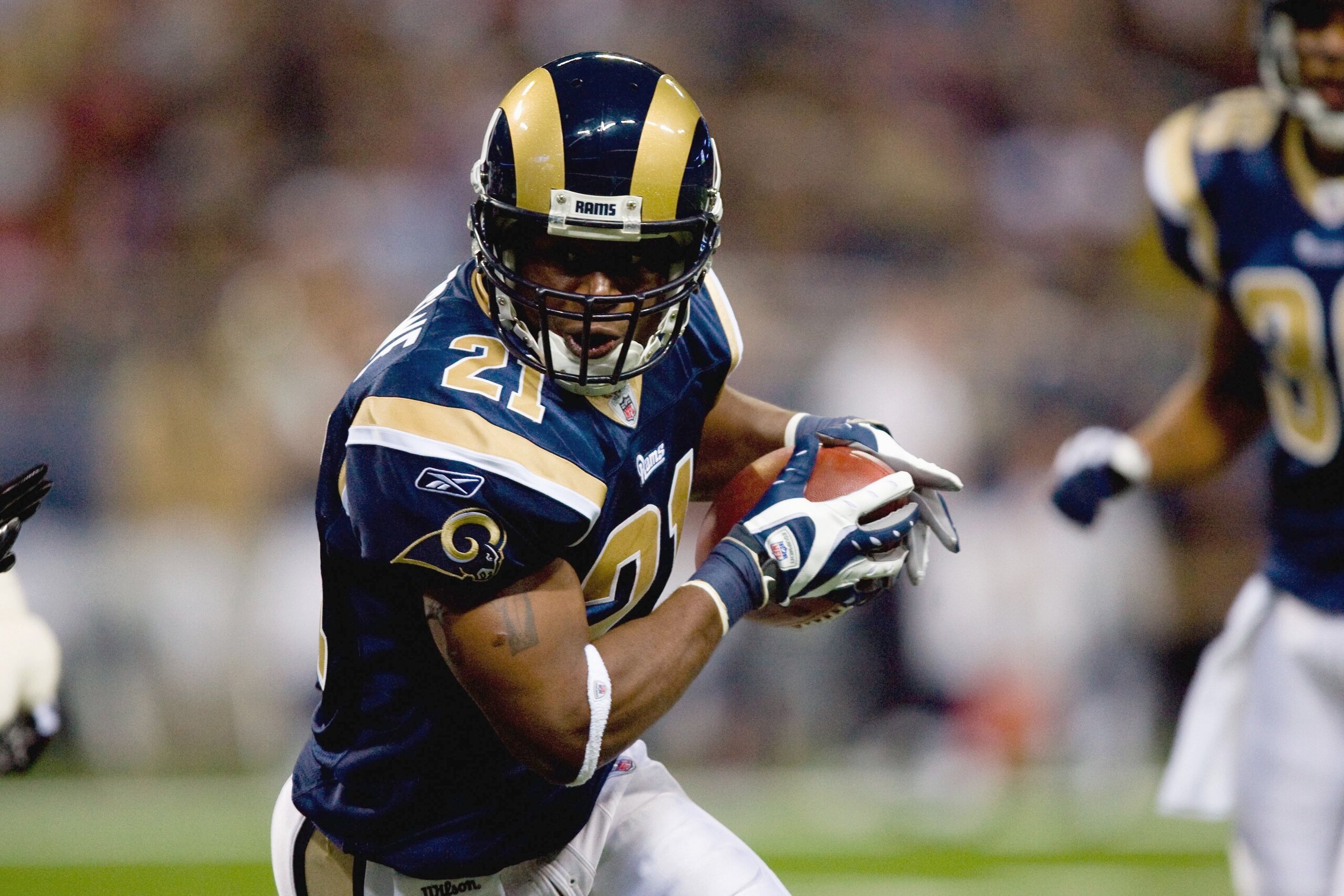
There was some scuttlebutt that the Seahawks might be among the teams interested in safety Bob Sanders, the former defensive player of the year who recently was released by the Colts.
There’s no reason to sign him for more than one year – and certainly not for very much money. Why? Because he has played in only nine games over the last three years.
The Seahawks are injury-bitten enough without making a big investment in somebody like that. Plus, Sanders turned 30 on Thursday.
The safety the Seahawks should look at is O.J. Atogwe, who was cut by the Rams this month.
Yes, he’s a free safety like Earl Thomas, but who says you can’t have two ball hawks in the secondary? Especially a secondary that got torched in almost every game in 2010?
Atogwe probably will want $5 million a year, but that’s the price you pay for a good safety in his prime (29). Plus, the Seahawks would be taking a key starter away from a division foe.
We championed this move all last off-season, so why not do it again?
The Josh Wilson trade matched the outright release of Houshmandzadeh as the worst moves Carroll and John Schneider made last year. Funny that both former Seattle starters ended up in Baltimore as role players.
The Wilson deal was a conditional fourth- or fifth-round pick, depending on how many games Wilson started, and it turns out Wilson started one fewer than needed to activate the fourth-round value. Convenient for the Ravens, huh?
So, the Seahawks will end up with a fifth-round pick for a corner who might have been their best had he stayed, considering the disappointing season by Marcus Trufant and injuries at various times to Roy Lewis, Kelly Jennings and Walter Thurmond.
By the way, good move by the Hawks to re-sign Lewis this week. He wasn’t going anywhere – he is only a three-year vet – but he’s an ascending player who makes Jennings, a pending free agent, expendable.



.jpg?w=2560 "🚨 Week 8 AP Top 25 Poll")
.jpg?w=2560 "Packers Safety Slams Refs 🤬")