
Super Bowl Lore: The 15 Most Dramatic Runs to the Super Bowl in NFL History
As the saying goes, "It's not the destination, but the journey."
For the teams on this list, that was certainly the case.
On this list are teams that faced adversity, fought hard when their backs were against the wall and performed admirably under pressure.
These are teams that won on the final play of the game. Teams that nobody thought would make it to the Super Bowl. Teams that most, if not all, believed were down if not out of it at some point.
Teams like the '85 Bears or the '86 Giants, who dominated in the regular season and the playoffs, are not on this list.
This is for teams that just as easily could've lost the Super Bowl or just as easily not made it to the Super Bowl had one or two things gone differently.
15. San Diego Chargers 1994
1 of 15In a year when many of the so-called experts predicted San Diego would finish last in the AFC West, the Chargers surprised everyone but themselves, finishing 11-5, good enough to clinch a first-round bye in the playoffs.
But shortly after their game versus Miami in the Divisional Round got underway, they found themselves in deep trouble, trailing 21-6 at the half.
In the beginning of the second quarter, things got worse.
The Chargers drove to the Miami 1-yard line, but failed to convert on 4th-and-goal, giving the ball back to the Dolphins.
And then things changed.
Running back Bernie Parmalee was tackled in the end zone for a safety and, after getting the ball back, Chargers running back Natrone Means ran for a 24-yard touchdown, cutting the deficit to 21-15.
In the fourth quarter, with the ball at the Miami 37-yard line, San Diego quarterback Stan Humphries hit wide receiver Shawn Jefferson for a touchdown in the corner of the end zone, only to see the official rule that he got just one foot inbounds.
Replays showed that he did, in fact, get both feet inbounds, but instant replay was not in use then.
But the Chargers would not be deterred.
Late in the fourth quarter, they drove the field and scored on an 8-yard touchdown pass from Humphries to wide receiver Mark Seay with 35 seconds remaining. John Carney's extra point made it 22-21, Chargers, giving them their first lead of the game.
But, with three timeouts remaining, Marino drove his offense to the San Diego 31-yard line, only to see kicker Pete Stoyanovich's 48-yard field sail wide right with one second remaining.
Against Pittsburgh in the AFC Championship Game, San Diego fell behind 13-3 in the third quarter and appeared to be out of it.
But, like they had against the Dolphins, the Chargers would make a dramatic comeback.
When the Chargers got the ball back, Humphries utilized a play-action fake, completely fooling the defense and setting things up for an open Alfred Pupunu, who took it 43 yards to the house to cut the lead to 13-10 and give San Diego new life.
With 5:13 remaining in the fourth quarter, Humphries hit Tony Martin, who out-jumped Steelers defensive back Tim MkcKyer to the ball, hauling it in for a 43-yard touchdown and giving the Chargers a 17-13 lead while creating a painful memory for Steelers fans.
On the ensuing drive, the Steelers drove from their own 17-yard line to the San Diego 3-yard line, but on 4th-and-goal Neil O'Donnell's pass for running back Barry Foster was knocked away by Chargers linebacker Dennis Gibson, sending San Diego to its first Super Bowl.
Unfortunately for the Chargers, the run ended there.
In Super Bowl XXIV against the San Francisco 49ers, they were severely overmatched, falling behind 7-0 when Steve Young hit Jerry Rice for a 44-yard touchdown on the third play from scrimmage.
The 49ers went ahead 14-0 on Ricky Watters' 51-yard touchdown reception, but the Chargers responded, going 78 yards in 13 plays, cutting the deficit to 14-7 on Means' 1-yard run.
From that point, however, it was all San Francisco as the 49ers scored 28 of the game's next 31 points to take a 42-10 lead before cruising to a 49-26 win.
14. Atlanta Falcons 1998
2 of 15After starting the 1997 season 2-8, the Atlanta Falcons closed with a 5-1 record to finish 7-9, hoping to create some momentum for the following the season.
It obviously worked.
The Falcons stormed through the regular season, going 14-2 to clinch the No. 2 seed in the NFC.
In the Divisional Round against San Francisco, despite being outgained 334-289 in total yardage, the Falcons managed to take a 14-0 lead on two Jamal Anderson touchdowns before holding off a late 49ers rally to win, 20-18.
In the NFC Championship Game, the Falcons faced the Minnesota Vikings and their vaunted offense. The Vikings, comprised of talented players like Randall Cunningham, Cris Carter, Randy Moss and Robert Smith, averaged 34.8 PPG, had a 15-1 record and what many thought was a sure spot in Super Bowl XXXIII.
The Falcons struck first, taking a 7-0 lead when quarterback Chris Chandler hit Jamal Anderson for a five-yard touchdown.
The Vikings, however, proceeded to score 20 unanswered points, taking a 20-7 lead midway through the second quarter.
But Atlanta held their ground and kept the game close, cutting the lead to 27-20 in the fourth quarter.
The Falcons were given one last chance when Vikings kicker Gary Anderson, who had not missed a field goal all season, inexplicably shanked a 38-yarder with four minutes remaining.
Atlanta took advantage of the opportunity, driving the field and scoring a touchdown when Chandler hit wide receiver Terance Mathis from 16 yards out with 49 seconds remaining.
In overtime, despite losing the coin toss, the Falcons were able to stop Vikings and get the ball.
The key of the drive was a 27-yard pass from Chandler to tight end O.J. Santiago that put the Falcons into Minnesota territory.
The offense continued to move the ball, taking it to the Vikings 21-yard line, setting up Morten Andersen, one of the greatest kickers in NFL history, for a 38-yard attempt.
As he usually did, Andersen came through, nailing the kick and sending the Falcons to their first Super Bowl.
Unfortunately for Atlanta, the fun ended there.
In Super Bowl XXXIII, on their first possession, the Falcons drove deep into Denver territory only to see their drive stall, resulting in a 32-yard field goal by Andersen that gave them their only lead, 3-0.
The Broncos responded by scoring 31 of the next 34 points to take a 31-6 lead before holding on for the 34-19 victory.
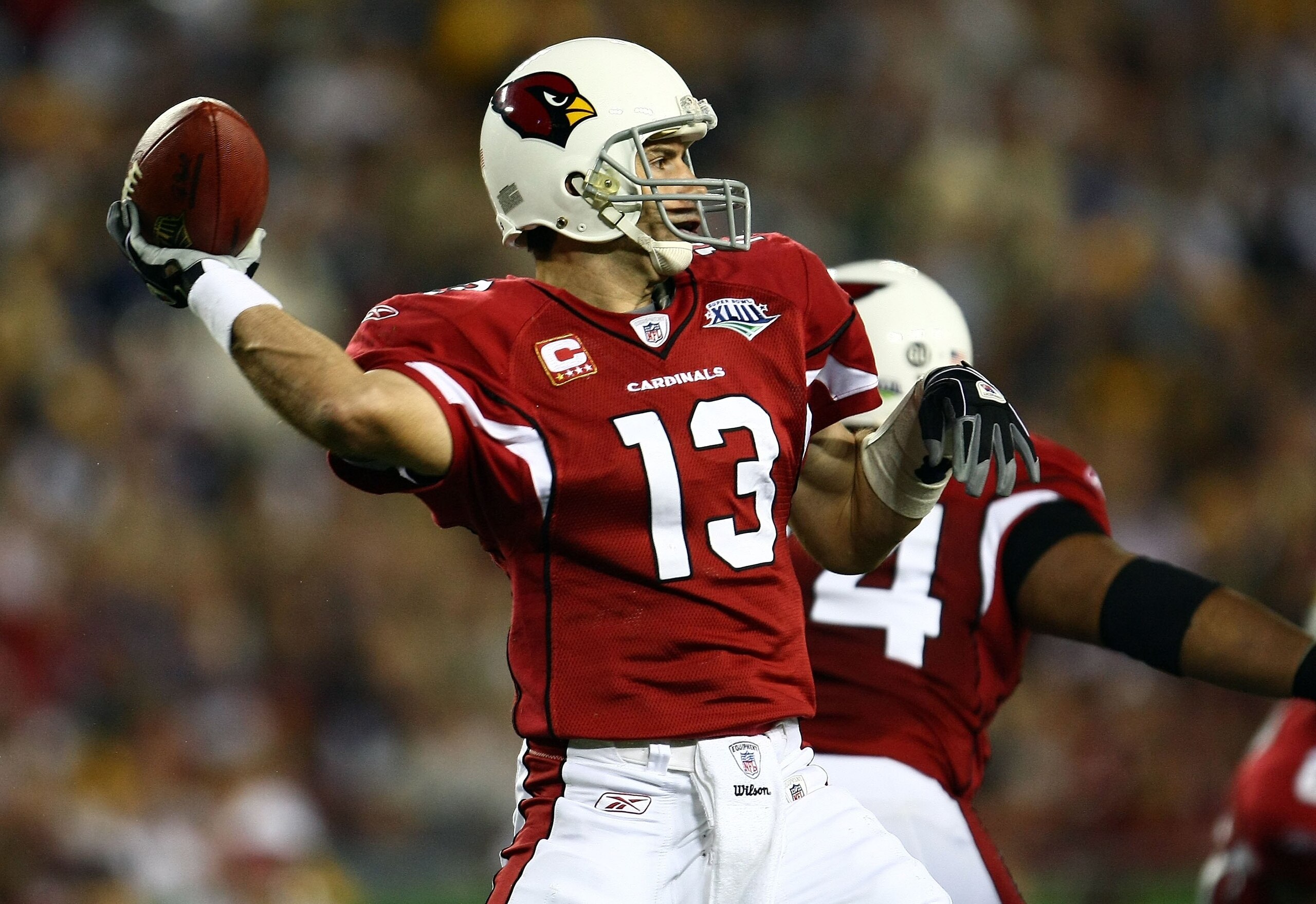
13. Arizona Cardinals 2008
3 of 15Eleven weeks into the season, the Arizona Cardinals were sitting pretty at 7-3.
Then they proceeded to lose four of their six remaining games, including blowout losses to Philadelphia (48-20) and New England (47-7).
After limping into the playoffs at 9-7 despite winning the NFC West, Arizona hosted Atlanta in the Wild Card Round. After falling behind 17-14, the Cardinals fought back, defeating the Falcons and rookie sensation Matt Ryan 30-24.
What happened next was a shocker to nearly everyone.
Except the Cardinals, that is.
In the Divisional Round, Arizona traveled to Carolina to face the Panthers, who were 8-0 at home that season. On top of that, Arizona had fared poorly in games on the East Coast, going 0-5.
On paper, the Panthers were clearly the better team.
Unfortunately for them, the Cardinals were in the middle of one of their greatest seasons in franchise history.
After falling behind 7-0, Arizona took the lead for good after scoring two touchdowns in the first quarter to go up 14-7.
The Arizona defense harassed Panthers quarterback Jake Delhomme all night, forcing him into six turnovers (five interceptions and a fumble).
The Cardinals won in a rout, 33-13, advancing to their first NFC Championship game.
Hosting Philadelphia for the right to go to the Super Bowl, the Cardinals took a 24-6 lead on three Larry Fitzgerald touchdown receptions before the Eagles stormed back to take a 25-24 lead midway through the fourth quarter.
But, as he usually did, Kurt Warner came through in the clutch, leading Arizona on a 14-play, 74-yard drive that ended with a nine-yard touchdown pass to running back Tim Hightower on third down. After the two-point conversion made it 32-25, the Cardinals held the Eagles on defense, advancing to their first Super Bowl in franchise history.
In Super Bowl XLIII, the Cardinals trailed 20-7 entering the fourth quarter and appeared to be out of it.
But, after switching to a no-huddle offense, things changed.
Warner was able to move the team down the field, and the Cardinals resembled the offense we had grown accustomed to seeing that season.
Arizona went on an eight-play, 87-yard drive that ended when Warner hit Fitzgerald on a one-yard fade route in the end zone, cutting the lead to 20-14.
With just under three minutes to play, the Steelers converted a 3rd-and-10 from their own 1-yard line, but it was wiped out on a holding penalty in the end zone by center Justin Hartwig, making it a safety and putting the score at 20-16 while giving Arizona possession of the ball.
On the second play of the drive, Warner hit Fitzgerald over the middle and the speedy receiver took care of the rest, racing 64 yards down the middle of the field untouched to give the Cardinals their first lead of the game.
Unfortunately, they had left the Steelers with too much time.
Pittsburgh got the ball back, staring at their own 22-yard line with 2:37 remaining and two timeouts.
Roethlisberger moved the offense to midfield, when, on 2nd-and-6, he found Santonio Holmes on a short route, and Holmes took it from there, racing down the field before being tackled at the 6-yard line.
After nearly making the game-winning pass on first-and-goal, Roethlisberger threw a bull's-eye to Holmes, who caught the ball in the right corner of the end zone with three defenders around him and 35 seconds remaining, giving the Steelers an NFL-record sixth Super Bowl victory.
Despite coming up just short, it had been a remarkable season for the Cardinals, who had been perennial losers since moving to Arizona in 1988.
.jpg?w=2560 "Rams Raiders Football")

.jpg?w=2560 "Steelers Saints Football")
12. Carolina Panthers 2003
4 of 15Two years removed from a 1-15 season, the Carolina Panthers, under second-year head coach John Fox, would make an incredible run to Super Bowl XXXVIII.
After going 7-9 in Fox's first season, the Panthers began the 2003 season 8-2, but lost three consecutive games to fall to 8-5.
But like they would do all season when their backs were to the wall, Carolina pulled through, finishing the season 3-0 to improve to 11-5, good enough for the No. 3 seed in the NFC.
In the regular season, the Cardiac Cats, as they came to be known, pulled off their share of dramatic comeback victories.
They won three games in overtime, all of them on the road, and seven of their victories came by a combined 19 points. In fact, the Panthers outscored their opponents by just 21 points, 325-304, during the regular season.
In the playoffs, the Panthers defeated Dallas 29-10 in the Wild Card Round behind a potent defense and a solid running attack, led by Stephen Davis and DeShaun Foster. They then outlasted St. Louis, 29-23, in a back-and-forth affair that saw five lead changes. Carolina won on the first play of the second overtime when quarterback Jake Delhomme hit wide receiver Steve Smith for a 69-yard touchdown.
In the NFC Championship Game, the Carolina offense put up just 14 points. But it was the defense, with four interceptions—two of which came with the Eagles deep in Carolina territory—and five sacks that stifled Donovan McNabb and the Eagles offense, holding them to three points and earning the Panthers their first trip to the Super Bowl.
For the first and much of the second quarter of Super Bowl XXXVIII, it was a defensive struggle between two of the league's best defenses.
But a Delhomme fumble—recovered by Patriots defensive lineman Richard Seymour at the Carolina 20-yard line—changed things, leading to the game's first score when Tom Brady hit wide receiver Deion Branch for a five-yard touchdown.
In the remaining 3:05, the Panthers would answer with a touchdown only to see New England do the same, making it 14-7 before kicker John Kasay made a 50-yard field goal as time expired, cutting the lead to 14-10 at intermission.
The Panthers scored 12 unanswered points to take a 22-21 lead in the fourth quarter, only to see New England respond, scoring a touchdown to take the lead back, 29-22.
But, just as he did with the Rams in the Super Bowl XXXVI, Ricky Proehl scored a touchdown to tie it late, leaving the Patriots with enough time to drive for a go-ahead field goal.
Kasay made a critical error when his kickoff sailed out of bounds, giving New England the ball on their own 40-yard line with 1:08 remaining.
Unfortunately for the Panthers, they had given Tom Brady too much time and too short of a field.
After moving into Carolina territory, New England faced a 3rd-and-3 and converted when Brady hit tight end Daniel Graham for a four-yard gain, giving the Patriots a fresh set of downs and some new-found hope.
Later, Brady found Branch on an out route at the 24-yard line, setting up Vinatieri for a 41-yard field goal attempt.
It's important to understand that at this point, Vinatieri had already missed a 31-yarder and had a 36-yarder blocked.
But this time, he was money.
The kick was true, and the Patriots had won their second Super Bowl in three years.
11. Tennessee Titans 1999
5 of 15Coming off three consecutive 8-8 seasons and a recent move to Nashville, these were uneasy times for the Tennessee Titans.
But the Titans answered the call, going 13-3 on the season, which was tied for the second-best record in the AFC.
Unfortunately for them, Jacksonville won the division with a 14-2 record, clinching the No. 1 seed. Because the Titans were in the same division, the highest seed they could attain was No. 4.
In the Wild Card Round against Buffalo, the Titans blew a 12-0 halftime lead and saw the Bills take a 16-15 lead with 16 seconds remaining when kicker Steve Christie hit a 41-yard field goal.
On the kickoff, fullback Lorenzo Neal picked up the ball and handed it to tight end Frank Wycheck, who lateraled a pass to wide receiver Kevin Dyson. Dyson took the ball 75 yards down the sideline, untouched, completing one of the most amazing plays in sports history. What came to be known as the "Music City Miracle" gave the Titans an improbable 22-16 victory, sending them to the Divisional Playoffs.
In the Divisional Round versus Indianapolis, both teams exchanged field goals in the first half, leaving the Colts with a 9-6 halftime lead.
And then things changed.
Early in the third quarter, the Titans workhorse, running back Eddie George, got some great blocking and ran up the middle, outracing defenders to the end zone for a 68-yard touchdown run, giving the Titans the lead for good at 13-9.
In the '99 NFL Playoffs, George was magnificent, rushing the ball 108 times for 449 yards and three touchdowns.
Two more Al Del Greco field goals made it 19-9 before Indianapolis could score a late touchdown.
For the game, Del Greco made four field goals, including a 49- and a 43-yarder.
After falling behind 7-0 and 14-7 in the AFC Championship game in Jacksonville, the Titans stormed back, scoring 26 unanswered points to defeat the Jaguars 33-14 and advance to the first Super Bowl in franchise history.
In Super Bowl XXXIV, St. Louis was able to move the ball down the field in the first half, but had to settle for field goals, taking a 9-0 lead into the half.
After the Rams blocked a Del Greco 47-yard field goal attempt, Kurt Warner and the offense marched down the field and scored when Warner hit Torry Holt for a nine-yard touchdown reception, making it 16-0.
But that only seemed to wake the Titans up.
They responded, scoring two touchdowns on lengthy drives that cut the lead to 16-13 before Del Greco's 43-yard field goal tied the game at 16 with 2:12 remaining.
But the Rams would not be denied.
On the first play of the ensuing drive, with the ball at the St. Louis 27-yard line, Warner dropped back and, under pressure, threw for wide receiver Isaac Bruce. The ball was underthrown, but Bruce adjusted and made the catch at the Tennessee 38-yard line, eluding defenders the rest of the way before scoring the biggest touchdown in Rams franchise history.
But it wasn't over just yet.
Down 23-16, the Titans, led by quarterback Steve McNair, embarked on a remarkable drive, moving all the way to the St. Louis 26-yard line.
Facing a 3rd-and-5, McNair took the snap, looked around, moved out of the pocket and, while nearly falling down in the process, cleared the grasp of defensive lineman Kevin Carter and Jay Williams. He got up and rifled a pass to wide receiver Kevin Dyson, who was tackled at the 10-yard line.
Tennessee used its final timeout, stopping the clock with six seconds to play.
What happened next is one of the most memorable plays in sports history.
Out of the shotgun, McNair took the snap, looked right and hit Dyson at the 5-yard line. He ran to the end zone and, as he was being tackled by linebacker Mike Jones, reached the ball forward, falling just one yard short and giving the Rams the most dramatic of victories.
The thinking on the play from the Titans' perspective was to get Jones to follow tight end Frank Wycheck. Wycheck and Dyson were both lined up to the right and Dyson ran a slant while Wycheck headed straight for the end zone. At first, Jones looked like he was going to follow Wycheck, but he turned back and focused his attention on Dyson, tackling him just before the Tennessee wideout could cross the goal line.
10. Pittsburgh Steelers 2005
6 of 15Following three straight losses, the Pittsburgh Steelers were sitting at 7-5 with four games to play and at risk of missing the playoffs.
But, as the Steelers usually do, they came through when it counted most, going 4-0 to finish the regular season and outscoring their opponents 115-33 in the process.
Despite trailing 10-0 and 17-7 against Cincinnati in the Wild Card Round, the Steelers, aided by the injury of Bengals quarterback Carson Palmer, rallied and defeated their division rivals handily, scoring 24 unanswered points to win 31-17.
Facing Indianapolis, who began the season 13-0 and had been thought of by many as the favorite to win the Super Bowl, the Steelers caught the Colts off-guard, scoring two touchdowns in the fourth quarter to take a 14-0 lead. A Jerome Bettis one-yard touchdown run in the third quarter put Pittsburgh ahead 21-3, but the Colts responded, scoring two touchdowns in the final period to cut the lead to 21-18.
After Joey Porter sacked Peyton Manning on fourth down at the Indianapolis 2-yard line with 1:20 left in the game, the Steelers took over, looking to finish off the Colts.
But because Indianapolis had all three of its timeouts remaining, the Steelers could not run out the clock by kneeling on the ball, so they decided to go for a touchdown—only to see Bettis fumble the ball on first down.
Defensive back Nick Harper recovered the ball and, save for quarterback Ben Roethlisberger, had a clear path to the end zone.
But Roethlisberger held his ground and made what is known in Pittsburgh as "The Tackle," grabbing Harper by the ankle and bringing him down at the Indianapolis 42-yard line.
The Colts drove to Pittsburgh's 28-yard line, only to see kicker Mike Vanderjagt—who, until that point, had been perfect at home in the playoffs—badly miss a 46-yard field goal, giving the Steelers the victory.
In the AFC Championship Game, the Steelers won their third road game of the playoffs, defeating Denver in convincing fashion, 34-17.
In Super Bowl XL, the Steelers, despite being outplayed in the first half, took a 7-3 lead into the half on Roethlisberger's 1-yard touchdown run. Following the intermission, Willie Parker's 75-yard touchdown run just 22 seconds in the third quarter gave them a 14-3 lead.
After the Seahawks cut the lead to 14-10 and drove deep into Pittsburgh territory early in the fourth quarter, quarterback Matt Hasselbeck threw an interception to Ike Taylor at the 5-yard line, ending the threat.
On the ensuing possession, after moving into Seattle territory, the Steelers ran a reverse to wide receiver Antwaan Randel-El, a college quarterback, who hit wide receiver Hines Ward for a 43-yard touchdown, giving Pittsburgh a 21-10 lead and head coach Bill Cowher his long-awaited Super Bowl championship.
9. New Orleans Saints 2009
7 of 15They had the weight of an entire city on their shoulders.
New Orleans, a city ravaged by Hurricane Katrina in 2005 and still recovering in some ways when Super Bowl XLIV came around, was desperate for a championship.
Without a professional hockey or baseball team and a basketball team, the Hornets, whose long-term stability was very much in question, the city often looked to their Saints for solace in difficult times.
Unfortunately for the people of New Orleans, the Saints were usually not very good.
But the arrival of head coach Sean Payton and quarterback Drew Brees changed all that.
In their first season with the team, 2006, New Orleans advanced to the NFC Championship Game.
In 2009, New Orleans started 13-0 and finished with the best record in the NFC, earning home field advantage throughout the playoffs.
Against Minnesota in the NFC Championship Game, despite being outgained 475-257 in total yardage, the Saints took advantage of five Vikings turnovers and, with the Vikings driving late in the fourth quarter for a potential game-winning field goal, cornerback Tracy Porter intercepted Brett Favre and sent the game into overtime.
After winning the coin toss, the Saints moved the ball down the field, converting a 4th-and-1 and moving deeper into Minnesota territory to get kicker Garrett Hartley in range for a field goal.
Later in the drive, he booted a 40-yard field goal to send New Orleans somewhere they'd never been before.
The Super Bowl.
Trailing 17-16 entering the fourth quarter, New Orleans answered the call and brought hope and joy to a town they call the Big Easy.
After Colts kicker Matt Stover missed a 51-yard field goal, the Saints had the ball on their own 41-yard line with a chance to make history.
Brees went to work, completing passes to seven different receivers on the drive before hitting tight end Jeremy Shockey from two yards out for the go-ahead touchdown with 5:42 remaining. The two-point conversion pass to Lance Moore gave the Saints a 24-17 lead.
Starting at the Indianapolis 25-yard line with 5:35 to play, the Colts went to work, taking seven plays to advance to the New Orleans 31-yard line.
Facing a 3rd-and-5, Peyton Manning looked for wide receiver Reggie Wayne on a slant, but Porter jumped the route and intercepted the pass, taking it 74 yards for the touchdown and ensuring a Saints Super Bowl victory while rejuvenating an entire city at the same time.
8. Pittsburgh Steelers 2008
8 of 15The 2008 Pittsburgh Steelers were a reflection of their head coach Mike Tomlin: tough, smart and resilient.
Those characteristics would prove to be quite helpful to the team during the season.
The Steelers had a successful regular season, finishing with a 12-4 record, winning the NFC North and clinching a first-round bye in the playoffs.
In the Divisional Round, they fell behind San Diego 7-0 and 10-7, but scored 21 unanswered points to go ahead 28-10 before cruising to victory.
Facing the rival Baltimore Ravens in the AFC Championship Game, the Steelers took control, grabbing 13-0 and 16-7 leads before the Ravens cut the deficit to 16-14 on a Willis McGahee one-yard touchdown run with 9:32 left to play.
After getting the ball back, the Ravens had a chance to take the lead with either a field goal or a touchdown.
But Troy Polamalu had other plans.
He intercepted Baltimore quarterback Joe Flacco's fastball, moving his way horizontally across the field before getting some blocks and running into the end zone for a 40-yard touchdown, giving the Steelers a 23-14 lead and sending them to Super Bowl XLIII.
In the Super Bowl, the Steelers led for nearly the entire game, but blew a 20-7 fourth quarter lead and fell behind 23-20 when Arizona quarterback Kurt Warner hit wide receiver Larry Fitzgerald for a 64-yard touchdown with 2:37 remaining.
But that's when Pittsburgh's toughness, intelligence and resiliency was put on display.
The Steelers, led by quarterback Ben Roethlisberger, embarked on an historic, eight-play, 78-yard drive that ended with Super Bowl MVP Santonio Holmes catching a touchdown in the corner of the end zone with 35 seconds to play, giving Pittsburgh its record sixth Super Bowl championship.
7. San Francisco 49ers 1988
9 of 15After 11 games, San Francisco was sitting at 6-5.
The 1988 season had been a tough one to say the least. The 49ers were transitioning from the 1981 and 1984 Super Bowl teams to a new breed of players, even playing Steve Young for Joe Montana at times, creating something of a quarterback controversy.
What the 49ers did from this point is one of the defining moments of their dynasty as well as something that helped to sustain Bill Walsh's legacy as one of the game's greats.
With Montana named as the starter for the rest of the season, the 49ers won four of their remaining five games, finishing 10-6 and earning a first-round bye in the playoffs.
They trounced Minnesota in the Divisional Playoffs, enacting revenge on the Vikings for the previous year's playoff defeat, winning 34-9 on three Montana touchdown passes—all of them to Jerry Rice—and two Roger Craig touchdown runs.
In the NFC Championship Game, after being questioned by the media all week about whether or not they could handle the cold weather and the stingy Chicago defense, the 49ers went into Soldier Field—where it was 17 degrees with wind gusts of up to 30 miles per hour—and ran up 406 yards of total offense and destroyed the Bears, 28-3.
In Super Bowl XXIII, the 49ers engaged in a back-and-forth affair with Cincinnati, taking a 3-0 lead before falling behind 6-3. They tied it at 6-6, fell behind again at 13-6 and tied it on a 14-yard pass from Montana to Rice early in the fourth quarter.
Kicker Jim Breech booted a 40-yard field goal with just over three minutes remaining, giving the Bengals their third lead of the game at 16-13.
With the ball on their own 8-yard line, the 49ers went to work, embarking on an 11-play, 92-yard drive that featured a variety of short passes to Roger Craig and a 27-yard reception by Rice that gave San Francisco a critical first down.
On arguably the signature play of the drive, facing a 2nd-and-20 from the Cincinnati 45-yard line, Montana hit Rice over the middle at the 33 and Rice did the rest, eluding Bengals defenders before finally being tackled at the 18-yard line.
It all ended a few players later with Montana hitting John Taylor on a 10-yard slant to win it with 34 seconds remaining to cap one of the great drives in NFL history and send Walsh off into the sunset.
6. New England Patriots 2003
10 of 15The Patriots were brilliant in the regular season, going 14-2 to clinch the top seed in the AFC.
However, things got much more difficult once the playoffs began.
In the Divisional Round, the Patriots faced the Tennessee Titans in a back-and-forth affair that saw the two teams play evenly matched football for nearly the entire game.
With the score tied at 14, the Patriots were able to pin the Titans deep in their own zone and force a punt that Troy Brown took from midfield to the Tennessee 40-yard line.
Despite gaining only 13 yards on the ensuing possession, the Patriots put Adam Vinatieri in position to give them the lead, and, despite the cold, frigid temperatures, he converted, kicking a 46-yard field goal through the uprights and thus adding to his legacy as the NFL's most clutch kicker of all-time.
The Titans responded, driving deep into New England territory, nearly converting on 4th-and-12 with less than two minutes remaining as quarterback Steve McNair threw a desperation pass that wide receiver Drew Bennett almost caught.
In the AFC Championship Game, the Patriots defense was able to stifle and frustrate Colts quarterback Peyton Manning all game, forcing the co-MVP into 23-of-47 passing for 237 yards, a touchdown and four interceptions.
The Patriots won the turnover battle, 5-2, and jumped out to a 15-0 halftime lead before Indianapolis got to within seven points in the second half, only to see the New England defense come through when it mattered most, ensuring the Patriots of a 24-14 win.
In Super Bowl XXXVIII, the Patriots faced the upstart Carolina Panthers, just two years removed from a 1-15 record.
A defensive struggle for most of the first half, a Carolina turnover created a spark for the Patriots as 24 points were scored in the latter portion of the fourth quarter.
New England took a 14-10 lead into the half.
After taking extending their lead to 21-10, the Patriots saw the Panthers rally and take a 22-21 lead midway through the fourth quarter on an 85-yard touchdown pass from quarterback Jake Delhomme to wide receiver Muhsin Muhammad.
The teams traded touchdowns, leaving the game tied at 29 with 1:08 remaining.
But Tom Brady, as he had done in Super Bowl XXXVI, led the Patriots down the field, completing a crucial 17-yard pass to Deion Branch with nine seconds remaining to set Vinatieri up for a game-winning field goal.
Vinatieri further secured his place in history, drilling the 41-yarder and giving the Patriots their second championship in three years.
5. Denver Broncos 1997
11 of 15It was a season filled with emotions.
In 1996, the Denver Broncos, after finishing 13-3 and clinching the No. 1 seed in the AFC, were primed to advance to the Super Bowl and give quarterback John Elway that elusive victory.
But the Jacksonville Jaguars, in just their second season in the NFL, had other ideas.
After falling behind 12-0, they ambushed the Broncos, catching them off-guard and taking the lead for good at 13-12 late in the second quarter before holding off Denver, winning 30-27.
Fortunately for the Broncos, they were given a chance at revenge the very next season, hosting Jacksonville in the Wild Card Round.
The Broncos, playing on great emotion, stormed out to a 21-0 lead only to see the Jaguars counter with 17 unanswered points.
In the fourth quarter, with Jacksonville driving and threatening to take the lead, quarterback Mark Brunell was sacked and fumbled the ball. The Broncos recovered and things completely changed from there.
The Broncos drove for a touchdown and piled it on from there, winning 42-17 and enacting their revenge on Jacksonville.
Facing Kansas City in the Divisional Playoffs, the Broncos were anxious for another chance to play their division rivals, who had defeated them in Kansas City, 24-22 in Week 12 on a Pete Stoyanovich 54-yard field goal as time expired.
The game turned out to be the difference in the Chiefs getting home field advantage in the AFC over the Broncos.
Denver came back from a 10-7 deficit against the Chiefs, defeating them 14-10 and advancing to the AFC Championship Game against Pittsburgh.
Against the Steelers, the Broncos took a 24-14 lead into the half, and no points were scored in the second half until Steelers quarterback Kordell Stewart hit Charles Johnson for a touchdown with 2:46 remaining.
The Broncos were faced with getting a first down or punting the ball back to Pittsburgh.
On the ensuing drive, with Denver facing a third down, Elway hit tight end Shannon Sharpe for a first down, allowing the Broncos to run out the clock and advance to their fourth Super Bowl.
Sharpe later said that Elway actually made up the play in the huddle, shortly before the snap.
In Super Bowl XXXII against Green Bay, it was a back-and-forth game throughout that saw the game tied at 24 with 3:27 remaining and the Broncos with the ball on the Packers 49-yard line with 3:27 remaining.
Then they did what they had done all game.
They rode Terrell Davis.
On the first play, he carried the ball for two yards, but a 15-yard facemask penalty on Green Bay moved the ball to the 32-yard line.
After John Elway completed a 23-yard pass to fullback Howard Griffith, a holding penalty brought the Broncos back to the 18-yard line.
From there, it was all Davis and the offensive line.
He nearly scored on the next play, running it 17 yards before being pushed out of bounds.
He later scored from a yard out when Packers head coach Mike Holmgren instructed his team to let Denver score, thus ensuring more time for his offense when they got the ball.
Denver had taken the lead, 31-24, but Brett Favre and the Packers had one last shot.
After moving the ball into Denver territory, the Packers faced a 4th-and-6 from the Broncos 31-yard line.
We all know what happened next.
Favre looked for tight end Mark Chmura over the middle, but linebacker John Mobley deflected the pass, sealing the win for Denver and giving John Elway his first Super Bowl Championship.
We all remember the call from Broncos play-by-play man Dave Logan:
"Favre, hit as he throws, pass is gonna be...INCOMPLETE! Denver has...Denver's gonna win it!"
4. New England Patriots 2001
12 of 15Midway through the second game of the season, things were looking quite bleak for the New England Patriots.
Quarterback Drew Bledsoe had been knocked out of the game, sustaining a vicious hit from New York Jets linebacker Mo Lewis while running to the sidelines.
In came second-year man Tom Brady, a sixth-round pick out of Michigan.
Things would never again be the same for New England.
Despite losing the game to the Jets and falling to 0-2, the Patriots were a completely different team from that point on.
They proceeded to finish the season 11-3 and earned a first-round bye behind a stout defense, led by Tedi Bruschi, Ty Law, Lawyer Milloy and Roman Phifer; and an offense that saw Brady throw for 2,843 yards and 18 touchdowns with 12 interceptions, Antowain Smith run for 1,157 yards and 12 touchdowns and Troy Brown catch 101 passes for 1,199 yards.
In the Divisional Playoffs against Oakland, the Patriots fell behind 13-3 after three quarters before rallying with 10 points in the fourth quarter, the last three coming on Adam Vinatieri's soon-to-be-historic 45-yard field goal in the snow with less than a minute remaining, sending the game into overtime.
After winning the coin toss, the Patriots drove the field, converting a fourth down and setting Vinatieri up for the game-winning 23-yard field goal.
In the AFC Championship Game, New England traveled to Pittsburgh to face the Steelers.
They took a 21-3 lead in the third quarter, losing Brady to injury along the way and scoring two touchdowns on special teams before the Steelers stormed back, closing to within 21-17 before a Vinatieri 44-yard field goal made it 24-17.
After Vinatieri missed a 50-yard field goal that would've iced the game, Pittsburgh got the ball back with one last chance, but Steelers quarterback Kordell Stewart was intercepted by Milloy, ending the Steelers' hopes of making a comeback.
In Super Bowl XXXVI, the Patriots were 14-point underdogs to the St. Louis Rams, led by NFL MVP Kurt Warner.
But the Patriots surprised everyone but themselves, taking a 17-3 lead into the fourth quarter.
The Rams responded, driving to the New England 3-yard line, and on fourth down Warner tried to run for a touchdown, only to have the ball stripped by linebacker Roman Phifer and returned by defensive back Tebucky Jones 97 yards for a touchdown, putting the game out of reach.
But there was a flag.
Linebacker Willie McGinest had been called for holding running back Marshall Faulk and the Rams were given new life.
Two plays later, Warner ran it in from two yards out, making it 17-10 with 9:31 left.
St. Louis was given a final chance late, taking over at their own 45-yard line with 1:51 to play.
"The Greatest Show on Turf," as they were called, went to work, completing two passes to move deep into New England territory before Warner hit Ricky Proehl from 26 yards out, tying the game and shifting the momentum back to St. Louis.
Starting the drive at their own 18-yard line with 1:21 remaining and no timeouts, Brady went to work.
He completed three passes in four plays to running back J.R. Redmond, moving the Patriots to the 41-yard line.
And then it happened.
Brady hit Brown at the St. Louis 45-yard line, with Brown running out of bounds at the 36-yard line, gaining 23 yards on the play and putting New England in field goal range.
A six-yard completion to tight end Jermaine Wiggins moved the Patriots to the 30-yard line, and Brady spiked the ball with seven seconds remaining.
After that, Adam Vinatieri nailed a 48-yarder, immortalizing himself and giving New England its first Super Bowl victory in three tries.
3. St. Louis Rams 1999
13 of 15The St. Louis Rams had been perennial losers.
Since moving from Los Angeles to the city known as "The Gateway to the West," the Rams had given their fans little reason to believe that good things lay ahead.
In 1998, the Rams were pathetic, going 4-12.
But in the offseason, head coach Dick Vermiel brought in Mike Martz to be his offensive coordinator, signed quarterback Trent Green, traded for running back Marshall Faulk and drafted wide receiver Torry Holt, bolstering their offense.
In the preseason, however, Green tore his ACL and was ruled out for the season. As Green went down, many reasoned, so had any chance the Rams having a successful season.
Enter Kurt Warner.
Today we know Warner as the just-retired future Hall-of-Fame quarterback who made it to three Super Bowls and won two MVP awards.
The Rams surprised everyone, steamrolling through the regular season, going 13-3 and clinching the No. 1 seed in the NFC.
After manhandling Minnesota in the Divisional Round, 49-37, the Rams ran into a Tampa Bay team that had one of the stingiest defenses in the league.
In fact, midway through the fourth quarter, the Rams had scored just five points and trailed, 6-5.
After a Dre' Bly interception set the Rams up with good field position, the offense drove to the Tampa Bay 30-yard line and faced a third down.
What happened next is one of the greatest plays in Rams franchise history.
Warner dropped back and threw deep down the sideline for journeyman receiver Ricky Proehl, who made an incredible reception in the end zone for his first touchdown of the season.
After the St. Louis defense, one of the best in the league, prevented the Bucs, who had driven into St. Louis territory, from scoring, the Rams advanced to Super Bowl XXXIV.
Against Tennessee, the Rams took a 16-0 lead in the third quarter, only to see the Titans storm back and score 16 unanswered points, tying the game with 2:12 to play.
But the Rams, seemingly a team of destiny, scored on the first play of their next drive when Warner hit wide receiver Isaac Bruce for 73-yard touchdown.
The Titans, like they had done in pressure situations all season, responded, driving the length of the field before getting to the St. Louis 10-yard line with six seconds remaining.
What happened next is one of the the most dramatic and memorable plays in NFL history.
Quarterback Steve McNair hit wide receiver Kevin Dyson on a slant at the 4-yard line only to see Rams linebacker Mike Jones tackle Dyson at the 1-yard line, winning the game for St. Louis and completing one of the most memorable plays in sports history.
2. New York Giants 2007
14 of 15After losing on a last-second field goal to Philadelphia in the playoffs the year before and wondering whether or not Tom Coughlin would remain the head coach of the team, New York faced its share of controversy even before the season began.
On top of that, there was criticism from recently-retired running back Tiki Barber, the Giants' all-time leading rusher, that quarterback Eli Manning was not a formidable leader. Barber even commented that Manning's attempt to lead an offensive meeting the previous season was "comical."
The beginning of the season didn't go very well, either.
The Giants lost at Dallas 45-35 in Week 1 and were trounced by the Packers at home the following week, 35-13.
In Week 3, the Giants rallied from a 17-3 second-half deficit, scoring 21 unanswered points in the second half to hold off Washington, stopping running back Ladell Betts on 4th-and-goal from the 1-yard line on the last play of the game.
They found their footing and improved to 6-2, putting them in the thick of the playoff race.
After rallying from a 14-0 deficit to defeat Buffalo on the road in Week 16 to improve to 10-5, they qualified for the playoffs.
Then Coughlin had a decision to make: play the starters in the final game against 15-0 New England and attempt to build some momentum for the playoffs, or rest the starters and take it easy?
Coughlin decided to go for it, and the Giants gave the Patriots one of their toughest games of the season before falling, 38-35.
Despite losing, the Giants had, as Coughlin hoped, built some momentum for themselves going into the playoffs.
Then New York accomplished a remarkable feat, winning three consecutive road playoff games.
They defeated Tampa Bay, 24-14, in the Wild Card Round and rallied to beat No. 1 seed Dallas 21-17, before winning the NFC Championship Game at Lambeau Field against the Green Bay in overtime, 23-20, on a Lawrence Tynes 47-yard field goal.
Two weeks later, in epic Super Bowl XLII, the Giants, just as they had in Week 17, stood punch-for-punch with the 18-0 Patriots.
The Giants took the opening kickoff and scored first to take a 3-0 lead, fell behind 7-3, and retook the lead on an Eli Manning five-yard touchdown pass to little-known receiver David Tyree early in the fourth quarter.
Late in the fourth quarter, however, the Patriots retook the lead on a Randy Moss six-yard touchdown reception, only to see the Giants respond, driving the length of the field to pull off the upset.
During the final drive, the Giants converted a fourth down, and, in one of the most memorable plays in sports history, Manning, who, after nearly being sacked, eluded pressure and hit Tyree for an incredible 32-yard pass down the middle with Tyree catching the ball and placing it between his hand and helmet to secure possession.
Shortly thereafter, after converting a 3rd-and-10, Manning hit wide receiver Plaxico Burress for a 13-yard touchdown, giving the Giants their third Super Bowl victory and completing one of the greatest upsets in sports history.
1. New York Giants 1990
15 of 15Through the first 10 games of the season, things were looking great for the New York Giants.
They were a remarkable 10-0, their offense was scoring points and their menacing defense, led by Lawrence Taylor and Leonard Marshall, was holding opponents in check.
It seemed like nothing could go wrong.
And then it did.
New York proceeded to go 1-3 in its next four games and lost starting quarterback Phil Simms for the season with a broken foot.
But they rallied around Jeff Hostetler and, as they saying goes, the rest is history.
They won their final two regular season games, albeit against poor teams, finishing with a 13-3 record and clinching a first-round bye in the playoffs.
In the Divisional Playoffs, they made easy work of Chicago, trouncing the Bears 31-3.
And then, the fun began.
In the NFC Championship Game at San Francisco, the Giants and the 49ers competed in one of the game's most epic battles.
A hard-fought contest throughout, the 49ers took a 13-6 lead early in the third quarter when Joe Montana hit John Taylor for a 61-yard touchdown.
The Giants drove and kicked a field goal, cutting the deficit to 13-9.
Midway through the fourth quarter, New York faced a 4th-and-2 from its own 46-yard line and was set to punt.
But the opportunistic Bill Parcells called a fake, and when the ball was snapped to up-man Gary Reasons, who took it right down the middle for 30 yards and a first down, putting the Giants in field goal range. Matt Bahr would kick a field goal later in the drive to make it 13-12.
But, with less than three minutes remaining and the 49ers with a first down at the New York 40-yard line, the Giants were in danger of running out of time.
But then it happened.
Nose tackle Erik Howard knocked the ball out of running back Roger Craig's hands and Taylor caught it in midair, giving the Giants the ball, the momentum and some new-found hope.
Hostetler and the offense answered the bell, driving to the San Francisco 24-yard line to set up Bahr, who booted a 42-yard field goal as time expired to give the Giants an incredible 15-13 victory.
In Super Bowl XXV against the Buffalo Bills and their potent, no-huddle offense, Parcells knew that his offense would have to control the clock to keep Jim Kelly and the Bills offense off the field. Parcells informed offensive coordinator Ron Erhardt that he wanted him to "shorten the game," thus limiting Buffalo's opportunities.
On top of that, defensive coordinator Bill Belichick had to convince his players that the best way to contain the Buffalo offense would be to allow running back Thurman Thomas to rush for over 100 yards, thereby limited the Bills' opportunities at converting on big pass plays.
Both philosophies proved to work.
The Giants held onto the ball for 40 minutes, 33 seconds compared to just 19:27 for the Bills.
While Thomas ran for 135 yards on 15 carries and a touchdown, Kelly was held in check, throwing for 212 yards on 18-for-30 passing with no touchdowns.
Despite falling behind 12-3 and 19-17, the Giants offense, led by Hostetler, answered the call both times, taking back the lead both times and going ahead 20-19 on a 21-yard field goal by Bahr midway through the fourth quarter.
After trading possessions, the Bills got the ball back on their own 10-yard line with 2:16 remaining and proceeded to drive to the New York 29-yard line, setting kicker Scott Norwood up for a potential game-winning 47-yard field goal.
As we all know, Norwood missed just to the right, and the Giants had their second Super Bowl victory in five years.
.jpg?w=2560 "Cowboys Packers Football")



.jpg?w=2560 "🚨 Week 8 AP Top 25 Poll")
