

2011 NFL Draft: Projecting Which Schools Will Have the Most First Round Picks
Underclassmen have until Saturday to decide whether they will enter April's draft, so we'll soon get an idea of the entire player pool available to NFL teams.
But which college team will have the biggest impact on the draft, particularly in the first round?
Well, you can expect some of the usual suspects out of the SEC to play a large role in the draft's first day, much like they have in recent years past.
But a few surprises may arise, including one unlikely program from the Pac-10.
Note: Projections were made on current draft order, which will be altered upon conclusion of the playoffs.
Alabama Crimson Tide
1 of 6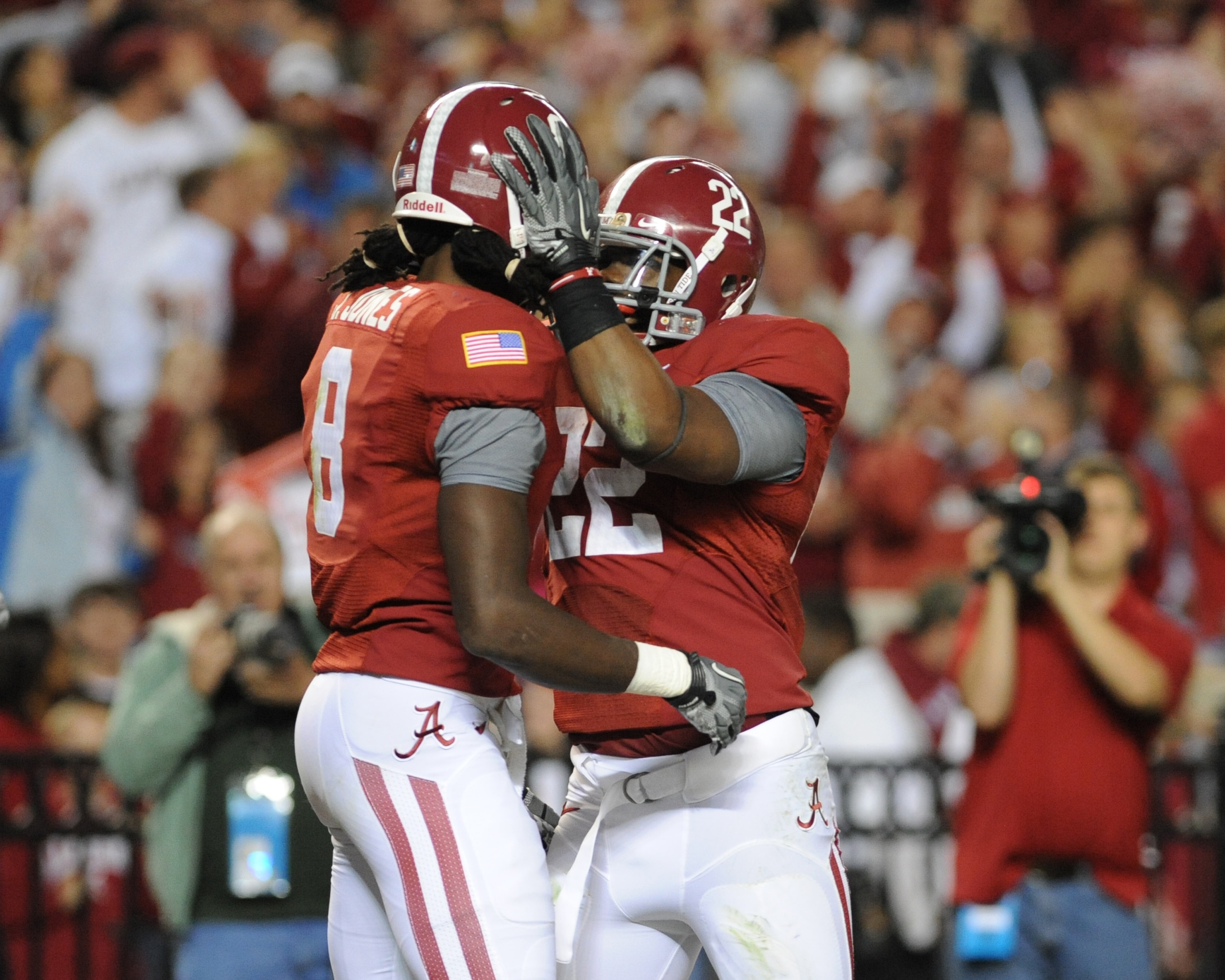
Marcell Dareus (No. 9 pick overall, Dallas Cowboys)
Dareus will be the first of three Tide players taken in the first round, more than any other school.
Just a junior, the 6’3”, 310-pound Dareus often dominated at the college level, using his awesome strength to dominate offensive tackles and guards. He’s a high-character guy with a terrific motor and allows the Cowboys the flexibility to use him as a prototypical end in the 3-4, as well as give him the occasional rep on the inside as a gap tackle.
Julio Jones (No. 14 pick overall, St. Louis Rams)
Arguably the most pro-ready receiver in the draft, Jones has everything you want from the position at the next level. Mixing great size, strength and quickness, Jones excelled in Alabama’s pro style and spread schemes, and has shown the ability to consistently beat his man off the ball, even when jammed at the line.
The Rams will covet A.J. Green’s big-play ability more, but with the Georgia Bulldog off the board, Steve Spagnuolo and his staff land the better long-term selection in Jones. He’ll instantly provide Sam Bradford with the explosive target the Rams offense so glaringly lacked in 2010.
Mark Ingram (No. 15 pick overall, Miami Dolphins)
The third and final Alabama player off the board in the first round is Ingram, who’s size and power Tony Sparano will love incorporating into his run-first mentality in Miami.
At 5’10”, 215 pounds, Ingram runs extremely well behind his pads and mixes power to complement his surprising ability to gain the edge and make defenders miss in space. And he’s shown terrific versatility in college that may translate to the next level, often taking snaps out of the Wildcat or lining up at wide receiver in Alabama’s offense.
Auburn Tigers
2 of 6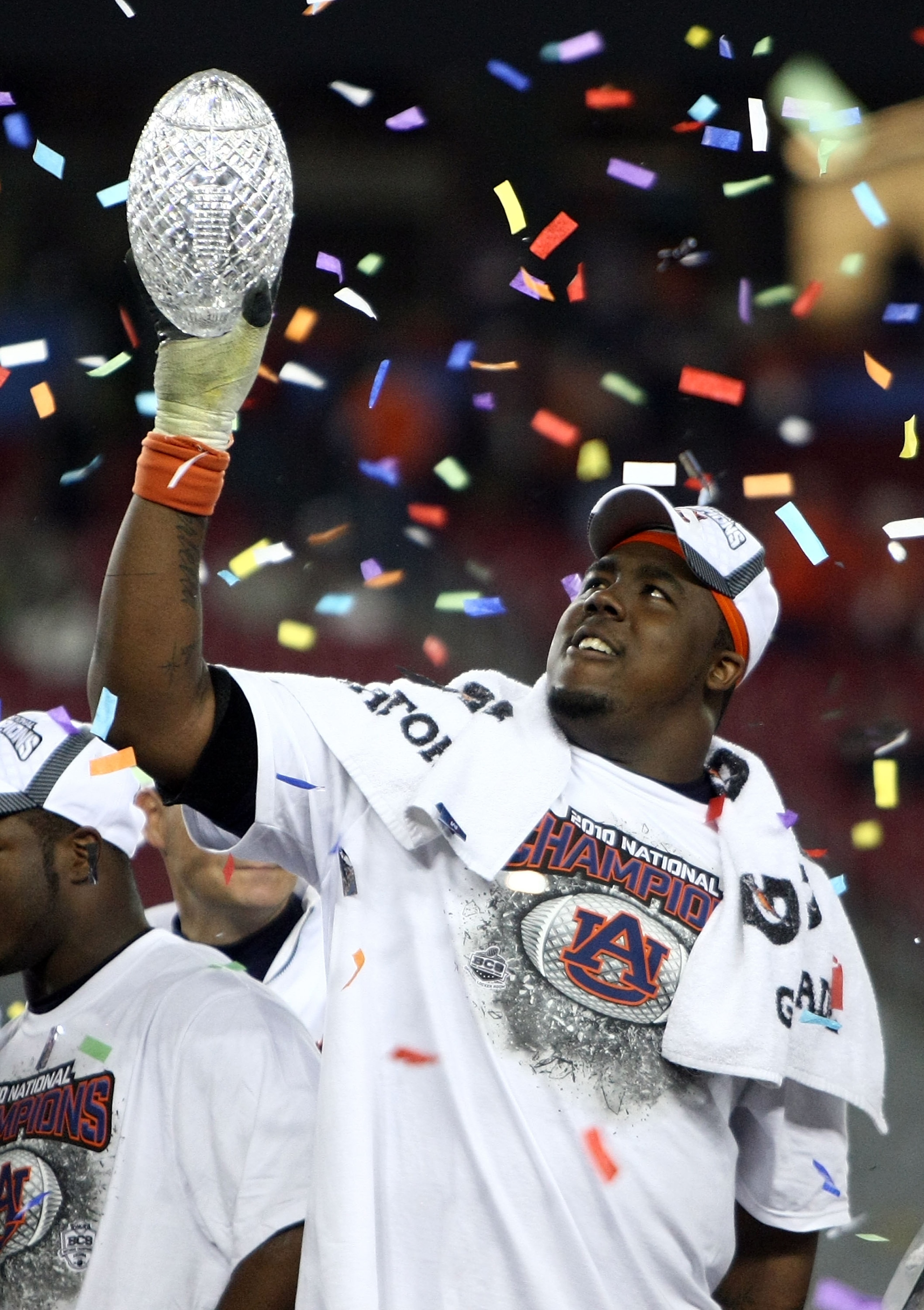
Nick Fairley (No. 1 overall pick, Carolina Panthers)
Fairley was a fringe top five pick prior to Monday’s BCS National Championship, but his dominating performance against Oregon has his stock soaring entering the heavy period of pre-draft evaluation.
Not only did Fairley display superior strength in shedding blocks and splitting double-teams, but his agility and closing speed were the reasons for perhaps the game’s two biggest plays. Oregon down just a score late in the third quarter and facing first-and-goal, Fairley lead an Auburn defensive charge, first chasing down back Kenjon Barner from behind on third down to save a sure touchdown. On fourth down, Fairley penetrated into the backfield to disrupt another running play as Auburn held from its own 1-yard line.
Cam Newton (No. 10 pick overall, Washington Redskins)
Mike Shanahan’s experiment with Donovan McNabb was, to say the least, disastrous, so replacing the quarterback after his inevitable trade or release will have to addressed. Is that replacement going to be Newton? There’s no reason why it cannot.
Newton didn’t have his best game against Oregon, but he elevates the play of those around him and he just flat-out wins games. That has to count for something. Say what you will about the character issues and NCAA investigation, which is ongoing, but Newton could just as easily be the draft’s second-best quarterback as its fourth-best. With so many teams looking to fill a void at the position, it won’t matter much and Newton still gets selected in the top 10.
Wisconsin Badgers
3 of 6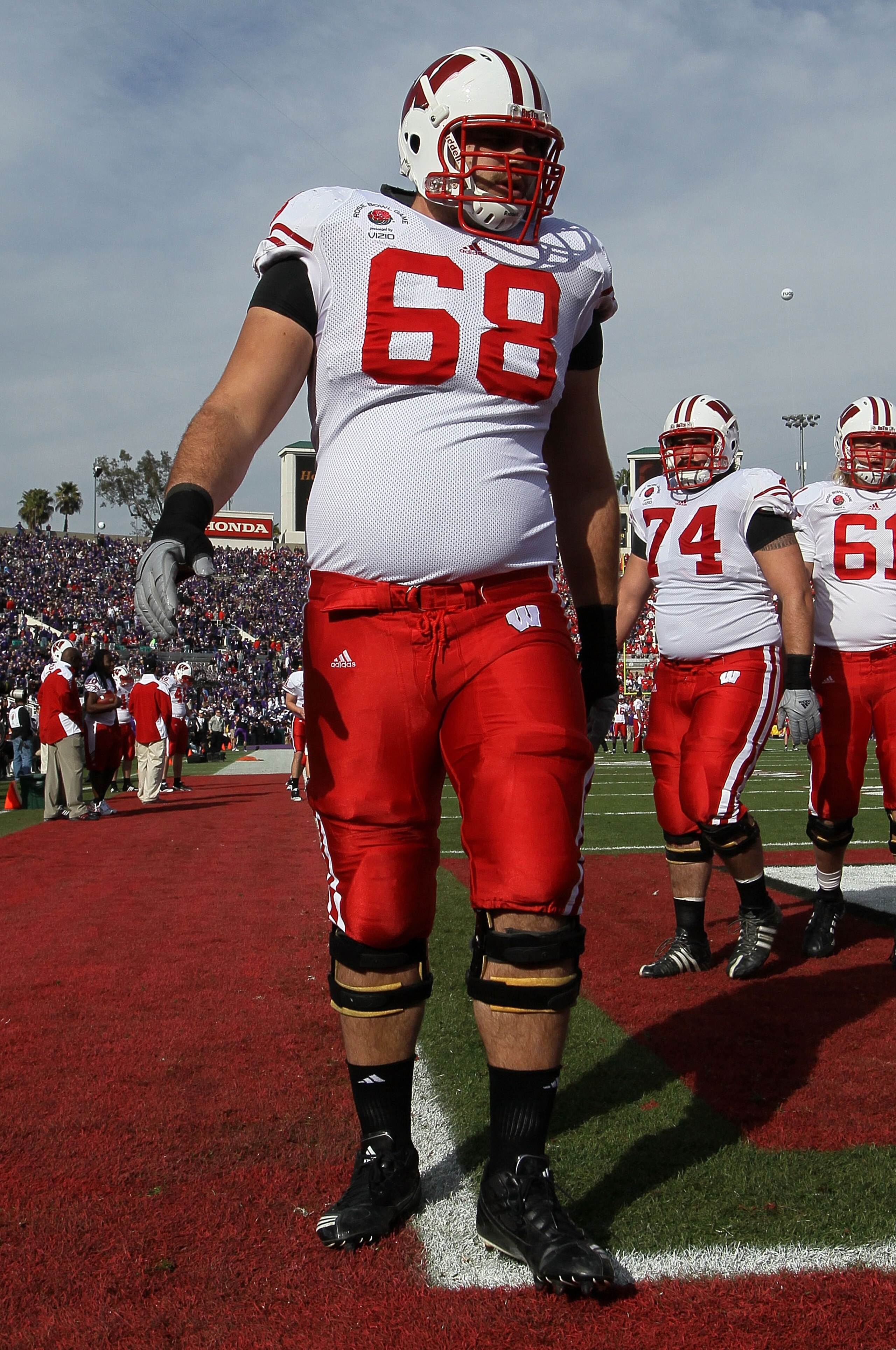
Gabe Carimi (No. 19 overall pick, New York Giants)
The Giants will flip-flop between Carimi and Colorado’s Nate Solder, but, ultimately, this season’s Outland Trophy winner gets the nod, becoming the first offensive lineman off the board.
The taller Solder would be more ideal in pass protection, but Carimi brings an edge and an attitude to the Giants running game that seemed lacking in 2010. The best among an ultra-impressive line at Wisconsin, Carimi started all but three games in his four-year career in Madison, and his overall durability allows the Giants to bolster the interior of the line by moving David Diehl from tackle to guard.
J.J. Watt (No. 31 overall pick, Atlanta Falcons)
The former tight end may be a tad of a reach in the first round, but the Falcons are in need of a pass rushing threat to replace veteran John Abraham, and Watt may be the best available player at his position by the time Atlanta’s choice rolls around.
Watt transferred from Central Michigan to Wisconsin after the 2007 season, at which time he made the switch to defense. Good call. Over the past two seasons, Watt has started 26 consecutive games and this season led the Badgers in tackles for loss, quarterback hurries, forced fumbles, blocked kicks and sacks while earning first-team All-Big Ten honors.
.jpg?w=2560 "Colts Football")
.jpg?w=2560)
.jpg?w=2560 "Commanders 49ers Football")
Miami Hurricanes
4 of 6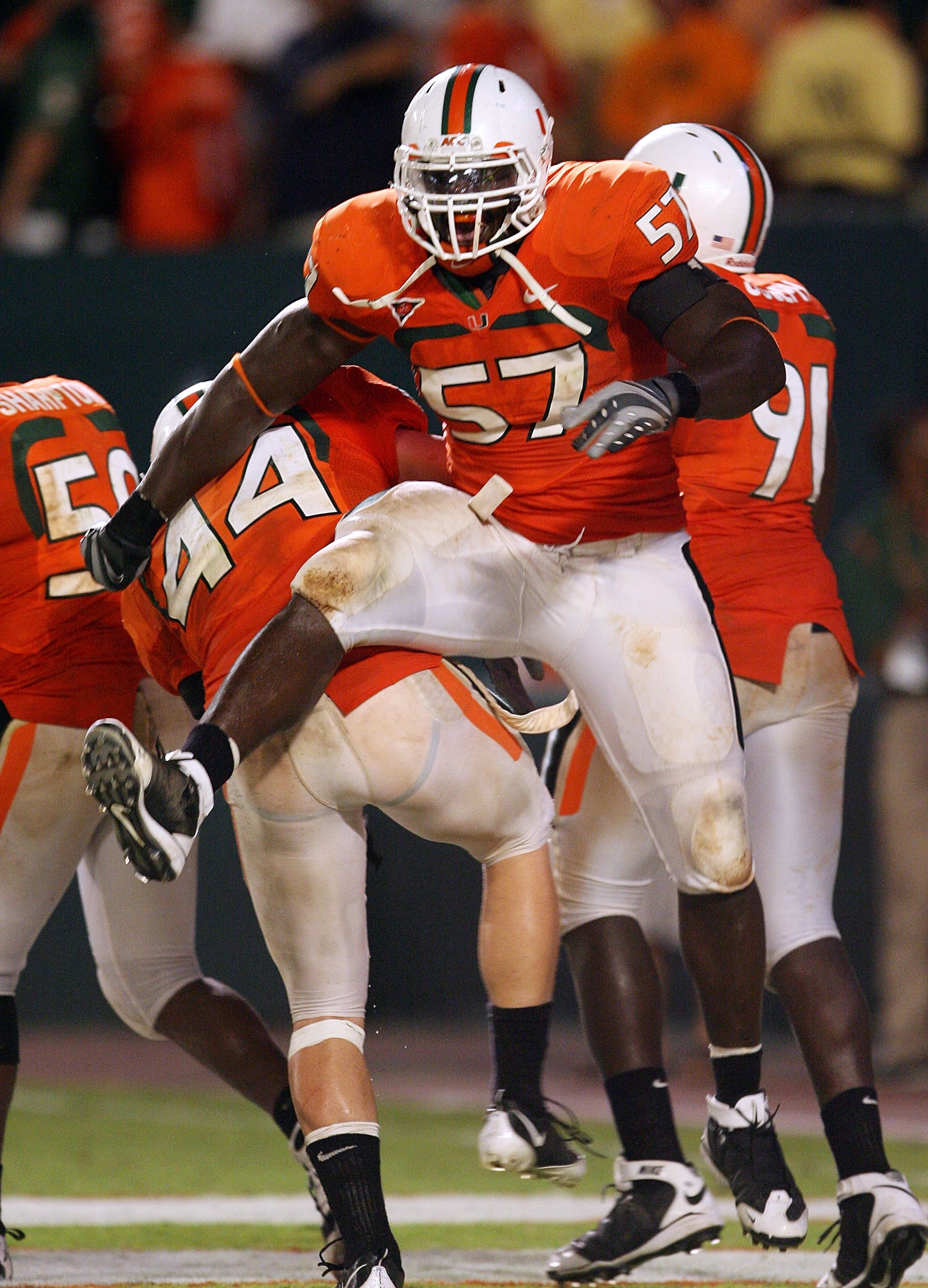
Allen Bailey (No. 26 pick overall, New Orleans Saints)
Bailey’s selection, like that of some other prospects on this list, is subject to change given the jumbling in draft order that will take place upon the completion of the playoffs, but his skill set is considerable as a prototypical defensive end in a 4-3 scheme.
He has above average size (6’4”, 285 lbs.) and quickness, but durability, tainted by a stress fracture in his back in 2006, could raise concerns. Nevertheless, Bailey, who led the 'Canes in sacks each of the past two seasons while splitting time between defensive tackle and end, possesses the talent to warrant a first round pick, whether it’s in New Orleans or elsewhere.
Brandon Harris (No. 30 overall pick, Pittsburgh Steelers)
Physical and stout in run support, Harris fits the mold of a Pittsburgh defensive back, and has the flexibility and overall athleticism to contribute effectively in pass coverage.
ACC opponents seldom tested Harris, but he still registered an interception and 10 pass breakups, tied for fourth-most in the conference. Even more, he’s a heady player, earning All-ACC academic honors in 2008, and is the son of Tim Harris, a former USA Today National High School Coach of the Year.
UCLA Bruins
5 of 6
Akeem Ayers (No. 22 overall pick, Kansas City Chiefs)
Built to handle the rigors of playing inside, Ayers (6’4”, 250 lbs.) manned the outside linebacker position at UCLA, where he finished 2010 with 68 tackles, including four sacks.
A fluid athlete with long arms and an ability to play in space, Ayers would provide the Chiefs with athleticism in the front seven alongside Derrick Johnson, particularly at the weak side position, where the aging Mike Vrabel may not be retained.
Rahim Moore (No. 24 overall pick, Philadelphia Eagles)
The top-rated safety on the draft board, Moore may not drop this far, but he’d be an ideal fit for the Philadelphia secondary, where the possible departure of free agents Ellis Hobbs and Quintin Mikell looms.
Moore (6’1”, 196 lbs.), who started 25 straight games in two seasons as a starter for the Bruins, lacks ideal height, but he has the room on his frame to add more bulk and his instincts are nearly superior to any other prospect at the position.
Overall, he would make an immediate impact for a Philadelphia pass defense that struggled mightily in 2010, allowing 31 touchdown passes during the regular season.
Georgia Bulldogs
6 of 6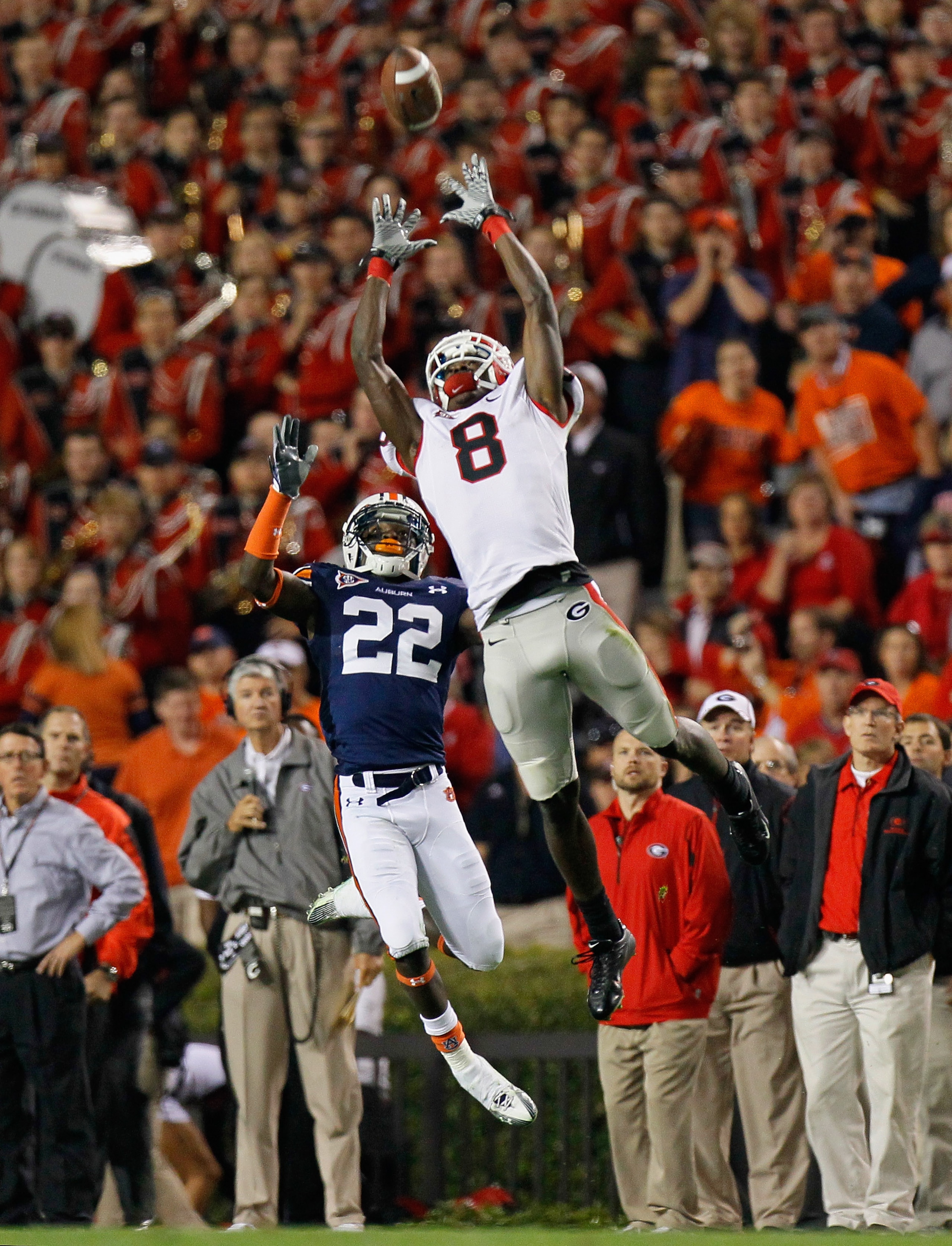
Justin Houston (No. 25 overall pick, Green Bay Packers)
There is no shortage of playmaking linebackers in Green Bay, but Dom Caper’s 3-4 scheme could always use a new toy. Houston is quick, able to fly from sideline to sideline, but his size (6’3”, 254) is ideal for roaming the middle of the defense.
Of all the top-flight defenders in the SEC, Houston was among the best, finishing behind only Auburn’s Nick Fairley in sacks (10) and tackles for loss (18.5). Because of the surplus of notable defensive prospects likely to go in the first round, Houston could fall to the second, but he would fit well in the Green Bay defense, playing alongside Clay Matthews and A.J. Hawk.
A.J. Green (No. 6 overall pick, Cleveland Browns)
The Browns are in desperate need of a playmaker on the perimeter of the offense, and you could make a very strong case that Green is the draft’s best overall receiving prospect, particularly as a route runner.
Despite being suspended for the first four games of 2010, Green finished the season with 848 yards and nine touchdowns on a team-high 57 receptions.
Playing with former teammate Mohamed Massaquoi, who was drafted by Cleveland in the second round of last year’s draft, Green would provide the Browns and quarterback Colt McCoy with a vertical threat in the passing game, thus relieving some of the pressure on running back Peyton Hillis.
.jpg?w=2560 "DOLPHINS-AIKMAN")
_0.png?w=2560 "Unranked Teams Cause Chaos in Rankings 📊")

.png?w=2560 "Week 8 Winners & Losers 📊")





