Top 10 Defensive Pairs in the NHL
Defense is essential for a team that is looking to be successful in the playoffs.
Although defense is a team effort, which involves both defensemen and two-way forwards, the top defensive pair sets the tone for team defense and is expected to score more than they are scored upon when they take the ice.
Often the top defensive pair is called upon to face the quickest forwards in the game. Often these players skate well, are difficult to check, and have heavy shots.
The following slides display the 10 best defensive pairs going into next season.
Due to offseason transactions some of these pairings may change or never come to fruition. In fact, four of the pairings are simply speculation. These four defensive tandems appear to be the most logical pairings for each respective team. The other six are pairings are ones from last year that worked out well.
10. Carlo Colaiacovo, Erik Johnson (St. Louis Blues)
1 of 10
2009-10 Statistics
Carlo Colaiacovo
67 GP: 7 G, 32 PT, +8
Erik Johnson
79 GP: 10 G, 39 PT, +1
Analysis
With the departure of Mike Weaver, Carlo Colaiacovo, who is entering his prime and coming off a solid season, is in need of a defensive partner.
Erik Johnson, a player with plenty of upside that would benefit from having a steady partner on the blueline, has the ability to become one of the NHL's best offensive defensemen. Colaiacovo is a responsible defensemen who will give Johnson the confidence to jump into the play in the offensive end.
With a better, more experienced team around him in 2010, Johnson should be expected to have a breakout season.
9. Dan Hamhuis, Christian Ehrhoff (Vancouver Canucks)
2 of 10
2009-10 Statistics
Dan Hamhuis
78 GP: 5 G, 24 PT, +4 (with Nashville)
Christan Ehrhoff
80 GP: 14 G, 44 PT, +36
Analysis
The defensive pairings will be shaken up in Vancouver due to the arrival of Dan Hamhuis and Keith Ballard, and there are many plausible combinations.
Christian Ehrhoff may benefit most from the arrival of Dan Hamhuis, who is responsible in his own end and has offensive upside.
Ehrhoff has thrived in Vancouver since arriving from San Jose in a move that freed cap space for Dany Heatley.
Ehrhoff has an erratic shot that either finds the back of the net or jumps out of the offensive zone, so having a reliable partner like Hamhuis would give him the confidence he needs to let it rip from the blue line.
8. Drew Doughty, Jack Johnson (Los Angeles Kings)
3 of 10
2009-10 Statistics:
Drew Doughty
82 GP: 16 G, 59 PT, +20
Jack Johnson
80 GP: 8 G, 36 PT, -15
Analysis:
Drew Doughty, 20, is quickly establishing himself as one of the greatest defensemen in the league. His shifty spin move and quick feet allow him to get open and make him a major threat from the blue line.
His partner, Jack Johnson, can hold his own as well. He will, however, have to be more responsible in his own end. The Kings are an offensively minded hockey team that relies on defensemen like Johnson to cut off angles and break up odd-man rushes.

.jpg?w=2560 "Golden Knights Blues Hockey")
7. Chris Pronger, Matt Carle (Philadelphia Flyers)
4 of 10
2009-10 Statistics:
Chris Pronger
82 GP: 10 G, 55 PT, +22
Matt Carle
82 GP: 6 G, 35 PT, +19
Analysis:
The 2nd overall selection by the Hartford Whalers in 1993, Chris Pronger is entering the latter stages of his career, but still remains one of the best—and most hated—defensemen in the league. He has been a part of the Stanley Cup Finals two of the last four years and knows what is necessary for a team to succeed in the playoffs.
Matt Carle, on the other hand, is a young player with plenty of upside. He will greatly benefit from playing with one of the NHL's best defensemen and should be an important part of the Flyers' franchise going forward.
6. Anton Volchenkov, Colin White (New Jersey Devils)
5 of 10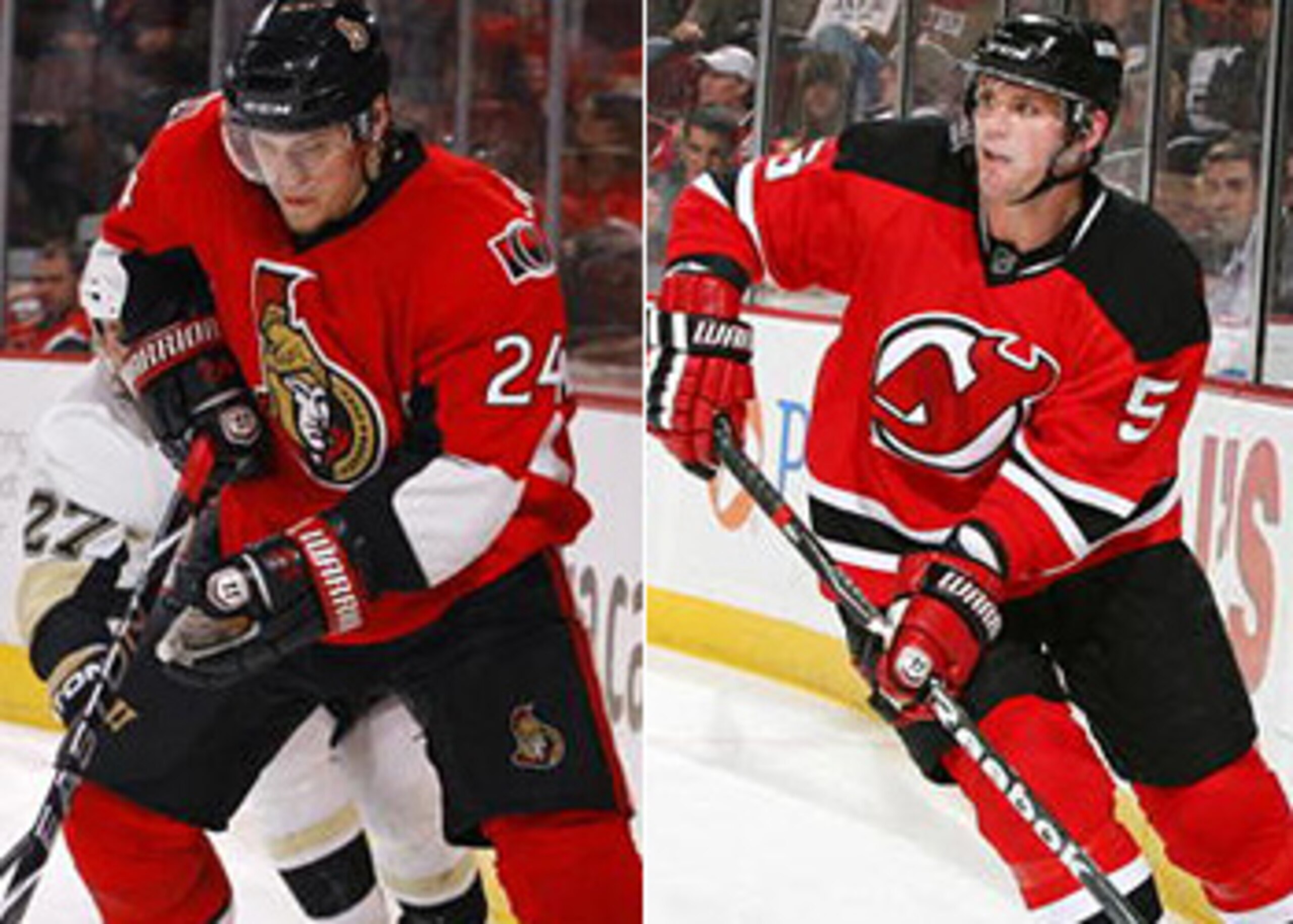
2009-10 Statistics:
Anton Volchenkov
64 GP: 4 G, 14 PT, +2 (with Ottawa)
Colin White
81 GP: 2 G, 12 PT, +8
Analysis:
New Jersey replaced longtime Devil Paul Martin by adding Anton Volchenkov and Henrik Tallinder in the offseason.
The Devils are a team that focuses on defense and by pairing Volchenkov with Colin White, the team should be able to shut down the best forwards in the league.
Neither player is incredibly offensively savvy, but both know how to make goaltender Marty Brodeur's job easy.
5. Dan Boyle, Marc-Edouard Vlasic (San Jose Sharks)
6 of 10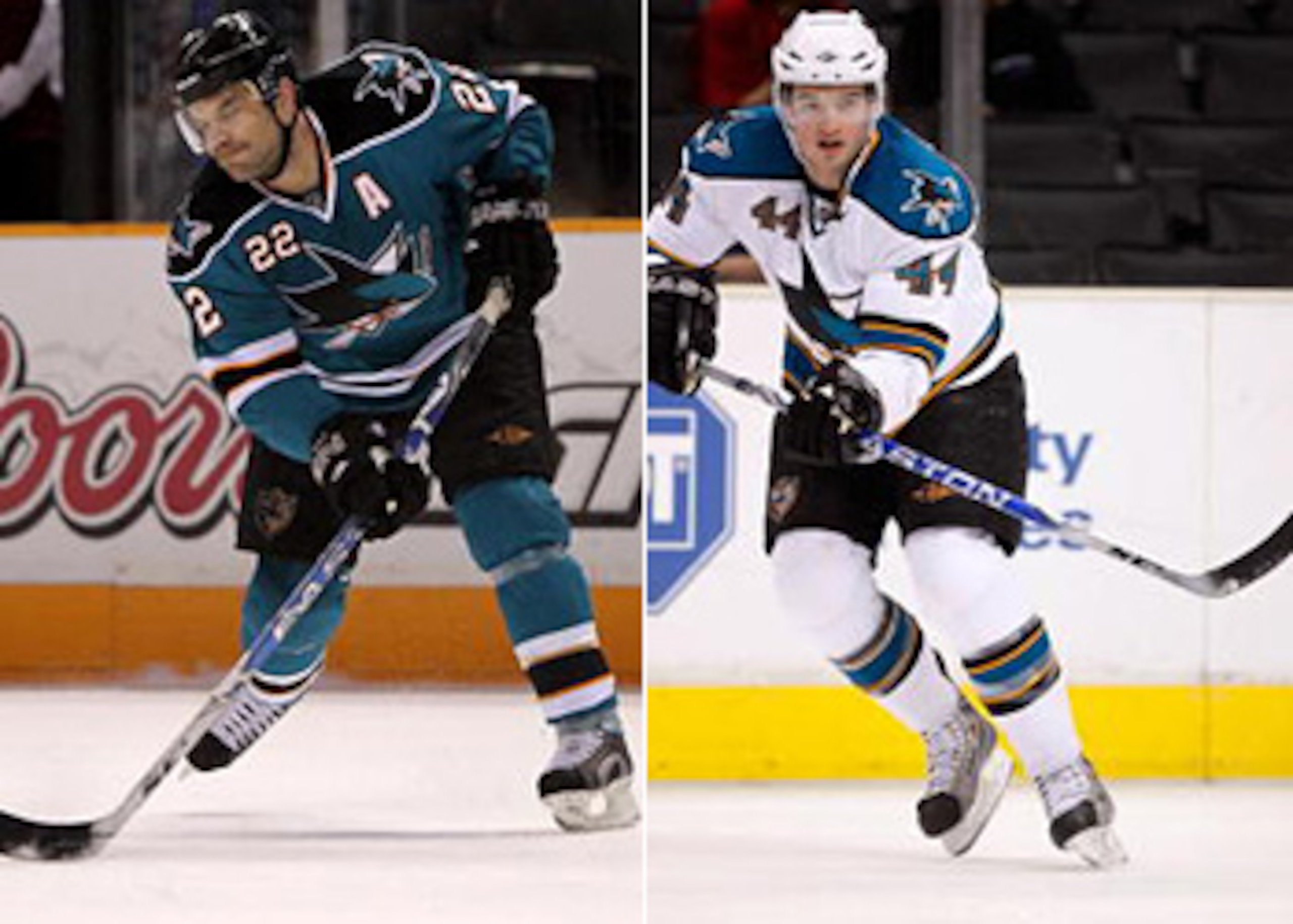
2009-10 Statistics:
Dan Boyle
76 GP: 15 G, 58 PT, +6
Marc-Edouard Vlasic
64 GP: 3 G, 16 PT, +16
Analysis:
With the departure of Rob Blake, the Sharks' defensive corps will be shaken up.
Dan Boyle has established himself as one of the best offensive-defensemen in the league and Marc-Edouard Vlasic, 23, is an overlooked young defensemen in the league. The two would make a dominant pairing in San Jose.
When paired with Jason Demers last season, another rising star, Boyle thrived, and Vlasic is a better talent that is looking to make an impact with the Sharks. The two could make the San Jose faithful forget about Rob Blake next season.
4. Shea Weber, Ryan Suter (Nashville Predators)
7 of 10
2009-10 Statistics:
Shea Weber
78 GP: 16 G, 43 PT, even
Ryan Suter
82 GP: 4 G, 37 PT, +4
Analysis:
Shea Weber and Ryan Suter are arguably one of the best young defensive pairs in the NHL.
Their combined plus-minus (4) is not astonishing, but it is a team statistic and the Preds play in a division with traditional powerhouse teams like the Chicago Blackhawks, St. Louis Blues, and Detroit Red Wings.
Weber and Suter are the cornerstone of the Nashville franchise, which will continue to hang in limbo until the team can win a playoff series and generate enough interest to increase salary and retain homegrown players that enter free agency.
3. Mike Green, Jeff Schultz (Washington Capitals)
8 of 10
2009-10 Statistics:
Mike Green
75 GP: 19 G, 76 PT, +39
Jeff Schultz
73 GP: 3 G, 23 PT, +50
Analysis:
Another young tandem that has become a force in the NHL, Mike Green and Jeff Schultz, both 24, had a ridiculous combined plus-minus of +89.
Granted, some of those numbers have been counted twice, and both of their plus-minus numbers should decrease in a more competitive Southeast Division next year, but their effort has made the Capitals one of the NHL's best teams over the last few years.
Nineteen goals is hardly a disappointing season, but Mike Green's 31 tallies in 2008 are going to be difficult to top. Schultz is less offensively savvy, but he's a disciplined stay-at-home defensemen that makes it difficult for forwards to score when he's on the ice.
2. Duncan Keith, Brent Seabrook (Chicago Blackhawks)
9 of 10
2009-10 Statistics:
Duncan Keith
82 GP: 14 G, 69 PT, +21
Brent Seabrook
78 GP: 4 G, 30 PT, +20
Analysis:
The only young defensive pair that tops Nashville's combination of Shea Weber and Ryan Suter is within their own division playing for the Chicago Blackhawks.
Keith's quick skates and vision allow him to be in position to score in the offensive zone and keep pucks out of his own net. Seabrook plays a physical game, but has become more disciplined since entering the league in 2005.
If this duo continues to clamp down on defensemen as they did last year, the team will remain competitive despite recent salary cap casualties.
1. Niklas Lidstrom, Brian Rafalski (Detroit Red Wings)
10 of 10
2009-10 Statistics:
Niklas Lidstrom
82 GP: 9 G, 49 PT, +22
Brian Rafalski
78 GP: 8 G, 42 PT, +23
Analysis:
This combination will not be around much longer, but it will continue to dominate while it lasts.
Niklas Lidstrom, 40, and Brian Rafalski, 36, are nearing the end of their careers. Lidstrom contemplated retirement last year and Rafalski was the elder statesman on the US Olympic team.
Neither player has lost production as they have gotten older, but the Red Wings are beginning to look old compared to younger competition in Chicago, San Jose, and Los Angeles.


.jpg?w=2560 "Chiefs, Steelers Eye WR Trades")