
The Dominance Rating: The Newest Revolution In Statistics
Have you ever tried to argue with someone about quarterbacks in different generations? Younger fans tend to argue that the current crop of QBs is better than the older generations because they have better numbers. Older fans will retort that the rules are different and favor the offenses more than in the old days. You could go back and forth arguing whether Peyton Manning or Johnny Unitas is better for days and not get anywhere.
Until now.
Recently, as a result of an argument about QBs in different generations, I decided to create a statistic that could effectively compare QBs from any era. I settled upon the dominance rating. Basically, it compares each QB to the league average for a season or group of seasons. Using some simple math I can figure out how much better or worse than average a QB was for a season or over the course of their career. A rating of 100 is average, higher is better and lower is worse. There are no upper or lower limits set on the rating.
TOP NEWS

New NFL Power Rankings 📊
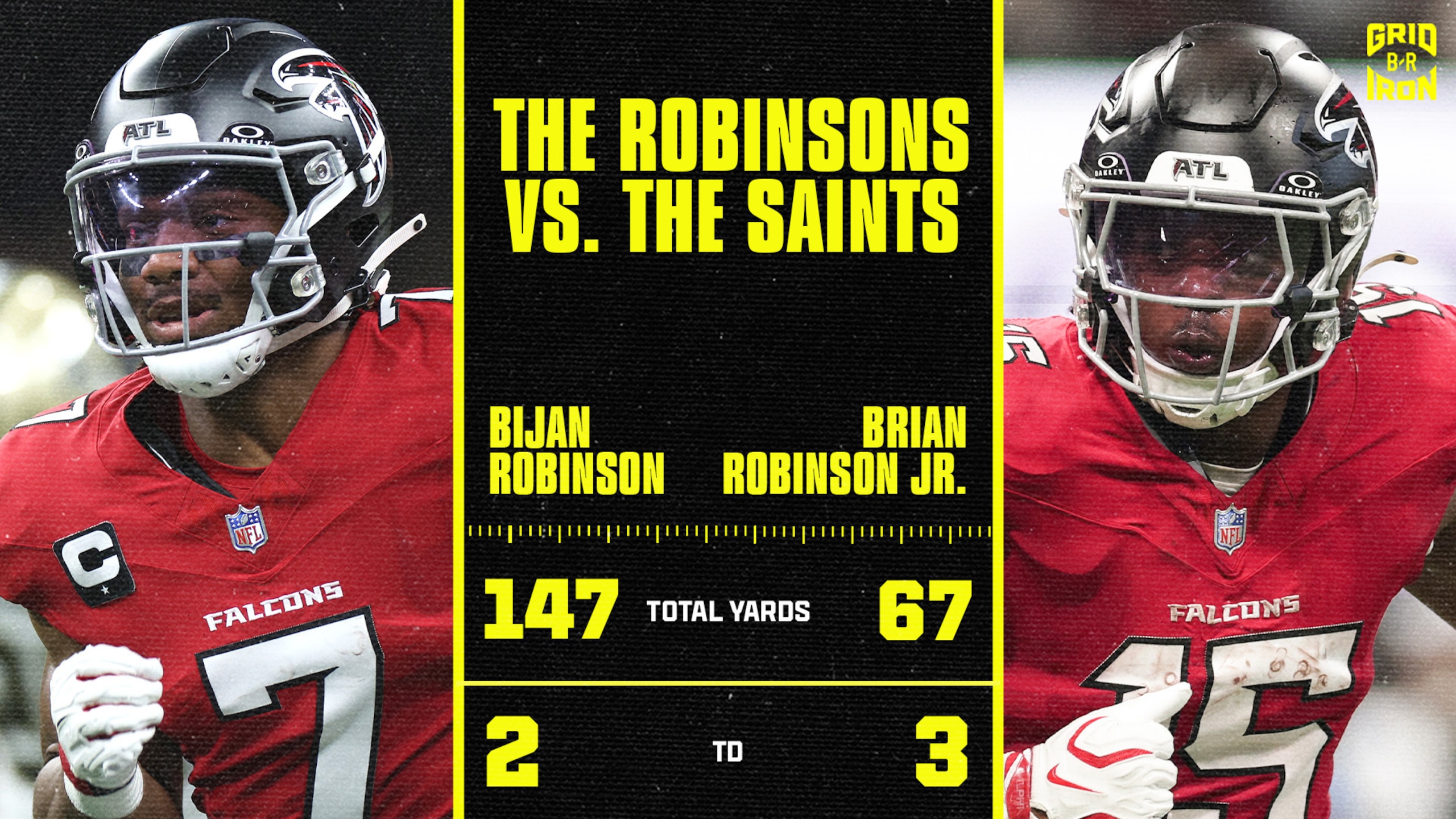
The Robinsons POUND the Rock 🪨
Takeaways from Falcons' dominant MNF win
The formula is as follows:
A=(Player Completions/Player Attempts) / (Average Completions/Average Attempts)
B=(Player Yards/Player Attempts) / (Average Yards/Average Attempts)
C=(Player Touchdowns/Player Attempts) / (Average Touchdowns/Average Attempts)
C=(Player Interceptions/Player Attempts) / (Average Interceptions/Average Attempts)
DR (dominance rating) = (A + B + C - D) x 50
So, it is uses completion percentage, yards per attempt, touchdown percentage, and interception percentage to determine who has played better or worse than an average QB for that year. Multiplying by 50 makes the average 100 instead of 2 and thus easier to compare. If you want to compare career numbers just average the numbers for each season that a player participated in during his career.
You can find the NFL average at the following link:
http://www.pro-football-reference.com/years/ALL/passing.htm
Just scroll down to the "league average per team season." This will give you the average stats for all passes thrown by one team over the course of that season.
Alright let's get to some examples. We'll use Drew Brees and Jake Delhomme from 2009.
Brees:
A=(363/514)/(324/532)=1.16
B=(4388/514)/(3495/532)=1.30
C=(34/514)/(22.2/532)=1.59
D=(11/514)/(16.4/532)=0.69
DR=(1.16+1.30+1.59-0.69)x50=167.50
Delhomme:
A=(178/321)/(324/532)=0.91
B=(2015/321)/(3495/532)=0.96
C=(8/321)/(22.2/532)=.60
D=(18/321)/(16.4/532)=1.82
DR=(0.91+0.96+0.60-1.82)x50=32.21
It's pretty easy to see that Brees was fantastic last year while Delhomme was bad enough to get cut.
Now let's do an example for career stats. We'll use the example from my introduction. Peyton Manning and Johnny Unitas over the course of their illustrious careers.
Manning (1998-2009):
A=(353/544)/(310/523)=1.09
B=(4177/544)/(3341/523)=1.20
C=(30.5/544)/(21.2/523)=1.38
D=(15.1/544)/(16.6/523)=0.87
DR=(1.09+1.20+1.38-0.87)x50=140.20
Unitas (1956-1973):
A=(166/305)/(197/391)=1.08
B=(2367/305)/(2465/391)=1.23
C=(17.1/305)/(19.4/391)=1.13
D=(14.9/305)/(22.7/391)=0.84
DR=(1.08+1.23+1.13-0.84)x50=130.38
According to the dominance rating, Manning is more dominant than Unitas. Manning is 40 points above average for his time, whereas Unitas is only 30 points above average. To be fair, anything 125 and up over the course of a career is Hall of Fame material.
At first glance you might think my stat is the same as passer rating. The difference between the two is that my stat compares a QB to the NFL average rather than to a static number. To get an average QB rating of 66.7 you must have a 50% completion percentage, a 7.0 average yards per attempt, a 5.0% touchdown percentage, and a 5.5% interception percentage. These numbers were near the NFL average when the passer rating was created in 1971.
However, in the last 30 years completion percentage has risen to 60% while the interception percentage has dropped to near 3%. The other two metrics have stayed reasonably consistent. This has led the NFL average to rise more than 20% since the creation of the passer rating, from 59.3 to 81.2. It cannot be used to compare QBs across generations as it will favor the more recent QB.
The dominance rating accounts for changes in the league average. This may be brought about by rule changes, such as the 5 yard chuck rule, or by offenses in general getting more efficient. Either way, a truly great player is one who dominates the era in which he played since trying to put him in another era in merely conjecture.
So now, go forth and use your new found knowledge to best your friends in arguments.

.jpg?w=2560 "Commanders Eagles Football")
.jpg?w=2560 "Grading WWE Raw 🔠")


.jpg?w=2560 "Viral Rams Coach Vid 🖕")
