
October is almost here and it's starting to feel more like football weather, making this a perfect time to assess how the NFL season is going.
There have been surprising performances through three games, with some players vastly exceeding low expectations, while others who were projected to do big things in 2021 have failed to live up to the hype.
This piece will focus on the latter, highlighting some of the biggest busts from the NFL's first month. These players haven't performed up to the level they have proved capable of or haven't justified their lofty draft position early in their careers.
With that in mind, read on to see which players have let their teams down this past month.
New England Patriots Tight Ends
1 of 6
The Patriots made a splash this offseason by signing two quality tight ends in Jonnu Smith and Hunter Henry.
It was a sorely needed upgrade after the position—which was comprised of Devin Asiasi, Dalton Keene and Ryan Izzo—produced only 18 receptions for 254 yards and one touchdown last year.
Unfortunately, the Smith-Henry duo hasn't quite performed at a level it is capable of. While the two are outpacing last year's pitiful tight end production, they have combined for a relatively meager 183 yards on 20 receptions, failing to find paydirt even once.
Pro Football Focus has given Smith a 37.4 grade and Henry a 65.2. It's been an especially disappointing showing for Smith, who scored a career-high eight touchdowns last year with the Titans. Henry was one of the Chargers' leading pass-catchers last year but hasn't assumed the same role in New England.
This comes despite a clear upgrade under center from Cam Newton to rookie Mac Jones, who has been playing well in his first year. Jones has earned a commendable 72.2 PFF grade after completing 67.5 percent of his passes for 737 yards and two scores against three interceptions.
Jones doesn't seem to have the same chemistry with either tight end as he does with wideout Jakobi Meyers, the team's leading receiver with 19 receptions for 176 yards. Meyers has drawn 29 targets, while Smith and Henry have merely matched that with 16 and 13, respectively.
The probability of New England shifting to a tight-end-focused attack—such as the one it deployed in 2011 when Rob Gronkowski and Aaron Hernandez combined for 2,237 yards and 24 scores—at this point in the season is low.
Jones still has plenty of room to improve, but his wide receivers will likely end up as the main benefactors, leaving this talented tight end room well short of its potential.
Trevor Lawrence
2 of 6
The Jacksonville Jaguars used this year's No. 1 pick on Trevor Lawrence in hopes he could turn this struggling franchise around. Through three games, it's been nothing but the same old Jags.
The team—which won just a single game last year to earn the right to take Lawrence—is off to an 0-3 start, the first three regular-season losses of his entire career.
The signal-caller has looked awful for much of these matchups. He's connected on just 64 of 118 pass attempts, gaining 669 yards and throwing five touchdowns against a league-high seven interceptions. He's been sacked five times and lost two fumbles, disheartening numbers for a quarterback considered a generational prospect.
He hasn't been improving, either, most recently turning the ball over four times in a double-digit loss to the Cardinals. PFF has graded him at 46.6, even lower than fellow winless rookie quarterback Zach Wilson's 56.9 and much worse than the 75.1 last year's top overall pick, Joe Burrow, earned in his first season.
Despite the poor showing against Arizona, Lawrence insists he has "gotten better" and can "feel the progress" since his first start.
He did have his best completion rate (64.7 percent) of the campaign in Week 3, a small victory after he managed to connect on a mere 42.4 percent of his attempts the prior game against Denver.
The turnovers are costing Jacksonville a chance to win games, however, and must stop if he is going to develop into the franchise signal-caller the club was expecting when it used the top pick on him.
Alvin Kamara
3 of 6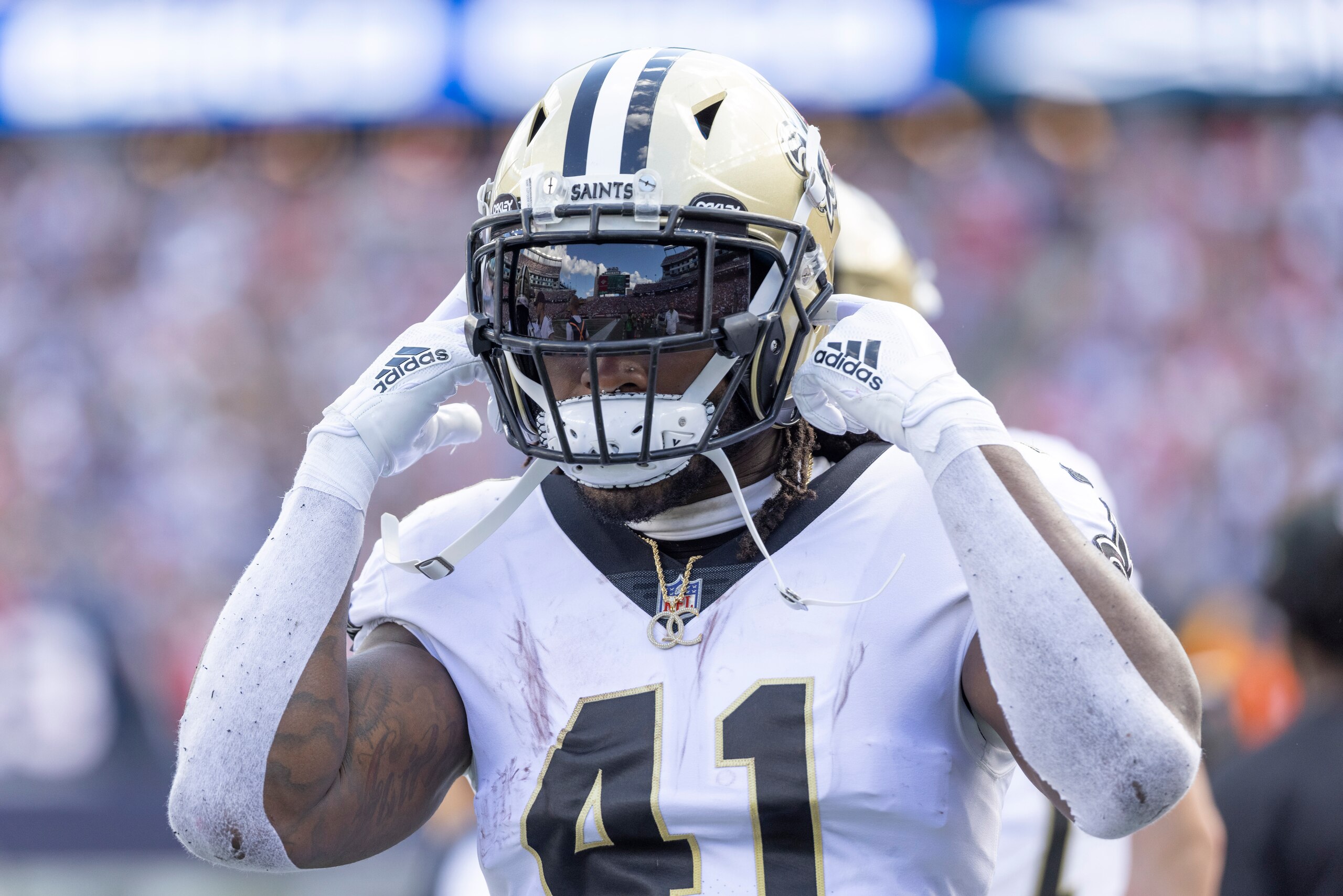
After Drew Brees retired, it seemed as though Alvin Kamara would put up massive numbers as the New Orleans Saints' entire offense revolved around the superstar back. That hasn't been the case with the four-time Pro Bowler slumping in September.
Kamara's disappointing start to 2021 certainly isn't due to a lack of touches.
He's already rushed 52 times in three games but gained just 177 yards. He's averaging a paltry 3.4 yards per tote, including an unsightly game against the rival Carolina Panthers in Week 2 during which he barely gained a half-yard per carry.
The 26-year-old hasn't been a force in the passing game, either. Bruce Matson of RotoBaller tweeted that Kamara has the largest target share of any running back in the league, but he hasn't done much with those looks.
Kamara's 10 receptions have gone for just 62 yards, although he did reel in his only two scores of 2021 through the air. The fifth-year vet ranks 70th in the league with 3.9 yards per touch. This is down significantly from last year, when Kamara came in 12th with a 6.3 yards-per-touch average.
Kamara has a 64.6 PFF grade, a far cry from his 82.2 mark last season. It is even well off his career-low 70.0 mark earned during an injury-plagued 2019, a season in which he said he played on "one leg" while dealing with knee and ankle issues.
Tony Jones Jr. has arguably been the more dynamic back in the Big Easy. The second-year undrafted free agent played well enough in the preseason to earn the backup job over Latavius Murray and has since rushed for 69 yards on 16 carries, besting Kamara's average by nearly a yard per attempt.
Jones has scored an 82.2 from PFF and may get more work if the starter keeps struggling.
There are likely better days ahead for Kamara, however, as he is still the lead back in an offense that has only trusted quarterback Jameis Winston to throw 63 times across three contests. It's reasonable to believe Kamara will turn things around soon, but for now he's one of the bigger busts of the season.

.jpg?w=2560 "Cowboys Eagles Football")
Kyle Pitts
4 of 6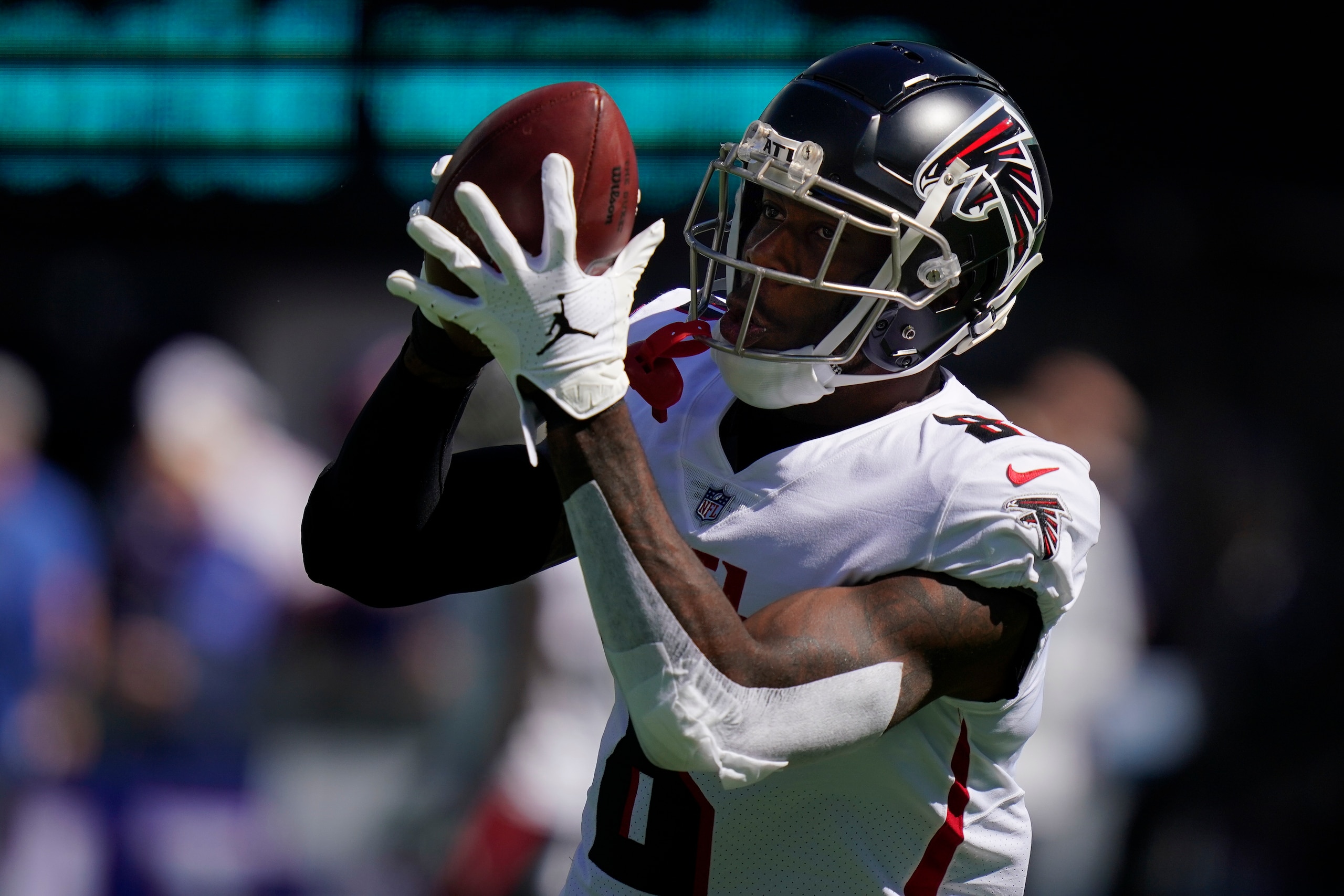
It's doubtful the Atlanta Falcons thought Kyle Pitts would get off to this slow of a start when the team drafted him No. 4 overall in April.
Through three games, Pitts has been nothing more than an average tight end. PFF has graded him at 65.6, a number the site considers worthy of a second-stringer.
The Florida product has caught 11 of 17 targets for 139 yards. He's yet to find the end zone, and his 13.9 total fantasy points rank just 18th at his position in standard scoring leagues. That puts him behind fellow rookie Pat Freiermuth, who was drafted late in the second round by the Pittsburgh Steelers.
While Pitts hasn't been the game-changer he has the potential to be, Atlanta's offense in general has struggled to create big plays. The team is averaging 301.3 yards per game on offense, which ranks ahead of only five other teams.
Matt Ryan has not been able to air it out, averaging 8.5 yards per completion in a passing game that has relied on checkdowns and short-yardage routes. That hasn't played to the strengths of Pitts, who clocked a 4.44 40-yard dash and can outleap and outmuscle defenders with his incredible athleticism packed into a 6'6", 246-pound frame.
Head coach Arthur Smith said the team wants to involve Pitts more but noted that teams like the New York Giants—who held him to two catches for 35 yards, both coming in the fourth quarter—have worked to take him out of the equation.
"Yeah, we want to get Kyle the ball, but give Patrick Graham and the Giants defense credit," Smith told reporters. "We chipped away, and we chipped away, and he came through at the end."
Atlanta will have to scheme harder to get Pitts more involved. It's clear what the 20-year-old brings to the table, but he hasn't had an opportunity to showcase it on a regular basis. That's disappointing and needs to change for the Falcons to improve.
San Francisco 49ers Backfield
5 of 6
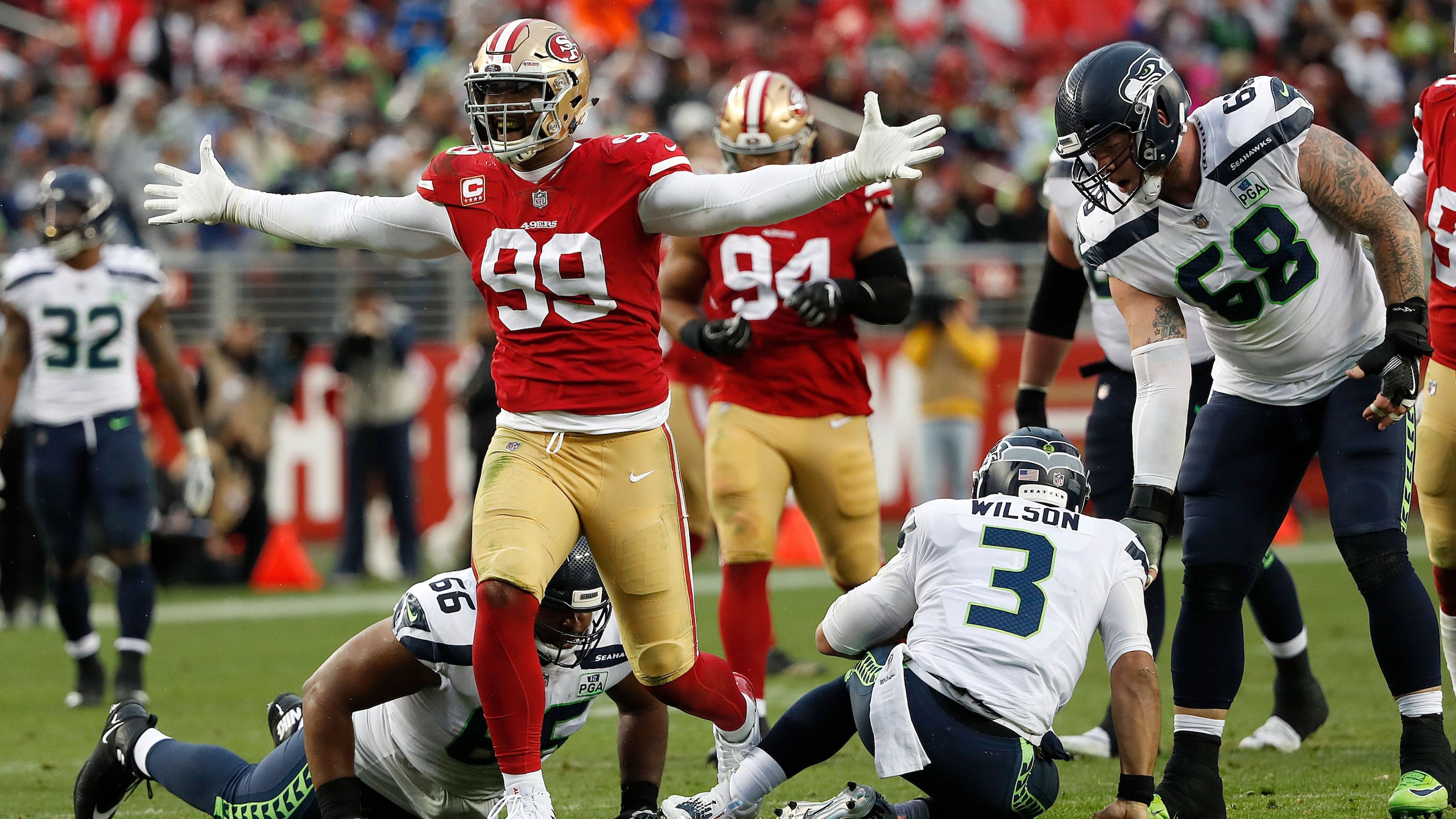
The San Francisco 49ers could have been one of the league's premier rushing teams this year, but so far they look average at best in that department.
The club came into the campaign with a loaded running back platoon, starting veteran Raheem Mostert ahead of a stable of promising young backs that includes rookies Trey Sermon and Elijah Mitchell.
Things quickly went off the rails after Mostert suffered a season-ending knee injury on his second tote of the opener. With Sermon—a highly touted third-rounder—surprisingly a healthy scratch, the Niners turned to Mitchell to shoulder the load.
While the sixth-round pick did well in his Week 1 relief duties—rushing 19 times for 104 yards and a score—he couldn't replicate that success against the Philadelphia Eagles, carrying 17 times for 42 yards before going down with a shoulder injury. Sermon saw just one carry in the contest and suffered a concussion after gaining eight yards.
With both Mitchell and Mostert sidelined, the team leaned on Sermon—who cleared protocols—and fullback Kyle Juszczyk in Sunday's prime-time clash with the Packers. The duo combined for a meager 45 yards and a score on 15 carries, a disappointing result against a Green Bay defense that had allowed opposing rushers to explode for 279 yards on 58 totes leading up to the contest.
Trey Lance, the No. 3 overall pick in 2021, has hardly been involved in the run game, either. The dual-threat quarterback has seen just seven snaps, rushing four times for three yards and a score in limited action.
San Francisco is now averaging just 105 rushing yards per game on the year. That is down from an injury-plagued 2020 campaign (118.1 YPG) and well below its impressive 2019 showing (144.1 YPG).
Even with injuries mounting in the backfield, the 49ers should be performing better on the ground based on the sheer amount of talent and potential within their ranks.
Saquon Barkley
6 of 6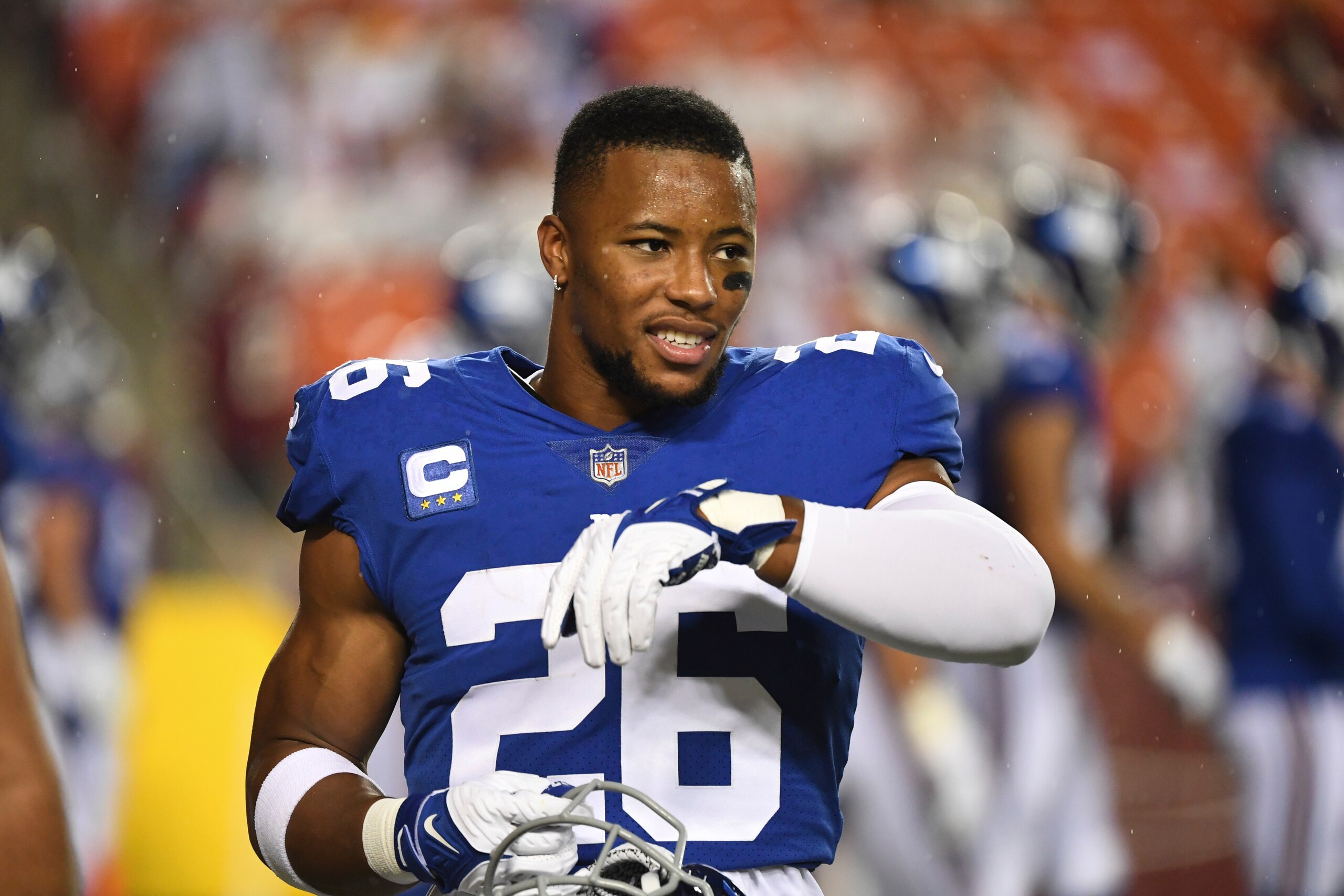
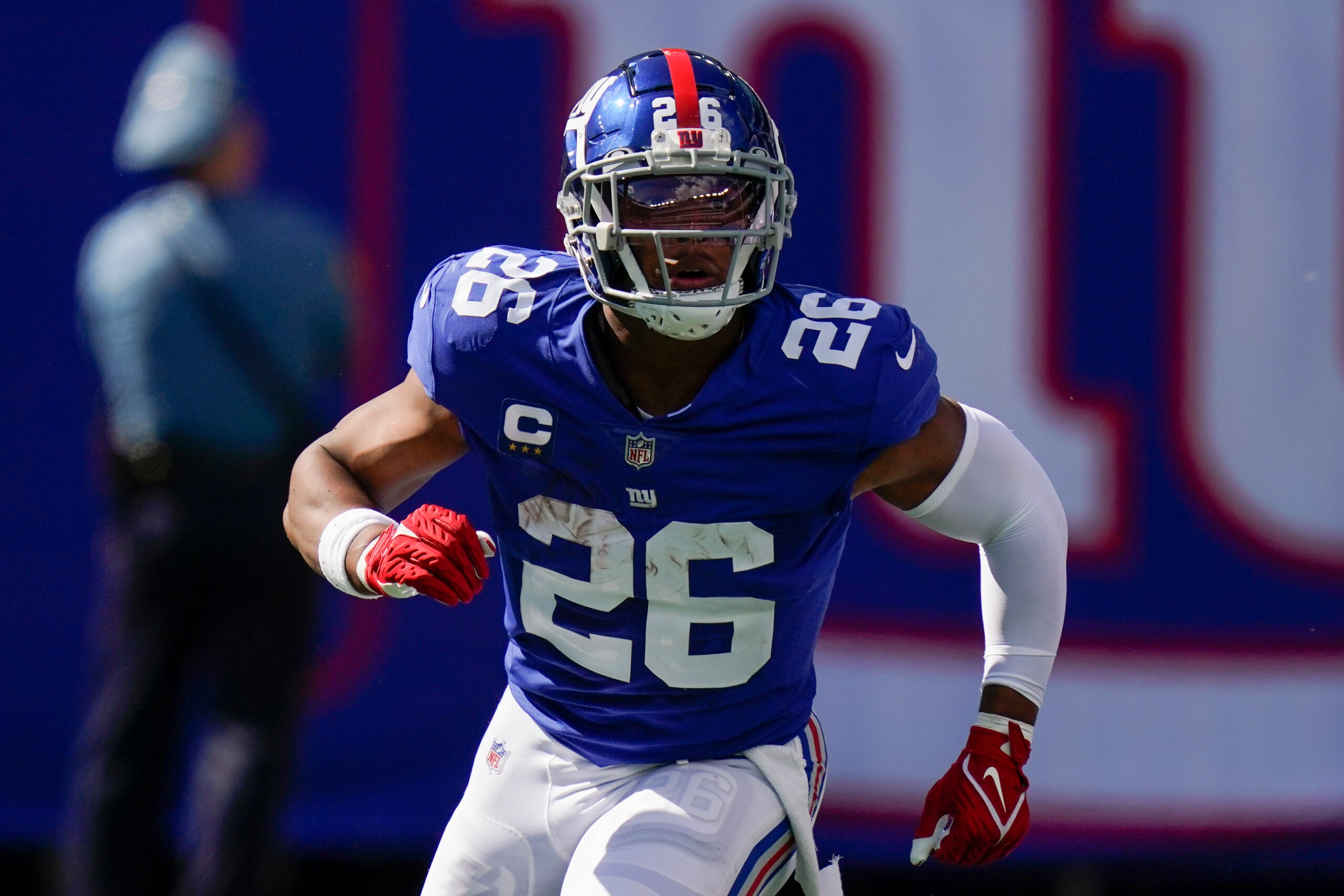
After returning from a lost 2020 season, Saquon Barkley has failed to live up to the lofty expectations set for a player of his caliber.
The Giants' star running back has been stuck in neutral during his first three games back from a torn ACL.
Barkley has put up a paltry 134 rushing yards and one touchdown on his 39 totes, averaging an underwhelming 3.4 yards per carry. Take away his two big gains of 41 and 15 yards, and he's averaging an even uglier 2.1 yards per carry.
His impact in the passing game is also diminished, as Barkley has caught nine of 13 targets for 56 yards. His 4.0 yards per touch ranks 68th in the league, putting him behind middling backs like Atlanta's Mike Davis. His 61.8 PFF grade is well below the career-high 85.2 mark he set as a rookie in 2018.
The 24-year-old's poor play hasn't helped the slumping G-Men, who are off to a brutal 0-3 start.
It wouldn't be fair to place the blame for Big Blue's failures squarely on one player, but Barkley is arguably the most disappointing of the bunch.
There isn't much hope for Barkley to turn things around, especially playing behind an offensive line that PFF ranked dead last coming into the season and hasn't inspired confidence through three games. To make matters worse, the team has already lost starting left guard Shane Lemieux and center Nick Gates to season-ending injuries.
Barkley deserves some blame, however, as he is struggling to take advantage of the holes New York's patchwork offensive line is creating.
This isn't a new issue for the player, as Sports Illustrated's Albert Breer noted at the beginning of the season he has had plenty of bad games stemming from his big-play-hunting style of running:
"Barkley's played 32 NFL games and has rushed for fewer than 50 yards on more occasions (13) than he has rushed for more than 100 yards (11). Moreover, in seven of his 11 100-yard games, he's had a run of 50 yards or more, which only adds to the idea that he's a football Adam Dunn (.237 career average with 462 home runs)."
Factor in embarrassing moments like when the back collided with right tackle Nate Solder in Week 1, and you have a messy situation that is going to take a lot of work for New York to fix.
All stats courtesy of Pro Football Reference unless otherwise noted.
.jpg?w=2560 "Colts Vikings Football")