

The Biggest Challenge Ahead for Every New NFL Coaching Staff
Though the particulars vary, the drills for every new NFL head coach are pretty much the same. You need to hire a staff and make sure everyone's on the same page. You need to coordinate your free agency and draft strategies with a general manager you may or may not know, and since you were probably hired in January, there isn't much time. You have to assess the strengths and weaknesses of your roster and gain a realistic sense of how successful your team can be.
Above that, there will be one primary challenge you will be facing in your first year. Perhaps it's time to move on from your most important player. Or maybe you're inheriting a dysfunctional situation, and you'll have to add a lot of psychological and motivational aspects to your daily duties. You might have one of the worst rosters in the league; you might have one of the best—each scenario presents its own unique challenges.
In the 2018 preseason, seven new NFL head coaches were hired. Here we'll describe the top challenge each will face while getting used to new surroundings.
Steve Wilks, Arizona Cardinals: Finding the Next Franchise Quarterback
1 of 7
For all his well-deserved reputation as a "Quarterback Whisperer," former Cardinals head coach Bruce Arians was never able to get Arizona's quarterback of the future. Through his five-year tenure in the Valley of the Sun, Arians amassed a 50-32-1 record and did great things with veteran quarterback Carson Palmer. But getting that young quarterback on the right track proved tougher, which was unusual for a guy who was pivotal in the development of both Ben Roethlisberger and Andrew Luck.
So, it's up to Wilks, the former Panthers defensive coordinator, to define the future of the Cardinals' quarterback position, now that Palmer has retired. Blaine Gabbert and Drew Stanton were stopgap players last year after Palmer suffered a broken arm seven games into the 2017 season. And both are free agents now—not that either one was ever going to be the franchise guy.
More specifically, it will be up to new offensive coordinator Mike McCoy to help general manager Steve Keim find the ideal signal-caller for the franchise going forward. It could be a free agent, though with $22.7 million in pre-free agency cap room, per Over The Cap, there won't be room for a big-ticket player like Kirk Cousins unless cuts are made.
The likelihood is that the next Cardinals franchise quarterback will be found in the draft, which probably means there's going to be a transition period eased by another bridge quarterback. Whether it's with the top-tier draft prospects dropping or the team taking a risk on a less-ready arm, like Wyoming's Josh Allen, Wilks and his crew will have to solve a barren quarterback situation not of their own making.
Matt Nagy, Chicago Bears: Developing Mitchell Trubisky
2 of 7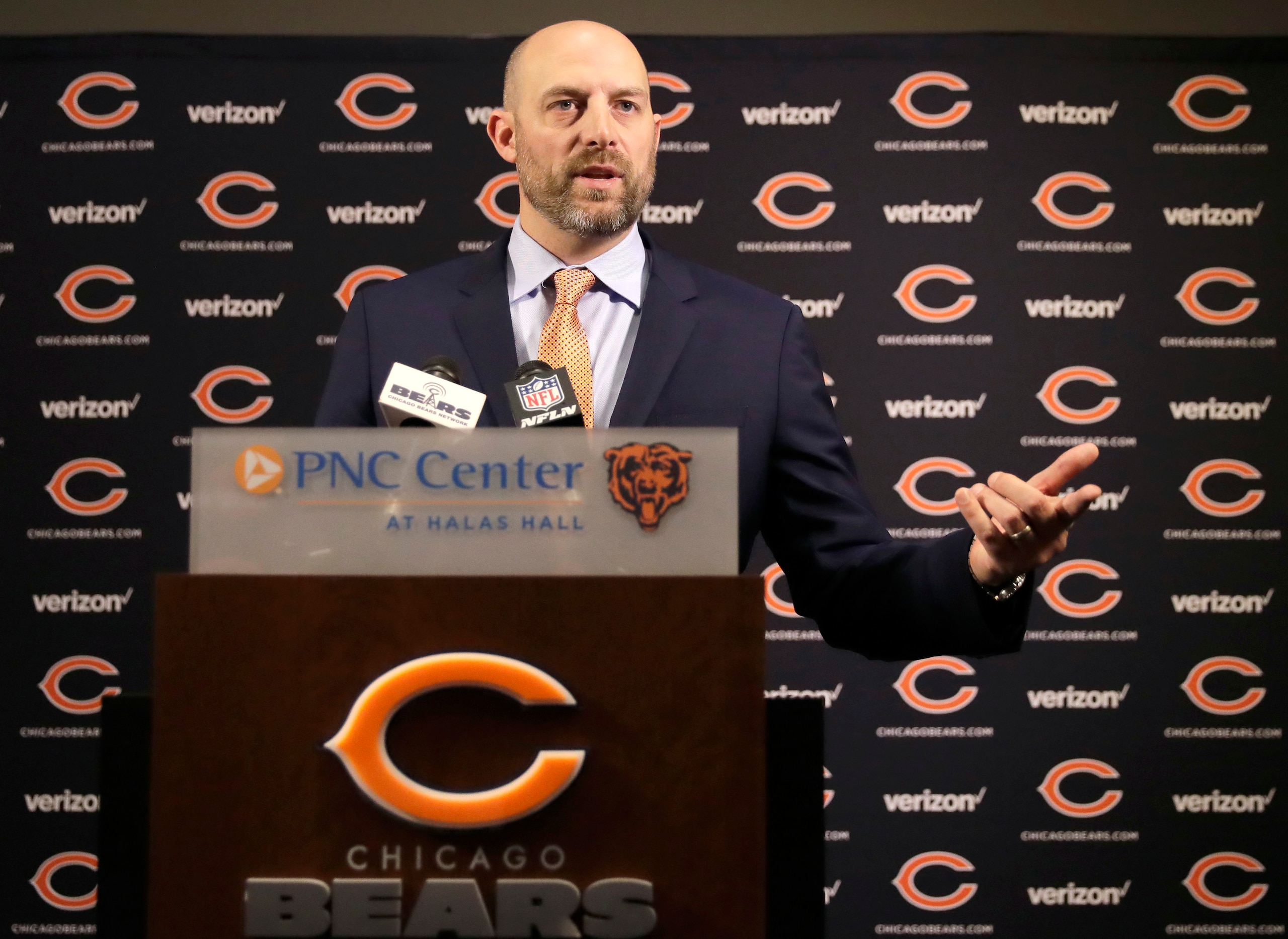
The Bears have made one thing clear in hiring their new coaching staff: The status quo wasn't working, and they're ready to shake things up—especially with an offense that was far too one-dimensional and predictable in 2017. New head coach Matt Nagy, formerly the Chiefs offensive coordinator, and new offensive coordinator Mark Helfrich, who was last seen devising option offenses for the University of Oregon, have one major task ahead of them: turning second-year quarterback Mitchell Trubisky into a franchise asset.
Nagy and Helfrich have the qualifications and mentalities to make things better for Trubisky than they were during his rookie season. Under former head coach John Fox and offensive coordinator Dowell Loggains, Trubisky was hidden in a run-heavy offense, and his development was stilted as a result.
Nagy won't let that happen. 2017 was his first season as the Chiefs offensive coordinator, and he was the prime mover behind a set of schemes that combined the West Coast offense, deep passing and a fantastic series of backfield option stuff and advanced playfakes that kept defenses on their heels through most of the season. Factor in Helfrich's offensive tendencies from Oregon, and it's evident the Bears want Trubisky to become a top-tier quarterback with schematic diversity in mind.
This is wise. Trubisky has every physical tool you'd want in a quarterback. He's mobile and eager to learn, and he has a fantastic arm. What he needs is a coaching staff that will bring him along in advanced NFL concepts while giving him enough to work with in the short term. This could be the beginning of a beautiful friendship—and an offense light-years ahead of what the Bears had last season.
Matt Patricia, Detroit Lions: Finding Balance for a One-Dimensional Offense
3 of 7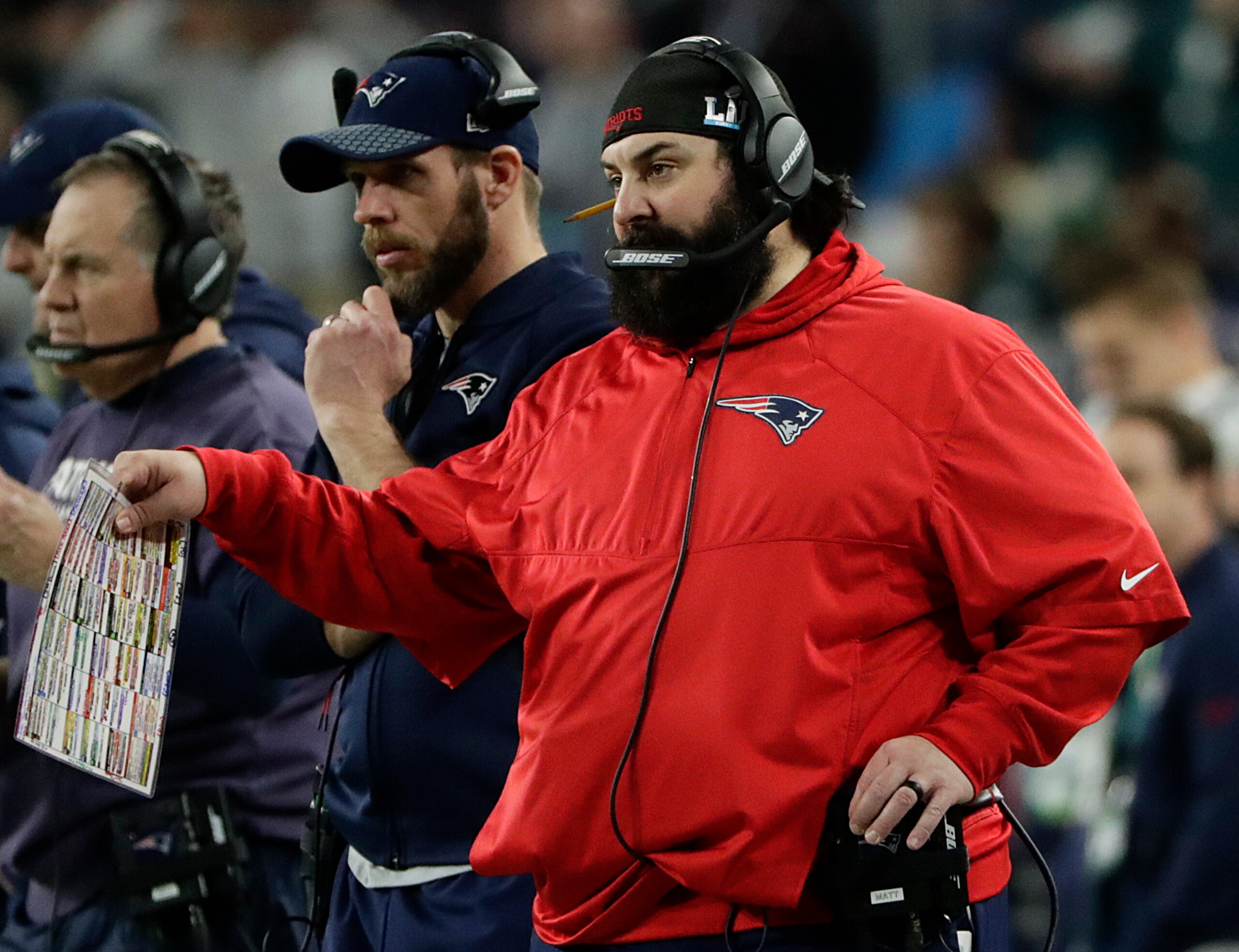
Former Patriots defensive coordinator Matt Patricia inherits a pretty good defense in his new position as the Lions head coach. And he has a quarterback in Matthew Stafford who can put up all kinds of numbers with a talented group of receivers. What Patricia does not have with his new team is a rushing attack of any distinction, and that's a problem that needs to be addressed as soon as possible.
In 2017, the Lions finished dead last in the NFL in rushing yards with 1,221. They tied with the Cardinals for the worst yards per carry average at 3.4, and the Cardinals did that without David Johnson, perhaps the most important offensive player on their roster.
In Detroit's case, the problem has had more to do with inattention to the position. Ameer Abdullah and Theo Riddick are decent players, but Abdullah does better as a change-of-pace back, and Riddick is perhaps best used as a receiving threat.
If Patricia is going to mirror the running-back-by-committee approach the Patriots used while he was on that staff, what he needs is a version of Dion Lewis—the underrated and sneaky effective back who did a lot to define New England's ground attack, especially late in the season.
Free agency is a possibility, but the Lions might do better to avail themselves of a pretty deep RB class in the draft. They really need a power rusher who can create yards after contact.
LSU's Derrius Guice would be a perfect match for this paradigm if he's available when Detroit selects with the 20th overall pick. Guice isn’t the shiftiest runner in this class, but his ability to create extra yards with power and keep defenses honest against the run might be the thing that puts the Lions over the top. Later in the draft, Georgia's Sony Michel and San Diego State's Rashaad Penny would be similarly intriguing.
However the Lions fix this issue, they need to do it and give their new coaching staff a complete offense.

.jpg?w=2560 "Rams Eagles Football")
.jpg?w=2560 "Texans-Mixon Released Football")
Frank Reich, Indianapolis Colts: Winning Without Andrew Luck
4 of 7
You can blame former general manager Ryan Grigson for most of the personnel problems that led to the Colts' 4-12 season in 2017. Grigson's failures in free agency and the draft left very little in the cupboard, and it was going to require a heroic season from quarterback Andrew Luck for anything good to happen.
Of course, Luck was out for the entire 2017 season, and the shoulder issues that caused his absence are not yet resolved. On February 6, ESPN's Chris Mortensen reported (h/t Adam Schefter) that doctors are concerned Luck may need additional surgery.
Into this unresolved story comes new Colts head coach and former Eagles offensive coordinator Frank Reich, who general manager Chris Ballard tapped for the post after Patriots offensive coordinator Josh McDaniels bailed on the job at the eleventh hour.
After speaking with him during Super Bowl week and talking to those who know him, it's my belief that Reich is the right man for the job. But it's entirely possible that he’ll have to manage a 2018 season with Luck's reduced presence—or complete absence—on the field.
Reich went through that with the Eagles last season, and he was as responsible as anyone for the success that backup quarterback Nick Foles had after Carson Wentz tore his ACL in Week 13. Reich has said that with the Colts, he'll feature a multiple, high-tempo, no-huddle offense to keep defenses off-center.
He's proved already that he can adapt to his quarterback. So who will Reich's quarterback be if it's not Luck?
Backup Jacoby Brissett is an athletic quarterback with a big arm and a lot of mobility who had trouble making quick reads in the offense last season. Perhaps Reich can put together an offense that maximizes Brissett’s strengths while allowing him to work on his processing speed. Reich did it with Foles, so confidence that he can transcend Luck's travails should be high.
Pat Shurmur, New York Giants: Bringing Order to a Formerly Chaotic Situation
5 of 7
New Giants head coach Pat Shurmur held the same position with the Cleveland Browns in 2011 and 2012, so it could be advantageous that he's worked in a dysfunctional organization because the 2017 Giants—a bastion of consistency in the Tom Coughlin era—fell apart under former head coach Ben McAdoo. Eli Manning was benched. Teammates were sniping at each other. McAdoo didn't foster a culture of accountability, and that worked its way down to the players.
So, beyond the personnel and schematic issues, Shurmur will have to re-establish a sense of normalcy to a franchise that clearly lost its way. His style will be different that Coughlin's because Coughlin was more autocratic, but Shurmur remembered in January that he learned a lot from his experience in Cleveland.
"I think what's important is you decide what's right and everybody tries to do the right thing every day," Shurmur said, per Pat Leonard of the New York Daily News. "And then what'll happen is your team will get to be the team you want it to be and you'll get to the place you want to be. So typically when a new coach goes in, he sets down the guidelines, the things that are important to him, and then he works with the players to make sure it's important to them, you know?"
It may be a long road to get the Giants back to their winning ways. The former front office, led by ousted general manager Jerry Reese, made its share of mistakes. And before a new era of success can begin, Shurmur will have to crack the players' code and get everyone back in step with a consistent philosophy.
Jon Gruden, Oakland Raiders: Coaching His Old Team in a New Era
6 of 7
Around the turn of the millennium, Jon Gruden was the belle of the NFL ball. He first resuscitated a Raiders team that had fallen into disarray, racking up a 38-26 record over four seasons. He then went on to win Super Bowl XXXVII at the end of the 2002 season with the Tampa Bay Buccaneers against his old team.
But success didn't come easy after that. Gruden coached in the playoffs just twice more after his Super Bowl win, never again won another postseason game and was fired by the Bucs in January 2009.
We all know what happened after that. Between his star turn on Monday Night Football and the wildly successful Gruden's QB Camp series, the ex-coach became a major face of ESPN's NFL coverage. His return to the Raiders as head coach, announced officially on January 6, was one of the biggest football stories of the new year.
Of course, Gruden has to produce now. And he'll have to do so in an NFL that's very different than the one he left a decade ago. When Gruden last coached, shotgun formations were considered oddities. Nickel and dime defenders were sub-package players only. Hybrid fronts were rare, and the NFL hadn't taken its full measure—as it has now—of college schemes that can be retrofitted to the pros. The West Coast offense, Gruden's preferred method of moving the ball, was still the NFL's primary offensive system, and its long play calls ("Brown Left Close F Right Sprint Right Solid Z Quick Drag" is but one example) were standard operating procedure. That was OK, because the no-huddle offense, particularly the speed no-huddle, wasn't used as much as it is now.
Gruden's advantage over similar "retread" coaches is that, in his preparations for his broadcasting and QB Camp duties, he crunches a ton of modern tape, both college and professional. So he does have a handle on the modern game and how things have changed. Now, he'll have to implement his old strategies in ways that work in an entirely new era. Not that he can't, but the temptation to use what worked a generation before is one that Gruden can never succumb to if he wants to succeed.
Mike Vrabel, Tennessee Titans: Bringing Explosive Plays to a Limited Offense
7 of 7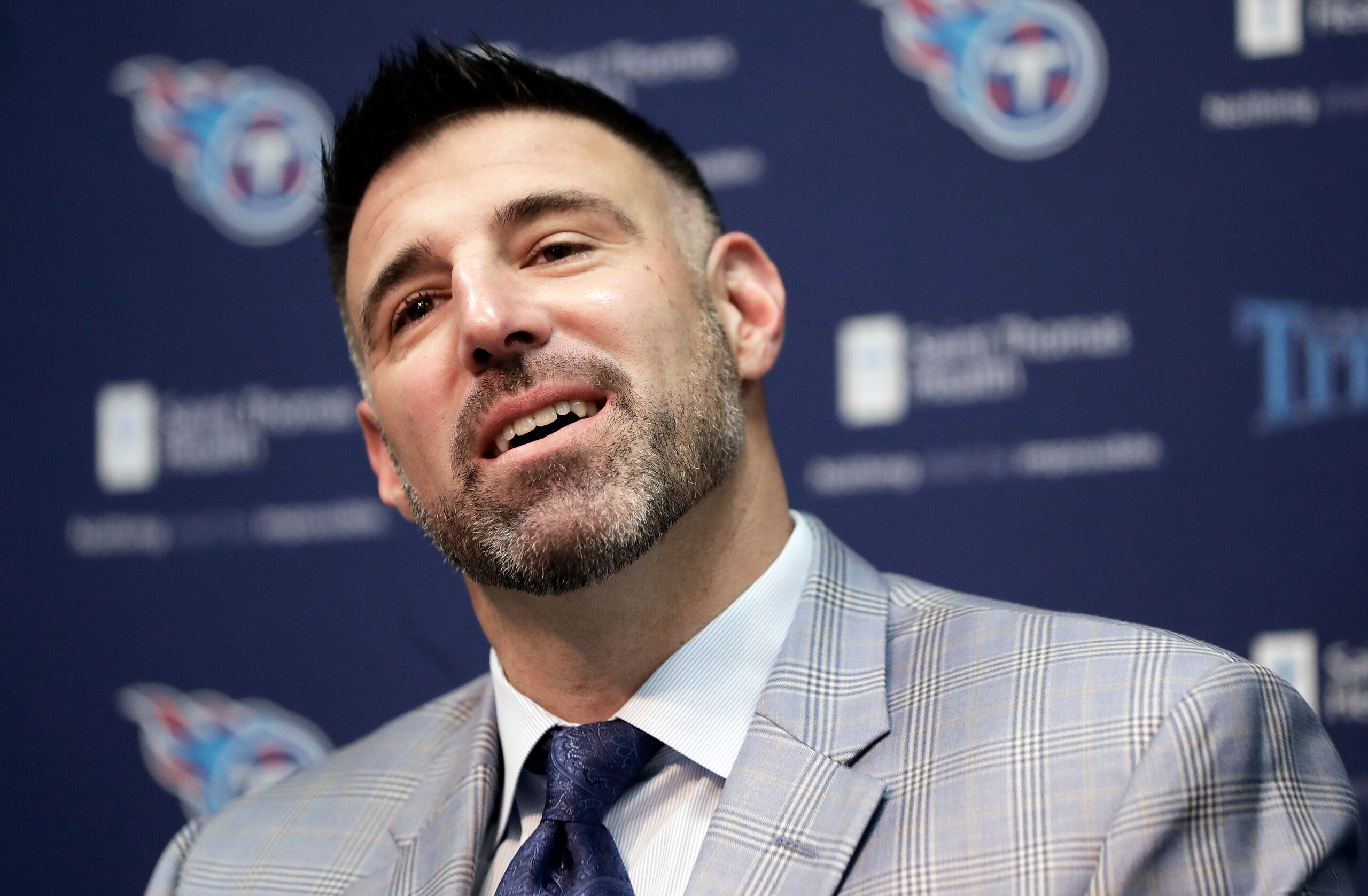
The Tennessee Titans finished the 2016 and 2017 seasons with identical 9-7 records, but the difference in offensive variety and quality was distinct—and not in a good way. Tennessee dropped from 14th to 19th in points scored and from 11th to 23rd in yards gained. An improved defense picked up a lot of the slack.
The regression had several causes. Former head coach Mike Mularkey insisted on making DeMarco Murray the feature back when Derrick Henry was far more effective, and the offensive line slipped. But quarterback Marcus Mariota was the main issue. He appeared hesitant and confused at times when trying to create explosive plays in a passing game that was comprised of short, simple routes and offered little to challenge downfield coverage.
Mariota threw 26 touchdowns to nine picks in 2016. He fell to 13 touchdowns and 15 interceptions last season. It was the first time his touchdown total was lower than his interception total, which was one of the primary reasons ownership made a coaching change.
Former Texans defensive coordinator Mike Vrabel was an outside-the-box hire, and new offensive coordinator Matt LaFleur isn't a household name. However, Vrabel—who faced Mariota twice a year with the Texans—seems to have a handle on how to make things better.
Vrabel spoke with Jim Wyatt of the team's official site in January, telling him, "The vision is that we're going to do things that are going to help him. We're going to get guys around him that are going to help him. We're going to get him to play with confidence, we're going to get him to play energetic and bring the passion of football out that he's so capable of showing.
"That's my idea for him. There's not going to be a greater relationship that I need to foster and develop than the one with our starting quarterback."
LaFleur spent 2017 as the Rams' offensive coordinator, so he saw firsthand how a better set of schemes can change a quarterback's career, as Sean McVay's playbook did for Jared Goff in the latter's second season.
"It is extremely difficult to dink and dunk all the way down the field," LaFleur said in February, per Wyatt. "The defenses are just too good. If you look at it, statistically the teams that are getting the chunk plays, the explosive (plays), those are the teams that are going to produce more yards, more points. Ultimately, the yards really don't matter.
"So you have to score enough points, and I have been fortunate in my career to have been around some really good play-callers … and that was always at the forefront of our minds: How can we create explosive plays?"
Mariota has more experience, estimable talent around him and every attribute you'd want in a quarterback. It will be up to Vrabel and his staff to extract as much of that as possible. As Mariota goes, so go the Titans.
.jpg?w=2560 "Commanders Eagles Football")



.jpg?w=2560 "Mahomes' Wife Trolls Kubiak 💀")

.jpg?w=2560 "Grading WWE Raw 🔠")