Picking Liverpool's Mount Rushmore
While rival supporters mock them for consistently living in the past, Liverpool fans rightly take pride in the club's storied history.
The list of honours won by the Reds includes 18 league titles, seven FA Cups and five European Cups. That's not bad for a club only formed following an argument between the Everton committee and John Houlding, club president and owner of the land at Anfield.
Once upon a time, the red half of Merseyside dominated domestically and conquered all before them in Europe. Their players and managers became household names as they put Liverpool on the footballing map.

But who are the greatest names to be connected with the club?
Mount Rushmore was sculpted to commemorate four American presidents for the part they played in shaping the United States, so Bleacher Report decided to do the same with a quartet of Liverpool legends.
Sadly, though, several greats failed to chisel their way onto the final list. Joe Fagan and Ronnie Moran—two long-standing members of the Anfield boot room—didn't make it, while founder Houlding also missed out.
There was no place for great goalscorers like Roger Hunt, Billy Liddell and Ian Rush either, nor Ian Callaghan and Jamie Carragher, the top two in terms of appearances.
Apologies to those who didn't make it, but here are the fantastic four chosen, along with a quote from each.
Bill Shankly

"Liverpool was made for me, and I was made for Liverpool."
When Bill Shankly took charge in December 1959, Liverpool were languishing in the Second Division. By the time he retired in 1974, the Reds were sitting pretty as one of the strongest clubs in English football.
The Scotsman bowed out after lifting the FA Cup for a second time, having also won the First Division title on three occasions. While the European Cup eluded him during his tenure, he did pick up the UEFA Cup in 1973.
Shankly, who grew up in a mining community, embarked on a playing career that was interrupted by World War II. A Scotland international, he stepped straight into management after hanging up his boots.
At Liverpool, he established the famous Anfield boot room, pushed to get training facilities at Melwood up to scratch and battled with the board to build a new squad of players, some signed from elsewhere, others coming through the club's system, capable of lifting them out of the doldrums.
The plan worked; the Reds returned to the top tier and, with Ron Yeats at the back and Ian St. John and Roger Hunt scoring the goals, they soon became a force to be reckoned with.
While charismatic and never short of a good quote, Shankly had a tough side. An FA Cup exit at the hands of Watford in the 1969/70 season led to him undertaking a dramatic rebuild. Familiar faces were jettisoned, and new blood—including a striker from Scunthorpe United named Kevin Keegan—arrived at Anfield.
The manager built a platform for success and, fittingly, bowed out a winner at Wembley in '74. He had transformed the club during his time in charge and established a dynasty.
Shankly died at the age of 68 after suffering a heart attack. However, his legacy—including introducing the famous "This Is Anfield" sign down the players' tunnel—lives on forever. His presence is still at the ground, too, albeit in the form of a bronze statue created by local artist Tom Murphy.
Bob Paisley

"Other people have earned more money than me in football, but no one has enjoyed it as much as me."
The obvious heir to the throne, Bob Paisley rather reluctantly stepped up from his role as Shankly's right-hand man to take over the top job in the summer of 1974.
He had already represented Liverpool in a number of roles before becoming the manager. As a player he won the First Division title before retiring in 1954, going on to work as a physiotherapist and then coach of the reserves until Shankly's arrival saw him promoted to work with the first team.
After the Scot had laid the foundations for success, Paisley built a powerhouse. During his nine years in charge, the Reds claimed an astonishing 20 trophies.
His haul included six league titles—they also finished second twice during Paisley's reign—and three European Cups (he still remains the only manager to win it three times with the same team). The FA Cup somehow eluded him, as he lost the final to Manchester United in 1977 to miss out on a famous treble.
Softly spoken but with a ruthless streak, Paisley wasn't afraid to make changes. When Keegan left, the manager identified Celtic's Kenny Dalglish as the perfect replacement.
It was one of a number of successful signings made during his tenure. Here's a few other club legends Paisley recruited: Bruce Grobbelaar, Alan Hansen, Phil Neal, Ian Rush and Graeme Souness. Oh, and Mark Lawrenson. Plus Steve Nicol and Ronnie Whelan. The man was a magnet for top-class talent.
"People often ask whether Paisley would have been as successful in the modern day, but there is no doubt in my mind about that because he was always insistent that we had to adapt to sustain our success at Liverpool. He would have adapted and been ahead of the game. Absolutely," Hansen wrote in the Telegraph.
After retiring at the end of the 1982/83 season, Paisley briefly returned to the club to serve as a director. He died in February 1996, aged 77.
Kenny Dalglish
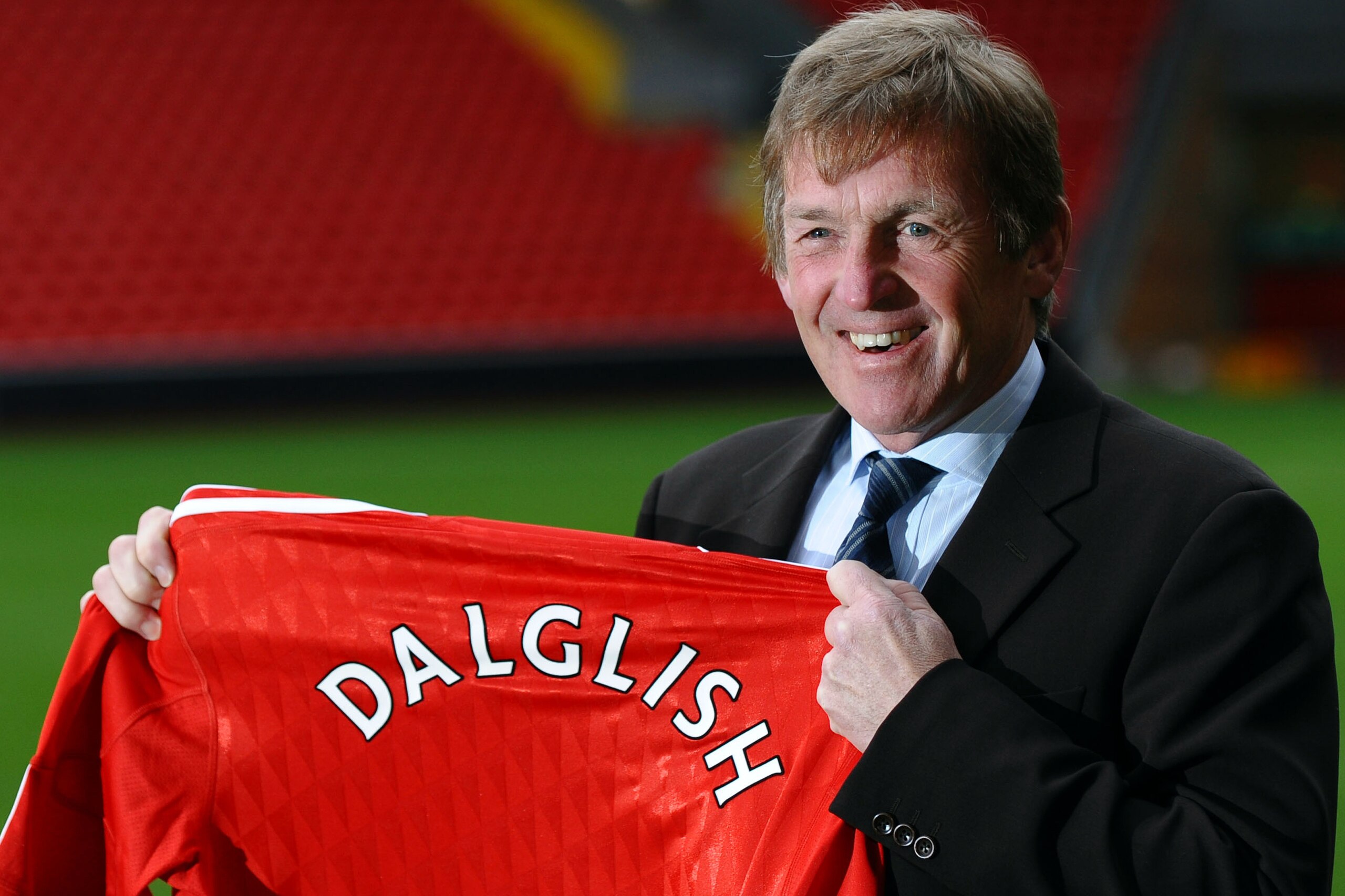
"I may have left Liverpool, but the city and club will always be part of me."
"King" Kenny has represented Liverpool in many guises.
As a player, he proved to be worth every penny of the £440,000 paid to secure his services in 1977. A British transfer record at the time, Dalglish turned down Manchester United to move to Merseyside.
Faced with the tough task of taking over the No. 7 jersey from Keegan, Dalglish quickly earned the admiration of the Kop during a debut season that climaxed with the winning goal in the European Cup final.
He scored 172 goals in 515 appearances, although those numbers would surely be higher had the Glaswegian not made the move into management at the age of just 34, following the departure of Fagan after the Heysel Stadium disaster in Belgium in May 1985.
Dalglish secured the Reds the League-FA Cup double for the first time in their history in 1985/86 and was named Manager of the Year three times in total.
He was also a crucial figure for both the club and city in the aftermath of the Hillsborough tragedy, making it his personal mission to help Liverpool cope in their darkest hour. The emotional strain took a toll, though, and, following a 4-4 draw in an FA Cup tie with Everton, Dalglish stunningly resigned in February 1991.
A second spell in charge didn't quite lead to the same level of success. Still, he remains the last Liverpool manager to win a trophy, having lifted the League Cup at Wembley Stadium in 2012.
Now serving as a non-executive director, Dalglish is an icon adored by supporters of all ages. His love for Liverpool remains strong: "This club means everything to me," he told James Pearce of the Liverpool Echo.

"When I die, don’t bring me to the hospital. Bring me to Anfield. I was born there and will die there."
Local boy Steven Gerrard deserves the fourth and final place on our Mount Rushmore. The midfielder scored 186 goals in 710 appearances before leaving in 2015 to finish his playing days in the United States.
Unlike Shankly, Paisley and Dalglish, Gerrard didn't get his hands on a league title. Still, he was a talismanic figure who too often had to fight a lone hand, a beacon of hope during some bleak years as Liverpool had to watch Manchester United knock them off their perch.
There were still occasional moments of glory, though.
Without him, there would never have been a fifth European Cup triumph in 2005. It was his long-range stunner against Olympiakos that squeezed the Reds out of their group and, six months later, it was his flicked header nine minutes after half-time against AC Milan that triggered the Miracle of Istanbul.
A year later, Gerrard saved Liverpool in the FA Cup final to West Ham United with one of the most dramatic moments in the competition's long and illustrious history, firing in from distance to force extra time.
But it wasn't just about the goals; he would hammer into tackles, spray long-range passes with unerring accuracy and dictate proceedings from the middle of the park. During his later years, the box-to-box runner morphed into a deep-lying playmaker. In his pomp, he could play any position with panache.
The Scouser who came through the club's academy system became a legendary figure for the fans. Despite strong interest from Jose Mourinho's Chelsea in 2004, he remained loyal to the cause until the twilight of his career.
After retiring at 36, the boy from Whiston is now back home working for the Reds as a youth coach. It would surprise no one if, at some stage in the future, he ends up in charge of the first team.
Rob Lancaster is a Featured Columnist for Bleacher Report. All statistics used in the article are from LFC History unless otherwise stated.
.jpg?w=2560 "Cam Ward Says He's Not A Loser")
.jpg?w=2560 "Texans Trade for MHJ")
.jpg?w=2560 "Chargers Fall to 0-5 🤢")

.jpg?w=2560 "Grading MHJ Trade 📝")