Kevin Shattenkirk Is Clearly the Top Prize Ahead of the NHL Trade Deadline
Effective action at the trade deadline can be the difference between being a Stanley Cup contender and actually winning the title. Sometimes it's a matter of adding a single impact player, as the Los Angeles Kings did in both 2012 (Jeff Carter) and 2014 (Marian Gaborik, their playoff goals leader).
The potentially available player with the best chance of having a similar impact on a team this season (the deadline is February 28) is Kevin Shattenkirk, currently of the St. Louis Blues.
Shattenkirk's usefulness puts the Blues in a difficult position. St. Louis has been a good team for a long time and harboured its own championship ambitions when it started the 2016-17 season.

At the same time, the Blues know the pain of letting an important player walk for nothing. A year ago they kept pending unrestricted free agent David Backes at the deadline, were knocked out of the playoffs in the Conference finals and got zero return when he signed with Boston.
There's a solid argument that St. Louis should take the chance and hang on to its player. The Blues have solid shot metrics and have a combined 6-3-1 record against Western Conference powers Minnesota, Chicago and San Jose. If not for the fourth-worst team save percentage in the NHL, Ken Hitchcock would still be head coach and the team would be reckoned a legitimate contender.
That's a big "if," though, and Hitchcock's firing suggests that the Blues are either unwilling or unable to pay the necessary price to upgrade their goaltending or possibly that they somehow don't see it as a problem. If that's true, the team won't be winning anything this year and would be well-advised to get what it can for Shattenkirk while he's still under contract.
St. Louis should be able to get a lot.
As an offensive defenceman, Shattenkirk has few peers around the league. He ranks 11th in points per game among rearguards since the start of the 2013-14 campaign, and two of the guys ahead of him have spent time as forwards over that span.
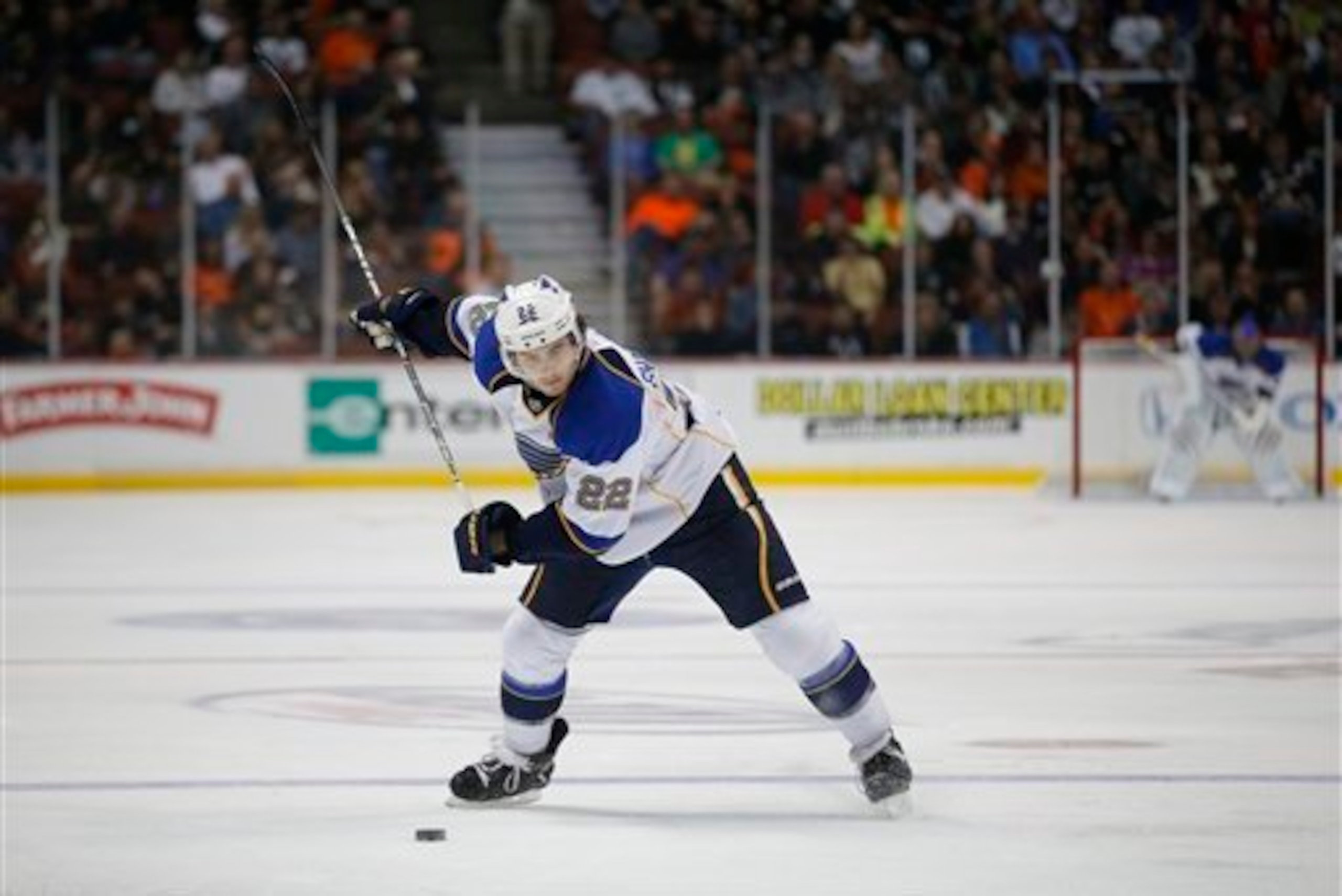
Shattenkirk is especially lethal on the power play. Over the same time period, he ranks first among defencemen (minimum 200 minutes played) in points per 60 minutes on the man advantage. That ranking only begins to capture his brilliance in those situations. He scores almost a full point per hour more than second-ranked Shea Weber. The difference between Shattenkirk and Weber is almost as great as the gap between Weber and Nick Leddy.
There just isn't any question about his utility. Shattenkirk is an elite power-play quarterback and one of the most productive defencemen in the game of hockey. In a league that increasingly requires its defencemen to be able to handle and move the puck with confidence, a player like Shattenkirk is incredibly valuable.
The bigger, and more difficult, question is whether he's also a strong defender.
The Blues have always had the luxury of having two very good right-shot defenders in Shattenkirk and Alex Pietrangelo. More recently, Colton Parayko has joined the club. That trio contrasts to a pretty forgettable group on the left side of the ice. Hitchcock's approach had largely been to feed Pietrangelo and veteran Jay Bouwmeester the toughest minutes while using Shattenkirk as more of an offensive specialist.
Still, everyone spends at least some of their minutes against the toughs. We can see that by looking back over the last two seasons (the St. Louis defence corps having been fairly stable over that time period) and isolating shifts spent against every opponent's first-line centre (based on average ice time) over that time period. That creates this chart:
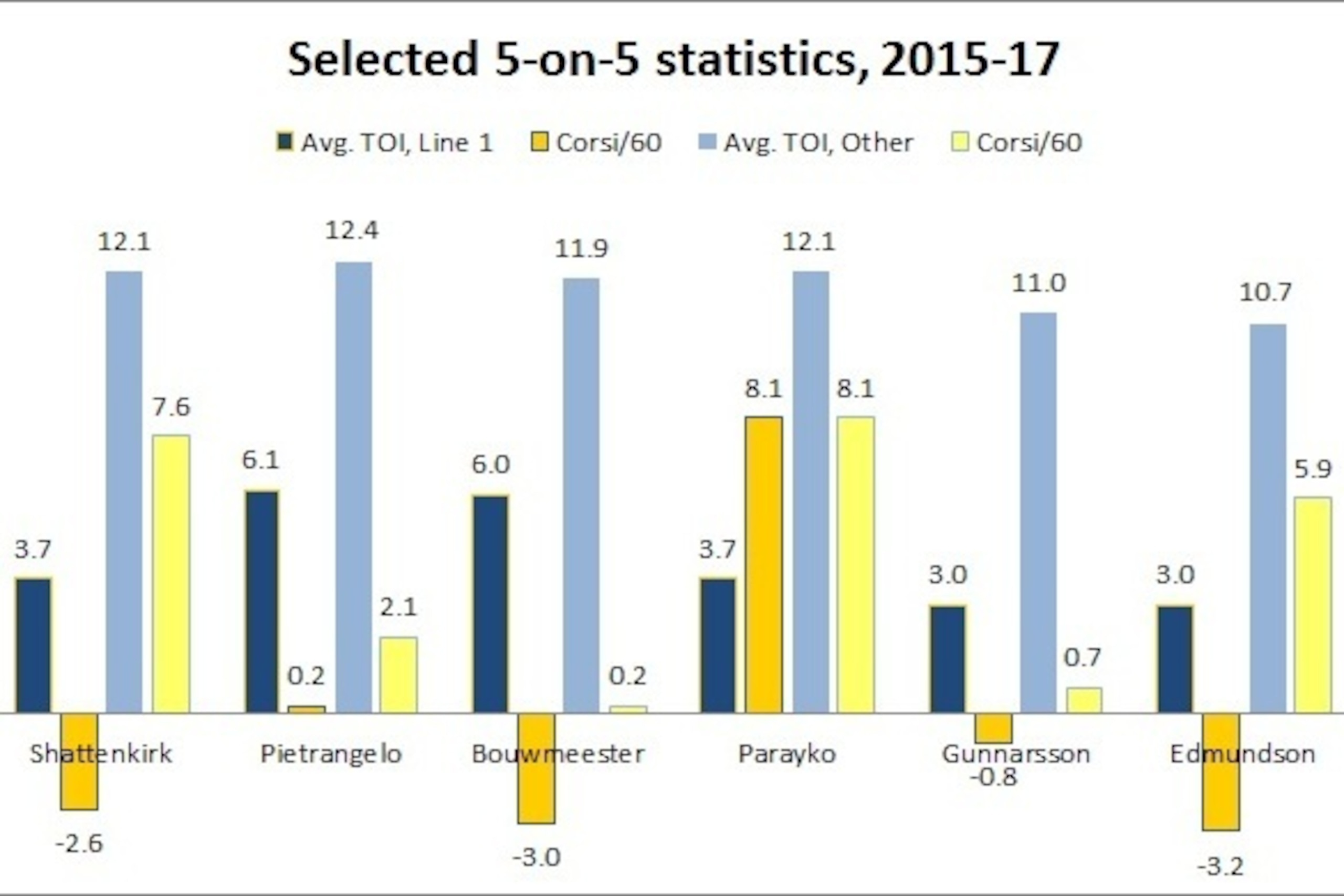
We can see the difference between a hard-minutes defence pairing and a more offence-oriented pairing by looking at the two blue minutes bars. This actually downplays time against tough competition a little—for example, if Patrice Bergeron was injured one night, we're missing shifts played against David Krejci—but for these purposes, it's good enough. Pietrangelo spends roughly one-third of his ice time against top lines. Shattenkirk spends roughly one-quarter.
The more important item here is shot rates, coloured in gold or yellow. These show a player's on-ice Corsi differential per hour against first lines and against the rest.
We're particularly interested in Shattenkirk, and at first glance, things look bad for him as a defender. He destroys secondary opponents, but against top lines, his defence pairing has mostly lost the puck possession battle. This would seem to suggest that the consensus view of him as an offensive specialist is accurate and that he struggles to defend against top opponents.
The complicating factor in all of this is the lopsided nature of the Blues' defence pairs. Bouwmeester and Joel Edmundson have both been worse than Shattenkirk in this area. Carl Gunnarsson's tough minutes numbers aren't so bad, but his soft minutes totals are so awful that skepticism would seem to be warranted there, too.
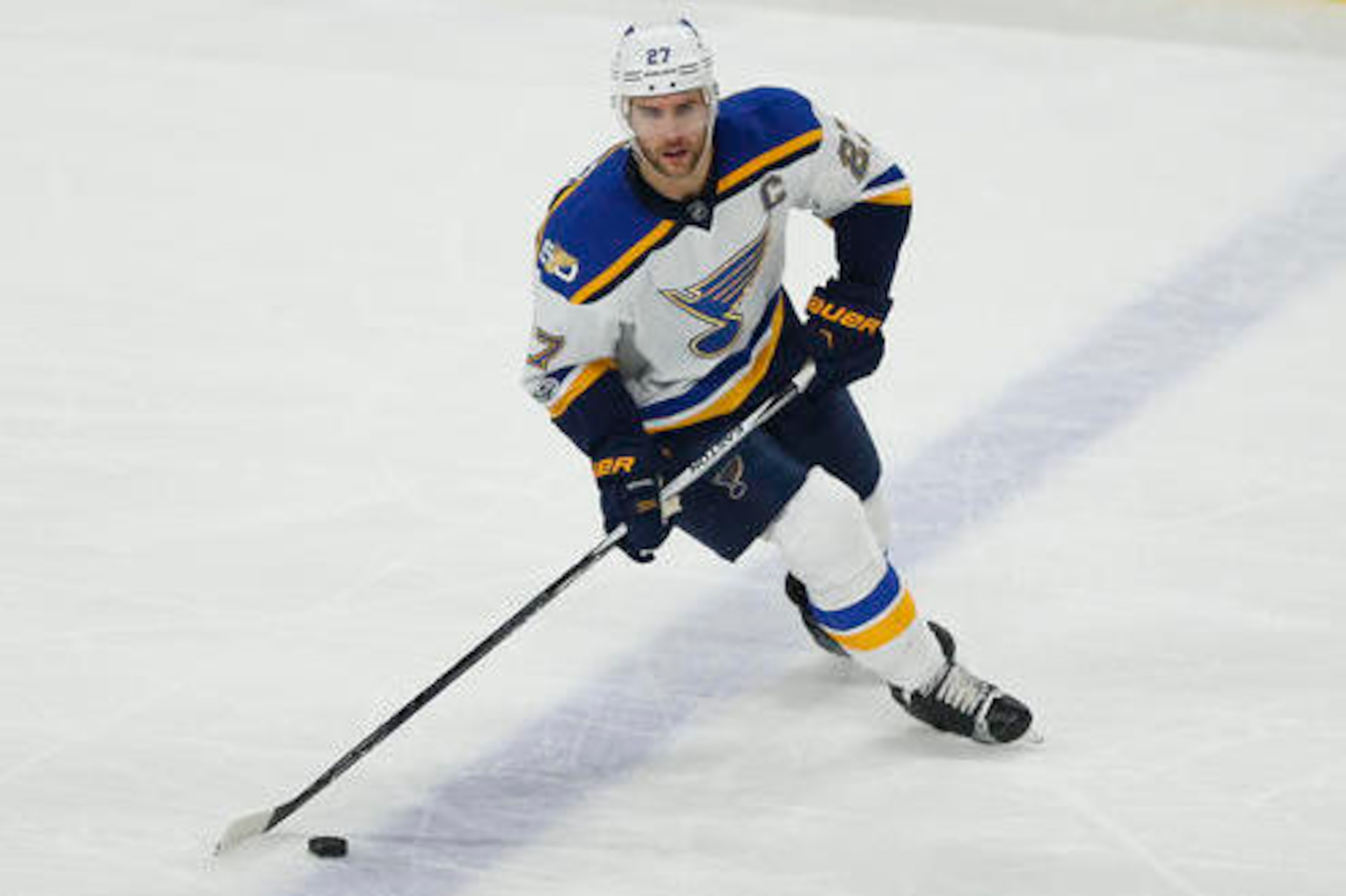
It’s fair to say that Shattenkirk is no Pietrangelo or Parayko when it comes to defending against the toughs; both have managed to overcome playing primarily with weaker partners.
(In that vein, it's worth noting that Pietrangelo has been just incredible when paired with either Shattenkirk or Parayko. With a Corsi number north of 55 percent and even better goal totals, that just goes to show that sometimes a pairing with two great righties is a better bet than a great righty with a mediocre lefty.)
At the same time, Bouwmeester has been a top tough-minutes option for years on a very good team despite putting in an inferior performance to that of Shattenkirk while playing with a superior partner. Give Shattenkirk someone reliable on the left side, and the gap between him and Bouwmeester would certainly increase.
Shattenkirk may not be able to carry the mail by himself in a tough minutes role, but it seems probable that he could handle it with a capable partner. Combine that with his offensive acumen, and he's a rental player every true contender in the league should have its eye on.
Statistical information courtesy of Hockey-Reference.com, Stats.HockeyAnalysis.com, Puckalytics.com and Corsica.Hockey. Contract details via CapFriendly.com.
Jonathan Willis covers the NHL for Bleacher Report. Follow him on Twitter for more of his work.
.jpg?w=2560 "NHL Trade Grades Connor Hellebuyck")


.jpg?w=2560 "Malik Beasley Negotiating Plea Deal (AP)")

.jpg?w=2560 "Aikman Blasts Cowboys WR 🫣")

.jpg?w=2560 "Jonathan Taylor Landing Spots")