

Prince Ibeh's Improbable Journey from Texas Bench to NBA Draft Boards
Oklahoma got the switch it wanted when Texas Longhorns behemoth Prince Ibeh ended up on guard Isaiah Cousins. The Sooners were college basketball's closest version to the NBA's Golden State Warriors, exploiting mismatches and spreading the floor with shooters.
But on this particular play, Ibeh blew the whole thing up. The big fella chased Cousins around a Buddy Hield screen, cutting to the basket, then stayed attached to the hip of Cousins as he ran around two staggered picks, drawing an illegal screen on the second.
TOP NEWS

Brown with an all-time summary of relationship with Tatum

Heat, Giannis were down by 20+ in each of their 3 losses

Power Ranking Every NBA Team's Starting Lineup 🔢
"I've never seen a big guy chase a guy on a stagger like that," Texas coach Shaka Smart said. "It was crazy. You just don't see that. Usually, when you get to that type of screening action, if there's been a switch, you switch back. It was just really impressive to speak to the way that the guy can move."
This is how Ibeh, relatively unknown a year ago, emerged as an intriguing NBA prospect in a span of weeks after spending most of his first three seasons on the bench. He put up modest stats on the offensive end as a senior, but his defensive prowess had the Texas staff comparing him to one of the best centers in the world.
"Our guys all say DeAndre Jordan," Smart said, then pausing, realizing comparisons of unproven prospects to All-NBA first-teamers aren't always fair or beneficial. "He's just unique. The way the guy can move and do some things at that size is pretty special."
Ibeh is the best shot-blocker in this draft. At 6'11" with a 7'5 ½" wingspan, he swats shots at the rim with ease and also has the ability to get out on the floor and defend a guard.
The NBA is getting smaller, but there's still value in rostering rim protectors, especially those who are mobile. Toronto Raptors' center Bismack Biyombo likely made himself a lot of money in the playoffs with his shot-blocking and motor. Jordan was an All-NBA selection this year without having much of an offensive repertoire outside of finishing lobs and cleaning the offensive glass.
Ibeh had been one of the nation's best shot-blockers his first three years in Texas, but that was knowledge only diehard Texas fans and Big 12 coaches had. He'd never played more than 13.6 minutes per game in his first three years in Austin under former coach Rick Barnes.
| 2015-16 | 11.9 | 7 |
| 2014-15 | 13.6 | 5 |
| 2013-14 | 13.8 | 7 |
| 2012-13 | 12.0 | 15 |
Which makes no sense if you paid attention to the advanced statistics. Had he logged enough minutes to qualify, he would have ranked top-15 nationally in block rate (the percentage of two-point attempts blocked while on the floor) each season.
"I'd ask, 'What am I doing wrong?'" Ibeh said. "[The coaches] would say I'm doing great and I'm a game-changer, things like that. I'm like, 'I'm a game-changer? But I'm not playing much. Why are you telling me all of these positive things and my situation isn't improving?'
"That's all I'd really hear. I wouldn't know how to go about it."
Ibeh nearly transferred following his sophomore season in search of more playing time. The next season, UT's frontcourt was even more stacked. Barnes and his staff added Myles Turner, a one-and-done lottery pick who could block shots and knock down jumpers. Ibeh played even less than he did his sophomore year.
The coaching change following his junior season, and Turner leaving for the NBA brought hope. Smart told Ibeh during the offseason he believed he could lead the Big 12 in blocks and win Defensive Player of the Year.
"He set out goals for me immediately, and that let me know he really believed in me because he had high expectations for me that I didn't even have for myself at the time," Ibeh said. "It gave me new life when he arrived."
Ibeh nearly met both of Smart's goals—he finished second in the Big 12 in blocks and won Defensive Player of the Year.
But we must rewind. All of this success required another's misfortune.
On Dec. 27, Texas center Cameron Ridley—then a starter—broke his foot during practice. Ridley, a former McDonald's All-American, had been playing the best basketball of his career, and the Longhorns had won six straight games, including an upset victory over North Carolina. He had averaged 13.5 points and 10.3 rebounds during UT's winning streak.
Ibeh, meanwhile, had been resigned to his usual role as a backup. He was playing only 9.5 minutes per game, and in the last contest before Ridley got injured, played six minutes at Stanford.
But once Ridley went down, Ibeh was next in line and became the team's starting center.
"The first thing Coach Smart told me is he couldn't think of one better player he'd rather go with, and I was ready for the situation," Ibeh said. "He just said to play like myself."
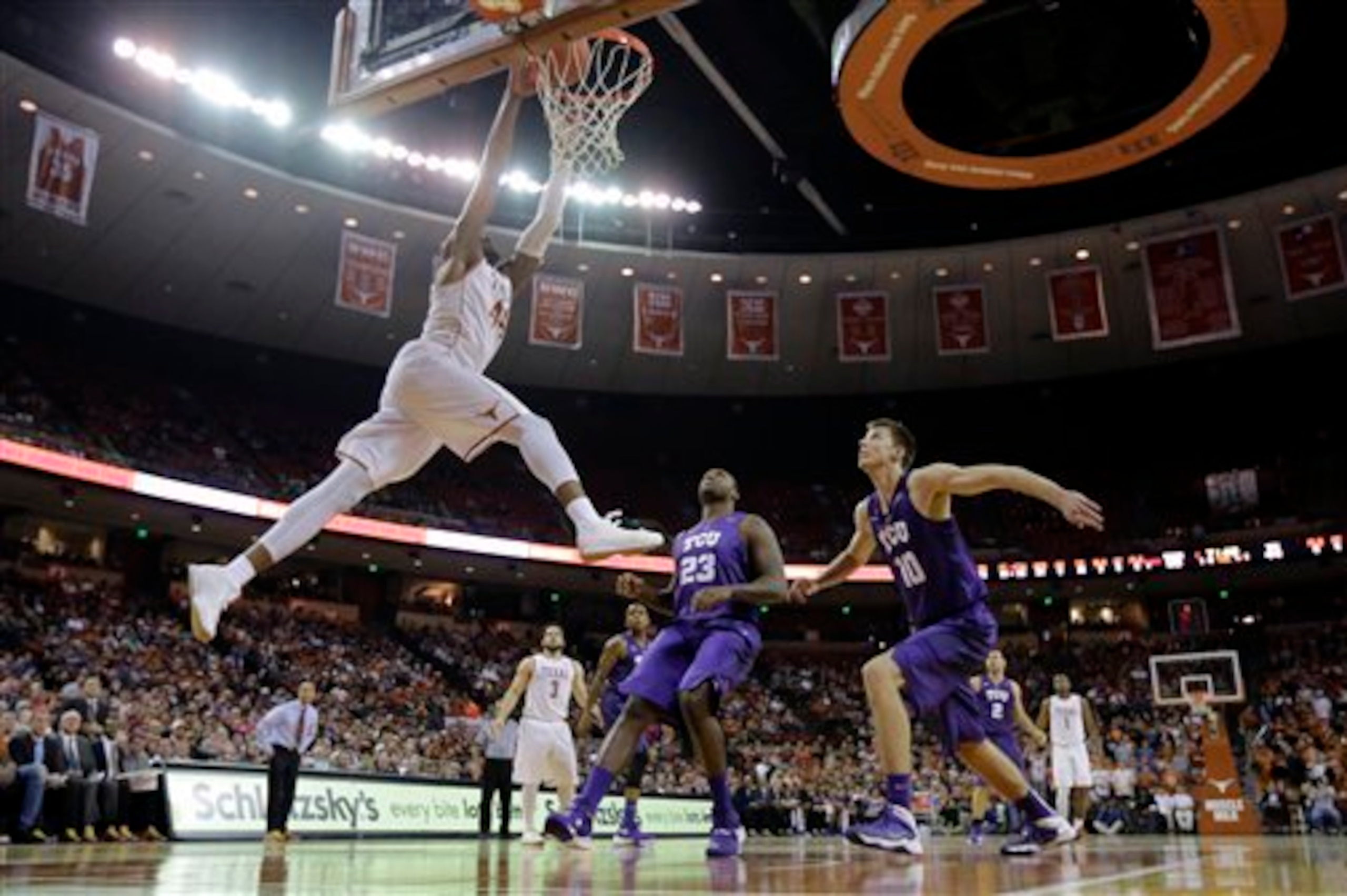
UT struggled at first, dropping three of its first four games without Ridley. But the Horns would win seven of their next eight, with the only loss of that stretch coming at Kansas. Ibeh had a breakout game that day, blocking a career-high seven shots. In one possession (see clip below), Kansas guards made the mistake of entering the lane twice and trying to shoot over him.
Look closely on the second block, and you can see Ibeh mouthing "gimme dat" when Frank Mason tries his floater in the lane. Every shot-blocker needs a signature celebration—think Dikembe Mutombo's finger wag—and Ibeh's "gimme dat" was the igniter of many UT runs. Following the Kansas game, he put up a line of 17 points, 10 rebounds and five blocks against TCU.
"I do believe that the boy always had the talent," said Lawrence Mann, who coached Ibeh on the AAU circuit. "After that TCU game, we all got excited. … Without a shadow of a doubt, the difference was his confidence level."
Ibeh followed the TCU game with 13 points, 11 rebounds and two blocks against Vanderbilt and projected first-round draft pick Damian Jones.
More impressive than any numbers were the little things he did on defense. He switched ball screens against guards. He waited until the last second to help off his man in the paint to disrupt the shot of a driving guard.
Those are the types of plays that pique the NBA's interest. Ibeh had been projected to go 53rd by DraftExpress until he fell out of its latest mock draft. Some scouts are skeptical because it took so long for him to really contribute at UT. Plus, he's limited on the offensive end to dunking and throwing down lobs.
"It's hard to validate investing in a guy who has difficulty scoring," a scout told B/R. "I can see someone taking a swing for the fence on him if he agrees to go to the [NBA] D-League and plays the whole year there."
Ibeh could be a few years away from being ready to contribute, but the same can be said for another athletic shot-blocker in the draft: Kansas freshman Cheick Diallo.
What's the difference between the two? Diallo is younger, but Ibeh possesses the same things that makes Diallo a first-round prospect (high motor, length, shot-blocking instincts and moves well for his size). Diallo is quicker, but Ibeh is a better, stronger and taller version right now.
Investing in either would be an upside pick.
"I think bigs tend to progress late," Baylor coach Scott Drew said. "A lot of them play their best basketball when they're 27, 28, 29 years old. I would think that he has the size and athleticism defensively right now, but I think his offense will definitely get better as he spends the next five and six years doing nothing but basketball.
"It really comes down to how hard he wants to work. If he lives in the gym, he'll be solid and become a skilled big man besides just a defensive player."
It's also no surprise that he was a bit of a late-bloomer. He took a circuitous route to becoming a big-time high school prospect. His family is from Mbaise, Nigeria, and moved to London before he was born. When Ibeh was five, his family moved to Texas, financed by money his mom won from a call-in contest on the radio.
Football is king in Texas, and that's the sport that attracted Ibeh at first. He had natural talent as a wide receiver and had dreams of playing in the NFL. But eventually, his height took that out of play, and he started playing organized basketball for the first time as a freshman in high school.
Mann saw Ibeh play for the first time the following summer and asked him to join his AAU team.

"I saw this big, long kid that was athletic but had no skills," Mann said.
By the end of the summer, Ibeh had a scholarship offer from Baylor before he ever played a minute of varsity basketball.
"It was from that point on I knew I'd have a real future in this sport," Ibeh said.
Ibeh believed he'd be a pro. But that confidence slowly started to dissipate during his first three years in Austin.
"I started to lose faith," he said. "I knew [NBA scouts] weren't seeing much. I knew I was capable, but I knew they weren't seeing much of me."
College coaches will tell you that just about every guy on their roster thinks he's going to play in the NBA. The lack of opportunity is typically a delusional excuse. That's why so many players transfer.
Mann said Ibeh has never been one to back down from a challenge, and that's part of the reason he stayed at Texas. And to his credit, he didn't pout and stayed ready.
"I don't think there's anyone that ever thought Prince wasn't capable and talented and had a lot of potential," Smart said. "I think what he was able to do this past year, more so than the past, is just say, 'Hey, this is on me. I've got to make sure I make it work for myself and the team,' and he was very successful with that. He's got some more growth that he can make, but the thing that he understood this year [more] than he understood in the past is that his growth is up to him.
"Prince is a guy when he sets his mind to something, really focuses on it, he can make major strides."
Whether he gets drafted or not, Ibeh once again believes he can make it.
"It keeps me motivated knowing that I have a shot," he said. "There's not a lot of people in my position, and I'm grateful."
C.J. Moore covers college basketball for Bleacher Report. You can follow him on Twitter @CJMooreBR.
_0.png?w=2560 "Unranked Teams Cause Chaos in Rankings 📊")
.png?w=2560 "Week 8 Winners & Losers 📊")
.jpg?w=2560 "Jonathan Taylor Landing Spots 📍")



