

Jack-of-All-Trades or Master of One: The Modern NFL Defender
There used to be no higher compliment to a player than calling him the "prototype" for his position—but in today's NFL, they don't mass-produce 'em like they used to.
Back in the day, the NFL rejected great athletes for not fitting into the mold of all-around positional excellence. The league regarded so-called tweeners who couldn't do everything well as fatally flawed.
On offense, we've already seen the revolution: quarterbacks at their best on the run; two-, three- and even four-headed running back attacks; specialized receivers who each bring an individual element to an offense. Whether most fans have realized it or not, the old molds we try to squeeze defensive players into have been cracking, even crumbling.
TOP NEWS

New NFL contenders starting to emerge after Week 4
.jpg?w=2560 "Cardinals Giants Football")
NFL investigating 2 referees for separate viral exchanges
.jpg?w=2560 "Hill Injury Update Football")
Report: Chiefs Contact Hill's Agent
Players with the versatility to play several roles have become prized, even if they're not doing anything at a Pro Bowl level. Players who do one thing well are inserted all over the field to maximize down-to-down matchups on that dominant trait.
Using Pro Football Focus' snap-charting data (which, full disclosure, isn't perfect for our purposes), we can see how 4-3 and 3-4 defenses are becoming far blurrier than ever before:
In 3-4-based defenses, nose tackles aren't getting as many snaps as defensive ends, likely because of the prevalence of 2-4-5 nickel alignments. Occasional hand-in-the-dirt 4-3 wide ends are vulturing even more defensive tackle snaps.
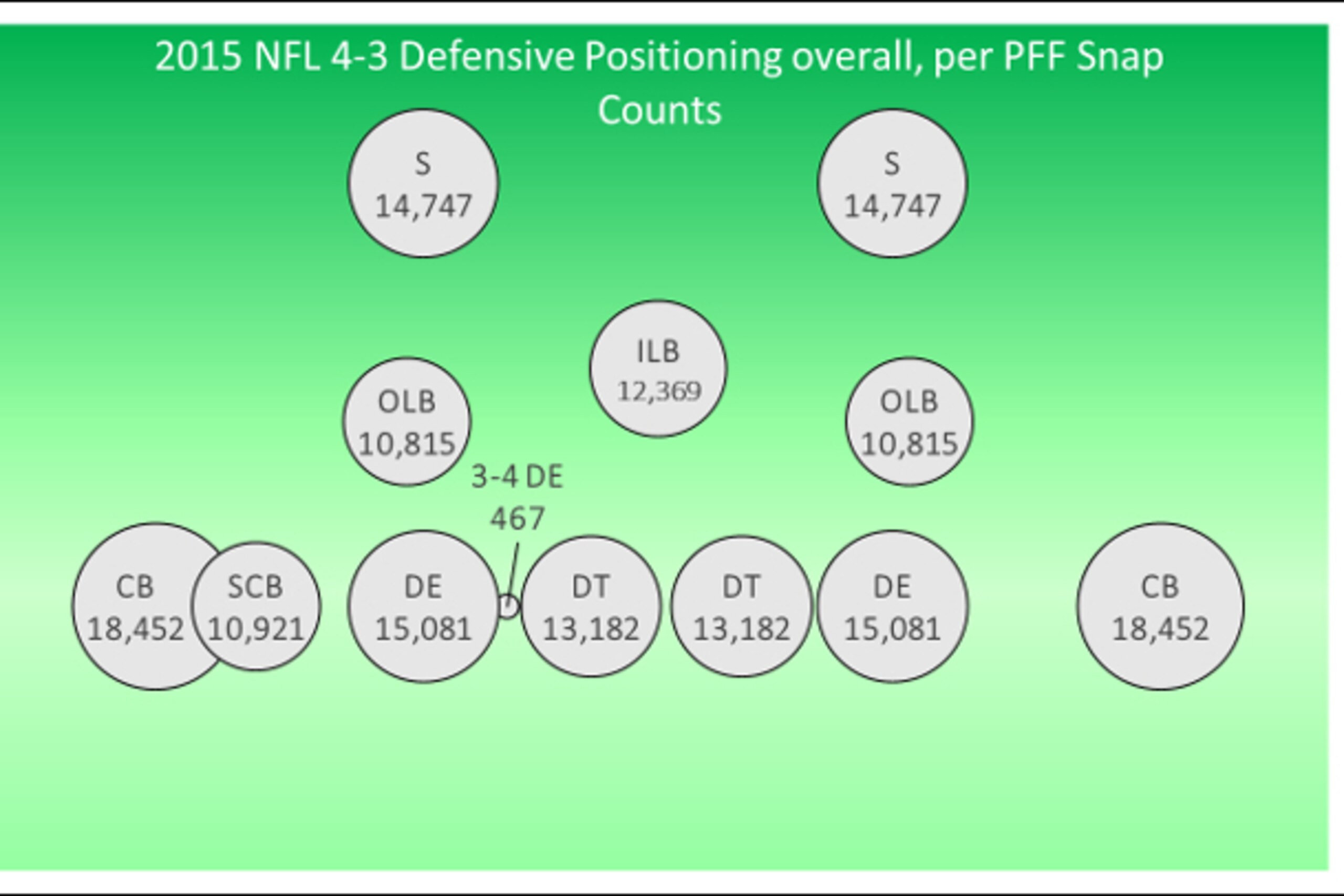
The story is the same for 4-3 teams. There aren't quite as many snaps to go around for tackles as ends, and there's sparing use of 5-technique 3-4 defensive ends. Interestingly, inside linebackers seem to get more snaps than their wingmen:
But what happens when we dive into the data a little deeper and find out which players are lining up in those spots?
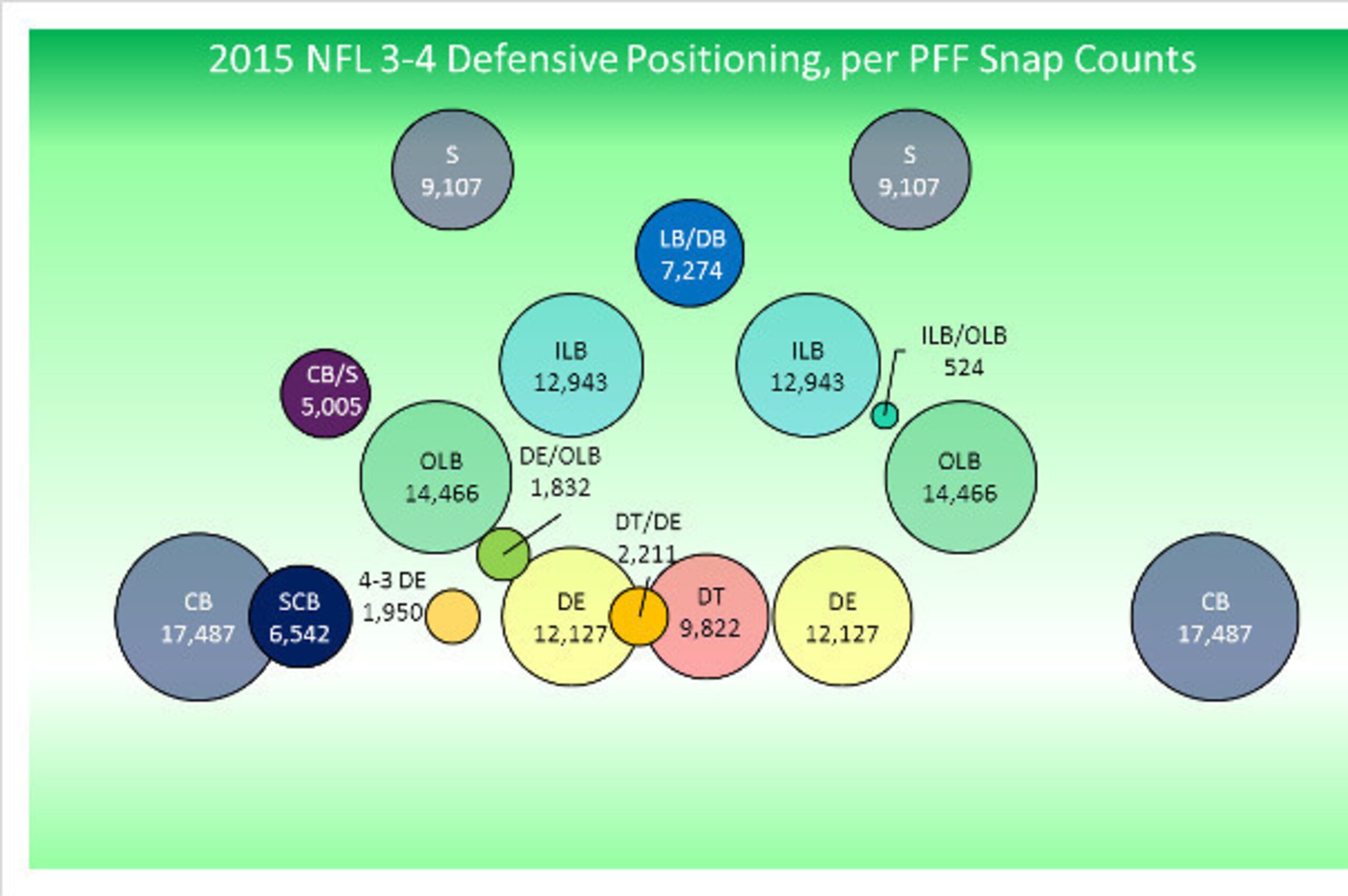
In the 3-4, pure nose tackles are getting even fewer snaps than it appears; almost a quarter of them are ends flexing inside.
Jaye Howard of the Kansas City Chiefs took a lot of tackle snaps last season when starter Dontari Poe got hurt, but Howard continued to make an impact all over the line regardless of Poe's health. Pro Football Focus charted him with 843 overall snaps, and he finished with a solid plus-8.8 overall rating. The Chiefs rewarded Howard with a two-year, $12 million contract in March.
Ends standing up and linebackers putting a hand down are sharing almost as many snaps.
Sheldon Richardson of the New York Jets, who's 6'3" and 294 pounds, took 77 of his 630 snaps at outside linebacker, earning a strong plus-4.6 PFF rating at that spot alone. That kind of athleticism at that size is rare, but both Datone Jones (6'4", 285 lbs) of the Green Bay Packers and Mario Edwards (6'3", 280 lbs) of the Oakland Raiders were also as effective rushing the passer in space as they were in the trenches.
Interestingly, there's little inside-outside flexibility; though 3-4 alignments can bring pressure from anywhere, inside 'backers are increasingly asked to drop into coverage. That's why a whopping 7,274 snaps went to linebackers who flexed to corner or safety, or were assigned extensive slot coverage.
Lawrence Timmons isn't what you picture when you think of a hybrid linebacker/safety—but as PFF's Sam Monson explained, the Steelers often asked Timmons to defend huge sections of the field against top-flight receivers.
The real flexibility of modern defenses is in the secondary. Deone Bucannon, star "moneybacker" of the Arizona Cardinals, has the build (6'1", 211 lbs) and athleticism of a safety, yet he lines up as an inside linebacker. Where old-school inside linebackers had to stuff the run, Bucannon had slot-coverage responsibility on 63 of his 525 coverage snaps.
Then there are the wild cards: Tyrann Mathieu of the Cardinals, Ron Parker of the Chiefs and Swiss army knife Washington rookie Kyshoen Jarrett each flex between safety and cornerback from game to game and down to down.

The Atlanta Falcons' Adrian Clayborn is the key to their hybrid front seven, disrupting up the middle on passing downs and flexing outside. He rushed the passer on 74.6 percent of his split inside/outside snaps, earning a strong plus-11.6 combined pass-rush grade in the process.
In modern 4-3s, defensive ends often have to generate pressure by themselves, and outside linebackers don't have to take on and shed blocks as frequently as they used to. The difference in size requirements for those two tasks doesn't lend itself to as much cross-positional flexibility as might be expected.
Inside linebackers are a different story.
Vincent Rey of the Cincinnati Bengals had to cover for injured teammates, but he earned his starts at multiple spots. He logged 246 snaps at inside linebacker and 436 on the outside (split between strong side and weak side, even!), and he had slot-coverage responsibility on 53 of them.
His all-over-the-field performance earned him a three-year, $11.5 million contract this spring—and the Bengals spent that money knowing he'll earn it one way or another.
Patrick Chung has been considered a liability in coverage for much of his career, but when the New England Patriots got the bright idea to line him up as a slot corner in nickel and dime situations, his physicality became a huge asset.
Byron Jones of the Dallas Cowboys applied his eye-popping combine measurables to every spot in the secondary in 2015. Seattle Seahawks defensive coordinator Kris Richard called defensive back DeShawn Shead a "jack-of-all-trades" this December, per John Boyle of the team's official site.
Then there's Shaq Thompson of the Carolina Panthers. Last spring, draftniks agreed he was an incredible prospect, but no one could figure out which mold to hammer him into. When the Panthers drafted him at No. 25 overall, it quickly became clear: There's no need for molds anymore. The undersized (6'0", 230 lbs) rookie earned a plus-4.8 overall rating playing strong- and weak-side linebacker, and flexing out to cover slot receivers on a whopping 67 snaps.
In today's NFL defenses, there are two paths to playing time, the starting lineup and guaranteed money: be versatile enough to do whatever the team needs on any down, or do one thing well enough to do it from anywhere on the field.
.jpg?w=2560 "Titans Giants Football")
.jpg?w=2560 "Dolphins Bills Football")



.jpg?w=2560 "Greenlaw Talks Payton Exchange")
