Anquan Boldin Could Be the Biggest Steal of 2016 NFL Free Agency
NFL free agency is like a high-roller auction when the market first opens. You know the scene: A ramblin’ man in his best white suit stands, points and flails behind a podium while those with too much money and not enough places to put it tug on their ears.
That lasts for, oh, about 48 hours.
The floor was swept up long ago in the 2016 free-agency auction room. The prizes have been taken home and polished, and the gawking has begun. But those moments of self-congratulating are fleeting, because the next leg of free agency comes fast, with the venue changing.

As the calendar flips from March to April, NFL decision-makers can be found shuffling around a yard sale. They’re surrounded mostly by, well, stuff. Just stuff, and the sort of stuff that’s aged, fading and reaching the end of its useful life. Each general manager knows this, because everyone does as they walk through discarded junk.
They still search, tossing items aside to find that one shining gem. Too often their scavenging efforts end in nothing more than wasted time, though little money is sacrificed. In 2015, for example, defensive end Darnell Dockett was thought to be an aging yet still effective temporary solution for the San Francisco 49ers. Then he was released in September.
It’s a new year now, with promise again hidden somewhere among the rubble of veterans. And in 2016, those in need of a meaningful contribution at wide receiver along with solid, bulky depth at the position can look to Anquan Boldin.
He may be 35 years old, but the possibly (likely?) former 49er can be this year’s bargain steal, and has plenty to offer a contending team.
Interest in Boldin is only beginning to build after he made what was reportedly his first free-agent visit Tuesday. The Washington Redskins brought him in for a look, according to several Washington Post sources:
Earlier, when free agency first started, the Buffalo Bills also kicked Boldin’s tires. But then general manager Doug Whaley said signing a veteran like Boldin isn’t ideal right now, though he added you can “never say never” when speaking to ESPN.com’s Mike Rodak.
The New England Patriots poked and prodded him too, according to Comcast SportsNet’s Mike Giardi. Then they opted to fill their veteran low-cost gamble needs by signing Chris Hogan and Nate Washington instead.
So Boldin has been left to sit and wait. He may be asking for too much money, and the passage of time has a way of bringing dollar figures down. Once that inevitably happens, the team that adds Boldin will have spent little during free agency’s dollar-store phase while adding a lot.
Receivers are generally considered to be among the NFL’s elderly population when they’re at or around the age of 35. However, there are exceptions if the right player is plugged into the right fit.
Notable age-defying examples are still fresh. In 2012, a then-34-year-old Reggie Wayne finished with 1,355 yards on 106 receptions for the Indianapolis Colts. That production tied the second-best single-season yardage output of his career.
And even more recently, Steve Smith of the Baltimore Ravens has racked up 1,735 receiving yards over his last 23 games (75.4 yards per game), which has all come during his age 35 and 36 seasons.
Boldin doesn’t have to match those highs to be a fine penny-stock purchase. He could play a lesser though important and specific role, just as Randy Moss did for the 49ers in 2012.
Moss was 35 years old then and had been out of the league for two seasons. He still completed the year with 434 yards (15.5 per reception) and three touchdowns, even though he played 43.9 percent of San Francisco’s offensive snaps, according to Pro Football Focus.
The concern with Smith, Wayne and so many others before them was speed, and how they’d adjust after losing a step or three. Ultimately, that’s the decline trigger for receivers. When the foundation of your success is rooted in the ability to separate through speed, the end can come abruptly.
But speed isn't a concern for Boldin. He never had much of it to begin with, and that’s not about to change now. The former Florida State standout can be purchased at a heavily discounted rate, then asked to be the same receiver he’s already been for 13 seasons.
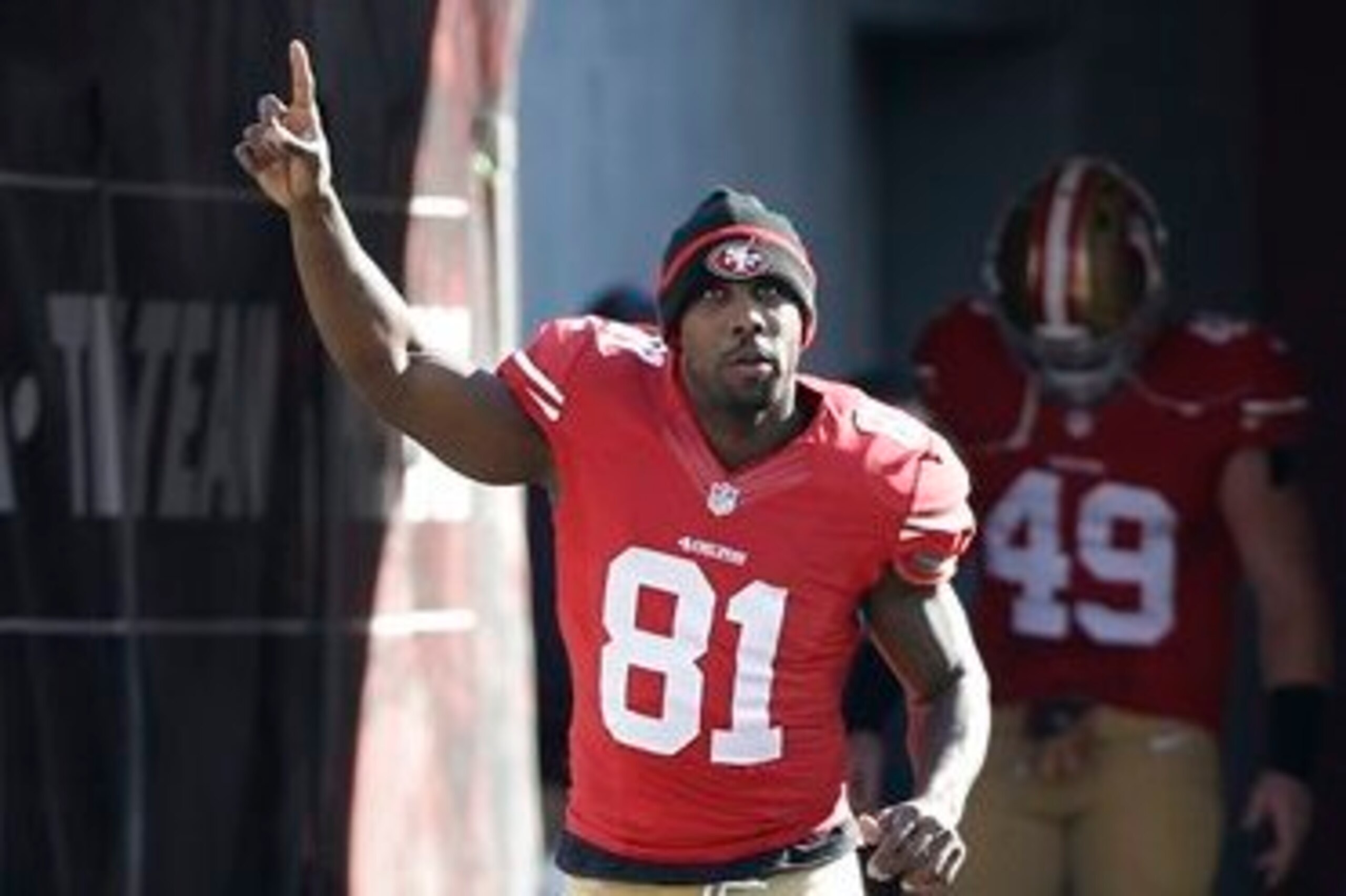
There’s little difference between an aging Boldin now, and the younger versions of the same receiver.
Speed has never fueled his career as he grew into a constantly whirring reception vacuum, and became one of just 13 players to record 1,000-plus career catches. At 6’1” and 220 pounds, he’s a physically dominant receiver who plays with the mentality of a tight end, grappling and clawing for balls amid chaos.
Of those career receptions, 69 came in 2015, when he finished with 789 yards over only 14 games. Those team-leading totals may sound mediocre, but please recall how putrid the 49ers offense was as it first navigated Colin Kaepernick’s struggles, and then was forced to embrace a life with Blaine Gabbert as the starting quarterback. The 49ers averaged only 207.2 passing yards per game (29th) and 6.9 per attempt (24th) in 2015.
But whenever they did complete a forward pass successfully, Boldin was on the other end an overwhelming percentage of the time compared to his fellow 49ers pass-catchers. Boldin’s receptions accounted for 21.4 percent of the 49ers’ completions in 2015. Meanwhile, wide receiver Torrey Smith caught the team’s second-most receptions (33), and occupied only 10.2 percent of the completion pie.
There’s only one useful piece of information that can be gleaned from Boldin’s most recent season then, but it’s significant. Boldin still has the ability to find open space and separate more than enough to be leaned on.
We saw that in his reception total even when Boldin was buried by the wobbly throwing of Kaepernick and Gabbert. Boldin’s career per-season catch average prior to 2015 was 84, and a drop of 15 feels modest considering the burning tire pit of an offense he was dealing with.
We also see it in his drop rate. Boldin is a reliable and sure-handed target, especially considering his frequent slot usage when he was often asked to secure balls thrown through tight windows, and into heavy traffic. He had only four drops on 73 catchable balls in 2015, per PFF. That led to a drop rate of only 5.48, which ranked a solid 12th out of the 30 receivers who saw at least 50 percent of their team’s targets.
You may be questioning the silky softness of Boldin’s hands, flashing back in your mind to one season ago. In 2014, Boldin finished among the league leaders in drops after he turfed 10 balls.
But that number is a vicious outlier next to recent seasons. It’s a balloon inflated by one uncharacteristically drop-filled afternoon in Week 10 of 2014 when Boldin suddenly caught a case of slime hands, dropping four routine throws.
One game accounts for 18 percent of his drops over the past four years.
| 2015 | 73 | 4 | 5.48 |
| 2014 | 93 | 10 | 10.75 |
| 2013 | 91 | 6 | 6.59 |
| 2012 | 67 | 2 | 2.99 |
That chart dates back to when Boldin was in his age-32 season. At the earliest season shown—2012, a year when Boldin had the league’s best drop rate—he still wasn’t exactly a young whippersnapper.
Speed may fade, but confident hands can become a sort of anti-aging force at wide receiver. They’re an antidote, one that provides a tool so valuable, and an asset so desired the receiver in question can transition seamlessly into a possession role as downfield acceleration wanes.
Which is the other beauty of Boldin’s career arc that has now plateaued or, at worst, taken only a mild downturn. There isn't much of an adjustment for him because he’s never been a burner. By NFL receiver standards, Boldin hasn’t even been a soccer mom van next to the league’s many racing Ferraris. Throughout his entire career Boldin has been a fast-moving bus, and I mean that as a compliment.
There’s a dedicated army of armchair talent evaluators who bemoan the emphasis on testing scores at the scouting combine each February. And annually their first source of ammunition is Boldin, who needed 4.71 seconds to run 40 yards back in 2003. That didn’t stop him from being a second-round pick, and a three-time Pro Bowler.
Boldin is the exceedingly rare exception to the league's speed rules due to a playing style that, when combined with trusted hands, has increased his potential to still be productive now as he approaches the wrong side of his mid-30s.

Being a physical bruiser and battering ram is how Boldin has made his living in the NFL. He doesn’t thrive off of pure, raw speed. Instead, Boldin has lived in the intermediate areas of the field, where he can thump and pinball his way to extra yardage.
Consider the 2014 season, which, again, was the last year to fairly evaluate Boldin before San Francisco’s offense was engulfed in flames. A then-34-year-old caught 83 passes for 1,062 yards. Boldin did that as he powered through to created 12 missed tackles after the catch, which ranked tied for 12th among the 78 receivers who were on the field for at least 50 percent of their team’s snaps, per PFF. In 2013, a year still not far in the rearview, Boldin averaged 73.7 receiving yards per game on the strength of 13 missed tackles generated (tied for 10th).
Please note once more that although Boldin has continued to age because, well, time passes for us all, those high-volume tackle-breaking seasons came during a time when most receivers are beginning to wither away physically. His 83 receptions in 2014 tied him for the 12th-highest single-season total all-time among wide receivers aged 34 or older, according to Pro-Football-Reference.com.
He hasn’t changed much since then. He’s still the same precise route-runner, and the same receiver who feels like a small tree during any tackle attempt up the middle. Just ask former Washington Redskins safety Ryan Clark, who was left dazed after trying to create a Boldin sandwich in Week 12 of 2014.
Clark ended the play on the ground as a direct result of the hit, but Boldin didn’t. He absorbed the impact and somehow still held on to spin away with the football in his hands.
The best way to get a feel for the high-speed carnage Boldin had to fight through is with a tiny dose of what he saw: a blur.

In real time, Clark appears only as a distorted streak when he’s getting ready to unload with an illegal helmet-to-helmet hit.
I’m not sure what’s more astonishing between Boldin holding on in the face of that blur, or when the play is slowed down and you can see his smushed face, and he still has the ball, captured here by CBS Sports' Eric Kay:
Boldin isn’t a savior, and no one should be selling him as such. Those don’t exist on the open market in April.
But he’s impressive in his own unique way. He can be a source of security up the middle, sliding in and assuming a complementary role as a possession receiver. And he can do it while pushing you to disregard one looming number, and absorb others first.
The ones you should pay attention to are the aforementioned digits tied to recent production, including two straight 1,000-plus-yard seasons in 2013 and 2014.
The one that will dissolve away? Thirty-five. His age.

.jpg?w=2560 "LA Premiere of \"Chad Powers\"")