

2016 Free Agency Could Blow the Lid off the NFL's Salary Scales
"What's the number?"
That's the question NFL movers and shakers will be asking each other at the beginning of the league's so-called "legal tampering window" on March 7—and, in reality, are probably asking each other as the combine rolls on in Indianapolis this weekend.
What is that number? The average annual value of free agents' contracts. Sure, an often-misleading total-salary figure gets trumpeted to the press, and the guarantee structure matters, too. But sort any position group's contracts by average annual value at Spotrac.com, and you'll see how the market really slots players.
.jpg?w=2560 "Commanders Eagles Football")
Aaron Rodgers is the top-earning quarterback at $22 million. Russell Wilson's new deal pays just $100,000 less per year, at $21.9 million—and that's not a coincidence. Ben Roethlisberger is right behind Wilson, Eli Manning is a little further behind him, and so on.
There's a well-regulated rhythm to this: As every player's contract comes up, he gets slotted roughly where he belongs relative to the existing pros' contracts. Every once in a while, a player (such as Tom Brady) intentionally takes a below-market deal or realizes the market has far outpaced the long-term deal he signed a few years ago and demands a renegotiation. More frequently, a team will overpay in free agency to secure a target or cut a guy whose play falls well short of the money the club has committed to him.
On the whole, the leapfrog-and-slot system works well—but in 2016, there will be some wild leapfrogging, which could blow the slotting to smithereens.
This season, Spotrac has used a mix of comparable players and statistical trends to calculate top free agents' market value. Kirk Cousins' projected market value of $20.6 million would slot him eighth among quarterbacks—but just $400,000 behind Manning's fourth-place deal and only $160,000 behind the contract Cam Newton signed this time last year.
Again: We're talking about a fourth-round pick who is coming off his first season as a starter and getting essentially the same contract as a former No. 1 overall pick with 62 starts and two Pro Bowl nods under his belt when he re-upped—and who is now league MVP.
As it happens, ESPN's Adam Schefter reports Cousins will get either the franchise or transition tag, which means he's likely to earn either $19.6 million or $17.5 million for 2016.

Sam Bradford has put up a career passer rating of 81.0 in 63 career starts. He was the NFL's 25th-rated passer of 2015, and if he earns Spotrac's projection, he'd slot 13th—ahead of Jay Cutler, Tony Romo and Matthew Stafford.
As high as these valuations seem, the 2016 free-agency cycle has the potential to push salaries past even these crazy numbers.
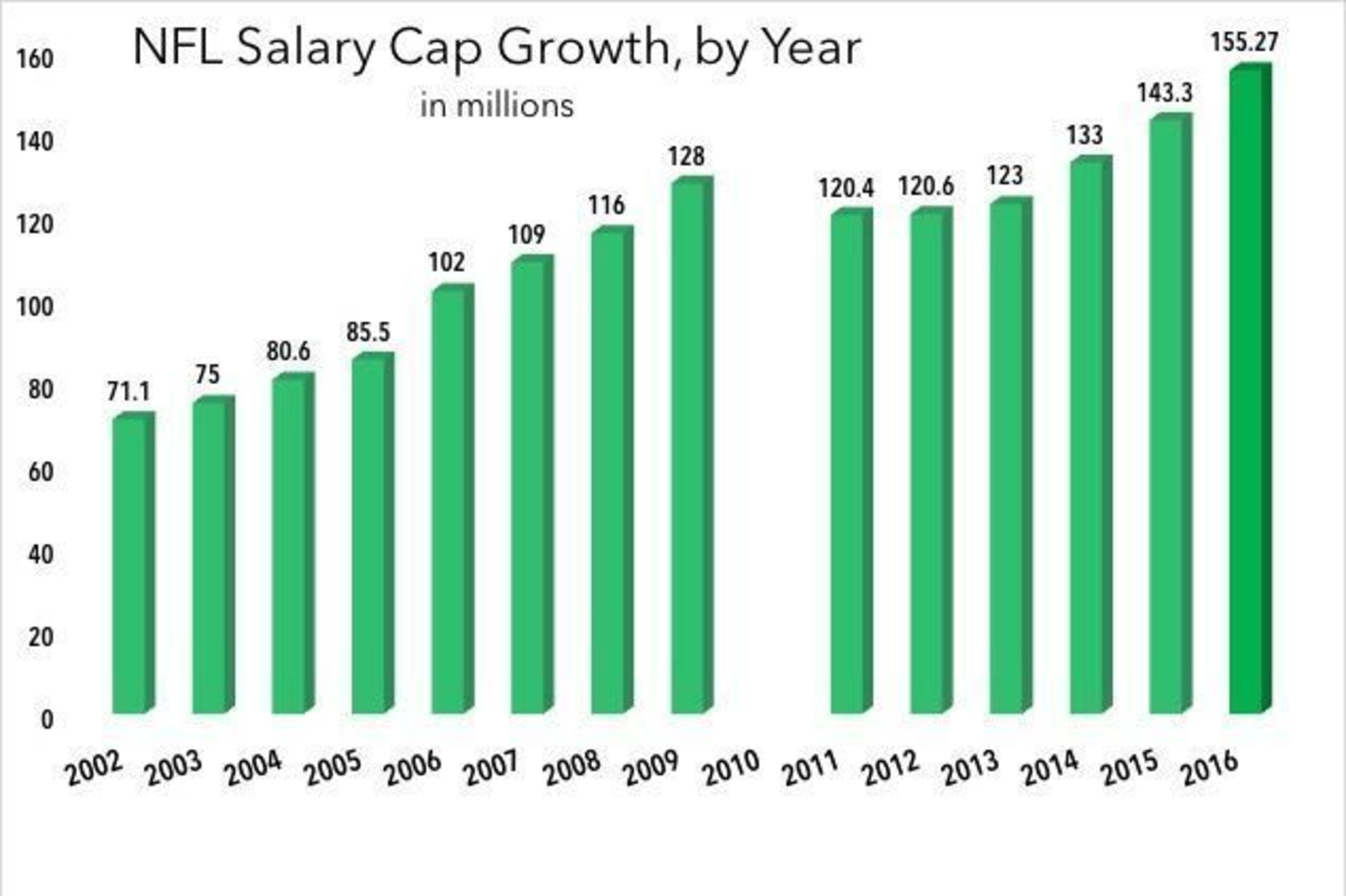
The NFL has set the official salary cap for 2016 at a whopping $155.27 million. According to OverTheCap.com, that means there's $978.6 million—almost a billion—in total cap space available. That's an average of $30.6 million per team.
The current positional markets have been set by long-term deals largely signed between 2008 and 2013, when the cap was essentially flat; the NFL world has been settled into a comfortable pay scale for the better part of a decade. But now the cap has grown by over $10 million in each of the last three offseasons:
In 2015, we finally started seeing some eyebrow-raising deals. Byron Maxwell, a solid starting cornerback with a limited skill set, got a whopping $10.5 million-per-year deal—the fifth-richest cornerback contract in the NFL.
Now, the cap has jumped again, and player salaries are finally going to have to jump with it. It's an incredible 26.2 percent bigger than three years ago—a lot more teams have a lot more money to spend. While most teams aren't going to max out the cap every season, and in fact most smart teams don't, no team should be letting a key target go elsewhere over $1 million per year—and you can be sure the cap-richest teams know they can load up on players.
"We need good players and we’ll try to look for good players at every level: offense, defense and special teams," New York Giants general manager Jerry Reese told Tom Rock of Newsday. "We need help all over the roster, and we’ll work hard to do that."
Spotrac pegs Malik Jackson's market value at $10.7 million—but he could turn down the Broncos' offer at that level, per the Denver Post's Troy E. Renck, perhaps anticipating offers in the $12-13 million range.
If that's where Jackson's market is, he'll be the fourth-richest defensive end in football, behind J.J. Watt, Mario Williams and Robert Quinn—three guys who combined for 27.5 sacks in 2015. Jackson had 5.5.
We may not see any top-of-the-market-setting deals like Calvin Johnson's 2012 blockbuster, because it's unlikely many A-list players will hit the open market. But due to a small class of viable prospects coming out when a lot of teams have a truckload of money to spend, a lot of second-, third- and fourth-tier players are going to get first- and second-tier dollars.
In turn, a lot of first- and second-tier players are going to want their deals to leapfrog the ones signed this March—and that's when hundreds of millions' worth of record-breaking checks will be written.
.jpg?w=2560 "Cowboys Giants Football")
.jpg?w=2560 "Packers Vikings Football")
.jpg?w=2560 "Grading WWE Raw 🔠")
.jpg?w=2560 "Follow WWE Raw 🇲🇽")
