

Breaking Down the Blackhawks and Penguins' Trevor Daley-Rob Scuderi Trade
At long last, the 2015-16 season finally saw a trade. On Monday, the Pittsburgh Penguins and Chicago Blackhawks pulled the trigger on the first in-season swap of the year, with defenceman Rob Scuderi going to Chicago in exchange for fellow rearguard Trevor Daley.
The move comes on the heels of Pittsburgh dismissing head coach Mike Johnston, a move which included an admission from general manager Jim Rutherford that his inability to address the blue line was part of the reason for the team’s struggles.
TOP NEWS
BS Meter on Latest NHL Trade Rumors
Best NHL Heritage Classic Jerseys 📋
Teams That Need Goalie Trade💡
Daley is a partial attempt to deal with those problems.
The 32-year-old veteran is both a strong skater and capable passer. For a Penguins team that had trouble advancing the puck from the back end, those are significant plusses.
However, he has other significant weaknesses, which is why the Blackhawks had been playing him less than 15 minutes per game this season. Additionally, Chicago kept him off the penalty kill entirely and started his shifts outside the defensive zone at five-on-five whenever possible.
That treatment worked, at least to a degree.
Daley’s shot metrics, which had been atrocious in his final campaign with Dallas, improved significantly with Chicago. He performed adequately on the team’s second-unit power play.
Nothing here says “world-beater,” but Daley was a competent defenceman for a long time prior to the disaster that was 2014-15, and these modest steps offer hope that he’s ready to take on a little more responsibility.
The cost of the transaction for Pittsburgh wasn’t so much the loss of Scuderi as it was the sacrifice of salary-cap space.
| Pittsburgh before | $3.375 million | 0 | $3.375 million |
| Pittsburgh after | $1.125 million | $3.3 million | $4.425 million |
| Chicago before | 0 | $3.3 million | $3.3 million |
| Chicago after | $2.25 million | 0 | $2.25 million |
Since they're retaining one-third of Scuderi's salary as part of the trade, the Penguins added a little over $1.0 million to the cap over each of the next two seasons in order to bring in Daley. He’s a much better fit stylistically, but it’s not a certainty that he’ll be much better overall than Scuderi over the remainder of his contract.
For Chicago, it’s hard not to see this almost entirely as a cap decision.
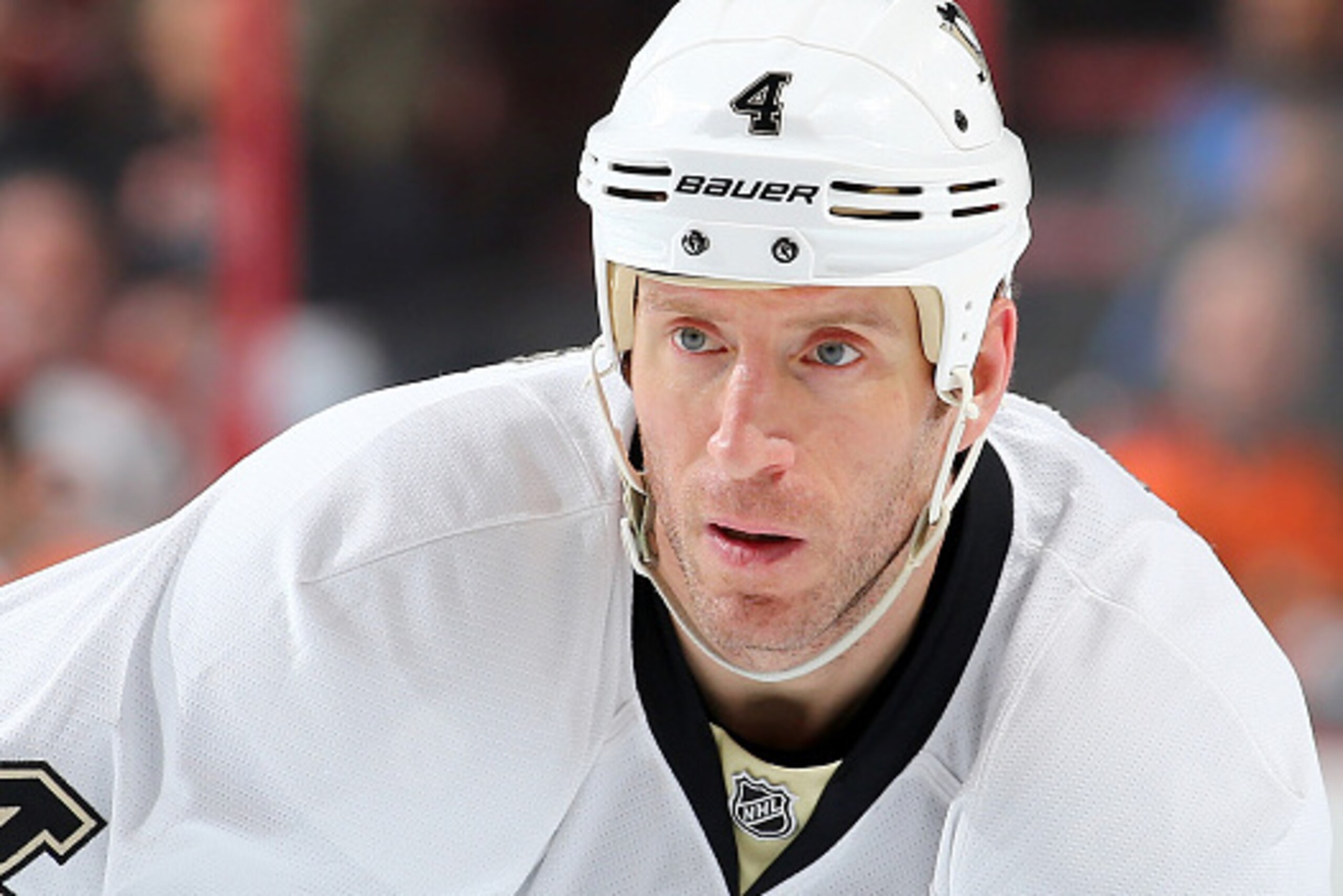
Scuderi was once a pretty effective defensive defenceman, but those days are long behind the soon-to-be 37-year-old rearguard.
It’s telling that Johnston took to using Scuderi more frequently in the offensive zone than the defensive end last season. This is a player whose entire skill set is built around shutting down the opposition, and he has never had a 20-point season in the NHL.
At even strength, Scuderi’s average playing time of 14 minutes and 24 seconds per game ranks sixth out of six regular Penguins defencemen, and despite the sheltered usage, his on-ice numbers are terrible.
His overall ice time looks more impressive because he gets heavy usage on the penalty kill. Unfortunately for Chicago, Stats.HockeyAnalysis.com indicates that Pittsburgh gets shelled when he’s on the ice at four-on-five.
If not for his guaranteed contract, it’s likely that Scuderi wouldn’t be in the NHL at this juncture. The Blackhawks would be wise to employ him no higher than the No. 6/7 slot on their defence, and a buyout in the summer or demotion to the minors at some point a la Bryan Bickell is not out of the question, either.
Essentially, this comes down to the question of whether Daley is still a competent NHL defenceman.
If he’s passable, the Penguins win this deal—particularly since his strengths (skating, passing, shooting) are good stylistic fits for the Pittsburgh blue line.
On the other hand, if he struggles, Chicago just traded one lousy veteran for another while saving more than $1.0 million per season in the process.
Statistics courtesy of NHL.com, BehindtheNet.ca, Stats.HockeyAnalysis.com and war-on-ice.com. Salary information via General Fanager.
Jonathan Willis covers the NHL for Bleacher Report. Follow him on Twitter for more of his work.
.jpg?w=2560 "NHL Trade Grades Connor Hellebuyck")


.jpg?w=2560 "Raiders Could Start Mendoza")
.jpg?w=2560 "Rodgers Iced Out on Plane 💎")

.jpg?w=2560 "🚨 Week 8 AP Top 25 Poll")

