
Breakout College Basketball Players Who Nobody Saw Coming
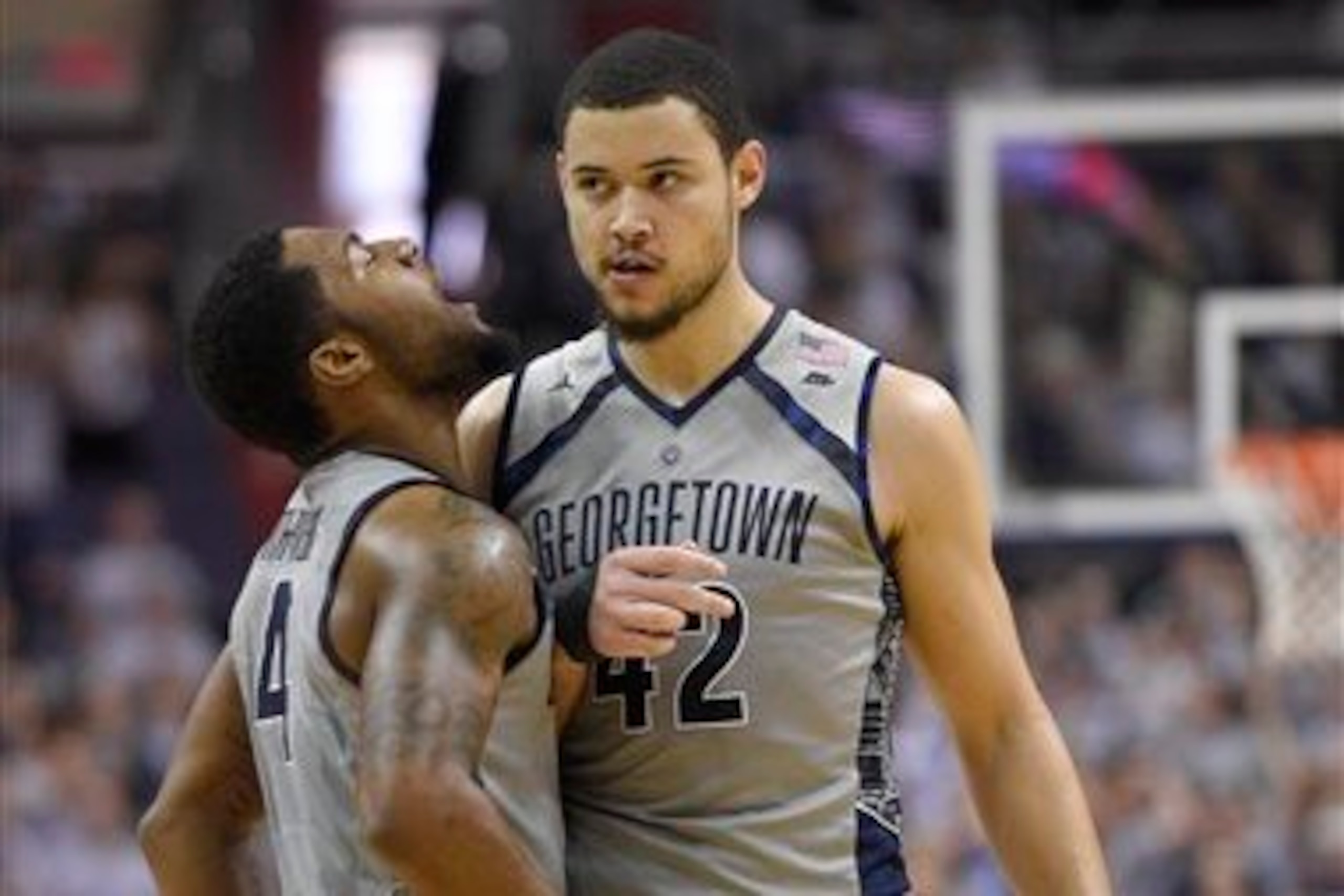
Georgetown's Bradley Hayes headlines our list of college basketball players having completely unpredictable breakout seasons, as it took less than two full games for him to score more points than he tallied in the entire first three years of his collegiate career.
With 351 teams and 12-15 players on each of those rosters, there are going to be a bunch of guys every season who come out of seemingly nowhere to make a significant impact.
I'm one of those weirdos who thinks the college basketball season never ends. Even in the absolute doldrums of the summer, I'm still researching like a loon, churning out multiple articles per week and absorbing as much information about the upcoming season as I possibly can. Yet not once during the painfully long offseason did I envision writing anything this year about guys like Hayes or Texas A&M's Tonny Trocha-Morelos.
There's a pretty good chance you didn't see any of these seasons coming either.
In lieu of some sort of formula, players on the following slides are ranked in ascending order of how far your jaw may drop to the floor when you realize how well these guys are playing in comparison to their expectations.
After you get through the list, be sure to head to the comments section to let us know which breakout stars we're still overlooking.
Honorable Mentions
1 of 11
Ben Bentil, Providence
17.5 PPG, 7.3 RPG, 1.0 APG, 1.0 BPG
Bentil is one of the biggest breakout players in college basketball this season. He's probably No. 1 on that list. But it would be hard to argue that he meets the "nobody saw coming" criteria when he was No. 2 on our list of players most likely to drastically increase production this season.
Yante Maten, Georgia
16.9 PPG, 8.7 RPG, 2.1 BPG
Like Bentil, Maten's significantly increased workload is hardly a surprise. After losing Marcus Thornton, Nemanja Djurisic and Cameron Forte in the same offseason, Georgia had little choice but to rely heavily on Maten in the frontcourt. Perhaps we didn't foresee his current four-game streak of scoring at least 20 points, but everyone expected a lot from Maten out of sheer necessity.
Bryant Crawford, Wake Forest
12.9 PPG, 4.9 APG, 3.6 RPG, 1.3 SPG
If he wasn't also averaging 4.4 turnovers per game, the relatively unheralded freshman point guard would certainly rank in our top 10. Nonetheless, we're very impressed by what he has been able to accomplish with Codi Miller-McIntyre still sidelined by a broken foot.
Kale Abrahamson, Drake
16.1 PPG, 3.7 RPG, 0.9 APG
He played both sparingly and inefficiently for two years with Northwestern, but it's hardly a surprise to see Abrahamson thriving after making the transition from major-conference bench to mid-major conference starting lineup. Also, his numbers are a bit inflated by his 41-point outburst against Western Kentucky.
Chris Boucher, Oregon
12.6 PPG, 8.5 RPG, 3.9 BPG
Boucher leads the nation in number of times an announcer feels compelled to reference an Adam Sandler movie when discussing his play, but Oregon's defensive juggernaut hardly had the out-of-nowhere career arc of The Waterboy. Boucher was one of the hottest JUCO commodities after averaging 22.5 points and 4.7 blocks per game last season. He led the nation in both categories.
Antwan Scott, Colorado State
15.1 PPG, 3.4 RPG, 2.0 APG
Scott was granted a sixth year of eligibility, and he's making the most of it. He scored just five points in 33 minutes last season, but he did average 15.7 points per game two years ago with Grambling State. He definitely belongs somewhere near the top of the list for comeback player of the year, but it's not that much of a breakout when it has happened before.
10. Andrew White III, Nebraska
2 of 11
Last Season (2013-14 with Kansas): 6.3 MPG, 2.4 PPG, 1.2 RPG
This Season: 27.0 MPG, 16.7 PPG, 5.1 RPG, 1.4 SPG
It's hard to not feel bad for the first half of Andrew White III's collegiate career.
He was a pretty highly rated recruit in the class of 2012—the summer before Kansas was scheduled to lose Trevor Releford, Elijah Johnson, Kevin Young and Jeff Withey to graduation. Toss in redshirt freshman Ben McLemore and fellow frosh Perry Ellis and White had to know he wouldn't play much in his first season. But the small forward signed with the Jayhawks with the presumed expectation of significant minutes as a sophomore.
That is, until Bill Self was able to land Andrew Wiggins.
White played a grand total of 238 minutes in his Jayhawks career, only 38 of which came in Kansas' final 28 games of his sophomore year.
More surprising than his production this season at Nebraska was that it took him that long to leave Kansas.
Prior to a slightly disappointing outing against Rhode Island on Sunday, he was leading the Cornhuskers in points, rebounds and steals and has been unquestionably their biggest threat from beyond the arc. If Nebraska is going to do anything in Big Ten play this season, White will need to continue filling the void left when Terran Petteway and Walter Pitchford decided to declare for an NBA draft that didn't want them.
9. Caleb Martin, North Carolina State
3 of 11
Last Season: 16.6 MPG, 4.8 PPG, 2.9 RPG
This Season: 36.2 MPG, 15.4 PPG, 4.9 RPG, 1.9 APG, 1.2 SPG, 0.8 BPG
We expected a sophomore to step up in a big way this season for North Carolina State, but that sophomore was Abdul-Malik Abu, not Caleb Martin.
Martin was a pretty highly rated recruit. 247Sports had him as the No. 61 overall player in last year's class. From that perspective, it's not a huge surprise to see him thriving.
However, he was very much a non-factor last season. Among the eight members of the Wolfpack who averaged at least 12 minutes per game, Martin ranked last in field-goal percentage and last in total rebounds. He pitched in the occasional assist, steal or block, but add them all together and he averaged just 1.4 per game.
But now, thanks at least in part to Terry Henderson's injury in the first game of the season, Martin is one of the most important players on the roster.
He leads NC State in steals and ranks second on the team in points, assists and blocks. He's also the team's primary three-point weapon, averaging 8.0 attempts per game and sinking 38.5 percent of them. Maverick Rowan is the only other player on the roster to make at least two triples this season, and the freshman is shooting just 30.6 percent from beyond the arc.
Basically, the Wolfpack would be completely lost without him. At 6-3 with nary a win against the RPI Top 150, they certainly aren't thriving because of him, but they should remain a feisty back-half-of-the-middle-of-the-pack ACC team as long as he keeps bringing the noise.

.jpg?w=2560)
8. Zach LeDay, Virginia Tech
4 of 11
Last Season (2013-14 with South Florida): 15.0 MPG, 3.5 PPG, 2.6 RPG
This Season: 27.9 MPG, 15.3 PPG, 9.5 RPG, 1.2 APG, 1.1 BPG
If Zach LeDay had struggled with Virginia Tech before thriving at South Florida, it wouldn't have been that much of a surprise. Case in point, Marshall Wood was extremely inefficient and ineffective in his two seasons with the Hokies, but he's currently one of Richmond's most important players, ranking fourth on the team in points and second in rebounds and blocks.
To struggle with an AAC school before excelling with an ACC school, however, is pretty unorthodox.
Buried on a frontcourt depth chart behind Chris Perry, John Egbunu and Victor Rudd, LeDay averaged just 15.0 minutes per game as a sophomore. Even though he broke into the starting lineup for most of the second half of the season, he decided to transfer to a school that would make better use of his talents.
The strangest thing about his breakout campaign isn't the points. When your playing time nearly doubles and your percentage of the team's shots taken while on the floor more than doubles, it makes sense for your scoring to drastically increase. Rather, LeDay's rebounding percentages have incredibly skyrocketed.
According to Sports-Reference, his offensive rebounding percentage was 8.0 with South Florida and his total rebounding percentage was 9.3. Thus far with the Hokies, those numbers are 16.2 and 18.1, respectively.
Part of that is certainly because his height goes a longer way on Virginia Tech's undersized lineup than it did with South Florida, but the guy has also packed on mass, weighing 12 pounds more this year than he did with the Bulls, according to KenPom.
The last time the Hokies had a legitimate bruiser in the paint was Jeff Allen in 2010-11—which is also the last time they won more games than they lost. It should be fun to see what they can do with LeDay in conference play.
7. Elijah Brown, New Mexico
5 of 11
Last Season (2013-14 with Butler): 18.6 MPG, 6.8 PPG, 2.2 RPG, 1.2 APG
This Season: 32.5 MPG, 18.8 PPG, 5.8 RPG, 3.3 APG, 1.1 SPG
Want to get recognized as a breakout player? Average more points per game than you had minutes per game the last time we saw you.
That's exactly what Elijah Brown has done through eight games with the Lobos, helping put his new team back in the conversation for the Mountain West crown after a dreadful 2014-15 season.
Brown showed occasional glimpses of serious potential during his one year with Butler, including a season-high 19 points in an exhilarating New Year's Eve game against Villanova. But with Roosevelt Jones returning from injury and Kellen Dunham showing no signs of jumping to the pros, it seemed Brown was destined to be stuck in a reserve role until his senior year.
However, it's clear from the first month of this season that the only bench he should be near is the one in the weight room so that he can survive a year's worth of finishing through contact.
He'll have some fierce competition from Wyoming's Josh Adams, Colorado State's Gian Clavell and Fresno State's Marvelle Harris, but Brown could lead the Mountain West in scoring this season.
6. Dean Wade, Kansas State
6 of 11
Last Season: DNP (Freshman)
This Season: 27.0 MPG, 11.3 PPG, 5.6 RPG, 1.0 APG, 0.9 SPG
There are a good number of freshmen putting up impressive early numbers, but the majority of those new players were expected to be pretty good.
Dean Wade, on the other hand, was a relatively unheralded commodity.
He did have 14 scholarship offers from such schools as Oklahoma, Iowa and Wichita State before settling on Kansas State, but he was just a 3-star player, rated as the 173rd-best incoming freshman in the country by 247Sports.
That doesn't necessarily mean anything. Penn State's Shep Garner was No. 173 last season, and he ranked second on the team in minutes and points. Marcus Foster was No. 224 two years ago for Kansas State, and he gave Andrew Wiggins a real fight for Big 12 Freshman of the Year. But being rated outside the top 100 pretty much guarantees a player will open the season nowhere near the national radar.
After one month, though, Wade is getting there.
He has scored at least 12 points in six of Kansas State's nine games, and it was in his two worst games that the Wildcats suffered their losses—arguably an indication of how important he is to the success of his team.
5. Jabril Durham and Moses Kingsley, Arkansas
7 of 11
Last Season (Moses Kinglsey): 10.8 MPG, 3.6 PPG, 2.5 RPG, 1.1 BPG
Last Season (Jabril Durham): 10.0 MPG, 1.8 PPG, 1.4 APG
This Season (Kingsley): 25.9 MPG, 15.2 PPG, 9.9 RPG, 2.7 BPG, 1.1 APG, 1.0 SPG
This Season (Durham): 30.8 MPG, 6.8 PPG, 8.1 APG, 4.3 RPG, 1.8 SPG
It's hard to separate Moses Kingsley and Jabril Durham, because Arkansas would be a complete disaster without them both blossoming. The 5-4 Razorbacks certainly aren't great, but they're at least competent thanks to this duo of breakout upperclassmen.
With Anton Beard still serving a semester-long suspension resulting from offseason forgery charges, Arkansas has been playing without six of its seven leading scorers from last season. Anthlon Bell is the sole exception, and he's averaging 16.9 points per game. But Bell is a scorer and little else. The Razorbacks desperately needed someone to step up in virtually every other category.
Even including Beard, Kingsley is the Razorbacks' only returning player taller than 6'3" who logged at least 50 minutes last season; and the only offseason addition they made to their frontcourt was Willy Kouassi, a graduate transfer who averaged just 4.6 points and 5.0 rebounds per game last year with Kennesaw State.
Basically, if Kingsley didn't have a breakout year, Arkansas was going to have no interior presence whatsoever.
Fortunately, he has answered the bell. He already has five double-doubles, has scored in double figures in every game and nearly had a triple-double on Saturday against Tennessee Tech, putting up 10 points, 13 rebounds and eight blocks. It's hard to believe, but Kingsley is almost unquestionably the best center in a SEC conference that's also home to Skal Labissiere and Damian Jones.
Arkansas might also have the best pure point guard in the conference.
Durham is currently second in the nation in assists per game and is averaging 3.84 assists per turnover. He doesn't shoot much—thankfully, given his brutal career field-goal percentage—but he is the sine qua non of this Razorbacks offense.
Any conversation about the best inside-outside duos in the country would be incomplete without this one, but it would have been ludicrous to include them a little over a month ago.
4. Tonny Trocha-Morelos, Texas A&M
8 of 11
Last Season: 10.2 MPG, 1.5 PPG, 2.0 RPG
This Season: 21.1 MPG, 9.0 PPG, 4.9 RPG, 1.8 APG
Tonny Trocha-Morelos was somewhere on the spectrum between ghost-like and ghastly as a freshman with the Aggies.
He averaged 5.8 points per 40 minutes and shot 28.1 percent from the field. According to KenPom, he had an O-rating of 72.1. According to Sports-Reference, he had an Offensive Box Plus/Minus (OBPM) of negative-5.4, meaning that for every 100 possessions on the court, he was actually costing Texas A&M 5.4 points on offense.
Only five other major-conference players in the entire country scored at least 40 points and posted a worse OBPM—Demetrius Houston (Mississippi State), Cheikh Ndiaye (Oregon State), Aaron Ross (Texas Tech), Shane Henry (Virginia Tech) and Stephane Manga (Seton Hall). We won't post them here, but look up the numbers those guys posted on offense last season if you have a strong stomach and want to know how dreadful a club Trocha-Morelos was in.
In no uncertain terms, he was a liability. And with the Aggies adding four 4-star freshmen and a solid graduate transfer in Anthony Collins to a roster that already had a firmly entrenched primary point guard (Alex Caruso), shooting guard (Danuel House) and small forward (Jalen Jones), it wouldn't have been much of a surprise for Trocha-Morelos to disappear altogether.
Instead, he has started all 10 Texas A&M games this season and is shooting 63.2 percent from three-point range. Of the eight Aggies that have attempted at least 20 shots, only center Tyler Davis has a higher field-goal percentage.
If you honestly saw that coming, let me just say it's an honor to have my stuff read by the most amazing prophet in the world.
3. Rodney Bullock, Providence
9 of 11
Last Season: DNP (Injury/Suspension)
This Season: 31.3 MPG, 13.9 PPG, 7.4 RPG, 1.3 BPG, 1.2 APG, 1.0 SPG
Ben Bentil's successful start to the season hasn't been much of a surprise, but can anyone honestly say they expected Rodney Bullock to play this well?
Plenty of us made the point that—given the lack of other non-Kris Dunn options on the roster—Bullock would need to play well in order for Providence to have a good season. And then we subsequently declared Providence to be a bubble team, at best, effectively ruling out much contribution from him.
Can you really blame us, though? This wasn't a case of a McDonald's All-American who missed a few weeks with a bad wheel. Bullock was a 3-star recruit who missed the entire 2013-14 season because of a sexual assault allegation as well as the entire 2014-15 season due to a torn ACL.
Forget about 14 points per game; 14 minutes per game felt like too much to expect from a guy who hadn't played in an official game in close to 30 months.
Yet, here we are in mid-December with Bullock leading the Friars in minutes, rebounds and blocks, second in steals and third in points. He isn't getting anywhere near the national acclaim of Dunn and Bentil, but make no mistake about it: This is not a tournament team without Bullock's contributions.
As long as he keeps playing at this high level, Providence will legitimately contend for the Big East championship.
2. Duncan Robinson, Michigan
10 of 11
Last Season: DNP (D-III Transfer)
This Season: 23.7 MPG, 12.4 PPG, 2.5 RPG, 1.2 APG, 0.8 SPG
According to Brendan Quinn of MLive, Duncan Robinson averaged 17.1 points and 6.5 rebounds per game as a freshman for D-III Williams College and was named the D-III Freshman of the Year.
"While he sat out as a redshirt last year, Michigan players described him as being as good of a shooter as former conference player of the year Nik Stauskas," wrote Quinn.
But outside of Ann Arbor, virtually no one had ever heard of Duncan Robinson.
How could we, though? D-III transfers aren't listed as freshman or JUCO recruits on 247Sports or ESPN, nor do they appear on the copious list of transfers that Jeff Goodman compiles every season for ESPN. For all intents and purposes, Robinson just randomly appeared on Michigan's roster one day.
"It's difficult to estimate how many players have transferred from Division III to Division I because the NCAA does not keep those stats, but anecdotal evidence suggests the jump to a high-major program is very rare. The gap in speed, strength and skill between the Big Ten and the New England Small College Athletic Conference is significant enough that few players would be able to successfully make that transition."
That's an excerpt from an August 2014 story on Robinson by Yahoo's Jeff Eisenberg.
In trying to find out how such a skilled player ended up at a D-III school, Eisenberg discovered that the now 6'8", 60.9 percent three-point shooting wing was just a skinny 5'7" freshman in high school who suffered a back injury in the summer before his senior year.
Even so, it's hard to believe that someone who shoots this well could possibly go so unrecognized throughout high school that he ended up playing at a collegiate level that really puts the "student" in student-athlete.
Listen, I graduated from a D-III school, and I accidentally went to a couple of our basketball games. No one on the court for either team on any of those nights was qualified to be the water boy for a program like Michigan, let alone its second-leading scorer.
Here's hoping Michigan can right the ship and make the NCAA tournament, because Robinson's is a story that everyone needs to read about in March, since hardly any of us had heard it before this season began.
1. Bradley Hayes, Georgetown
11 of 11
Last Season: 4.1 MPG, 0.9 PPG, 1.4 RPG
This Season: 21.9 MPG, 10.4 PPG, 7.2 RPG, 1.3 BPG, 1.1 APG
Last year, we marveled over Rakeem Christmas' sudden transformation into a star in his senior season at Syracuse. However, it's not like Christmas was a complete non-factor before then. Averaging 17.5 points and 9.1 rebounds per game was certainly unexpected, but he did play more than 2,000 minutes and scored more than 500 points in his first three seasons with the Orange.
Bradley Hayes, though?
This dude really came out of nowhere.
In his first three years with Georgetown, Hayes played a grand total of 134 minutes and scored 30 points. Prior to a surprising eight points and six rebounds in the 2015 NCAA tournament game against Eastern Washington, he had never posted more than a four in either of those categories.
As of about five weeks ago, Hayes' entire career was roughly equal to an average season from Jon Hood's career at Kentucky. And I'd guess at least 97 percent of non-BBN members have never even heard that name before.
But Hayes immediately made his presence felt this year with 19 points and 12 rebounds in the season opener against Radford. Three nights later, he played 39 minutes and put up 16 and eight against a legitimate national title contender in Maryland.
A pair of duds in the 2K Classic against Wisconsin and Duke are hurting his season averages, but he has gone for 13.9 points and 8.4 rebounds in the Hoyas' other seven games.
Those certainly aren't "Candidate for the Midseason Wooden Watch list" numbers, but they are unthinkable averages for a guy who tallied all of 14 points and 17 rebounds in his first two collegiate seasons.
Kerry Miller covers college basketball for Bleacher Report. You can follow him on Twitter @kerrancejames.


.jpg?w=2560 "Viral Rams Coach Vid 🖕")