

Breaking Down New York Giants' Running Game Woes in 2015
If two’s company and three’s a crowd, then what does that make the four-man New York Giants running back rotation?
Ineffective? Disappointing?
Take your pick of negative adjectives because the fact that this unit is currently ranked 29th in the NFL after averaging 88.1 yards per game this season certainly would support any descriptive term you fancy.
TOP NEWS

New NFL Power Rankings 📊
The Robinsons POUND the Rock 🪨
Takeaways from Falcons' dominant MNF win
Except if you are head coach Tom Coughlin, who on Thursday vigorously defended the four-man committee’s role in the rather disappointing showing thus far from the Giants ground game.
“You know what? That’s not the reason the run game is not going, ok?” a rather defiant Coughlin said during his Thursday morning press briefing.
“I’ll just tell you point blank. Believe me, I’d love to stand here and tell you that, ‘Yeah, that’s the reason we’re not making any yards running.’ But it’s not. It’s not.”
If the committee isn’t to blame for the poor showing this season, then what is? Is it the offensive line? The play calling? The tight ends? The individual backs?
The answer is that it’s most likely a combination of all of the above, so let's look at some examples of where these different elements have let the Giants’ ground game down.
The Backs
The popular theory is that in a group that includes Rashad Jennings, Andre Williams, Shane Vereen and Orleans Darkwa, the Giants really don’t have a guy who can be that feature back.
| Jennings | 116 | 431 | 3.7 | 27 | 1 |
| Vereen | 51 | 216 | 4.2 | 39 | 0 |
| Williams | 71 | 202 | 2.8 | 35 | 1 |
| Darkwa | 33 | 134 | 4.1 | 17 | 1 |
If one prescribes to the theory that a running back needs at least 15-20 carries to be effective, then it’s probably not fair to judge any of the four men, none of whom is averaging more than 9.6 carries per game (Jennings, the starter).
However, football—any sport for that matter—is all about what one does when one gets an opportunity to take center stage.
If we were to go based on the average yards per carry, Darkwa’s number blows the rest of the committee’s out of the water.
While some might argue that Darkwa’s number is inflated given he has the fewest carries and yards, a counter argument is that Darkwa has made the most out of his touches, a theory supported by a couple of stats from Pro Football Focus.
The first is yards after contact. A solid running back finds a way to get yards after the initial contact by a defender, and this is accomplished by squaring his shoulders and keeping his feet moving until the whistle.
Darkwa (2.6 avg.) currently leads the Giants in this category, followed by Jennings (2.4), Vereen (2.3) and Williams (1.9).
The second stat is missed tackles. Jennings leads the Giants’ committee with eight, followed by Darkwa and Vereen (tied at seven) and Williams (six).
Let’s take a closer look at Williams, a second-year player, for a moment. In his two 100-yard rushing performances, both coming as a rookie in 2014, he carried the ball 24 and 26 times, those due to injuries at the position.
There are a couple of trends that seem to be developing with Williams. One, he’s not always patient in letting his blocks develop and then following them. In his two 100-yard rushing performances last year (both coming in the final four weeks of the season) he was, and his numbers showed it.
Two, when he has to wade through the trash (players who have fallen to the ground either due to losing their balance or from a block), he struggles because he just doesn’t have the quick-twitch feet to change direction on a dime.
Here is an example from the second quarter in the Jets game in which on 3rd-and-1, Williams was stopped for a one-yard loss.
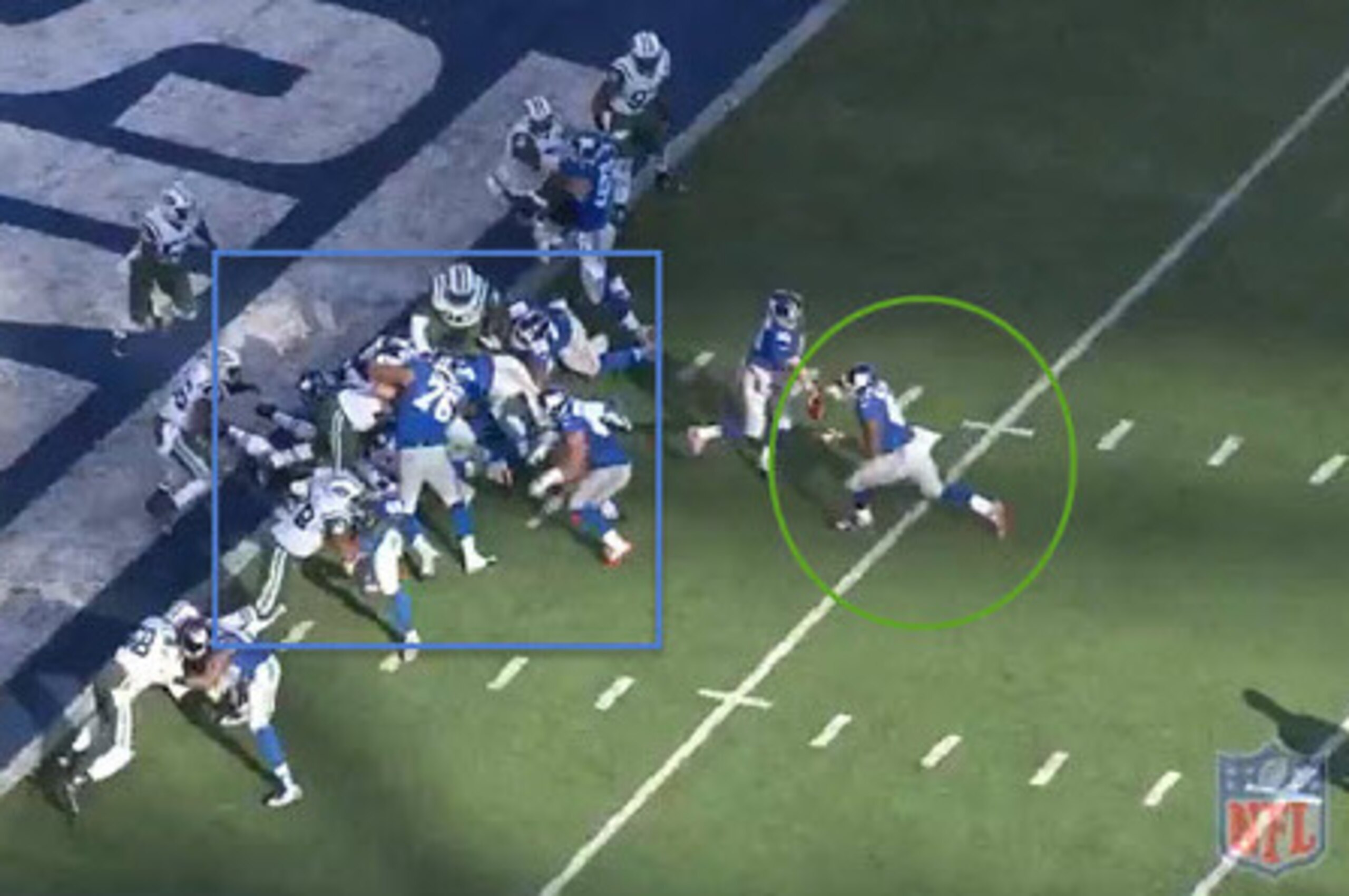
On this play, you can see that Williams, who is headed straight up the gut, is going to have to face a pile even before he takes the handoff. Let’s now look at this from Williams’ perspective.
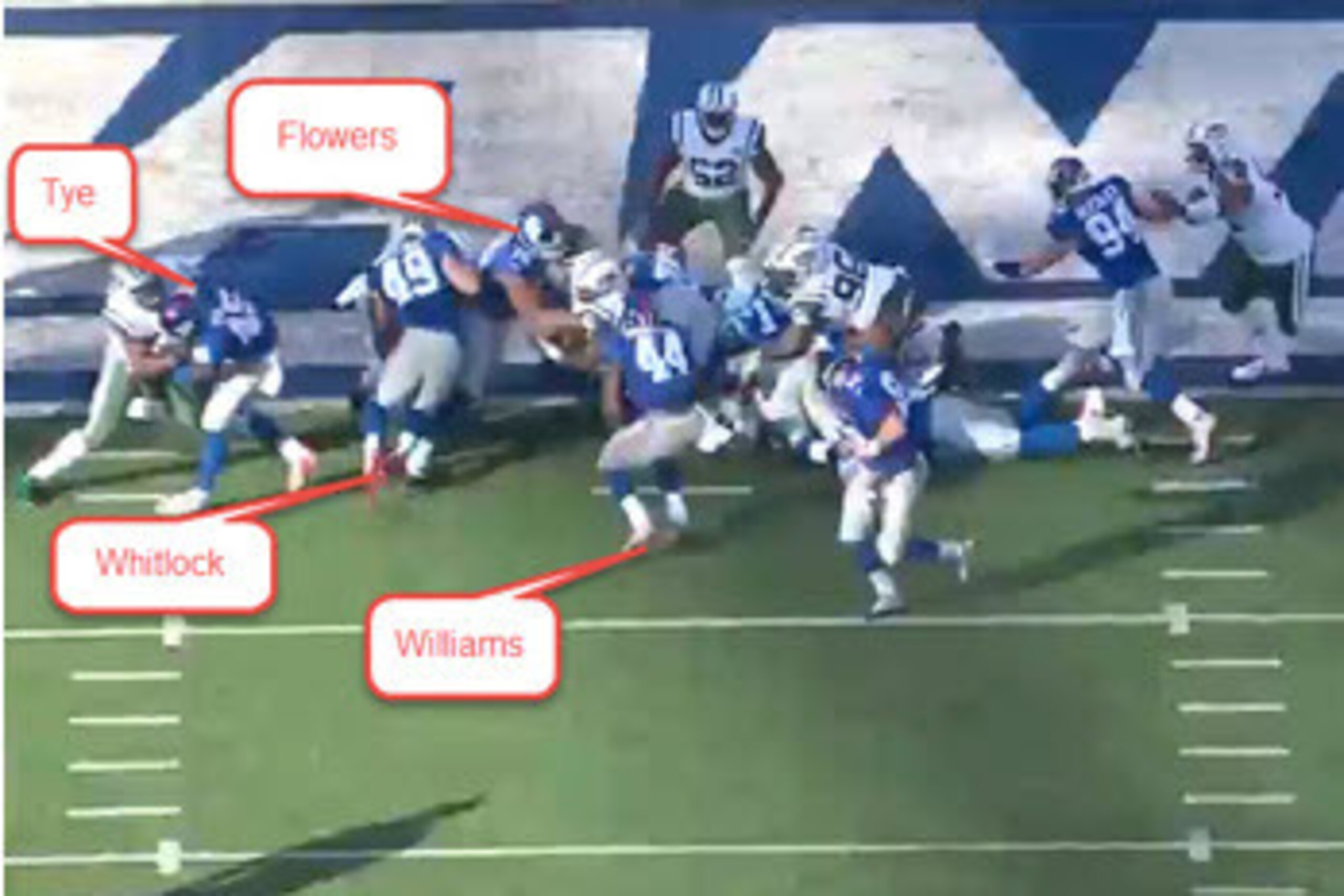
Williams now has the ball, but Ereck Flowers has allowed penetration into the backfield.
Rather than try to bounce the run in that crease created by fullback Nikita Whitlock and tight end Will Tye, Williams’ head and shoulders are squared to where Flowers is trying to push his man out of the way, thus he tries to power through the trash, only to be stopped for the one-yard loss.
This isn’t to suggest, by the way, that Williams is a poor runner. Remember, his success at Boston College was largely due to the fact that he was the bell cow.
Since coming to the Giants, his role has changed so many times, from initially being the short-yardage back to a starter (because of injury) to a rotational back.
The constant changes have not done him any favors and it would certainly be interesting to see how effective Williams might be if he had a bigger role in the running game instead of the 5.91 average carries he gets per week.
The Offensive Line and Tight Ends
The story of the 2015 Giants offensive line is well-known by now—left tackle Will Beatty suffered a pectoral injury that knocked him out of action, forcing the coaches to move Flowers, the first-round draft pick, to the quarterback’s blind spot.
At right tackle, which was supposed to be Flowers’ initial position, the Giants were forced to plug in veteran journeyman Marshall Newhouse, who per Pro Football Focus, has the worst run-blocking grade (minus-12.3) on the entire Giants offense.
Still, with Newhouse in the lineup along with the other four guys—Flowers, Justin Pugh, Weston Richburg and Geoff Schwartz—the coaching staff was able to compensate by sending the majority of its running plays to the left with success.
Then the injuries began to happen. Pugh missed two games with a concussion; Schwartz had his season end on a broken ankle; Richburg suffered a high ankle sprain that cost him one game; and Newhouse had a back issue that kept him sidelined last week.
Suddenly the Giants, who had started the same five players on the offensive line and at tight end in seven of their first eight games (Flowers missed Week 3 due to a sprained ankle), have since gone through a different line/tight end combination in each of the last four weeks.
This week, given the uncertainty of Flowers (ankle) and Newhouse (back), they could be looking at yet another combination.
The result of the revolving door? In the first eight weeks of the season, the Giants’ running game averaged 94.5 yards.
That number has dropped to 75.3 yards per game, a 20 percent decrease.
Besides the drop that came when the offensive line had to be reconfigured and the tight ends replaced, there is also a matter of performance.
Let’s look at a first-quarter play from last week’s game against the Jets, a play in which Jennings is stood up for no gain.

On the play, Jennings takes the handoff and starts to his right before making a little stutter step over to the left side where a hole was supposed to be waiting for him between the left guard and left tackle.
Just one problem: Left tackle Flowers appears to be beaten by Jets defensive end and fellow rookie Leonard Williams.
And tight end Tye, who looks like he was supposed to help on the block, is seen in this screen grab standing behind Flowers.
Flowers, meanwhile, has been turned toward the sideline and must reach to try to block Leonard Williams.
No such luck as Leonard Williams fills the hole and stops Jennings.
In the interest of fairness to both Andre Williams and the Giants offensive line, let’s look at a successful running play that gained 13 yards, Andre Williams’ longest run against the Jets’ No. 1-ranked run defense.

On this play, tight end Jerome Cunningham (left box), Flowers (middle box) and Pugh (right box) did a nice job in creating a lane for Andre Williams to exploit.
In the screen grab, you can see that Flowers and Pugh both kicked out their respective men on an angle which allowed Andre Williams to pick up some yardage.
The takeaway? Injuries and the drop off in depth have been just as much of a factor in the running game's struggles.
If there is any doubt about the role the offensive line, tight ends and fullback have in the success of the running game? Flip back the pages to the 2007 and 2008 seasons.
In those two seasons, the Giants had the same starting five offensive linemen (David Diehl, Rich Seubert, Shaun O’Hara, Chris Snee and Kareem McKenzie) and the same starting fullback (Madison Hedgecock, who was picked up off waivers early in 2007).
Those blockers, plus tight ends Jeremy Shockey and then later on Kevin Boss, helped the running game finish fourth in 2007 and first in 2008, with the 2008 season producing two 1,000-yard rushers, Brandon Jacobs (1,089 yards) and Derrick Ward (1,025 yards).
The Play-Calling
Sometimes the failures of the running game can be laid squarely on the shoulders of offensive coordinator Ben McAdoo.
Let’s look at a 1st-and-10 call from the Jets’ 12-yard line in the fourth quarter, a play that gained one-yard by Vereen.
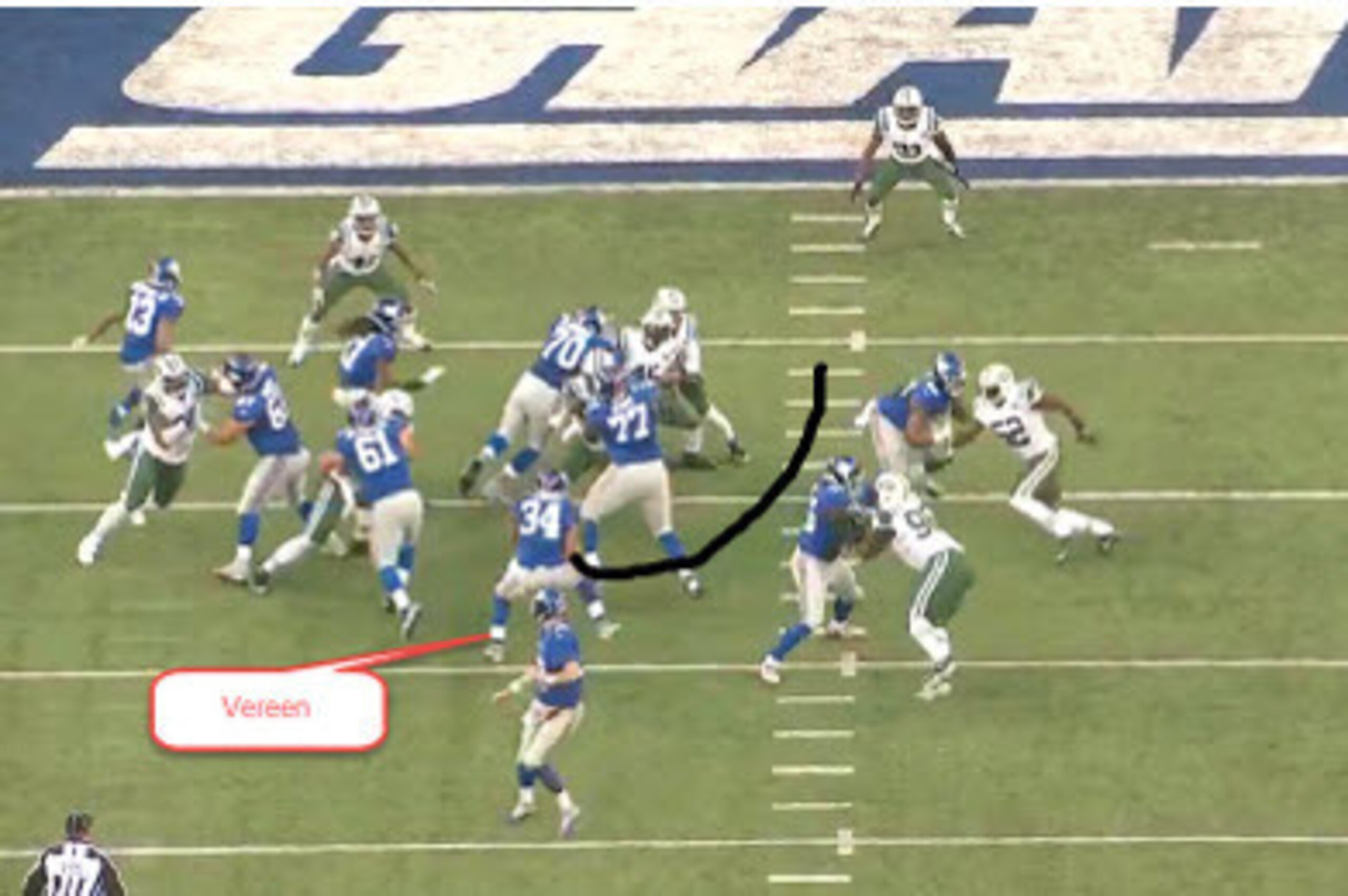
When inside the red zone, the idea is to try to get a play going as quickly as possible and not give the defense a chance to readjust position to make the stop.
The longer a play takes to develop inside the red zone, the better the chance that it will be defended for minimal to no gain because the back-end defenders, who might ordinarily drop deep into coverage, now have less ground to make up.
What happens on this play is that Vereen lines up seven yards deep in the backfield. As he takes the handoff, there appears to be a nice hole to his right.
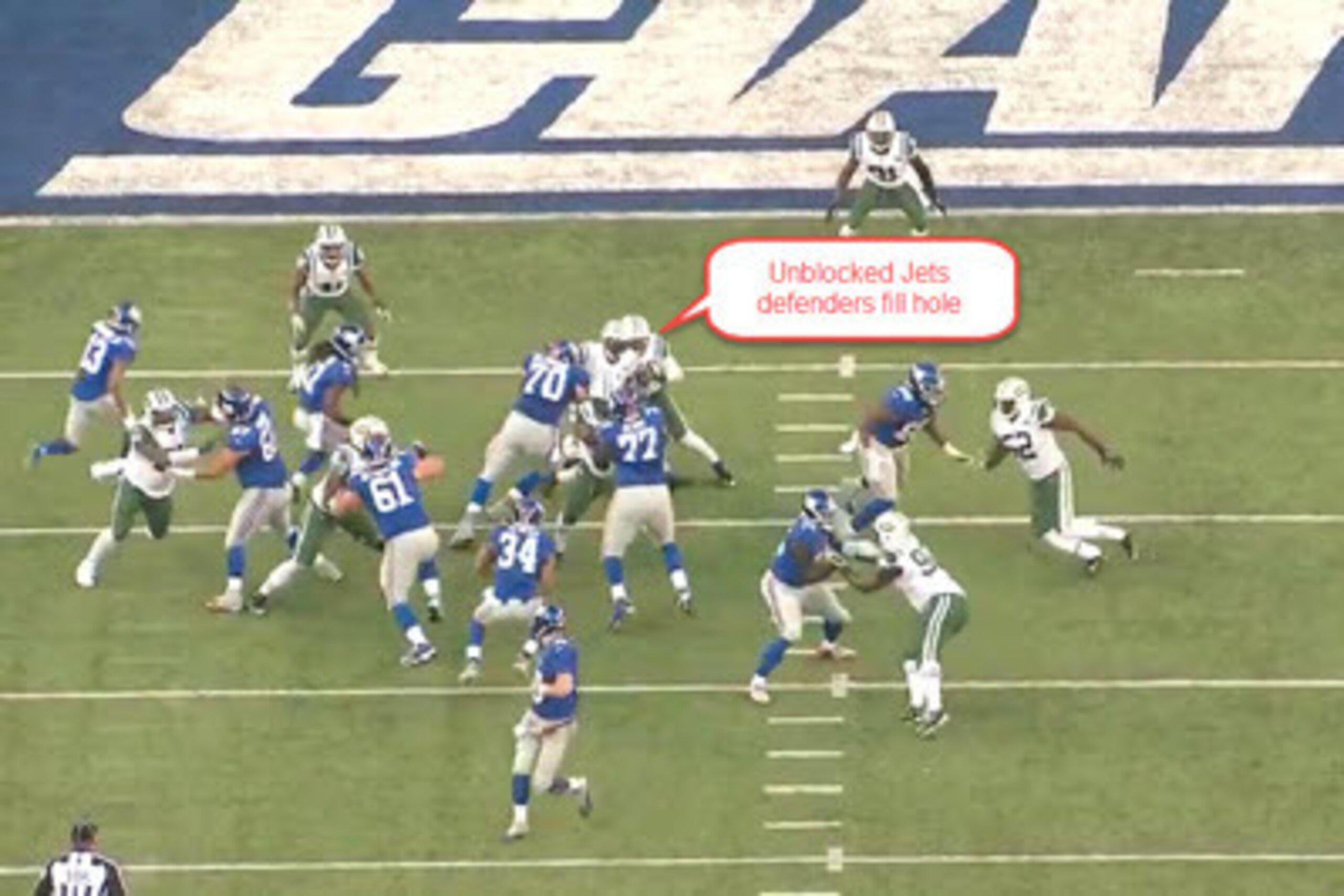
Because the play has taken an extra second or two to develop, there is an unblocked Jets defender, safety Rontez Miles, who comes up, fills the hole and stops Vereen for a minimal gain.
The Answer
Just as they did two weeks ago against a porous Washington run defense, the Giants rushing offense is going to get another chance to go against a struggling unit when they face the Miami Dolphins on Monday night.
The Dolphins run defense is currently ranked 30th in the league, allowing an average of 134.8 yards per game to opponents and an average of 4.2 yards per carry, which should have the coaching staff and the four healthy Giants running backs salivating, right?
The reality, as Coughlin said, is that all they can do is keep chipping away and hope that someone somehow steps out of the shadows and to the front of the committee and that the breakdowns that occur in the blocking get cleaned up.
“All we can do is keep working at it and working at it and not lose patience with it, understand why it’s there in the first place, why it’s important for our team for the way in which we’d like to play,” Coughlin said.
Let's hope it's just that simple because if there was ever a week in which the Giants offense needed a balance game, this would certainly be it.
Patricia Traina covers the Giants for Inside Football, the Journal Inquirer and Sports Xchange. All quotes and information were obtained firsthand unless otherwise sourced.
Follow me on Twitter @Patricia_Traina.

.jpg?w=2560 "Commanders Eagles Football")
.jpg?w=2560 "Grading WWE Raw 🔠")



.jpg?w=2560 "Viral Rams Coach Vid 🖕")