

5 NFL Stars Who Must Prove Their Worth Before the 2016 Offseason
Five NFL stars are already playing out the string—and playing for their jobs.
With 10 weeks in the books, and every team having played at least nine games, we're well and truly past the halfway point of the season—and for a lot of teams, it's becoming increasingly likely that we're well and truly past the point where they're legitimate contenders.
For five NFL stars on losing teams that have either completely imploded, or are far enough behind the division leader that they're unlikely to make the playoffs, their motivation has to shift from team to individual accomplishments.

.jpg?w=2560 "Rams Eagles Football")
.jpg?w=2560 "Falcons Saints Football")
No, not statistical records or contract-incentive benchmarks; these players are spending the rest of 2015 auditioning for their jobs in 2016—either where they're playing, or anywhere else.
Forte is one of the most underrated, unappreciated players in recent NFL history. The Chicago Bears' full-time starter at tailback from the second they drafted him No. 44 overall in 2008, Forte has been the definition of a stud, a workhorse, an every-down back.
Missing just five starts in seven seasons prior to this one, Forte's averaged a whopping 346 touches per year in that stretch, by far the most of any running back. Only Chris Johnson has more rushing attempts, and no back has anywhere near as many receptions.
Forte was rewarded for his consistency, durability, effort and production with a four-year, $30.4 million contract in 2012. This is the last year of that deal, and he's set to become a free agent.
There's been no dip in his workload or production: Forte is averaging 19.4 carries per game, actually up from his 17.1 career average. He's averaging 4.0 yards per carry, slightly up from last year (though slightly off his 4.2 career average). So why might Forte be gone?
The obvious answer is Jeremy Langford, the fourth-round rookie draft pick who's been increasingly excellent in relief of Forte. He's certainly made a case to continue to be involved in the offense even when Forte is healthy, but there's more to it than this.
Frank Gore has powered through a slow start in Indianapolis, but rather than be rejuvenated by a change of scenery, he's on pace for the least-effective season of his career. It's a dramatic reminder that running backs on the wrong side of 30 rarely earn new contracts—and Forte, who'll turn 30 on December 10, represents a very risky investment for a Chicago Bears team on the upswing.
Talented quarterbacks in their prime don't switch teams—they just don't.
A No. 1 overall pick coming off his first Pro Bowl appearance, in almost any other situation, would be absolutely untouchable. But this isn't any other situation, and Matthew Stafford isn't a typical quarterback.
Early in his career, he flashed plenty of the jaw-dropping talent that inspired the Lions to take him at the top of his 2009 draft (in between major injuries, of course). But the Matthew Stafford that emerged after his breakout 2011 season—and has been around ever since—is a boom-or-bust, inconsistent, maddeningly mediocre player.

Of course, several teams would kill to be cursed with a talented-but-inconsistent seven-year veteran who won't turn 28 until February. But the Lions have spent all seven of those seasons blowing draft picks and free-agent dollars on linemen, weapons and coaches for Stafford, and nothing's working.
If he doesn't take a big step forward under newly promoted offensive coordinator Jim Bob Cooter, the Lions might be better off admitting that if Stafford's ever going to reach his potential, it won't be in Detroit.
Stafford signed a relatively modest three-year, $53 million contract that extended his original deal; he's currently under contract through 2017. But his dead-money hit drops from a whopping $27.2 million to a far-more edible $11 million this spring, per Spotrac.com. Either a release or a trade becomes eminently possible in a year where the Lions will be picking near the top of the draft.
What? Jimmy Graham? Didn't the Seattle Seahawks just trade All-Pro center Max Unger and a first-round pick to add Graham to their offense? Like, just-just? How can he be playing for his job already?
There are two factors at play: One, whether the problem is with Graham, offensive coordinator Darrell Bevell or just the way the Seahawks play football, Graham is an awful fit.
Graham is just weeks away from his 29th birthday, and has four Pro Bowl appearances and one first-team All-Pro nod. In four seasons as a starter in New Orleans he averaged 5.6 catches per game, and 12.4 yards with each catch. In Seattle, he's averaging 4.6 catches per game, and 12.0 yards with each.
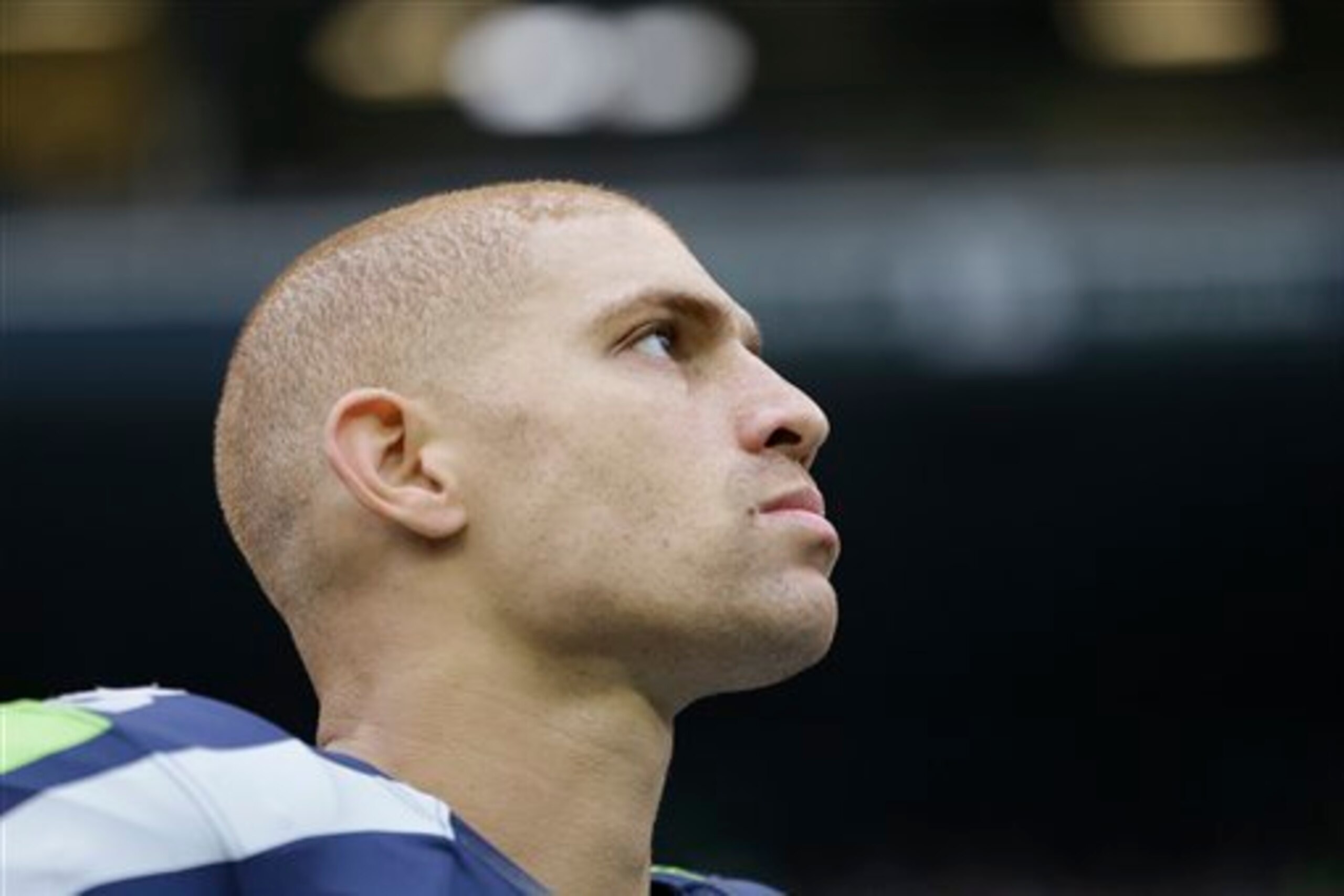
But that doesn't tell the whole story. In his entire pre-Seahawks career, Graham caught 51 touchdown passes in 50 starts. He averaged more than a touchdown per start! So far in Seattle, Graham has nine starts—and just two touchdowns.
It can be argued that this is the fault of the flailing Seahawks offense, of the degraded protection for quarterback Russell Wilson. But giving up Unger for Graham was supposed to make the Seahawks offense better, not worse—and 2014's 10th-ranked scoring offense is currently ranked 20th.
Moreover, while Graham has two years left on his reasonably affordable contract, his dead-money hit disappears when the new league year begins. Seattle could release or trade Graham with zero cap hit, making him a very movable piece in Seahawks general manager John Schneider's game of salary-cap chess.
If Graham wants to stay in the beautiful Pacific Northwest, he'd better start making himself invaluable.
Joe Haden
There's no way to sugarcoat this: Between injuries, effectiveness and consistency, Cleveland Browns cornerback Joe Haden simply isn't worth what he's being paid. Haden is on the league's fifth-richest cornerback contract, in terms of average annual value. He's under contract all the way out through 2019, the year he turns 30.
Through 10 weeks, Pro Football Focus has graded Haden 104th out of 111 qualifying cornerbacks.

Yes, a concussion has had him in and out of the lineup. Sure, he's been relatively consistent on a year-in, year-out basis. Absolutely, a Cleveland Browns team desperate for any kind of talent shouldn't be looking to get rid of a proven-until-now veteran. But right now, he simply isn't worth anywhere near the paycheck he's drawing.
As Browns Featured Columnist Andrea Hangst pointed out, Haden's 2016 salary is guaranteed only for injury. As long as he isn't put on injured reserve, the Browns can jettison Haden for just $9.6 million, down from the $21.6 million it would have cost them this offseason.
With Tramon Williams already age 32, and 2013 first-round pick Justin Gilbert all but completely useless, the Browns desperately need Haden to play up to his ability, and his contract. Once Haden's out of the concussion protocol for good, he'll have just over a month to prove he's worth the trouble.
Calvin Johnson
Two years ago, Calvin Johnson caught 122 passes for 1,964 yards.
It seems like a lot longer, doesn't it? We haven't seen a healthy Calvin Johnson at his best practically since that 2013 season, save for very brief flashes. For the Lions, a franchise almost certainly going into full reboot mode, a past-his prime household name is exactly the kind of guy they'll want to get rid of for whatever they can get.
Of course, Johnson's mind-bending seven-year, $113.5 million deal makes him not only a huge cap liability, but almost impossible to move. If the Lions were to cut him after this season, they have to eat a $12.9 million cap hit—down significantly from the $21 million they'd be on the hook for if they cut him right now.
Let's be real for a second, though. Johnson's cap numbers are unwieldy, but he's still the greatest collection of wide-receiver DNA the NFL has ever seen. His production hasn't been a function of the quality of the rest of the offense until his recent injury struggles. Whether or not they're moving on from Stafford, keeping a big, talented deep threat like Johnson around for whoever's next can only be a positive.
But right now, even given all his tools, Johnson doesn't look effortlessly dominant anymore. Whether that means his body is beginning to break down, or the Lions' offensive struggles are finally hurting him, too, these are issues that mere mortals—not Megatron—must come to grips with. If this is the new normal for Johnson, he's eating up about twice as much cap as he ought to be.
If he still has greatness in him, he may as well stay in Detroit and serve as a crutch to whomever's quarterbacking in 2016. But if the Lions regime feels Johnson's diminished for good, he can't possibly keep getting paid like the best receiver in the world.
Ty Schalter is a National NFL Analyst for Bleacher Report. All salary information provided by Spotrac.com, unless otherwise noted.
.jpg?w=2560 "Texans-Mixon Released Football")
.jpg?w=2560 "Commanders Eagles Football")

.jpg?w=2560 "Grading WWE Raw 🔠")


