Johnny Oduya's Price Tag Should Make NHL Teams Cautious of Signing Veteran D-Man
Generally speaking, players who are still available on the open market two weeks after the start of NHL free agency are going to end up signing low-dollar contracts due to a lack of interest in their services. A lot of times, this point in free agency is a good place for NHL teams to find value contracts, adding players who will outperform their deals.
It’s too early to say for sure, but it certainly looks like Johnny Oduya is not going to be one of those players.
Andy Strickland, an NHL reporter perhaps best known for covering the St. Louis Blues as part of Fox Sports Midwest, reported Tuesday that Oduya had turned down an eye-popping contract with a $5 million average annual value from the Buffalo Sabres:
TOP NEWS

Grades For Every Team's Prospect Pool 🔠
Coach Replacements for Tocchet
BS Meter on Latest Trade Rumors 🌡️
Oduya’s rejection of that offer could turn out to be a blessing in disguise for Buffalo, provided that the Sabres don’t redouble their efforts to land the former Chicago Blackhawks defenceman.

Oduya is coming off an exceptional playoff performance and a distinguished run in Chicago, during which time he also contributed to the club’s 2013 Stanley Cup championship. Oduya’s playoff reputation and recent demonstration of his ability are obviously critical to any decision regarding the player, but they also make it easy to overlook the various red flags that indicate signing him might be a mistake.
The first red flag is an obvious one: age. Oduya turns 34 on October 1, meaning a three-year deal would take him through his age-34, -35 and -36 seasons. This is a point where most NHL players see a steep decline in their productivity. It’s hard to calculate the typical age curve for defencemen, but a lot of work has been done with the scoring rates of forwards, and the results are not pretty. Here’s what SB Nation’s Eric Tulsky wrote on that subject last year:
"In addition, we now have an estimate of how even strength scoring ability changes through a player's 30's. On average, players retain about 90% of their scoring through age 29, but the drop from there is pretty sharp -- they hit 80% at age 31, 70% at age 32-33, and 60% at age 35. ... I want to stress that some players age better than others and there's lots of randomness layered on top of that. This is a population average, not a hard-and-fast rule.
"
Tulsky’s caveat is worth noting, as is the fact that his study only focused on forwards. However, Oduya is at that point in his career where performance drops off rapidly.
The second red flag is Oduya’s performance during the regular season, and based on recent history, it suggests the drop-off has already started.
Oduya, who used to be a pretty effective puck-moving defenceman, scored at the lowest rate of any Chicago rearguard last season. His on-ice shot numbers were the worst of any Chicago defenceman. The Blackhawks were also just barely above .500 in the goals department when he was on the ice, even as his responsibilities (the number of shifts starting in the defensive zone, the quality of opponents he faced) declined.
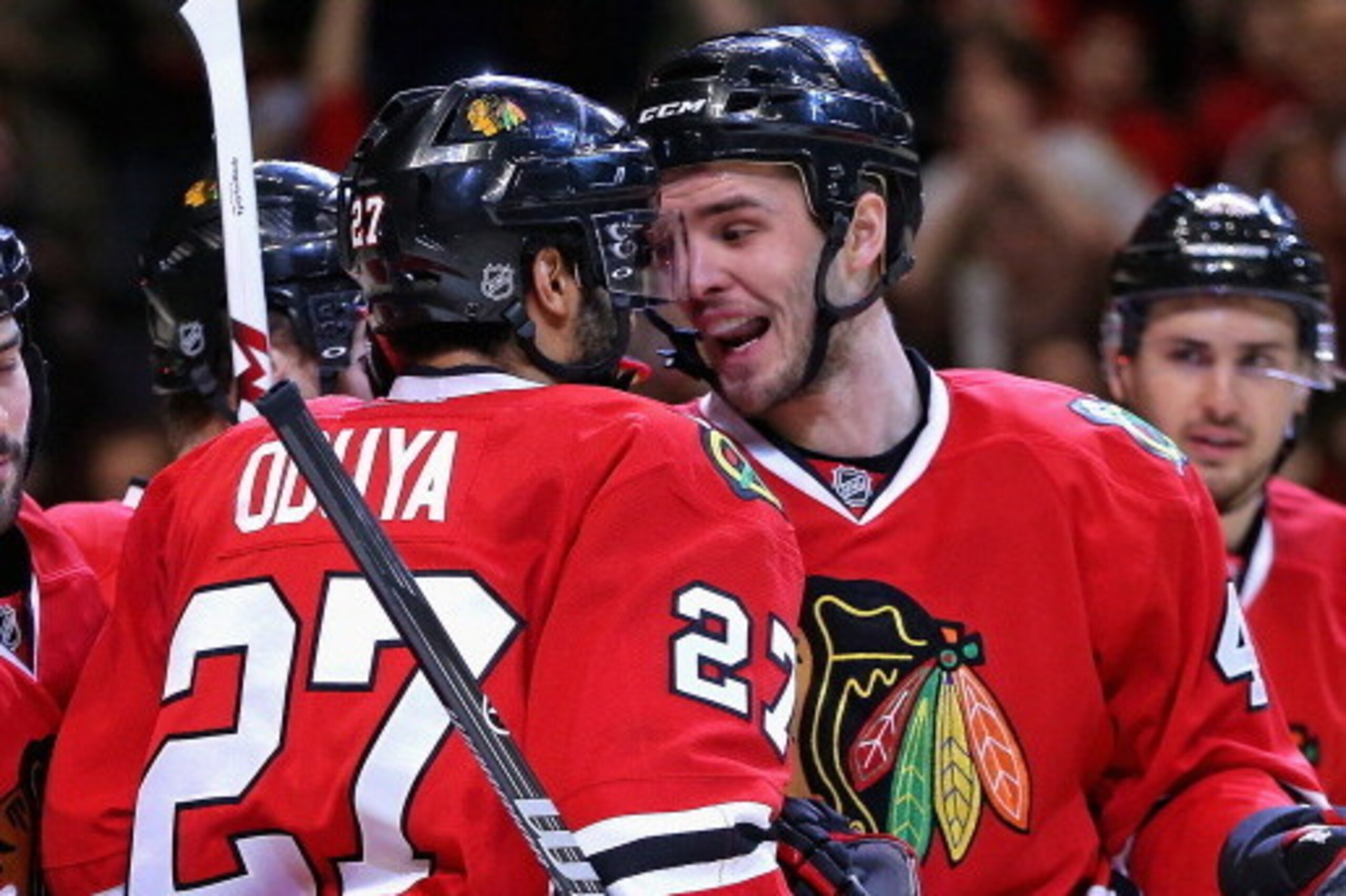
The biggest problem, though, is simply that Oduya won’t be playing with Niklas Hjalmarsson wherever he goes next, and over the last three seasons, he’s been far better with Hjalmarsson than he has been away from him.
| Oduya and Hjalmarsson | 2,543 min | 56.0% | 53.2% | 49.4% |
| Oduya and other | 898 min | 49.4% | 51.7% | 56.4% |
| Hjalmarsson and other | 1,171 min | 59.5% | 53.9% | 48.7% |
Oduya’s numbers away from Hjalmarsson are deeply concerning, particularly since he hasn’t exactly been playing with scrubs; his most common defence partners in Chicago outside of Hjalmarsson have been Michal Rozsival and Brent Seabrook. Rozsival is competent, Seabrook better than that and, of course, the forwards have been quality.
Despite that, Oduya has struggled recently, posting an ugly on-ice goals rate and a mediocre Corsi number despite lots of shifts in the offensive zone.
Hjalmarsson, on the other hand, has played tougher minutes and had better results when away from his regular partner.
That’s the long argument against signing Oduya to a massive contract. The short argument is simply that expectations should be limited for any old No. 4 defenceman coming off a bad season with a great team. Oduya has been in a good situation with Chicago, and to be fair, he’s contributed.
But he’s also been in a supporting role, and it’s imprudent to expect him to become a leading man with a lesser club as he enters his twilight years as a player.
Statistics courtesy of NHL.com, war-on-ice.com and stats.hockeyanalysis.com.
Jonathan Willis covers the NHL for Bleacher Report. Follow him on Twitter for more of his work.
.jpg?w=2560 "Cam Ward Says He's Not A Loser")
.jpg?w=2560 "🚨 Texans Trade for MHJ")
.jpg?w=2560 "Grading MHJ Trade 📝")
.jpg?w=2560 "Chargers Fall to 0-5 🤢")

.jpg?w=2560 "MHJ Bought Own Jugs Machine")