
What to Know About Rays Move from Tropicana Field to Yankees Spring Training Facility
Fans tuning into the first Tampa Bay Rays game of the new season on Friday afternoon might be surprised to see the venue they are temporarily calling home for the 2025 season.
Let's back up.
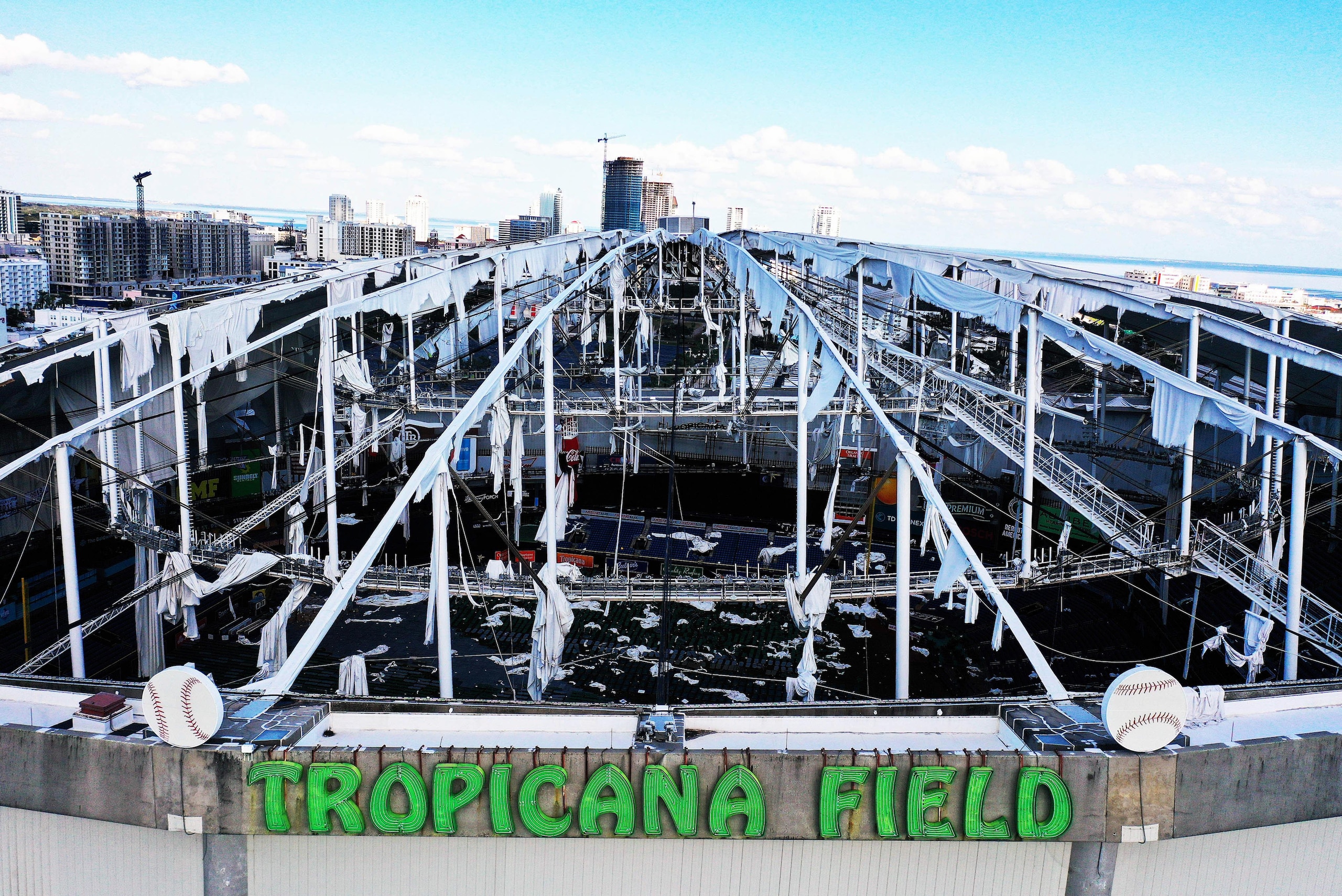
On Oct. 9, 2024, Hurricane Milton made landfall along the Florida coast, and damaging winds shredded the fabric roof at Tropicana Field, also doing some secondary storm damage to the inside of the now-exposed stadium the Rays have occupied since their inception as a franchise in 1998.
TOP NEWS

Ranking Top 25 Trade Chips For Offseason 🔢

MLB Playoffs Winners and Losers ⚾

Brewers Beat Dodgers in Game 1
The cost to fix the damage: $55.7 million
That might sound like a drop in the bucket on the scale of a professional sports franchise, but keep in mind the Rays operated with a payroll of just under $90 million in 2024 and are perennially among the most budget-conscious teams in the league.
The fact that Tropicana Field is already scheduled to be demolished with a new $1.3 billion stadium opening for the 2028 season makes that expense a difficult one to swallow, but the more pressing short-term issue was finding a place to play while the repairs are completed.
That brings us back to where the Rays will be when they take the field on Friday.
Steinbrenner Field will be home sweet home in 2025, as in the stadium named after former New York Yankees owner George Steinbrenner.
It is the spring training site of the Yankees and also where their Single-A affiliate, the Tampa Tarpons, play their home games, so the Rays will officially be borrowing a field from one of their division rivals.
With 11,026 seats and 13 luxury suites, it has the largest capacity of any Tampa-area spring training site, and that helped make it the eventual choice over several other options, including the Phillies' site in Clearwater and the Blue Jays' site in Dunedin.
"We deeply appreciate that the Yankees have graciously allowed us to play at Steinbrenner Field for the 2025 season,” Rays principal owner Stuart Sternberg told reporters. “The hurricane damage to Tropicana Field has forced us to take some extraordinary steps, just as Hurricanes Helene and Milton have forced thousands of families and businesses in our community to adapt to new circumstances as we all recover and rebuild."
To the Yankees' credit, they invested a ton of money into upgrading their spring training facilities to help make the park a more attractive venue for an MLB team.
"The Yankees renovated the home clubhouse in the spring training ballpark and added 34,000 square feet of contiguous dining areas, weight rooms and training rooms in their year-round adjacent training areas, bringing the overall footprint to about 50,000 square feet," wrote Barry M. Bloom of Sportico. "There is now an additional 12,000 square feet of concourse space along the first-base side of the stadium above the new construction. The square footage devoted to players has doubled."
The field's dimensions are identical to Yankee Stadium, including the 314-foot short porch in right field, so keep that in mind when mulling over the upside of left-handed hitters Brandon Lowe and Josh Lowe in your fantasy leagues.
The move accomplishes the simple goal of keeping the Rays as close as possible to their fanbase, though it's fair to wonder if that should even be a priority after the Rays ranked 28th in the majors in average home attendance at just 16,515 fans per game in 2024.
However, there is also a glass-half-full mindset that the temporary move to a new location and the exclusivity that a smaller ballpark brings could help create some positive buzz and lead to consistent sellouts.
Here's former Rays pitcher Tyler Glasnow providing that take:
The move has ramifications beyond just creating a new home ballpark for Rays fans to visit, as it has also created some interesting scheduling quirks.
Since Steinbrenner Field does not have a roof, Major League Baseball has loaded up the Rays' schedule with home games over the first two months of the season in an effort to avoid summer rains and the inevitable rescheduling issues that rainouts would create.
They will play 19 of their first 22 games at home and 37 of 54 overall at Steinbrenner Field through May 28. During July and August, they will have just eight home games each month.
There is data to suggest that scheduling is in the team's best interest.
"The Class A Tampa Tarpons, the usual team at Steinbrenner Field, had six home postponements, two cancellations and four suspended games this year from June 21 through their season finale on Sept. 8," reads an Associated Press article (via ESPN).
Of course, that also means the team will play 64 of its final 108 games on the road, which figures to make the second half an absolute grind from a travel standpoint.
As spring training wraps up, work begins on hiding any and all traces of the Yankees logo to try to make it feel more like a true home venue for the Rays.
It is going to be a unique season for the Tampa Bay Rays in more ways than one, and it will be interesting to see how the uneven schedule, unfamiliar facilities, and unpredictable weather ultimately impact their 2025 season.
For now, the buzz of a new MLB season and the hope of a fresh start makes it difficult to be anything but optimistic about what's to come.

.jpg?w=2560)
.jpg?w=2560 "AD Trolls Bears WR on IG 😂")
.jpg?w=2560 "Viral Dan Campbell Presser 💙")

.jpg?w=2560 "Report: Steelers WR to Miss 'Weeks'")
.jpg?w=2560 "Cam Ward Says He's Not A Loser")
.jpg?w=2560 "Buzz: MHJ Hired Agents for Trade")
.jpg?w=2560 "Chargers Fall to 0-5 🤢")