
2015 NBA 2nd-Round Draft Picks You Need to Know Next Season
Although the second round of the 2015 NBA draft was largely underwhelming, there are a few diamonds in the rough worth checking out next season.
Once the first round concluded, many teams went into draft-and-stash mode or picked players who will be nothing more than trade sweeteners. However, a small handful of second-rounders will prove to be key contributors right away.
We focused on draftees whose skills and production will translate immediately to the NBA level. Unlike most other second-round assets, they landed on teams that could actually use their services in 2015-16.
Our select group of must-see prospects includes a couple of electrifying combo guards, a pair of three-and-D wings and a ferocious power forward.
Don't sleep on these late-draft acquisitions who can make a difference from Day 1.
Olivier Hanlan, Utah Jazz PG/SG
1 of 5
The Utah Jazz backcourt isn't particularly deep, so No. 42 pick Olivier Hanlan could play a dynamic role off the bench.
He doesn't floor you in any specific area, but he'll hurt opponents in several different ways. Hanlan can shoot from the perimeter, slash smoothly and create opportunities for teammates. During his junior year, he carried Boston College's offense with 19.5 points and 4.2 assists per contest.
Hanlan was never a part of prolific teams at Boston College, but he's looking forward to the speed and spacing that the NBA game offers.
"I'm looking forward to everything being more spaced out and being decisive with my decisions and getting people the ball," he told Tony Jones of the Salt Lake Tribune.
Hanlan won't likely enjoy a massive role for the Jazz, but he's a candidate to become one of the biggest steals of 2015. Bleacher Report's Jonathan Wasserman projects a versatile role for him:
"He ultimately projects as a playmaking combo whom Utah can bring off the bench to generate offense. ... He is a strong second-round value pick."
Pat Connaughton, Portland Trail Blazers SG
2 of 5
Pat Connaughton is one of the most well-equipped second-round wings because he owns a superb blend of physical tools, basketball IQ and shooting skills.
Sporting a 6'5" frame, abundant athleticism and a dead-eye delivery from beyond the arc, the Notre Dame product has a good chance to crack the Portland Trail Blazers rotation.
Connaughton doesn't show great lateral speed, but his defensive positioning, intensity and leaping ability enable him to contest shots and rebound well for his position (8.3 boards per 40 minutes in 2014-15, per Sports-Reference.com).
He's arguably the best three-and-D prospect in the second round. Connaughton drilled 42 percent of his triples last season and has the steady mechanics to be a reliable off-guard option.
"Guys that can shoot it and are tough and can defend their position tend to endear themselves to coaches at our level," one scout told NBA.com's David Aldridge. "He checks all of those boxes."
Portland's roster is in flux this offseason, so Connaughton has a chance to establish himself as one of the most relevant second-round picks next season.
Joseph Young, Indiana Pacers SG
3 of 5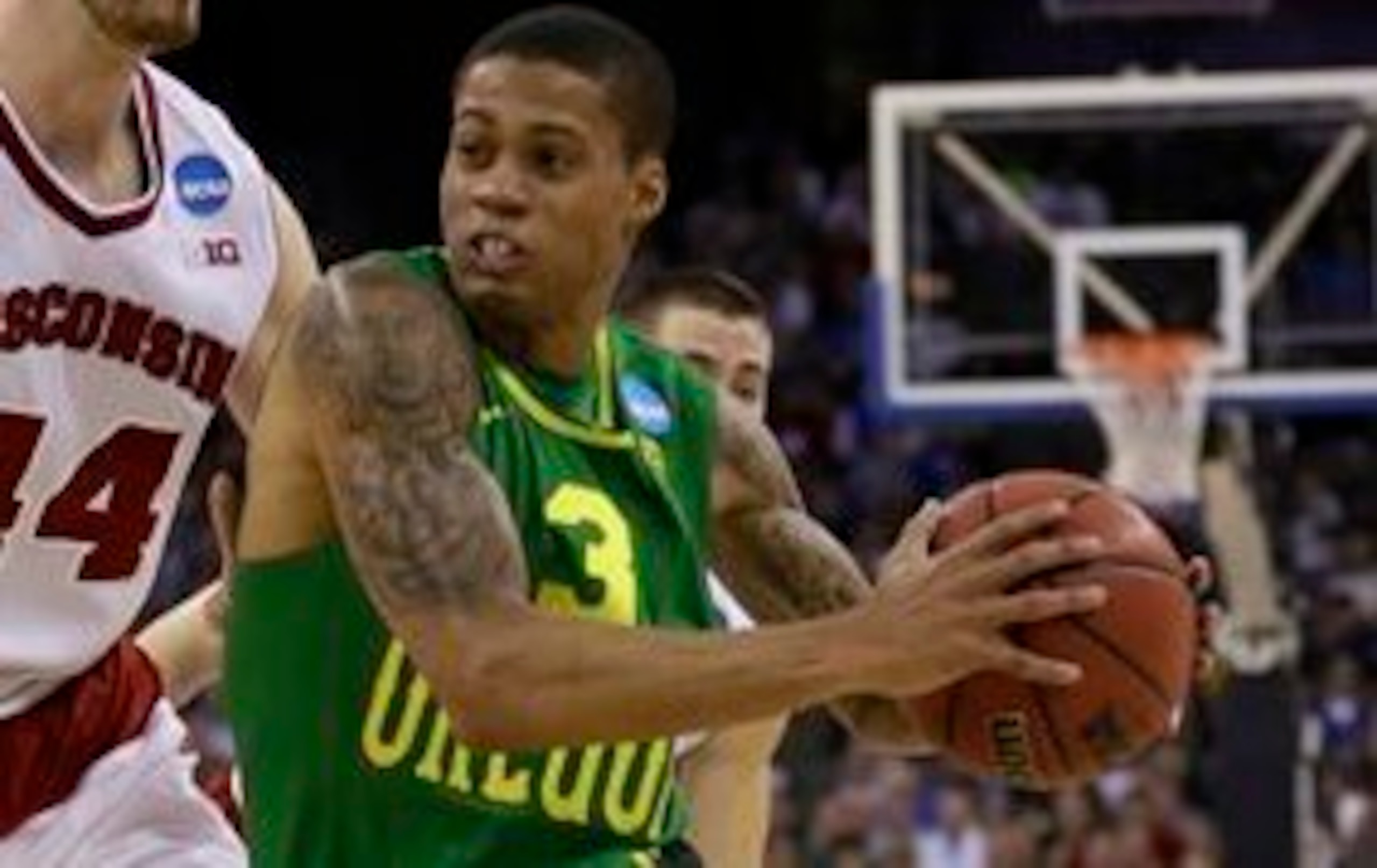
Despite scoring 20-plus points per game and earning 2014-15 Pac-12 Player of the Year honors, Oregon's Joseph Young landed in the second round. At 6'2" in shoes, he's vastly shorter than most scoring guards and therefore a risky investment.
Don't expect him to have a huge role on the Indiana Pacers, but he could supply some much-needed electricity off the bench.
When he's in attack mode, he's as shifty as they come.
Young has a knack for slashing explosively into the lane or stopping and popping for outside jumpers. He shot 39 percent from three-point land during his four-year college career, and he also improved his passing in 2014-15 (3.8 assists per game).
One NBA scout gave Young a favorable comparison.
"I think he can be an Aaron Brooks kind of player," the scout told Sports Illustrated's Seth Davis. "He really scores. He’s not a pure point, but he’s got high energy, high character. ... He can give you that instant offense, but for him to have a long career, he has to compete at the defensive end more."
Even with the addition of free agent Monta Ellis, per ESPN's Chris Broussard and Marc Stein, head coach Frank Vogel could use speed and scoring depth off the bench. Young's NBA-ready skills and aggressive instincts will come in handy for Indy.

Anthony Brown, Los Angeles Lakers SG/SF
4 of 5
The Los Angeles Lakers won't hand Anthony Brown a role next season. The 6'7" Stanford product will have to earn it.
He has a couple of key factors working in his favor, however.
Brown's chief contribution to the Purple and Gold will be outside shooting. He went 132-of-296 (44.9 percent) from long distance during his last two years at Stanford, demonstrating a knack for stretching defenses and burning them when they strayed too far. Given his 6'7" height and 6'11" wingspan, Brown should have no problem comfortably connecting against NBA foes.
The other notable contribution Brown offers is defense, which isn't common among first-year players.
He's not an above-average vertical athlete, but he slides swiftly to stay in front of attackers. DraftExpress' Mike Schmitz explained Brown's defensive potential.
"[He] has the physical tools to be a sound defender with potential to guard 2s and 3s," Schmitz said. "[He] moves well laterally for a player his size."
He won't steal any minutes away from Los Angeles' top dogs, but he'll make a strong case for regular exercise off the bench.
Montrezl Harrell, Houston Rockets PF
5 of 5
The Houston Rockets aren't hurting for power forwards, but Louisville's Montrezl Harrell gives them an NBA-ready presence and the flexibility to make trades if they so desire.
He was, by far, the best prospect available at No. 32. Harrell doesn't own intricate post moves or a breathtaking finesse game, but he's prepared to battle NBA forwards in the paint and on the glass.
The 250-pound bruiser has a 7'4" wingspan that he'll use to rip down rebounds, play stout defense and forcefully finish pick-and-roll lobs. Harrell competes aggressively on every square inch of the court and will beat opposing bigs down the floor more often than not.
Houston won't depend on Harrell for copious touches in the post, but when he does receive the ball in good position, he'll score or draw a foul. As a bonus, he's shown flashes of a running hook and up-and-under move.
If he can add eight to 10 points per game to go along with top-shelf defense, he'll be a steal.
Harrell's diminutive stature (6'8") and lack of consistent jump shooting led to his slip down the draft boards. Even though he may not be more than a role player, he has a great chance to outperform his draft placement and give Western Conference opponents fits.
.jpg?w=2560 "Dart Believed to Have Sprained MCL")

.jpg?w=2560 "WWE Raw Live Grades 🔠")
.jpg?w=2560 "Ertz Returning to Eagles")
.jpg?w=2560 "Dak Addresses 'Dumb' Old Romo Tweet 🤣")

.jpg?w=2560 "Follow Raw As It Happens 👊")