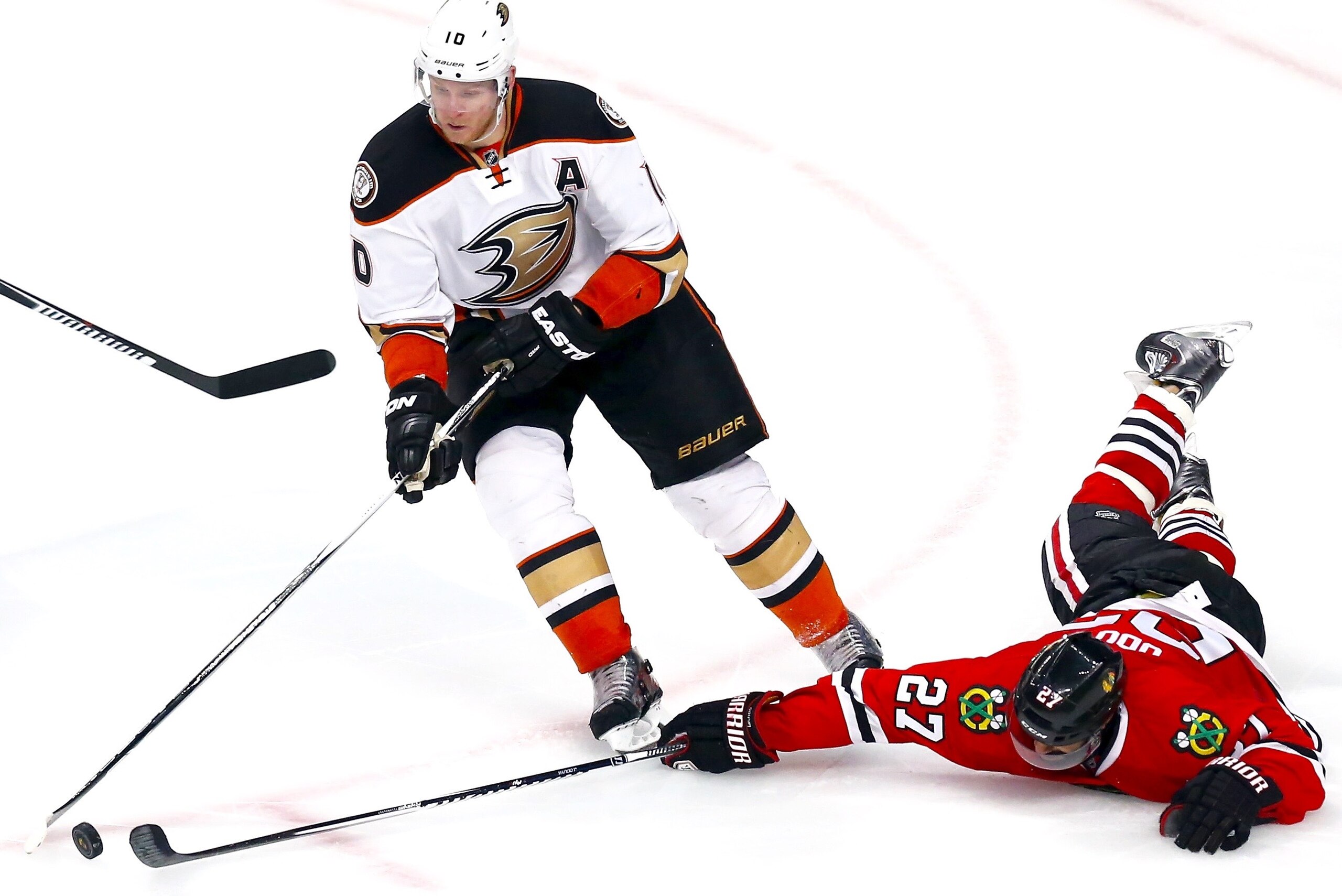

Chicago Blackhawks' Overworked D Too Tired to Handle Physical Ducks in Game 3
It’s a hockey truism that depth wins championships. Right now, the Chicago Blackhawks don’t have any on defence, and it’s starting to cost them. It may end up costing them the Western Conference Final against the Anaheim Ducks.
Looking at the 2-1 score in Game 3, it’s easy to think that perhaps Chicago’s defence wasn’t the problem, to argue that Anaheim only managed a pair of goals and that if the Blackhawks want to win, they have to find a way to get more pucks past Frederik Andersen. It’s certainly true that Chicago needs to score more, and it’s fair to say some of the blame for that falls on the team’s forwards.
TOP NEWS
Best NHL Heritage Classic Jerseys 📋
Teams That Need Goalie Trade💡
Hellebuyck Trade Takeaways 📊
But it’s a perspective that misses much of what happened Thursday.
It misses, for example, the massive territorial and scoring-chance advantage that Anaheim ran up in the game’s first two periods—the 40 minutes that decided the contest before the Ducks settled into what might be termed a “Katie, bar the door” approach to defence.
The game-winning goal, from Ducks defenceman Simon Despres, is a solid example of Chicago’s struggles:
The NHL’s official highlight package doesn’t go back to the start of the play, a scrambled faceoff in Chicago’s zone. The draw turned into a 50-50 battle between Patrick Maroon and Johnny Oduya on the half-boards; Maroon outmatched his counterpart and won it. After cycling through the point positions, the puck next went behind the Chicago net, where both Oduya and Niklas Hjalmarsson had the chance to fight for it; neither could secure it.
The sequence in the video above captures what happened in front of the Chicago net afterward. We can blame the forward who didn’t fan out to take away Despres, and we can blame Corey Crawford for not getting over in time to prevent a bad-angle shot, but it’s worth watching the two Ducks forwards in front of the net.
Oduya and Hjalmarsson barely even engage Maroon and Corey Perry. Maroon has some brief opposition from Oduya, but Hjalmarsson doesn't touch Perry (even when obvious opportunity arises), who plays a key role in screening Crawford on the goal.
Anaheim’s forwards could not have had an easier time in front of the Chicago net.
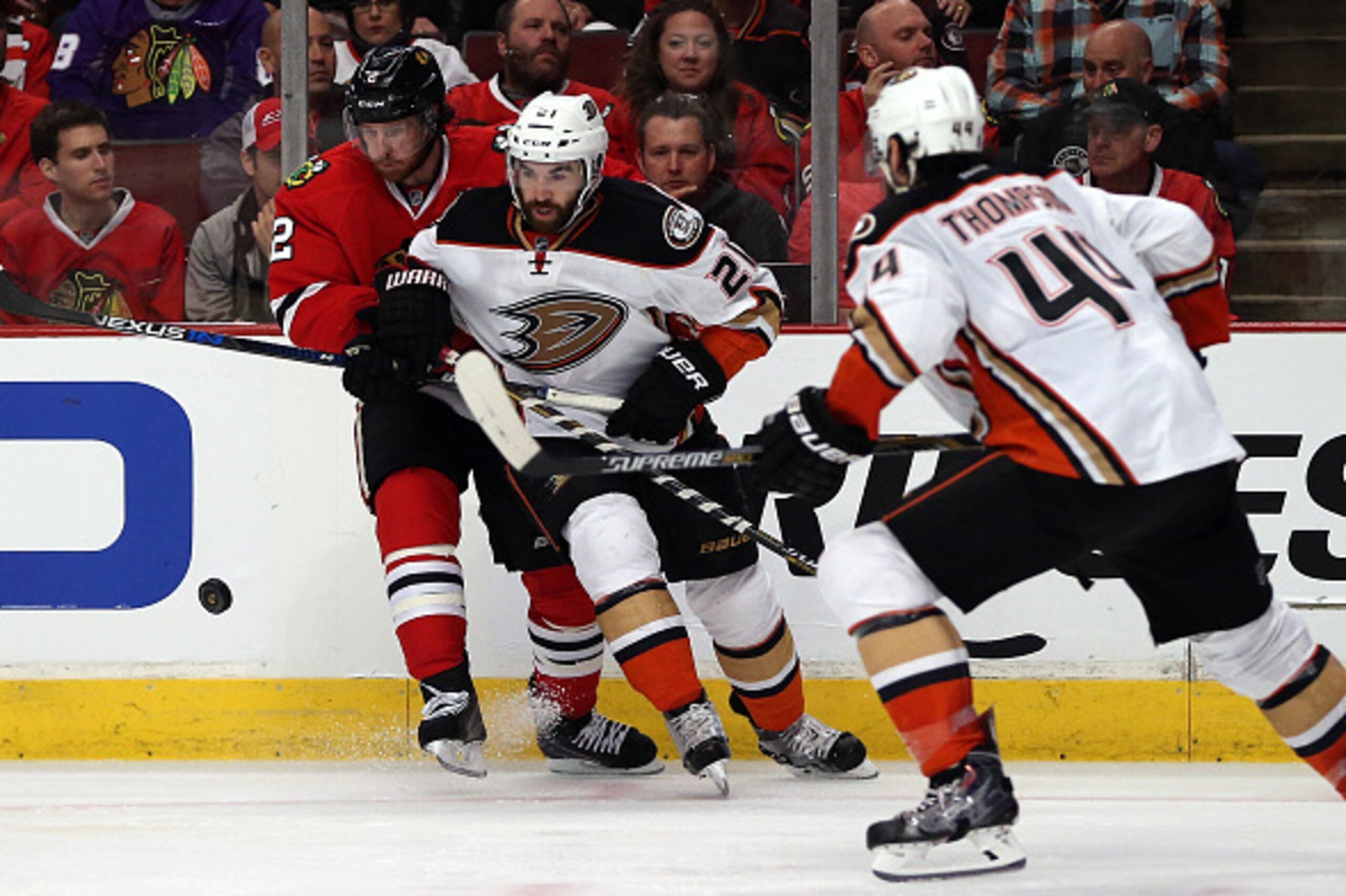
This was a recurring theme throughout the game. So too were slow reactions from some surprising culprits.
The Ducks burned both Oduya and Hjalmarsson for chances off defensive-zone draws when the pair couldn’t seal the lane between the faceoff dot and the net quickly enough. Duncan Keith made primary errors on chances from shooters like Jiri Sekac and Andrew Cogliano. Both are strong enough players, but one doesn’t expect bottom-six opponents to expose Keith.
It’s not that Chicago’s defence is soft or slow or gaffe-prone; Keith is a two-time Norris winner, and Hjalmarsson and Oduya have proven their worth time and again as Chicago’s top shutdown duo. These are good defencemen, and while nobody’s perfect, it’s hard not to wonder to what degree fatigue is taking its toll on them.
Keith played 49 minutes and 51 seconds in Tuesday’s triple-overtime win. Hjalmarsson and Brent Seabrook were both close to 48 minutes. Oduya was over 46. This is a top-four group that has been run into the ground in this series and had particularly hard usage late in Game 2.
The Globe and Mail’s James Mirtle noted Wednesday that Anaheim set the modern record for minutes by a team’s top-four defencemen in 2007, when the Ducks leaned heavily on Scott Niedermayer and Chris Pronger.
“The Blackhawks' four top defenceman played roughly 85 percent of [Game 2], which is well past the extreme example set by the 2007 Ducks team that had those two Hall of Famers eating minutes,” he added.
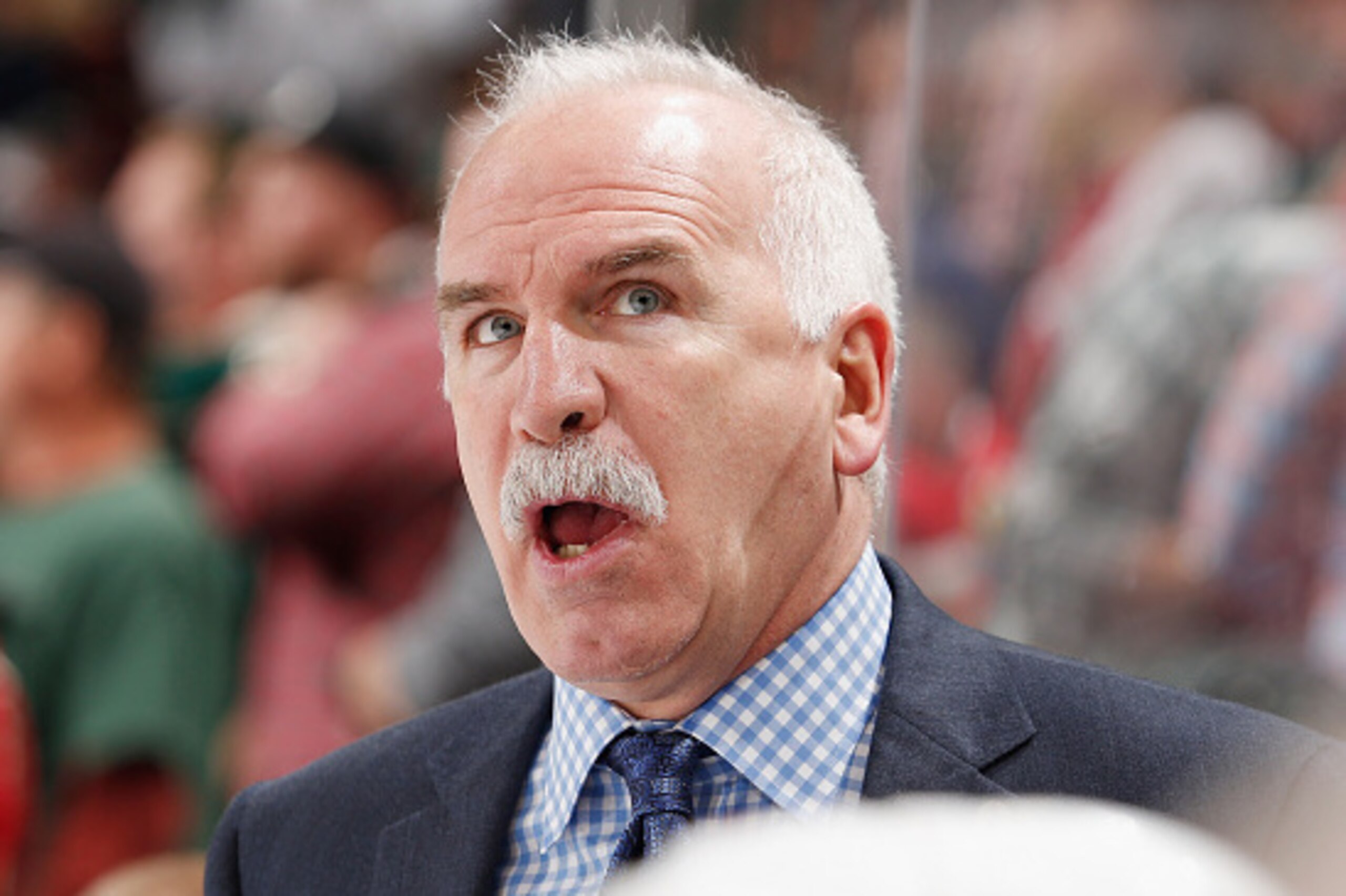
Asked during the first period of Game 3 how he prepared his team after such a long, arduous Game 2, Blackhawks coach Joel Quenneville seemed like a man without answers. As he told NBC’s Pierre McGuire:
"We flew in, didn’t go home to our house until about five o’clock. We came in this morning; the guys that felt they needed to skate would skate. These guys have been through so many wars and battles and big stages and big games and long ones. With these guys the leadership takes over.
"
Quenneville continued to lean on his defensive leaders Thursday. No. 5 defenceman Kyle Cumiskey, a minor league journeyman who played 54 games in the AHL this season, played less than nine minutes. No. 6 defenceman Kimmo Timonen, who was an appalling addition at the trade deadline, played under seven.
It’s not clear if there’s any way out of this for the Blackhawks. Timonen has been reliably awful for Chicago all postseason (he has below-average metrics despite a ridiculous 77.0 percent zone start and a steady diet of weak opposition). Cumiskey hasn’t been a full-time NHL’er in a half-decade. David Rundblad, a scratch for the last two games after a difficult playoff debut in Game 1 of this series, is still trying to establish himself as an everyday NHL’er.
Somehow, Chicago has to find a way to distribute some of the load from its top four defenceman to one or more of its bottom three. If it can’t, it’s hard to imagine Keith and company having the stamina to carry the team to another championship.
Statistics courtesy of NHL.com and War-on-Ice.com.
Jonathan Willis covers the NHL for Bleacher Report. Follow him on Twitter for more of his work.
.jpg?w=2560 "NHL Trade Grades Connor Hellebuyck")

.jpg?w=2560 "Raiders Could Start Mendoza")



.jpg?w=2560 "Rodgers Iced Out on Plane 💎")
.jpg?w=2560 "🚨 Week 8 AP Top 25 Poll")
