

Rangers' Coach Alain Vigneault's Line Changes Show Blueprint to Win East Final
In the opening game of the Eastern Conference Final on Saturday, New York Rangers head coach Alain Vigneault did more than guide his team to victory. He unveiled his plan to win the entire series.

It started with a line shuffle.
TOP NEWS
Best NHL Heritage Classic Jerseys 📋
Teams That Need Goalie Trade💡
Hellebuyck Trade Takeaways 📊
Martin St. Louis has spent most of the postseason on the team’s top line, and it simply wasn’t working. Vigneault decided to go with a very different look.
In the place of a 5’8” veteran on the eve of his 40th birthday, the coach promoted Kevin Hayes, a 6’5”, 225-pound rookie who tallied 45 points in the regular season but had mostly been confined to a depth role during the playoffs.
That much we knew before the start of the game. What we didn’t know was how Vigneault would deploy his new-look lines.
The toughest minutes went to a line Vigneault didn’t touch. The trio of Derek Stepan, Chris Kreider and Jesper Fast was tasked with shutting down the Lightning’s red-hot “Triplets” line centered by Tyler Johnson. Just for good measure, Vigneault also had his top defence pairing (Ryan McDonagh and Dan Girardi) shadow that line.
Essentially, the Rangers’ plan consisted of running a five-man defensive unit against Tampa Bay’s best trio.
It worked. Johnson’s line failed to produce a goal and ended up right around the 50 percent mark in terms of shot metrics.
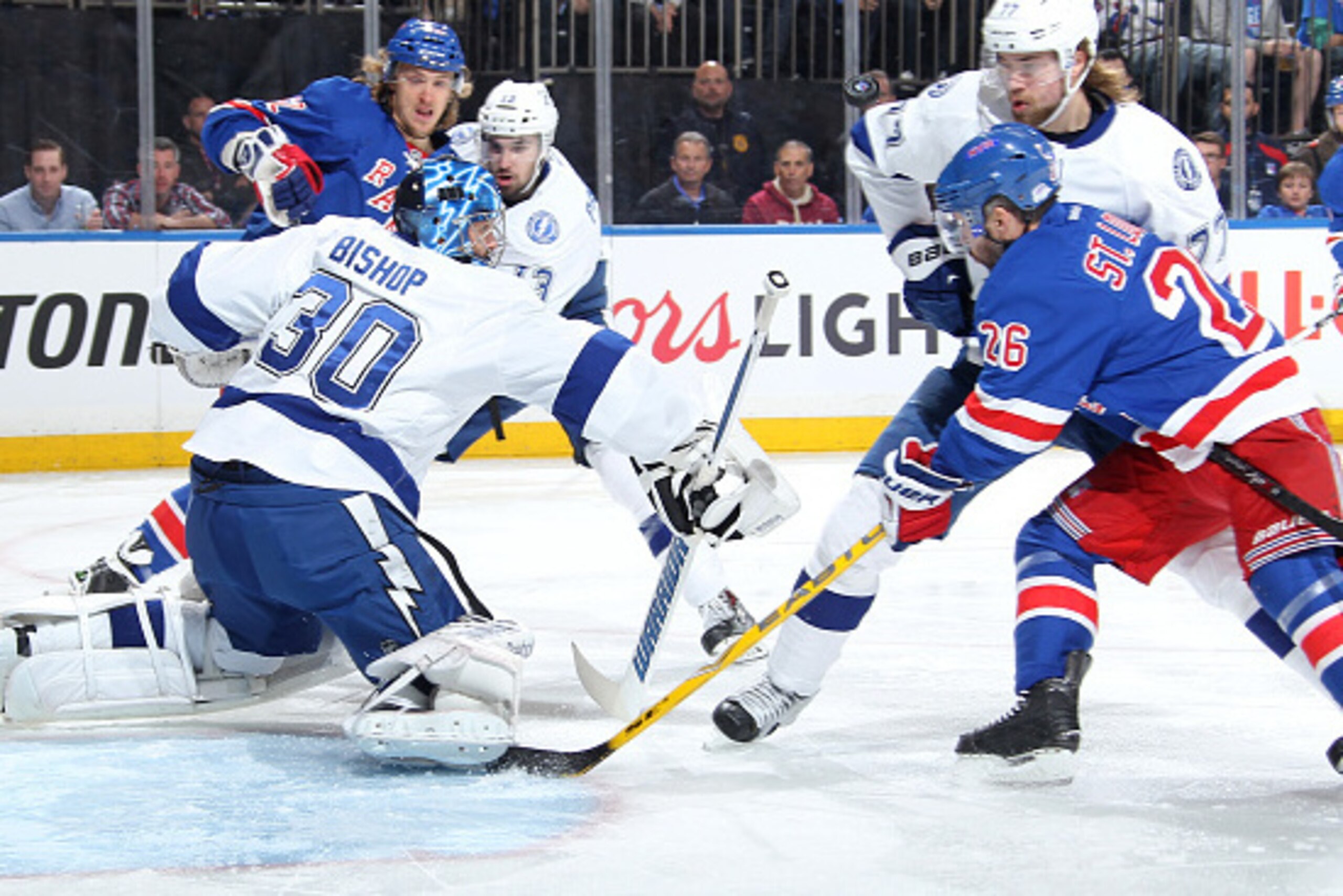
The Rangers succeeded in keeping that unit in check. Better still, Stepan potted the game’s first goal, finally beating Ben Bishop late in the second period after 40 minutes of strong play from the Lightning goalie.

Of course, the Johnson line wasn’t Tampa Bay’s only offensive weapon. Steven Stamkos struggled badly in the first round but came on strong in the second. How would New York handle the Lightning’s captain?
That job fell to the new-look first line of Hayes, Derick Brassard and Rick Nash. Generally, those three were joined by the second pairing of Marc Staal and Dan Boyle, though the McDonagh-Girardi pairing saw some of that matchup, too.
It went spectacularly well—even better than Vigneault could have hoped.
The line dominated puck possession, with New York attempting 24 shots to Tampa Bay’s eight when Brassard was on the ice at even strength. The ratio of shots which got through to the goaltender was even more lopsided in the Rangers’ favour. With Brassard on the ice, 80 percent of the shots taken were fired at Bishop.
Unsurprisingly, this line produced the game-winning goal. Brassard picked up a second assist on New York’s 2-1 marker, a Hayes centering pass which banked in off the leg of Rangers forward Dominic Moore and past Bishop with just over two minutes remaining in the game.
It took almost the whole game, but New York’s best line was rewarded for its great work.
The funny thing is that these matchups were made with at least as much attention to defence as offence. The goals from the top two lines were welcome, but keeping Stamkos and the Triplets off the board was just as important.
As long as Vigneault sticks with these matchups—and given how well they worked in Game 1, there’s no reason for him to change them—the objective is going to be to limit the opposition’s chances and then chip in offence whenever possible.
And what of St. Louis? That’s where the focus shifts from defence to offence.
St. Louis, dropped down to the third line alongside Moore and Carl Hagelin, was ostensibly demoted. His ice time actually increased from the last two games, though, as Vigneault used him as an offensive weapon against the Lightning’s worst players.
Virtually every shift saw St. Louis starting in the offensive zone. His most common opponents were Cedric Paquette and Jonathan Marchessault.
Lightning coach Jon Cooper got Braydon Coburn and Jason Garrison out on defence but basically accepted the unpleasant forward matchup.
The results were ugly for Tampa Bay. St. Louis’ line didn’t score but ran up a significant edge in shots and shot attempts, caving in the Lightning’s depth forwards. It could easily have been a multigoal night for the line. It’s the kind of thing that Tampa Bay can’t sustain if it wants to win this series.
For Vigneault, it’s just part of the plan.
He trusts Stepan and his top defence pairing to contain Tampa Bay’s top line. He expects a revitalized first line to outscore a struggling Stamkos. St. Louis looked energized out there against low-end opponents. He should be able to continue to feast on the soft underbelly of the Lightning forward corps.
Vigneault’s fourth line doesn’t have a matchup per se. He continued to use it the way he has all year, asking it to take on defensive zone draws, add a physical edge and not do much else.
It’s a solid formula, and there’s no reason for Vigneault to deviate from it, though he acknowledged to reporters that things might change if the plan stops producing the desired results.
“It goes back to watching how they played in those series,” Vigneault said, per Bleacher Report's Dave Lozo. “There will be adjustments on both sides as the series moves on here. But I felt going into today that that would be a good matchup.”
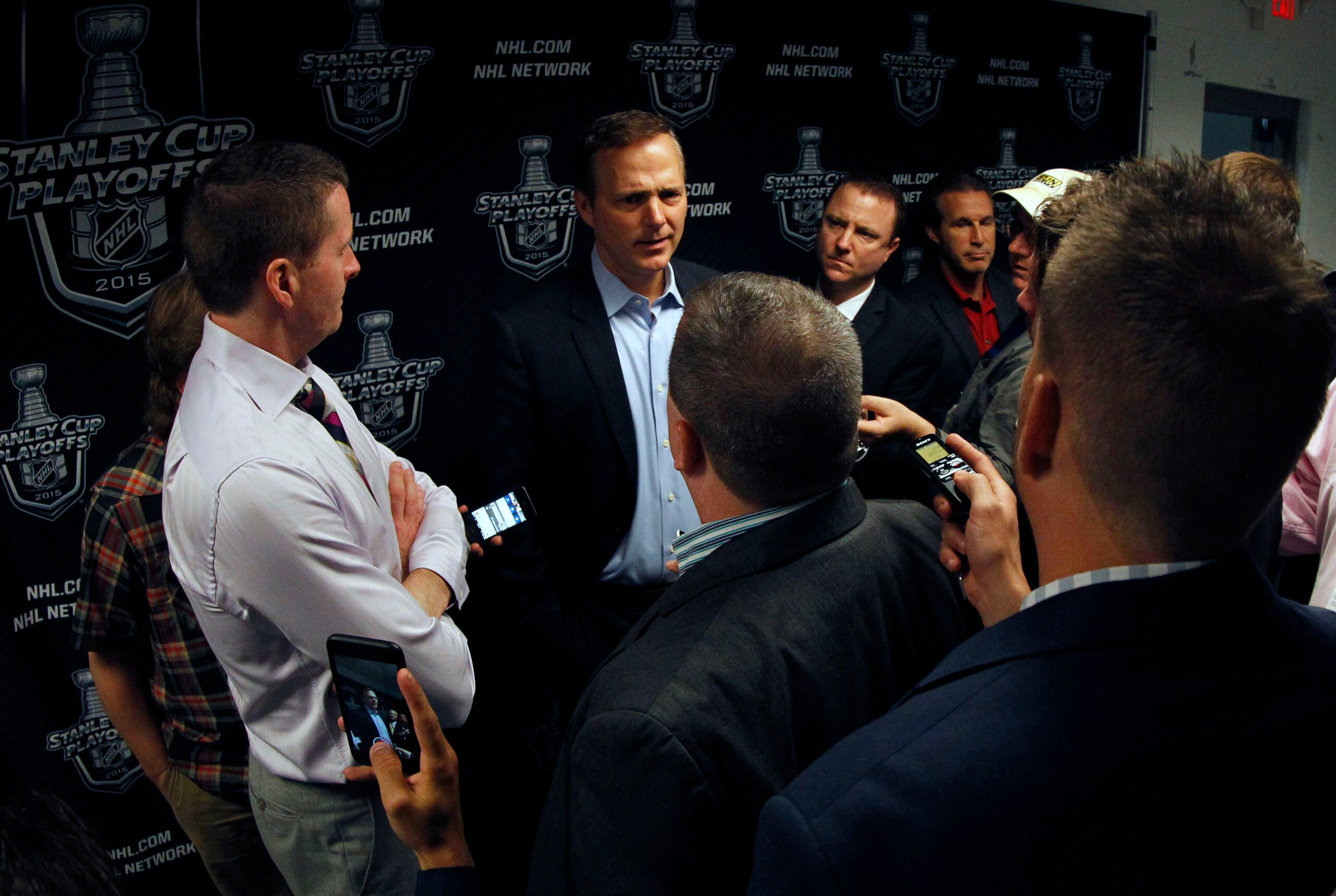
Right now, the onus is on Tampa Bay’s coach to figure out a way to counteract Vigneault’s game plan.
It won’t be easy for Cooper. The obvious move is to bump Stamkos back to centre and put together a competent third line with Valtteri Filppula at its heart, but weakening that second line is dangerous given the way Nash and Co. ran over it in Game 1.
New York now has one game in the bank and a blueprint for winning the other three. It’s up to Cooper to find a fatal flaw in that plan.
Statistics courtesy of Natural Stat Trick.
Jonathan Willis covers the NHL for Bleacher Report. Follow him on Twitter for more of his work.
.jpg?w=2560 "NHL Trade Grades Connor Hellebuyck")

.jpg?w=2560 "Raiders Could Start Mendoza")



.jpg?w=2560 "Rodgers Iced Out on Plane 💎")
.jpg?w=2560 "🚨 Week 8 AP Top 25 Poll")
.jpg?w=2560 "Packers Safety Slams Refs 🤬")