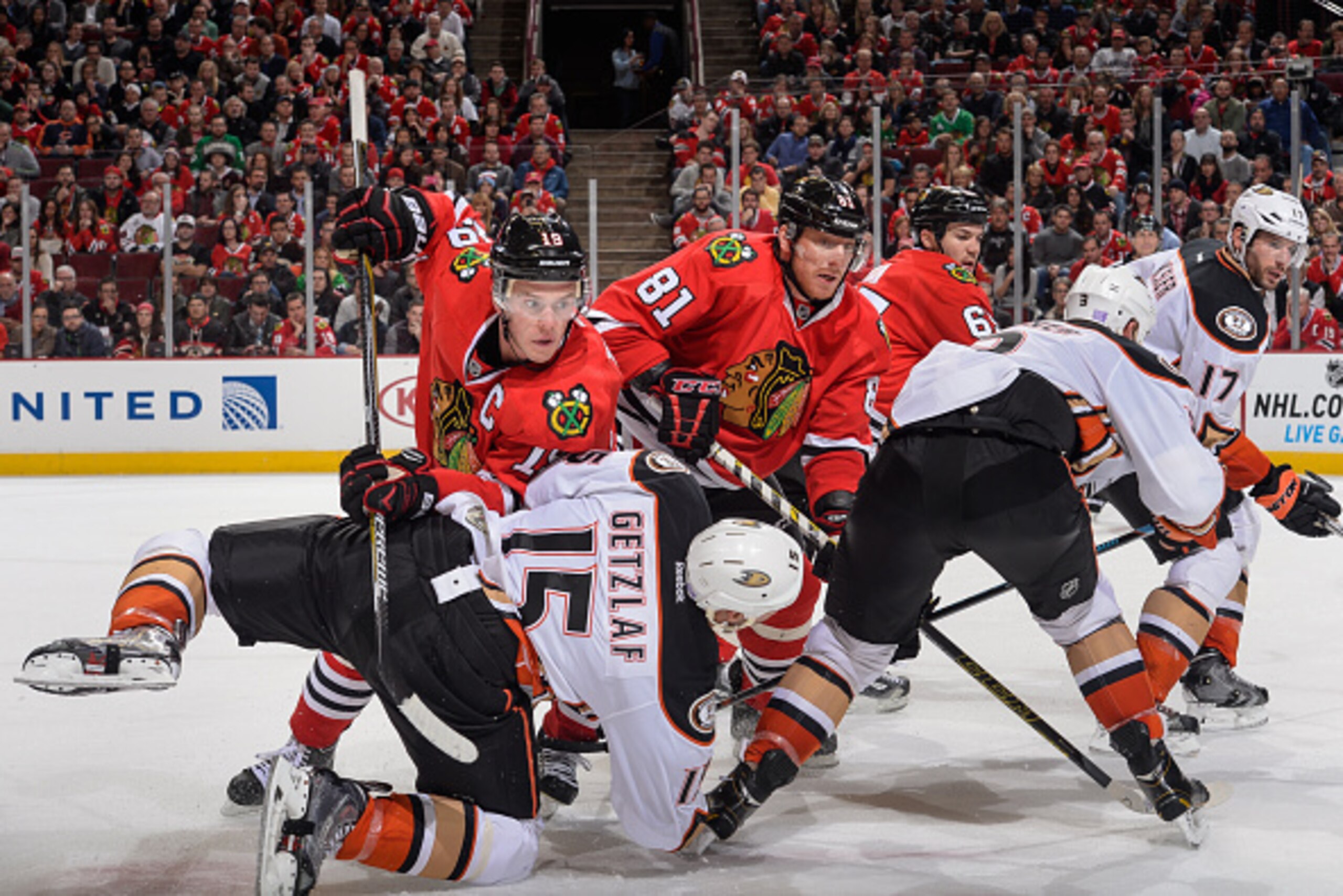

Blackhawks vs. Ducks: Line-by-Line Breakdown of 2015 Western Conference Final
The Western Conference Final is upon us and features two exceptional teams that took very different routes to get to this point.
Chicago fought its way through a tough Central Division, toppling the Nashville Predators in a close first-round series and then dominating an excellent Minnesota Wild team in a four-game sweep. The Blackhawks managed to dodge St. Louis, a Cup contender in its own right, after the Wild knocked off the Blues early.
Anaheim has had a comparatively easy time of it, dispatching the Winnipeg Jets in four straight in the first round and then not taking much more time (five games) to handle the Calgary Flames. Both Calgary and Winnipeg were competing after long absences from the postseason, and so the Ducks have not yet had an opponent who's widely regarded as a genuine Cup threat.
Given their differing routes to this point, it's worth asking what these two teams look like in a head-to-head comparison. The following slideshow goes through the rosters on each side, based on their most recent line combinations, and compares the players who will meet Sunday for Game 1. Read on to go through their respective depth charts and see how they stack up.
First Line
1 of 9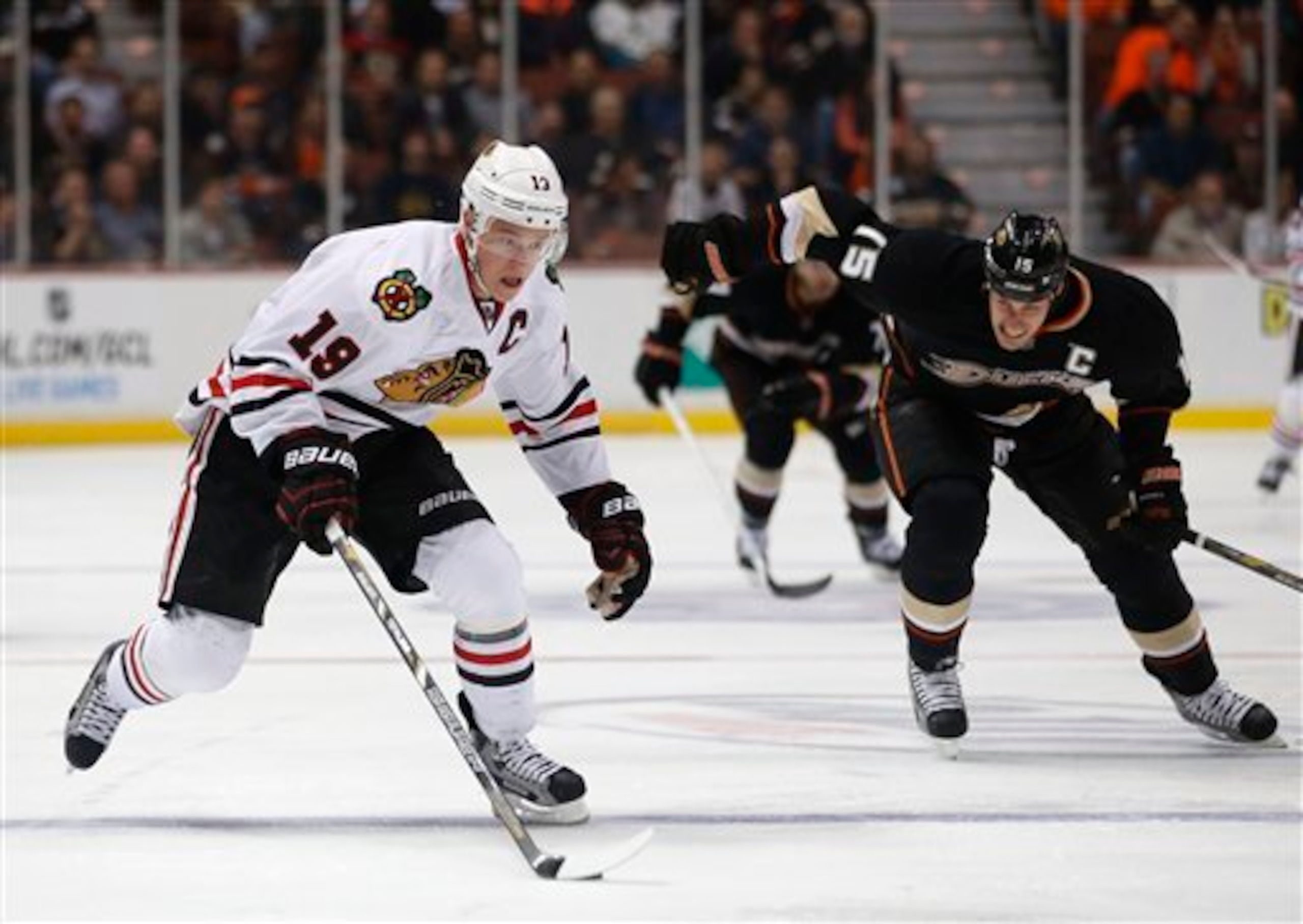
LW Patrick Maroon, C Ryan Getzlaf, RW Corey Perry
Perry is the NHL's leading playoff scorer with an astounding 15 points in just nine games. Getzlaf is in a tie for third place with 12 points. They are one of the top tandems in the NHL and have been for ages, regardless of who plays with them. Both are big, powerful two-way threats—elite NHL players who have dominated throughout their respective careers.
Maroon is very much the sidekick on this line, but he's been good, too. He's big, plays the same sort of power game as the other two and has four goals through nine games on this line.
LW Brandon Saad, C Jonathan Toews, RW Marian Hossa
Toews might be the pre-eminent defensive centre in the game. If he isn't at the top of the list, he's in the conversation. The 2013 Selke winner was named a finalist for the best defensive forward award again in April; it's the fourth time in five years he's earned that distinction. Oh, and he's also over a point per game so far in the playoffs.
Hossa is cut from the same cloth and is a reliable two-way threat, while emerging youngster Saad plays a similar style. Saad recently described the top line's game to NHL.com's Brian Hedger:
"When we're on top of our game, we all have some size out there, protecting the puck and playing in [offensive] zone, getting pucks to the net and making plays down low. That's our game. We don't want to get involved in [rush] attacks. We have some skill on our line, too, so we can do that, but with three big bodies we like to play down low.
"
Advantage: Anaheim, narrowly
Second Line
2 of 9
LW Matt Beleskey, C Ryan Kesler, RW Jakob Silfverberg
Kesler was Anaheim's big upgrade during the summer, and so far he's been a nice fit. The two-way centre does everything, providing offensive production, defensive responsibility and doing it all with the physical edge the Ducks have long been enamoured with.
His partners are pretty solid, too. Silfverberg plays the game with the kind of defensive conscience that seems to come standard with Swedish forwards, and he's been a superb offensive weapon in these playoffs (11 points in nine games). Beleskey exploded for 22 goals this year and has five in just nine games in the postseason. He plays a rugged style that is a nice fit for the Ducks.
LW Bryan Bickell, C Brad Richards, RW Patrick Kane
Kane is the best player on either team's second line, and it's fun to imagine him next to Jonathan Toews going head-to-head with Ryan Getzlaf and Corey Perry for 15-20 minutes per game. Instead, he's the primary offensive generator on a potent second line.
The addition of Richards hasn't worked out as well as it could have this season, but the 35-year-old pivot remains a formidable player with a wealth of offensive ability and exceptional hockey sense. Bickell hasn't stood out in these playoffs but adds an element of size to a smaller line and has been a key contributor in Chicago's last two postseason runs.
Advantage: Chicago, narrowly
Third Line
3 of 9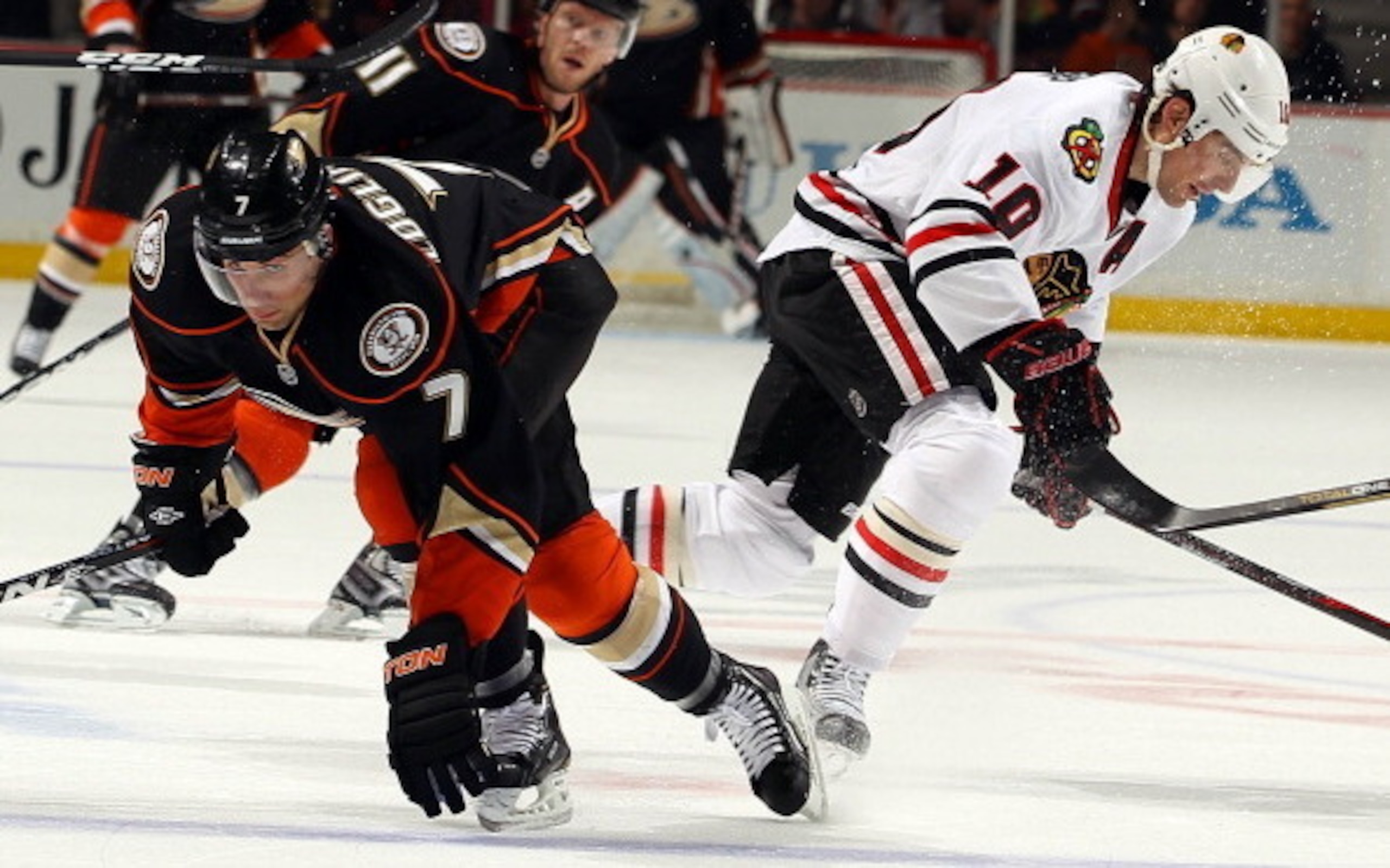
LW Andrew Cogliano, C Nate Thompson, RW Kyle Palmieri
Cogliano has been a really nice player for Anaheim since coming over in trade from the Edmonton Oilers a few years back. He's versatile enough to slot in anywhere in the lineup, and his exceptional speed helps him create offensive opportunities and recover defensively. He had an off year offensively but has been good (five points through nine games) in the playoffs.
Palmieri's a nice fit for Cogliano because the two have much in common; like Cogliano, Palmieri boasts high-end mobility and offensive skill. He's cold entering this series, with just two assists in the playoffs despite some opportunities. Thompson is a big defensive pivot who plays regular minutes on the penalty kill, wins draws and plays a physical game, but he lacks the scoring touch of his linemates.
LW Patrick Sharp, C Antoine Vermette, RW Teuvo Teravainen
It says a lot about Chicago that its third line at this point includes Sharp, just a single season removed from 34 goals, and Vermette, one of the whales who commanded a massive return at the trade deadline.
Vermette is starting to come into his own after some difficulty adjusting to Chicago; at his best, he's a high-quality defensive forward who can chip in 40-odd points. Sharp is a volume shooter and goal scorer who plays a responsible game, qualities that landed him on Canada's dominant 2014 Olympic team.
Teravainen is the third member of the line. The 20-year-old has not yet reached his potential as an offensive weapon, but he has shown himself to be sneaky and creative since being inserted in the lineup.
Advantage: Chicago
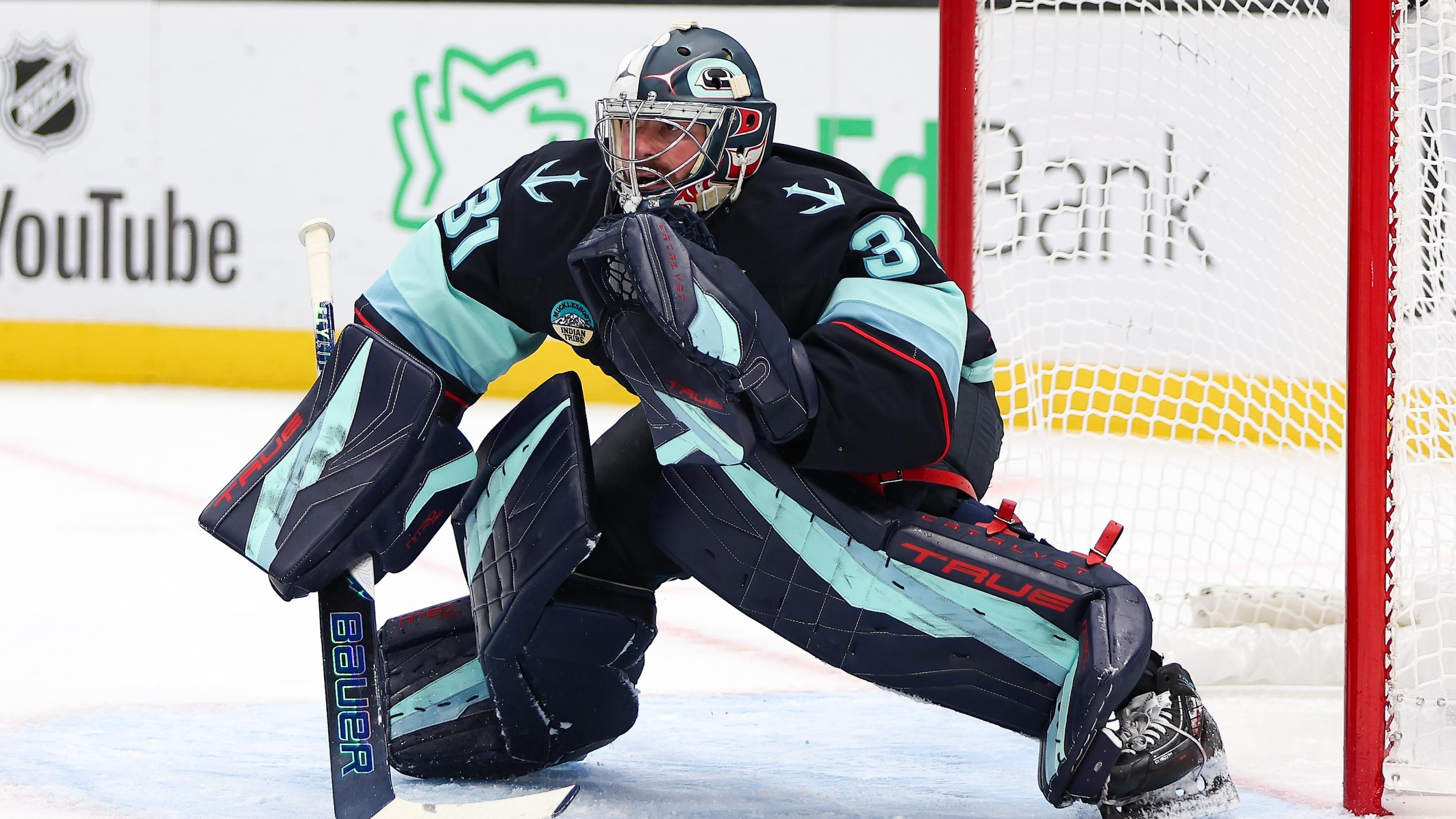

Depth Forwards
4 of 9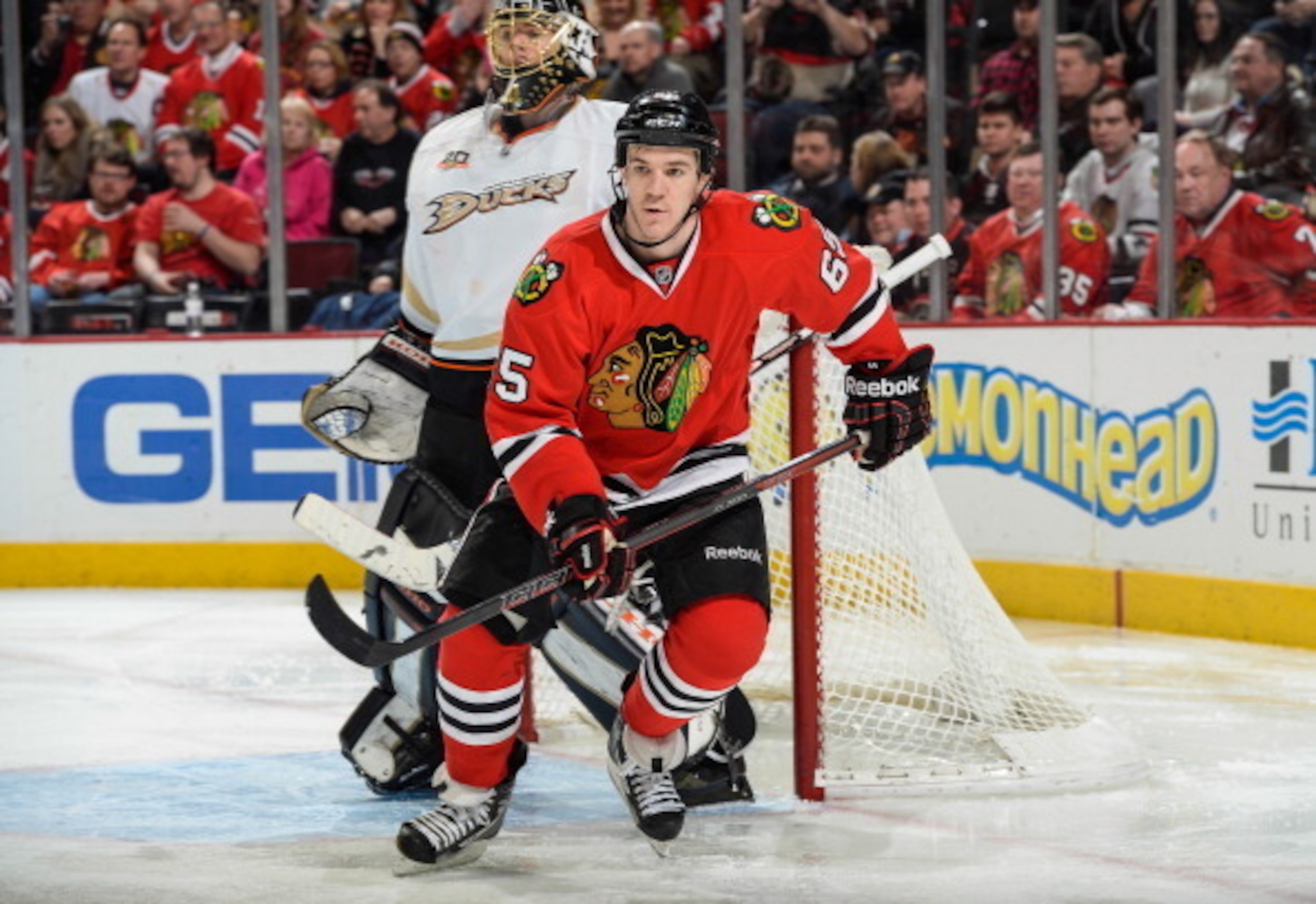
LW/C Tomas Fleischmann, C Rickard Rakell, RW Tim Jackman (Spares: LW Emerson Etem, C/RW Chris Wagner, LW Jiri Sekac)
When the Globe and Mail's Eric Duhatschek asked Ducks coach Bruce Boudreau about his lineup decisions in the second round, Boudreau made it clear that he had a wealth of options, and good players were going to be sitting most nights.
"It speaks to our depth," Boudreau said, "and if things don't go right, we've got guys we can put in. Jiri Sekac has played great for us as well."
Sekac, who managed 23 points as an NHL rookie this year, has yet to find his way into a playoff game. Anaheim has a bunch of different looks it can go with in its bottom six, and the most recent incarnation of the fourth line features an established scorer on one wing, a tough physical veteran on the other and a young centre with both an offensive touch and a surprisingly mature defensive game.
LW/C Andrew Desjardins, C Marcus Kruger, RW/C Andrew Shaw (Spares: LW/RW Kris Versteeg, LW Joakim Nordstrom, LW Dan Carcillo)
Chicago has long had an impressive fourth line, and that hasn't changed. The team's current incarnation is charged with taking tough defensive zone assignments and coming out on top, and so far it has managed that.
Kruger has been in the role for ages, and the demotion of Shaw to this unit gives it some additional offensive bite. Desjardins, a physical pivot who came over from San Jose at the deadline, has mostly played the wing and filled in ably there.
Of the club's spare forwards, Versteeg is the most famous and most likely to be inserted into the lineup at some point; he's a capable complementary scorer who can be plugged into the top nine.
Advantage: Chicago
First Pairing
5 of 9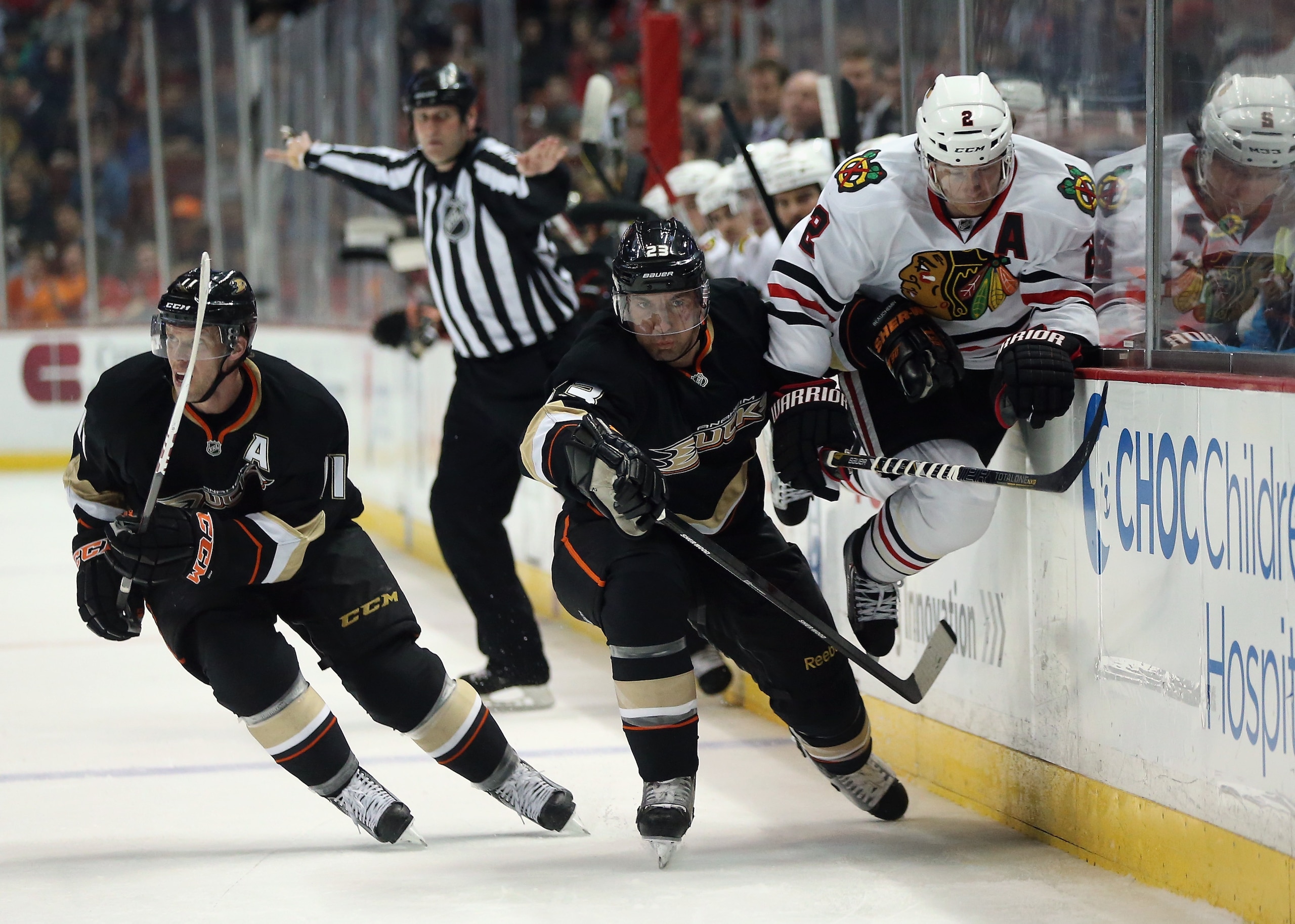
LD Hampus Lindholm, RD Francois Beauchemin
Anaheim picked Lindholm No. 6 overall in 2012, siding against the consensus wisdom that had the defenceman going lower. It's paid off in spades for the Ducks so far; just two seasons into his NHL career, the 21-year-old rearguard has emerged as a two-way threat. He's a big, mobile defenceman with significant offensive ability—a guy with no discernible weaknesses.
His partner, Beauchemin, is an old warhorse who has long been underappreciated around the NHL. The 34-year-old plays an uncompromising defensive game and logs the toughest minutes on the Ducks blue line. He's more than capable of making an outlet pass or rushing the puck up ice if he sees an opportunity.
Few first pairings in the league are as good as this one has quietly become.
LD Duncan Keith, RD Niklas Hjalmarsson
Chicago has been rotating its defencemen constantly, so there haven't really been set pairings. With that said, the team has at times played the Norris trophy-winning Keith with its top shutdown option in Hjalmarsson to form something of a super-pairing. Given Anaheim's fear-inducing top line, it wouldn't be a surprise if the Hawks did so again.
Keith is a known quantity around the league, a highly capable, puck-moving defenceman who mostly plays a positional defensive game and is acknowledged as one of the finest players in the NHL at his position. Hjalmarsson isn't as famous as he should be; he's a stellar defensive defenceman and has been doing yeoman's work for the Blackhawks for ages.
If these two stay together, it's one of the best duos in hockey.
Advantage: Chicago
Second Pairing
6 of 9
LD Cam Fowler, RD Simon Despres
Fowler is a famous player, going back to the 2010 draft where he fell all the way to No. 12 overall after being projected in many outlets as a top-five pick. He's a mobile, puck-moving defenceman with good size, but he isn't without his flaws; he can be overwhelmed defensively and is nowhere near as physical as he could be in front of his own net. Still, he's a solid second-pairing option.
His partner, Despres, is a great example of stealing a quality player away from a team that undervalued him for one reason or another. The 6'4", 214-pound rearguard had seemingly worn out his welcome with Pittsburgh, the team that drafted him in the first round in 2009. Anaheim added him at the deadline, and he instantly and effectively began logging second-pairing minutes.
LD Johnny Oduya, RD Brent Seabrook
Oduya has been playing tough minutes for a long time in Chicago, generally with Niklas Hjalmarsson as his partner. He's had a difficult season, however, and has looked especially bad when separated from his regular collaborator. At age 33, the miles seem to be showing, and he's due for a reduction in his role.
Seabrook, on the other hand, is arguably a first-pairing defender and has often been used that way by the Blackhawks. He has a heavy shot, makes a good first pass and also brings size and a willingness to use it defensively. He's probably the most belligerent of Chicago's regular defencemen.
Advantage: Chicago, narrowly
Depth Defencemen
7 of 9
LD Clayton Stoner, RD Sami Vatanen (Spare: RD James Wisniewski, RD Korbinian Holzer, LD Mark Fistric)
It's a little surprising to see Wisniewski relegated to the sidelines after Anaheim paid a big price for him, but as Bruce Boudreau explained, Stoner and Vatanen have had good chemistry together all year.
"Sami seems to play his best with Clayton, and now Clayton's fully healthy, so I don't see why he would lose his position," Boudreau told Eric Stephens of the Orange County Register. "He's been injured a little bit coming down the stretch and now that he's healthy, I think those two made a great pair together all year."
It's a logical pairing on paper. Stoner is a big, physical, defensive defenceman, while Vatanen is a pint-sized offensive dynamo. Both have been good in these playoffs. If injuries hit or there are performance problems, Wisniewski is an awfully nice depth piece to have.
LD Kimmo Timonen, RD David Rundblad (Spare: LD Kyle Cumiskey, RD Michael Paliotta; Injured: LD Michal Rozsival, RD Trevor van Riemsdyk)
The 40-year-old Timonen was a shockingly expensive deadline add for the Hawks, and it isn't at all clear that he's been worth it. He's had a brilliant NHL career but is averaging just over nine minutes per game as Chicago's seldom-used No. 6 option.
His partner in the third round is a matter of debate, as the Blackhawks lost Rozsival to injury in their Game 4 win over Minnesota and will dip into their reserves for the first time in this postseason. Offensive defenceman David Rundblad seems the best bet, as injuries have whittled down the position and he was leaned on more in the regular season than either Cumiskey or rookie rearguard Paliotta.
Advantage: Anaheim
Goaltenders
8 of 9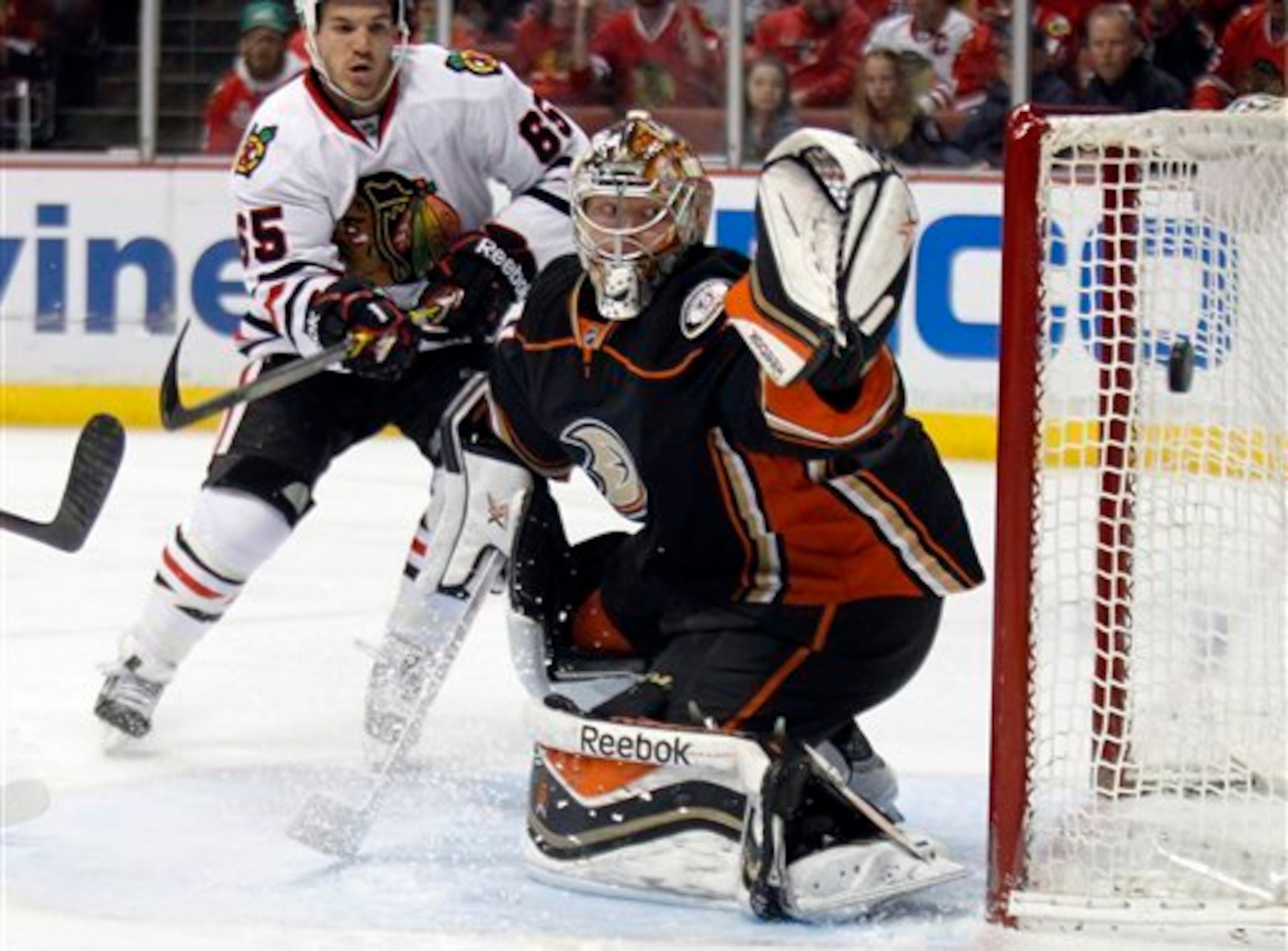
Starter Frederik Andersen, Backup John Gibson (Spare: Jason LaBarbera)
Andersen struggled as a rookie playoff starter last year but has improved upon that performance this season. It's true that he wasn't rigorously tested in the first two rounds of the playoffs, but even so, his 8-1 record and .925 save percentage speak well of him, as does his excellent regular-season performance.
Gibson played well when called upon in the 2014 postseason and was an able backup in the majors this year. If Andersen struggles, the Ducks can feel confident in him.
Starter Corey Crawford, Backup Scott Darling (Spare: Antti Raanta)
The good news for the Blackhawks is that Crawford is playing well these days, and if he falters, the team has depth.
Crawford struggled early but returned to the Chicago net for the second round of the playoffs, winning four straight against Minnesota and showing the form that made him a Cup winner with the Blackhawks in 2013. He's now 5-1 with a .916 save percentage in the postseason.
Darling filled in ably when called upon, going 3-1 with a .936 save percentage against Nashville, while Raanta is also a legitimate option in the event of injury.
Advantage: Anaheim, narrowly
Summary
9 of 9
- First Line: Anaheim
- Second Line: Chicago
- Third Line: Chicago
- Depth Forwards: Chicago
- First Pair: Chicago
- Second Pair: Chicago
- Depth Defencemen: Anaheim
- Goalies: Anaheim
This is going to be an interesting series. This comparison shows the two teams are relatively close in terms of total strengths/weaknesses, but in many cases, the gap between the two clubs at various positions isn't all that wide, either.
Anaheim boasts a great first line, good quality elsewhere and exceptional defensive depth. Chicago has a better set of forwards overall and a stellar defence but does have depth concerns on the back end and could see its top rearguards exposed through fatigue.
It's hard not to prefer Chicago here, but the Ducks roster has a lot going for it, too.
Statistics courtesy of NHL.com and NaturalStatTrick.com.
Jonathan Willis covers the NHL for Bleacher Report. Follow him on Twitter for more of his work.
.jpg?w=2560 "NHL Trade Grades Connor Hellebuyck")

.jpg?w=2560 "Raiders Could Start Mendoza")



.jpg?w=2560 "Rodgers Iced Out on Plane 💎")
.jpg?w=2560 "🚨 Week 8 AP Top 25 Poll")
.jpg?w=2560 "Packers Safety Slams Refs 🤬")