

The Sports Tax Man Breaks Down the Financial Ins and Outs of NFL Free Agency

On March 10, the free-for-all begins, when the floodgates open and free agency kicks off across the NFL.
There's already been a boatload of speculation regarding potential destinations for this year's top free agents. Pundits and fans alike have talked breathlessly of contract sizes, cap space and roster needs. They speak of "hometown discounts" and "the chance to win."
However, in the opinion of one financial expert, one big piece of the puzzle sometimes gets overlooked.
TOP NEWS
.jpg?w=2560 "Chiefs Giants Football")
Mahomes Told Teammate to Leave Meeting
.jpg?w=2560 "Titans Colts Football")
5 Teams Eyeing Jonathan Taylor
.jpg?w=2560 "Colts Football")
Jonathan Taylor Landing Spots 📍
When I asked "The Sports Tax Man" what the biggest misconception was regarding professional athletes' contracts, he didn't hesitate. "They don’t realize how much money they (athletes) have to pay in taxes," New York CPA Robert Raiola said.
Raiola is the Sports and Entertainment Group senior manager with O'Connor Davies LLP, a New York accounting firm. He specializes in athletes, broadcasters, coaches, entertainers and other high net worth individuals. He's also a major force on social media, with over 40,000 followers on Twitter.
Want to know how Brandon Marshall's trade from the Chicago Bears to the New York Jets affects his bottom line? Raiola's your man:
"Every sports story I would see," Raiola said, "I would think about the tax or financial implications, so a few years ago I decided to take to Twitter to start sharing those ideas with others and people have found it pretty fascinating."
"I’m always looking to talk about sports and the business and money issues—how much player’s make per game, how free agency affects decisions—so coming up with a clever Twitter handle and writing about what I love and do for a living has taken off."
As Raiola points out, even after paying federal tax—and state taxes in both the state the athlete resides in and plays in—they still aren't done. Most road games are taxed as well.
"People are surprised to learn that athletes are taxed every time they step off a plane to play," Raiola said. "It’s called the jock tax, and athletes must file wherever they play throughout the season. It’s easy for states to track these players, so it’s easy to impose the tax; whereas if you or I travel to another state, no one cares."
According to Raiola, all those taxes can add up—depending on which state(s) a player lives and works in. "Most professional athletes are in the top income tax brackets and that federal percentage is 39.6 percent. The other figure to factor in is the state income tax where the player plays—if he plays for a team in Florida, Texas, Tennessee, Washington, those states don’t have a state income tax. But the other states with NFL teams do."
"California, for instance, has the highest state income tax at 13.3 percent," Raiola said. "So in some cases players can be paying 50 percent in taxes, depending on what team they play for and where they live."
California's at the apex of those state tax rates, and states like Florida and Washington are at the nadir. Those differing state tax rates can make a big difference in the "take home" pay of a player's contract.
Especially when that player is about to break the bank.
According to Jason La Canfora of CBS Sports, the Miami Dolphins are prepared to offer defensive tackle Ndamukong Suh a contract that would make the 28-year-old the highest-paid defensive player in the NFL, both in terms of average annual salary and guaranteed money:
The numbers being thrown around are six years and $102 million, and the difference in the amount of that money that stays in Suh's pocket in South Florida versus, say, Oakland is staggering:
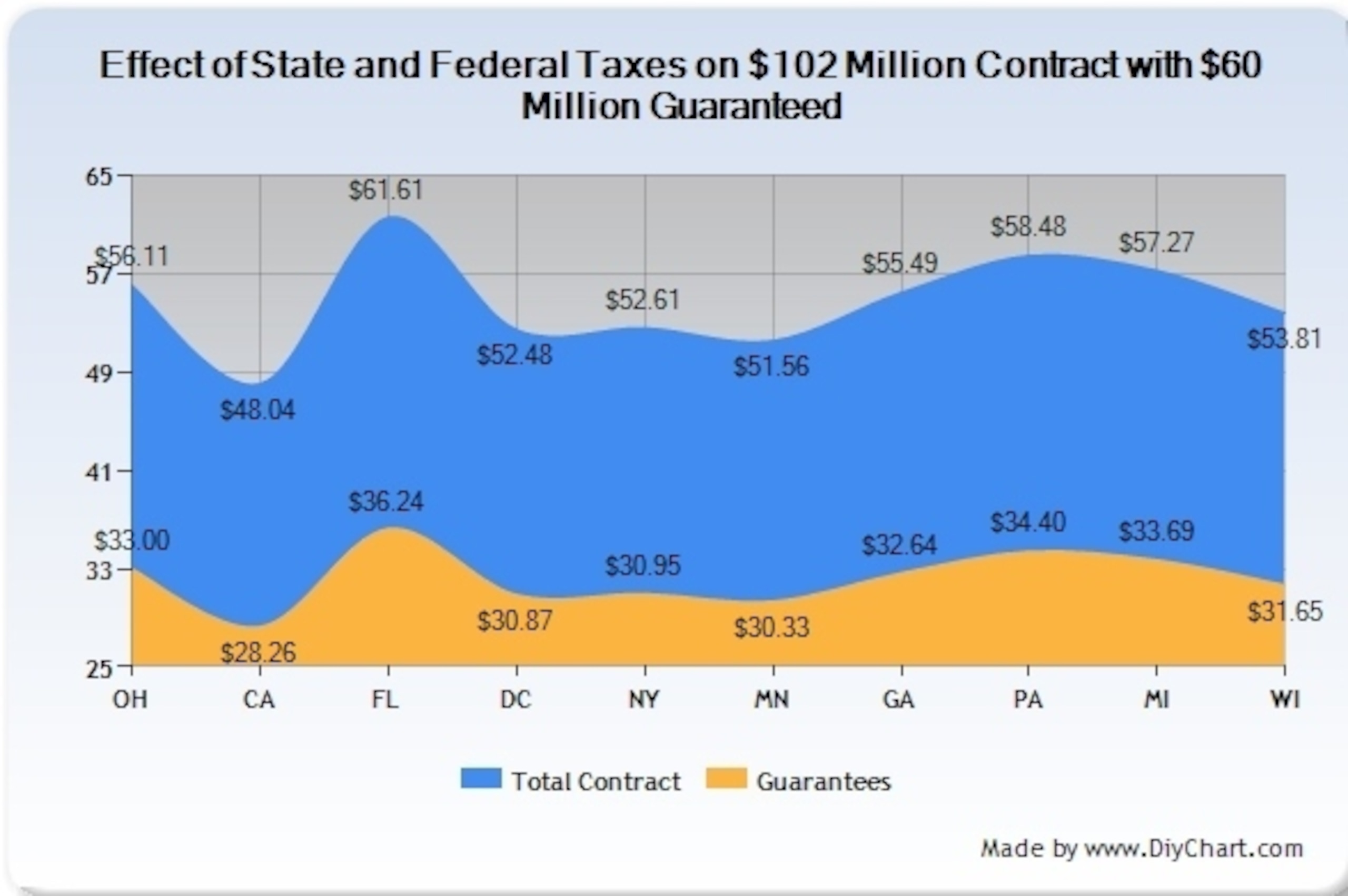
Granted, that chart is a bit simplistic, in that it only shows the net value of a six-year, $102 million deal (and $60 million guarantee) after state and federal taxes.
However, simplified or not, the fact remains that, assuming an identical deal, Suh would leave millions of dollars on the table by spurning the Dolphins or Jacksonville Jaguars for the Raiders or San Diego Chargers.
It's a fact that teams aren't shy about when negotiating with free agents, according to Raiola. "Teams like the Dolphins, Cowboys, the Jaguars, the Seahawks—they'll flaunt the fact they have no state tax," Raiola said. "Then you have a team like the Raiders, and the fact that they have a high tax, then maybe like last year they'll have to overpay some players."
For instance, in order for the Raiders to effectively match the "net" money Suh would get from the Dolphins, Oakland would have to pony up about $118 million—stretching their salary cap even more than that beast of a contract already would.

Raiola doesn't believe that the effect of state taxes on a contract is the determining factor for players, but it's up there—even if many fans don't exactly sympathize with the players' plight.
"An average fan says, 'Whatever, it's $100 million.' But, if you were in their position, you'd see this is a situation where, while state taxes aren't the No. 1 consideration (there's a lot of things that go into it—where does a guy want to play, wanting to win, wanting to be close to home, all those things), state taxes are a real factor."
In fact, Raiola thinks that one mistake a pro athlete can make is going into free agency without having already carefully considered how state and local taxes could impact potential offers. "They need to be proactive rather than reactive," Raiola said. "If they aren’t considering how taxes affect the offer before they sign, then it’s too late."
"When looking at the offers, they need to look at state taxes and not only gross dollars but net dollars for each offer they have. The Raiders may offer you most money, but net-net may not be most money because of the high income tax rate in California."
That's where professionals like Raiola come in. "At O’Connor Davies, I consider myself a financial quarterback to help lead players through these complex tax situations," he said. "I always want my clients to have a have concrete plan in place."
We'll see those plans start to unfold on Tuesday. And as we do, bear in mind that the factor that puts a team over the edge may simply be a matter of playing the percentages.
Or in this case paying them, because thanks to the tax collector when it comes to NFL free agency, the biggest offer isn't necessarily the best.
All quotes were obtained firsthand unless otherwise noted.
Gary Davenport is an NFL Analyst at Bleacher Report and a member of the Fantasy Sports Writers Association and the Pro Football Writers of America. You can follow Gary on Twitter at @IDPManor.
.jpg?w=2560 "Steelers Buccaneers Football")
.jpg?w=2560 "Eagles Jaguars Football")




