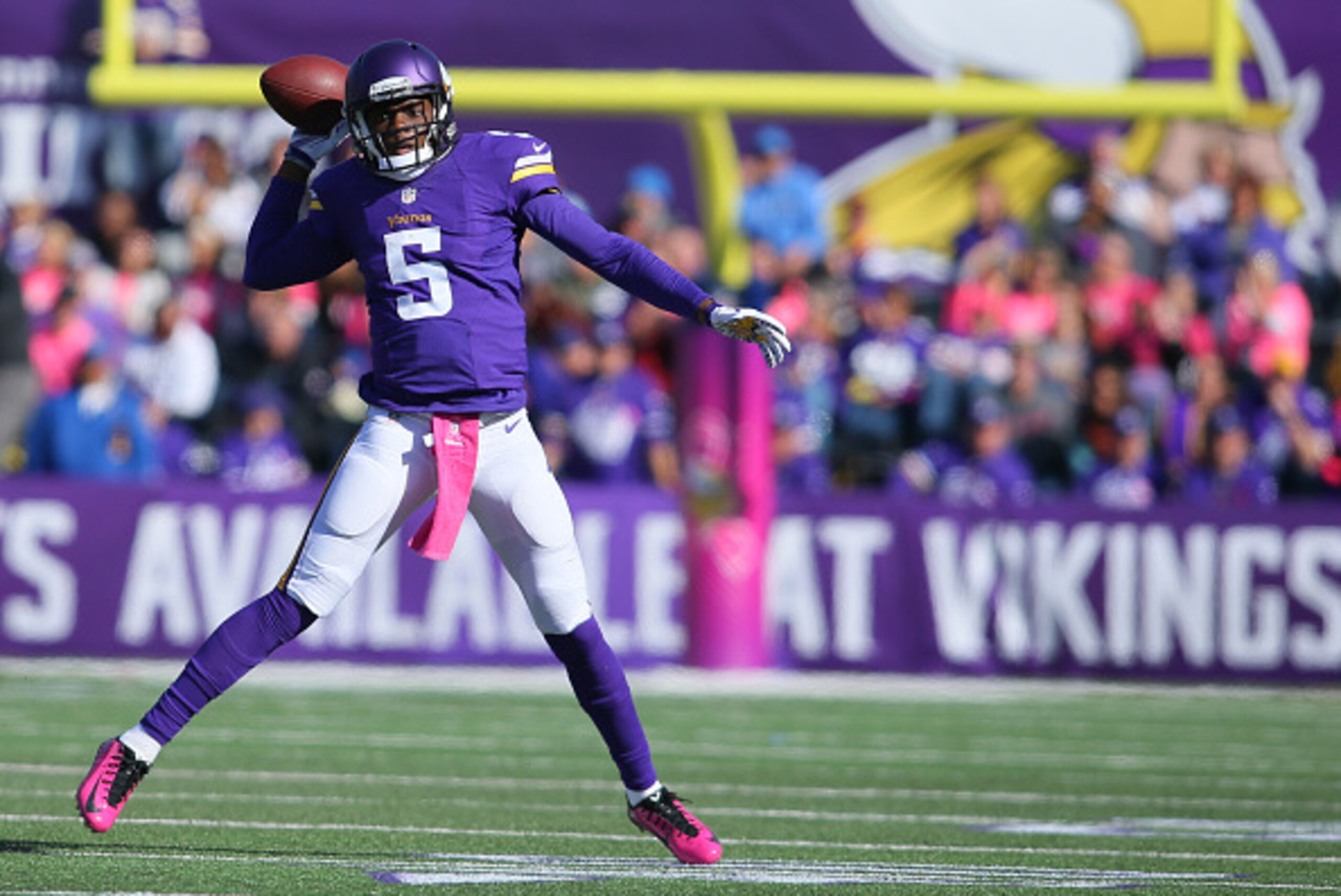

Did Teddy Bridgewater Overtake Matthew Stafford as No. 2 QB in NFC North?
The 2014 season was a consistently entertaining, occasionally brilliant and often chaotic one for the quarterbacks of the NFC North.
It featured the NFL's top overall quarterback and likely MVP, the best rookie quarterback of 2014 and the most discussed quarterback meltdown. The year also provided a seismic shift in the division's hierarchy at the game's most important position.
Aaron Rodgers remains without an equal among NFC North quarterbacks. He's captained the Green Bay Packers to four straight division titles and six straight playoff appearances. The question now centers around which quarterback finished the 2014 season as his greatest looming adversary inside the division.
TOP NEWS
Lane Johnson Retirement Post🦅

New NFL Power Rankings 📊
.jpg?w=2560 "Nolan Wells Lawsuit")
Terrell Owens Being Sued for Defamation
Thankfully, health at the quarterback position wasn't a significant issue: Rodgers and Matthew Stafford both started 16 games, Jay Cutler would have started 16 had he not struggled and rookie Teddy Bridgewater probably should have started all 16.
The futures for Rodgers, Stafford and Bridgewater in their respective locations are secure. While Cutler is financially tied to the Chicago Bears, it remains unclear if he'll be staying in the division for 2015.
Here's how the four quarterbacks in the division stacked up during the 2014 regular season, focusing on just the last year and which player provides the greatest threat to Rodgers' place at No. 1:
1. Aaron Rodgers, Green Bay Packers
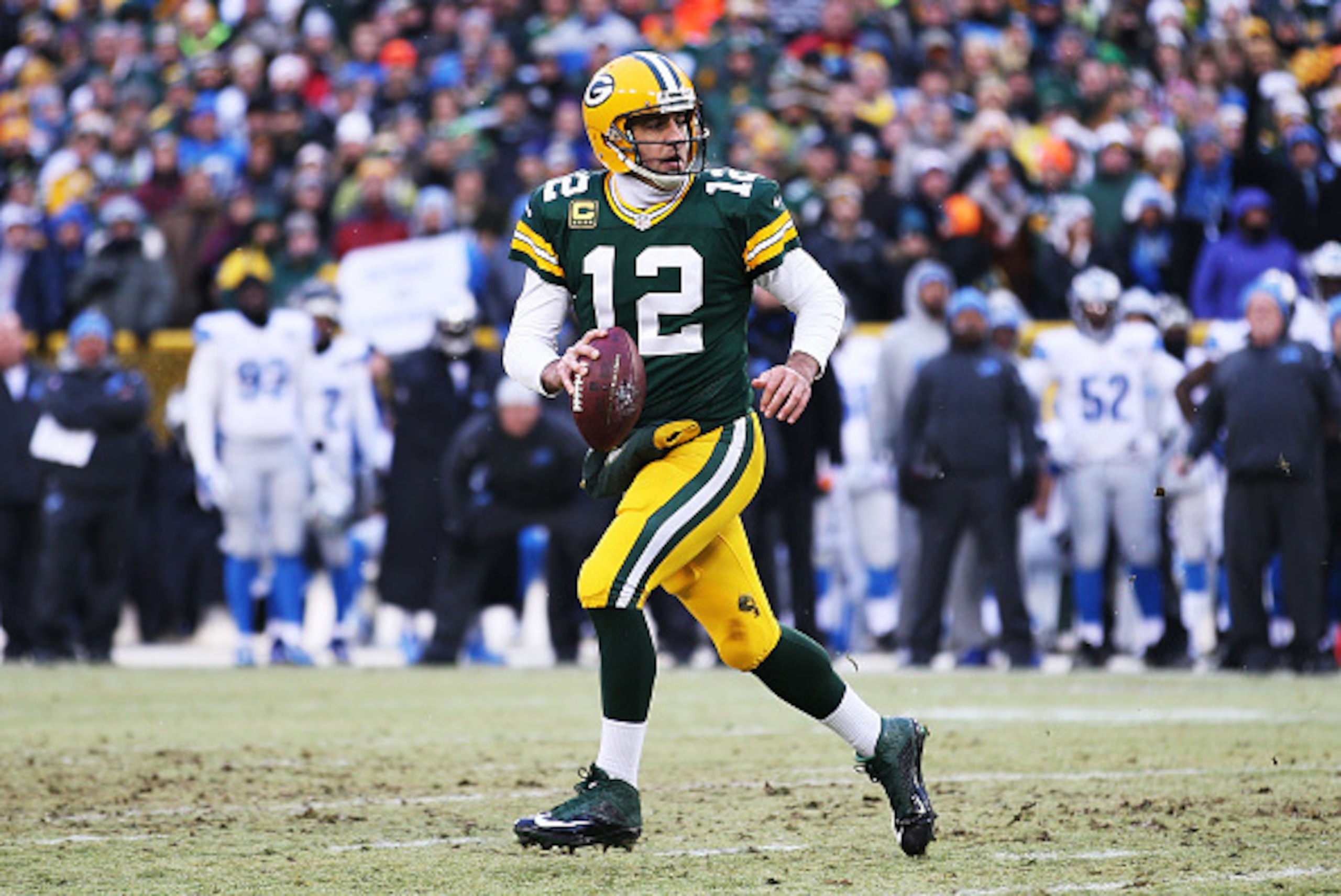
A substantial gap remains between Rodgers, the NFL's likely MVP, and the rest of the division's quarterbacks.
Rodgers threw 38 touchdowns and ran for two more, while tossing just five interceptions (least among quarterbacks with at least 200 attempts) and losing two fumbles (one on a botched snap in Week 2). Essentially, Rodgers was responsible for 40 touchdowns and just seven turnovers, an amazing production-giveaway split unmatched by a quarterback in 2014—especially given four of his interceptions actually hit the hands of his intended receiver.
If not for Tony Romo's red-hot December and a late hiccup in Buffalo, Rodgers would have finished the season with the league's best passer rating, yards-per-attempt average and total QBR. He instead ended up second in all three categories, averaging 8.43 yards per attempt with a 112.2 passer rating and 82.6 QBR.
| Cmp. % | 65.6 | 9th |
| Passing Yards | 4,381 | 7th |
| Passing TDs | 38 | 3rd |
| Touchdown % | 7.3 | 2nd |
| Interceptions | 5 | 1st |
| Interception % | 1.0 | 1st |
| Yards per Attempt | 8.4 | 2nd |
| Yards per Completion | 12.8 | 3rd |
| QBR | 82.6 | 2nd |
| Passer Rating | 112.2 | 2nd |
He was voted first team All-Pro, receiving 44 of the 50 votes at the quarterback position. He was also the leading vote-getter among all players for the Pro Bowl.
Rodgers was once again dominant against the division. Over six games (the Packers won five), Rodgers threw 18 touchdowns and zero interceptions and averaged 9.1 yards per attempt. Ten of his touchdown passes came against the Chicago Bears, including the five he threw in the first half of an early November contest. He finished with a passer rating of at least 110.0 against all three division opponents, and his total passer rating inside the division ended at a sizzling 137.5.
His best moments included a four-touchdown afternoon in Chicago after R-E-L-A-X, a game-winning drive in the scintillating sun in Miami, throwing for six scores against the Bears at Lambeau Field, out-dueling Tom Brady and the Patriots to end November and returning from a calf injury to beat the Lions in a winner-take-all season finale.
The Packers won a fourth straight division title in 2014. The dominance will continue until another NFC North quarterback emerges as his legitimate competition.
2. Teddy Bridgewater, Minnesota Vikings

Bridgewater over Stafford is not as preposterous as it sounds on the surface.
Bridgewater can't match Stafford's volume stats. He threw for significantly fewer yards (2,919 to 4,257) and touchdowns (14 to 22). The Lions also won 11 games, compared to the six Minnesota won with Bridgewater as the starter. But peel away the mostly meaningless volume numbers, and Bridgewater's season stacks up well against Stafford's.
The rookie completed 64.4 percent of his passes (11th in the NFL, fourth best completion percentage ever for a rookie quarterback); Stafford only connected on 60.3 (25th). Bridgewater averaged 7.3 yards per attempt (14th); Stafford averaged 7.1 (19th).
Why are the two sets of numbers important? For starters, Bridgewater completed a significantly higher number of his overall attempts, while using his attempts more efficiently in terms of yards gained. And he did so without the help of a receiver such as Calvin Johnson or Golden Tate.
| Cmp. % | 64.4 | 60.3 |
| Accuracy % | 77.3 | 71.9 |
| Yards per Attempt | 7.3 | 7.1 |
| Under Pressure Accuracy | 75.2 | 56.9 |
| Touchdown % | 3.5 | 3.7 |
| Interception % | 3.0 | 2.0 |
| Passer Rating | 85.2 | 85.7 |
| PFF Grade | +4.5 | -7.1 |
Advanced analytics also give Bridgewater a sizable edge.
According to Pro Football Focus, Bridgewater finished third in accuracy percentage (77.3) and first in accuracy under pressure (75.3), while Stafford was a distant 22nd in accuracy (71.9) and 21st under pressure (56.9).
Both figures are telling. Accuracy percentage takes away drops, throwaways and other factors that hurt a quarterback's overall accuracy, while accuracy under pressure is an efficient way to measure a quarterback's ability to deal with the chaos of a broken play. Bridgewater was considerably better in both areas.
The rookie also dealt with as much in-house turmoil as any young quarterback could ask for.
He never played a single down with Adrian Peterson. His offensive line crumbled in front of him, with his left tackle becoming a human turnstile (Bridgewater was actually under pressure on a higher percentage of dropbacks than Stafford, 39.9 percent to 31.9 percent). Cordarrelle Patterson, a receiver many expected to break out in his second year, became a liability. Tight end Kyle Rudolph missed eight games. By Week 17, Charles Johnson—signed off Cleveland's practice squad—was Minnesota's top receiver. Matt Asiata led the Vikings in rushing.
He also didn't have one of the league's top-ranked defenses on the other side of the football.
| Packers | 79.8 | 76.7 |
| Bears | 82.8 | 87.1 |
| Saints | 83.3 | 85.3 |
| Falcons | 98.9 | 78.8 |
| Bills | 56.1 | 78.8 |
| Buccaneers | 81.5 | 133.3 |
| Panthers | 120.7 | 72.5 |
| Jets | 117.7 | 116.7 |
| Dolphins | 114.1 | 89.6 |
Despite all the general disarray, Bridgewater still managed to engineer three game-winning drives and three games with a passer rating over 100.0—while helping the Vikings win one more game in 2014 than 2013. His final passer rating of 85.2 was the 14th-highest among rookie quarterbacks all-time—better than recent first-year starters Cam Newton, Andrew Luck, Joe Flacco, Carson Palmer, Sam Bradford, Ryan Tannehill and Andy Dalton, among others.
Most encouraging was Bridgewater's late-season progression.
Over four games in December, Bridgewater completed 72.3 percent of his passes (second in the NFL) and averaged 9.2 yards per attempt (first) and 273 passing yards per game (fifth). His overall passer rating was 99.8 (fourth). Among the four games was a mid-month trip to Detroit, where Bridgewater outplayed Stafford at Ford Field.
If any NFC North quarterback is capable of challenging Rodgers in coming years, it's Bridgewater—a young, promising passer with the necessary pocket presence, accuracy and poise to become one of the NFL's top 10 or 15 quarterbacks within the next one or two years.
3. Matthew Stafford, Detroit Lions

Stafford's ranking should not detract from what he accomplished in 2014.
Despite learning a new offense and dealing with a shaky offensive line, Stafford still managed to finish with three-year bests in completion percentage (60.3) and passer rating (85.7), and his 12 interceptions set a new career-low for a 16-game season. Stafford also help lead five come-from-behind victories for the 11-win Lions, the No. 6 seed in the NFC playoffs and a yearlong contender to win the NFC North.
Yet his inability to find consistency continues to hamper his development and hurt the Lions.
While Stafford cut down on his turnovers, he was still the same up-and-down passer he's been since the 2012 season. He finished 2014 with just four games above 90.0 in passer rating, and five below 75.0. His final 85.7 passer rating ranked 21st—only 0.5 points ahead of Bridgewater—and represented his third straight season under 90.0 overall.
| 2012 | 59.8 | 6.8 | 20/17 | 79.8 |
| 2013 | 58.5 | 7.3 | 29/19 | 84.2 |
| 2014 | 60.3 | 7.1 | 22/12 | 85.7 |
| TOTAL | 59.6 | 7.1 | 71/48 | 83.0 |
Stafford was downright awful in five regular-season games against playoff teams, completing 52.8 percent of his passes with five interceptions and a passer rating of 67.5. He was also considerably better at home than away, completing 67.2 percent of his attempts with a passer rating of 97.7 at home and only 54.1 and 74.9 on the road.
The Lions offensive line was clearly a problem. Stafford took 45 sacks and had a 7.0 sack percentage, both new career highs. Detroit also struggled to run the ball, finishing 28th in yards and 29th in yards per carry. That said, the Lions were considerably better up front in 2013 and Stafford was still an inconsistent thrower of the football.
The Lions won 11 games on the back of a suffocating defense and a handful of late rallies from Stafford and the offense. He played safer in 2014 but not considerably more efficient. Detroit can beat anyone when Stafford is on (Lions were 4-0 when he had a passer rating over 100.0 in 2014), but his drive-to-drive and game-to-game inconsistency is now an established detriment.
He will turn 27 in February. Has Stafford already peaked? Has his development been stunted to a certain degree? His three-year numbers and 2014 statistics suggest that Stafford would have been the recipient of significant criticism had the Lions not made the postseason.
4. Jay Cutler, Chicago Bears

Cutler was the victim of farcical expectations, and he took the brunt of the blame for system-wide problems in Chicago. That said, the buck always stops at the quarterback, and the quarterback in Chicago wasn't very good in 2014.
Many believed Marc Trestman's system and professorial ways would help Cutler evolve, mostly by stemming the tide of turnovers and maximizing efficiency in an offense loaded with playmakers. At age 31, lasting change was just too hard to create, especially with all the crumbling pieces around him.
Cutler was essentially the same quarterback he's always been in 2014. He led the league in interceptions (18), lost fumbles (six) and total turnovers (24). While he threw 28 touchdowns, many came in garbage time (18 with the Bears trailing). He completed a career-high 66.0 percent of his passes, but the 6.8 yards he averaged per attempt was his lowest since 2009, his first year in Chicago.
Trestman and offensive coordinator Aaron Kromer became so disillusioned with Cutler that by Week 16, he was pulled from the starting lineup. It took an injury to backup Jimmy Clausen against the Lions to thrust Cutler back into the starter's role for the season finale, which concluded with another thud performance from No. 6.
| Home (7 games) | 65.9 | 6.8 | 13/11 | 84.3 |
| vs. NFC North (6 games) | 65.2 | 6.6 | 8/8 | 80.6 |
| When Trailing | 65.1 | 6.8 | 18/13 | 86.4 |
Cutler's season lacked bright spots. He threw for four touchdowns during a late rally against the San Francisco 49ers in Week 2, and he averaged 10.0 yards per attempt over 38 passes in a win over the Atlanta Falcons. But he also threw two or more interceptions in seven games, and he failed to register a passer rating of 100.0 or more at home in 2014.
Cutler deserves blame for Chicago's 5-11 season, but not all of it. The Bears defense finished in 31st in points and 30th in yards allowed. Opponents scored 27 or more points eight times against Chicago; the Bears were 0-8 in those games. Meanwhile, Trestman proved time and again that he was in over his head leading the franchise.
Still, Cutler's future is up in the air (despite the guaranteed money Chicago still owes him) because no one position is more important than quarterback. The greats can transcend situation. Cutler can't. He's like the football version of the eighth seed in the NBA playoffs: just good enough to keep you relevant, but unlikely to ever take you much further.
Zach Kruse covers the NFC North for Bleacher Report.
.jpg?w=2560 "Chargers Bills Football")
.jpg?w=2560 "Bills Browns Camp Football")