
Boxing's Most Memorable Fight from Each Decade of the Past Century
Great prizefights retain a sense of immediacy and drama, even many years after they happen. Decades later, fans who were not even born at the time debate Muhammad Ali's "phantom punch" against Sonny Liston or the Jack Dempsey-Gene Tunney "long count."
Great prizefights pass into the realm of myth, as well. With the "Thrilla in Manila," Ali and Joe Frazier became Hector and Achilles for the 20th century. Joe Louis' dramatic Round 1 knockout of German Max Schmeling on the eve of World War II made The Brown Bomber an instant folk hero.
Reducing all the great fights of the past century to one "most memorable" per decade was a challenge. Memorable, by definition, is a subjective term. Still, a lot of these seemed like obvious choices.
2010-Present: Juan Manuel Marquez KO 6 Manny Pacquiao
1 of 11
Juan Manuel Marquez vs. Manny Pacquiao is the most important boxing rivalry of this century. The first three fights were razor-close affairs, with none of them yielding a clear winner.
The first fight was a draw, and the second was a split-decision win for Pacquiao. The third fight went to Pacquiao by majority decision, though it was perhaps the most criticized decision of the three. The Boxrec entry lists 56 media members scoring for Marquez, 51 for Pacquiao and 36 for a draw.
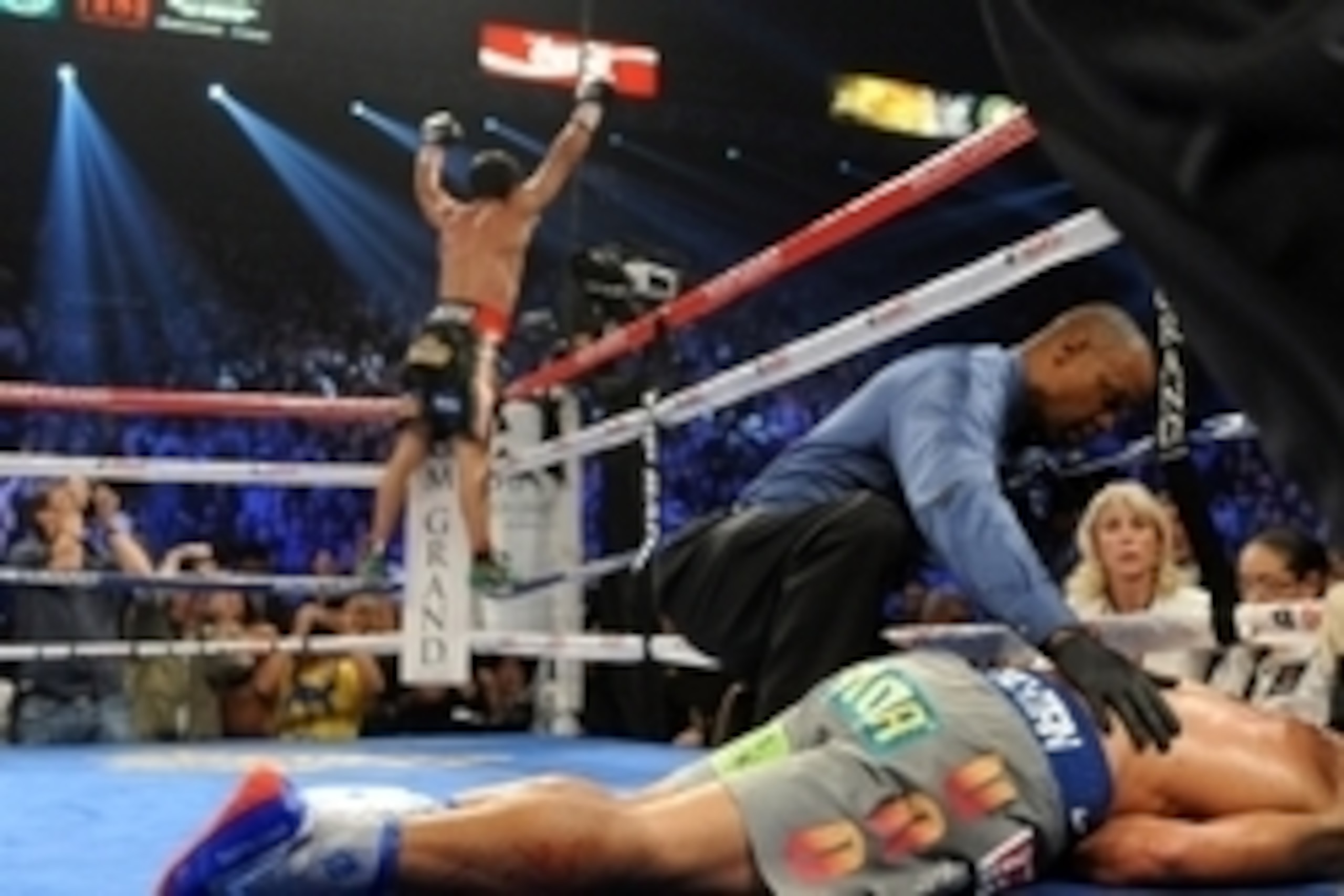
It seemed reasonable to expect more of the same when the two legends met for a fourth time in December 2012. After two relatively tentative rounds, Marquez began to work Pacquiao's body and used a feinted left hook to the body to set up an overhand right that dropped Pacquiao for the first time in their four fights together.
Marquez continued to land hard in the fourth and looked to be taking control of the fight. But Pacquiao came back strong in the fifth, dropping Marquez with a left. Both men traded solid power shots, but Marquez ended the round with a broken nose and on wobbly legs.
Round 6 was all Pacquiao, until the very end. With just a second remaining, Marquez lured Pacquiao forward and landed one of the great right-hand counters in the sport's history, knocking Pacquiao out cold and giving this great rivalry its first decisive finish.
2000-2009: Floyd Mayweather TKO10 Ricky Hatton
2 of 11Manny Pacquiao's Round 2 KO of Ricky Hatton was more spectacular, but Floyd Mayweather's earlier stoppage of the tough English star in December 2007 seems like the all-around more memorable fight to me. Both fighters came in undefeated, with Mayweather fresh off beating Oscar De La Hoya and Hatton having just knocked out Mayweather's toughest opponent, Jose Luis Castillo.
The British fans who travelled across the Atlantic to cheer their man played a large role in making this such a major event. At times the MGM Grand seemed more like a soccer stadium in Manchester.
Hatton's heart and bruising style made for an entertaining fight, but Mayweather's pinpoint accuracy with his lead right and check hook punished Hatton all night long. Seven years later, Mayweather haters still complain about the way Mayweather used his elbows in close range during this fight, while his fans still hail his unbelievable accuracy and control of distance.
1990-1999: Evander Holyfield TKO 11 Mike Tyson
3 of 11I would rank Evander Holyfield's first two fights with Riddick Bowe as better fights than his Round 11 stoppage of Mike Tyson. And the Holyfield-Tyson rematch, which ended with Tyson's bizarre cannibal turn, was certainly memorable.
But the first fight between Tyson and Holyfield in 1996 was an exciting scrap and has to be counted as one of the most memorable nights in boxing history. It was the night that the mystique of Iron Mike officially crashed to earth.
After coming out of prison in 1995, Tyson had stopped Peter McNeeley, Buster Mathis Jr., Frank Bruno and Bruce Seldon in rapid succession. The total number of rounds for all four fights was eight.
By this time, Holyfield had been through three wars with Bowe, getting stopped in the third. He'd lost a majority decision to former light heavyweight Michael Moorer and briefly retired with a heart condition. In the mind of the average sports fan, Holyfield was destined to be destroyed by the still monstrous Tyson.
Instead, Holyfield instituted a rugged, brawling game plan and beat Tyson up. My memory of watching the fight is that Tyson seemed to literally shrink in the ring. By the last round, I felt like I was watching Holyfield bully a little guy.
It would have been interesting to see what would have happened if this fight could have taken place four years earlier. It would have unquestionably been a great fight. But I'm not sure it would have ended up being quite so memorable.

.jpg?w=2560 "Chargers Mack")
.jpg?w=2560 "Green Bay Steelers Football")
1980-1989: Marvelous Marvin Hagler TKO 3 Thomas Hearns
4 of 11Most of the biggest fights of the 1980s involved some configuration of what sportswriter George Kimball dubbed "The Four Kings" in his seminal book on boxing during the decade. Sugar Ray Leonard vs. Marvelous Marvin Hagler, Leonard's first and second fights with Roberto Duran and his first fight with Thomas Hearns, along with Duran's 15-round war with Hagler and Hearns' two-round destruction of Duran, were all extremely memorable and historically important fights.
But the sheer intensity of Hearns and Hagler's three-round slugfest in 1985 deserves top billing here. It's the most memorable fight of the past 35 years.
With Leonard in retirement, Hagler and Hearns were clearly the two biggest pound-for-pound stars in the sport. Hagler was in the middle of the most dominant run in middleweight history. Hearns was less than a year removed from poleaxing Duran.
Both men came out intent on knocking out the other as quickly as possible. I suspect most readers have seen it countless times already, but if not, take the 10 minutes and watch it now.
Special mention should also go to the first fight between Alexis Arguello and Aaron Pryor, which Pryor came back to win by Round 14 TKO.
1970-1979: Muhammad Ali TKO 14 Joe Frazier
5 of 11The first fight between Muhammad Ali and Joe Frazier, held four years earlier, in 1971, had far more buildup than their third and final fight in 1975. Ali had recently returned to the sport after a forced layoff of over three years, due to his refusal to be drafted into the military during Vietnam. Frazier had risen in his place as a dominant heavyweight champion in his own right.
Heading into "The Fight of the Century," Ali and Frazier were both undefeated champions. The country was engulfed in political turmoil, and it hung over the fight as a subtext. Frazier standing over the downed Ali in Round 15 is one of the most famous boxing photos of all time.
But the third fight, in 1975, was the kind of epic, back-and-forth war that Hollywood tries to emulate with movies like Rocky. "The Thrilla in Manila" is a kind of Platonic ideal for a heavyweight prizefight.
Both men were a bit past their prime for this fight, but nevertheless they dug deep and achieved near-immortal greatness one more time. Angelo Dundee had to convince Ali not to quit late in the fight. Eddie Futch was forced to make Frazier quit after Round 14, to protect his fighter after both eyes had finally swollen shut during the 13th.
1960-1969: Muhammad Ali KO1 Sonny Liston
6 of 11A half century later, the rematch between Sonny Liston and Muhammad Ali remains one of the most talked-about fights ever. The photo of an enraged Ali standing over Liston and yelling for him to stand up is probably the most famous boxing poster in the world. A copy of it is hanging up in my office as I write this.
Whether or not Liston took a deliberate dive in May 1965 in Lewiston, Maine, or simply quit rather than risk being made a fool of again by Ali's blinding speed is impossible to know. But nobody, including Ali, seemed to think that Liston had been hit hard enough to put him down for a 10 count.
Even the choice of venue for this fight was incredibly strange. I once covered a professional MMA card at the same arena, which serves as a high school hockey rink in its regular duty.
It's impossible to imagine a less likely location for a heavyweight title fight. I'm almost positive that the only other world-class fighter to ever fight there is Joey Gamache, and that's because he was actually from Lewiston.
Less than 2,500 people were able to attend due to the limited seating at the venue. Lewiston native, Broadway star and eventual Vegas icon Robert Goulet muffed the lyrics to "The Star-Spangled Banner."
In the end, it wasn't much of a fight. In fact, it was barely any fight at all. But however unfortunate, it provided the most enduring and iconic moment in the sport during the 1960s.
1950-1959: Rocky Marciano KO 13 Joe Walcott
7 of 11In 1951, Jersey Joe Walcott had become the oldest heavyweight champion ever when he beat Ezzard Charles at the age of 37. In truth, Walcott probably should have become champion back in 1947, when he lost a highly controversial split decision to Joe Louis, in which he knocked the legendary champ down twice.
Walcott had come up in the sport the hard way, and his record was not exactly glittering, which has led him to become seriously underrated in historical terms. He was a slick, talented boxer.
He faced the brawling, awkward Rocky Marciano in his first defense in September 1952. For 12 rounds, Walcott made The Rock look like an amateur.
But in Round 13, Walcott looked to keep the pressure on Marciano and ended up walking into one of the most famous right hands in boxing history, Marciano's dangerous "Suzie Q" punch. Marciano was suddenly the heavyweight champion, and his legend as a great comeback artist was secure.
1940-1949: Joe Louis KO 13 Billy Conn
8 of 11This classic from 1941 came tantalizingly close to being one of the biggest upsets of all time and seriously rewriting the entire history of the sport. Trailing on two of three cards and even on the third, heavyweight champion Joe Louis came from behind in Round 13 to knockout his challenger, the light heavyweight champion, Billy Conn.
Louis had already written his ticket as an all-time great heavyweight champion by this point, having knocked out all five men to previously hold the belt. Conn was a talented boxer with moxie but a heavy underdog. The official weights for the bout were given as 199.5 pounds and 174, but as this FightSaga.com entry and a couple of other biographies I've read note, the true weights were likely 204 for Louis and 169 for Conn.
Conn used his quicker reflexes and faster feet to move in and out of range and outscore Louis all fight. But after he staggered Louis in Round 12, he got greedy in the 13th and attempted to go toe-to-toe with the legendary Bomber.
The outcome was disastrous for Conn. Knowing he needed a stoppage to win, Louis seized the opportunity he was given and hammered Conn with a right hand.
Louis staggered Conn and went into killer mode. A second right hand dropped Conn, and with two seconds left in the round, the underdog was counted out.
1930-1939: Joe Louis KO 1 Max Schmeling
9 of 11I consider this the most important sporting event in U.S. history. In 1938, with World War II quickly approaching, newly crowned heavyweight champion Joe Louis faced off with former champion Max Schmeling of Germany.
Schmeling was a decent man who would risk his own life to help Jewish people escape the Nazis during the war and then keep the story largely hidden for decades out of personal modesty. But in 1938, he was Hitler's favorite fighter.
Two years earlier, Schmeling had fought a tactically brilliant fight against Louis, knocking him out in Round 12. Hitler and the Nazi PR machine had pointed to this as proof that the Germans were a "master race."
As the rematch approached, the fight became much bigger than the sport itself. It became a battle between the racist ideals of the Germans and the democratic melting pot of the United States. For the first time in history, white Americans rallied around an African-American athlete as "our guy."
In the fight, Louis exploded all over Schmeling and crushed him in less than a round. It was a great boxing victory, but beyond that, it was an important step toward the needed civil rights breakthroughs that would follow in the second half of the century.
1920-1929: Gene Tunney UD Jack Dempsey, Second Fight
10 of 11Just as the second fight between Muhammad Ali and Sonny Liston is still debated today, the rematch between Jack Dempsey and Gene Tunney also continues to inspire speculation and arguments. After using his jab and lateral movement to wrestle the crown from the ferocious Dempsey a year earlier, Tunney was doing more of the same for the first six rounds of this 1927 rematch.
Then, in Round 7, Dempsey connected with the big punch he'd been looking for, flooring Tunney. However, the rule requiring a fighter to retreat to a neutral corner while the ref counted for 10 was new in 1927, and rather than follow it, Dempsey continued to loom menacingly over Tunney, as was his normal habit after felling an opponent.
This violation delayed the ref's count. There is little debate that Tunney was clearly on the canvas for longer than a count of 10. The argument is whether or not Tunney stayed down that long because he was following the ref's count or was truly unable to get up.
From watching the old footage, I believe Tunney clearly could have risen sooner, if necessary. At any rate, he recovered and continued to outbox Dempsey from a distance for the rest of the fight, ultimately retaining his title.
1910-1919: Jack Johnson TKO 15 James Jeffries
11 of 11While the reign of Joe Louis was a moment in which the United States made important progress in race relations, the country's reaction to Jack Johnson, 40 years earlier, was far less laudable. Boxing's first black heavyweight champion was met with shameful racist hostility by the white public, who recoiled in horror at the fact that a man with dark skin had claimed the title of the toughest man on the planet.
I won't say that Johnson went out of his way to provoke white America. A grown man has every right to live his life the way he wants to live it, and that's all Johnson really did. But it is accurate to say that Johnson made no efforts to spare the feelings of racists with his own public behavior.
He taunted white opponents and dated white women, even marrying one. At the turn of the 20th century, these were unfortunately unforgivable sins for many Americans.
The sporting public became so desperate for a "white hope" that they dragged former champion James Jeffries out of retirement, after six years. Jeffries had been a great champion. But by 1910, he had grown fat on his farm.
Jeffries managed to get himself into something like fighting condition for this bout. But his skills had long since grown rusty.
It was one of the most anticipated fights of all time, with telegraph operators sending round-by-round updates across the country. It was filmed for later showing around the world.
And despite the most avid wishes of racist America, Jeffries took a sustained beating before going down in Round 15 of a scheduled 45-round fight.
.jpg?w=2560 "MHJ's Potential Trade Value 📉")