Umberger-Hartnell Trade Still Looks Like a Terrible Deal for Philadelphia Flyers
It was always easy to understand why the Philadelphia Flyers would be interested in trading Scott Hartnell. After all, Hartnell is 32 years old and signed to a contract that combines both a long term with a pretty hefty cap hit. He’d rebounded in 2013-14 from a disappointing 2012-13 season, but the team was looking down the barrel of a long commitment to a player on the back nine of his career.
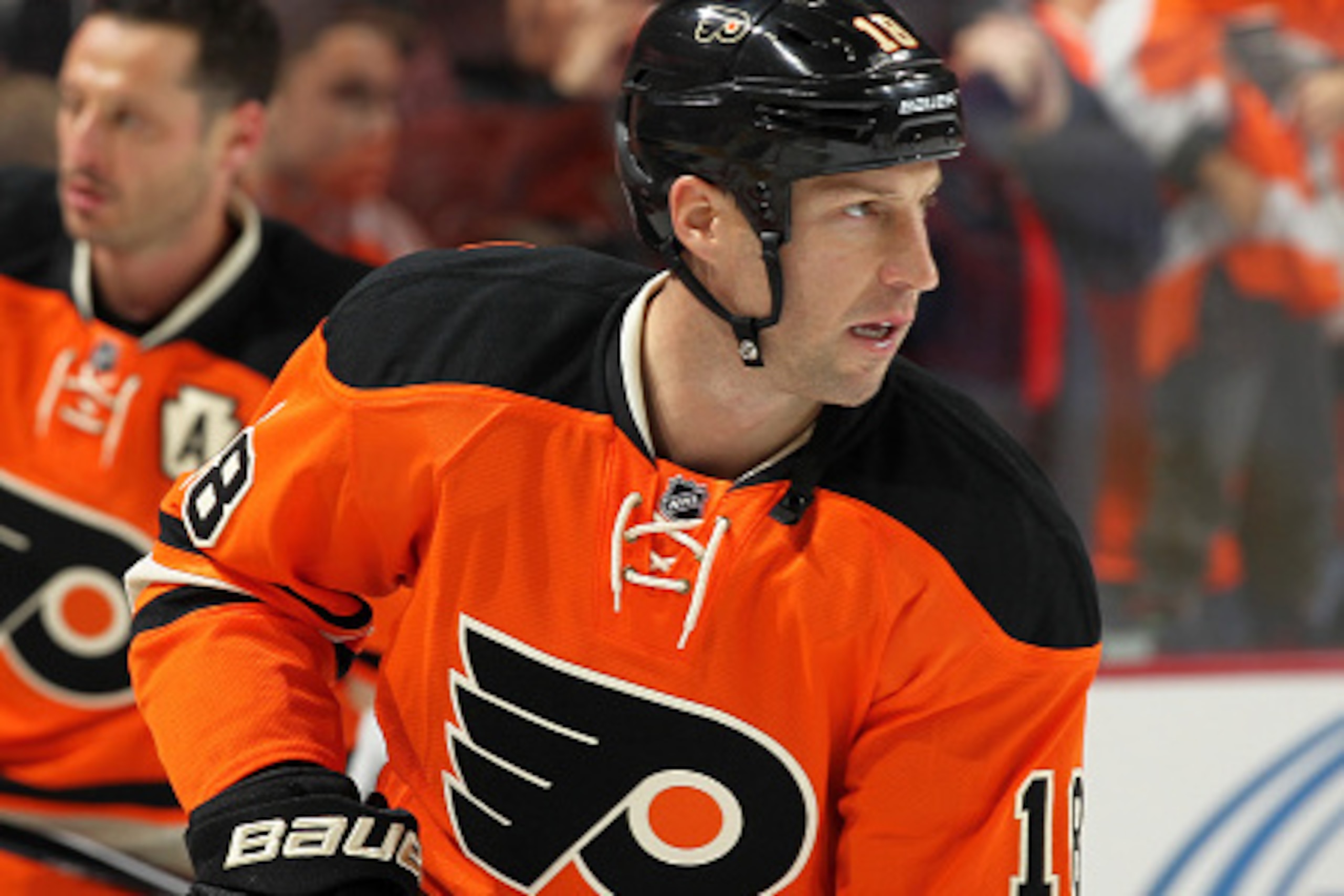
The baffling thing was that Philadelphia decided to solve those problems by trading Hartnell for R.J. Umberger.
.jpg?w=2560 "NHL Trade Grades Connor Hellebuyck")
Umberger carries many of the same negatives that Hartnell does. Like Hartnell, Umberger is 32 years old (he’s all of two weeks younger) and on the back nine of his career. Like Hartnell, Umberger has a deal that carries a hefty cap hit and stretches for multiple seasons after this one. And just like Hartnell, Umberger had a disappointing 2012-13 campaign; the difference was that he didn’t rebound from it to nearly the same extent.
That isn’t to say that the Flyers didn’t make any headway in the trade. After all, there are some marginal advantages to their deal with Columbus:
- Umberger’s contract is worth $150,000 per year less against the salary cap; with Philadelphia squeezed tight against the upper limit, every penny counts.
- Umberger’s contract ends two years sooner, meaning the Flyers aren’t on the hook for Hartnell’s age-35 and -36 seasons and that it’s easier to buy him out if that decision gets made.
- The Blue Jackets were also willing to throw in a fourth-round selection in the deep 2015 draft.
The not-so-marginal disadvantage to the trade is that Scott Hartnell is a better player than R.J. Umberger, whom the Jackets had considered buying out before offloading him to Philadelphia.
How much difference is there, really?
One key indicator of a forward’s ability is scoring. To compensate for differences in ice time, we’ll consider how many points each player scored per hour in five-on-five play rather than looking at raw point totals:
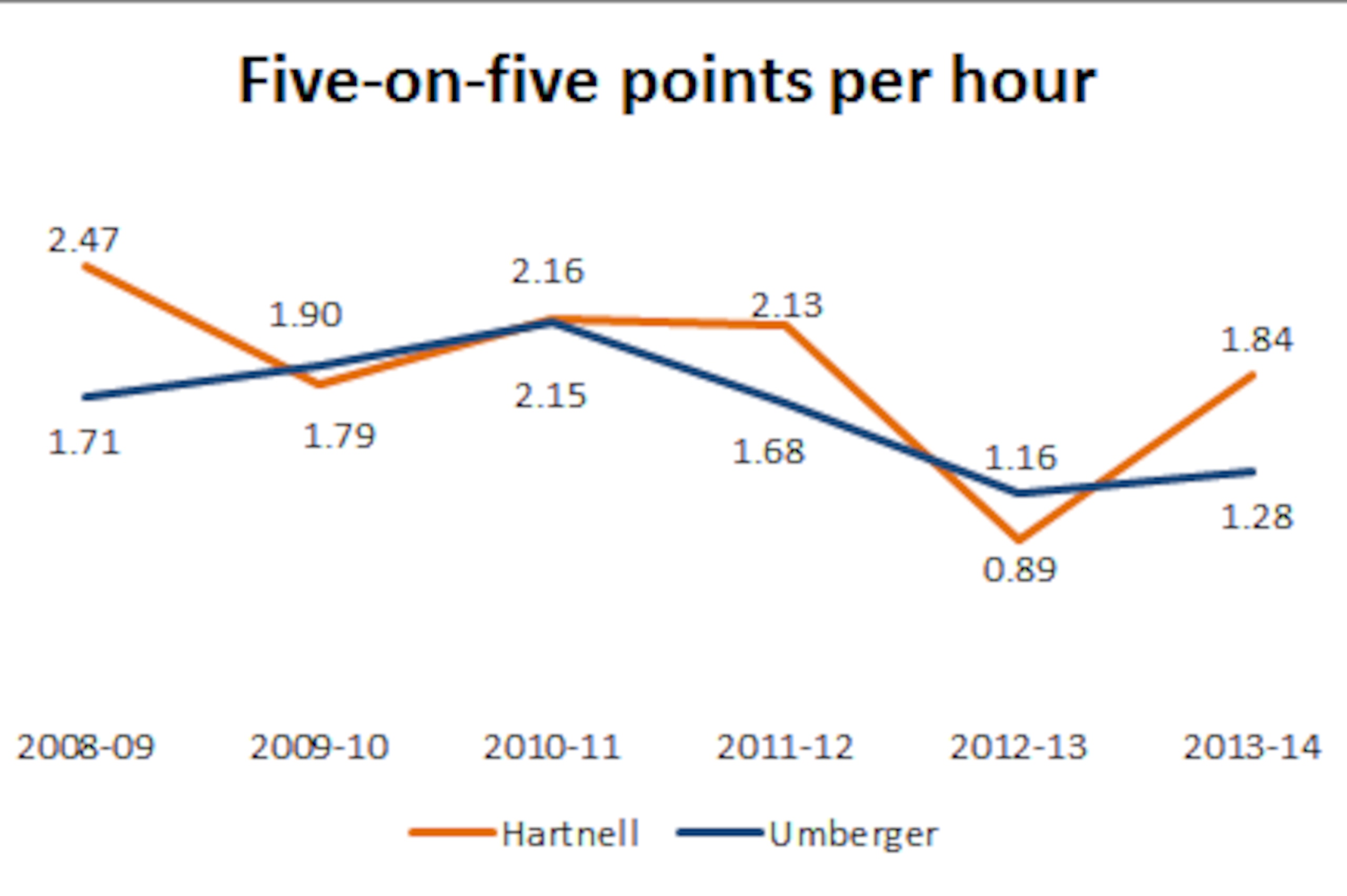
In three of the last six seasons, Umberger and Hartnell have marched in lockstep, with their points per hour interchangeable or close to it.
In the other three seasons, Hartnell has outscored Umberger by a minimum of one point for every two hours of five-on-five play. This trend isn’t confined to even strength, either; in five-on-four play, Hartnell and Umberger are neck and neck three times out of six, but in the other three cases, Hartnell’s numbers are clear of Umberger’s by a wide margin.
There’s simply no question which of these players is better at putting up points; Hartnell clears Umberger by a wide margin over time.
Over the 400-odd games considered in this span, Hartnell scores at a total rate of 1.95 points per hour in five-on-five play and 3.90 on the power play, while Umberger scores 1.57 points per hour five-on-five and 3.28 on the power play. Both average roughly 13 minutes per night on the man advantage and both average a hair less than three minutes per game on the power play, but Hartnell is a much more effective offensive player.
But the differences extend beyond offensive production. Umberger and Hartnell have played similar minutes at even strength over the last six years, and they’ve done so for similar teams.
The Blue Jackets managed a 50.0 percent Corsi rating with Umberger off the ice (meaning they took just a hair less than half of all unblocked shots at evens), while the Flyers were a 48.9 percent team minus Hartnell over the same stretch. But with Hartnell on the ice, the Flyers averaged a 51.1 percent Corsi rating, while with Umberger on the ice, that number was just 47.8 percent.

Some of that is certainly a factor of linemates; after all, Hartnell spent better than a third of his even-strength ice time alongside the magnificent Claude Giroux. But the funny thing is that with Hartnell on the ice without Giroux, the Flyers still managed a 49.3 percent Corsi rating, which is better than the 48.3 percent number that Umberger recorded in his 1,200-odd minutes playing on a line with Rick Nash.
In light of this, it’s not even the least bit surprising to see Hartnell lapping Umberger in the early going of 2014-15. Hartnell has 10 points in nine games, despite scoring just one goal on his 35 shots so far (Hartnell’s a career 11.0 percent shooter, meaning he’d normally have four goals on that quantity of shots). Meanwhile Umberger has one goal on 10 shots (right in line with his career average) and two helpers for a total of three points in nine games.
The gap between them probably isn’t as large as the absurd numbers to date paint it (Umberger has spent most of his time on the shutdown line with Sean Couturier), but this was always a bad deal for the Flyers.
Jonathan Willis covers the NHL for Bleacher Report. Follow him on Twitter for more of his work. Statistics via behindthenet.ca, war-on-ice.com, stats.hockeyanalysis.com and NHL.com. Salary information courtesy of CapGeek.com.

.jpg?w=2560 "NFL House in Paris Closes for Protests")

.jpg?w=2560 "Trevon Diggs Cut by Seahawks")