History in the Making: Local Woman Has Influence On Title XI
published in the July 26 issue of the Current-Argus
By Omar A. Gonzalez
Current-Argus Sports Editor
TOP NEWS
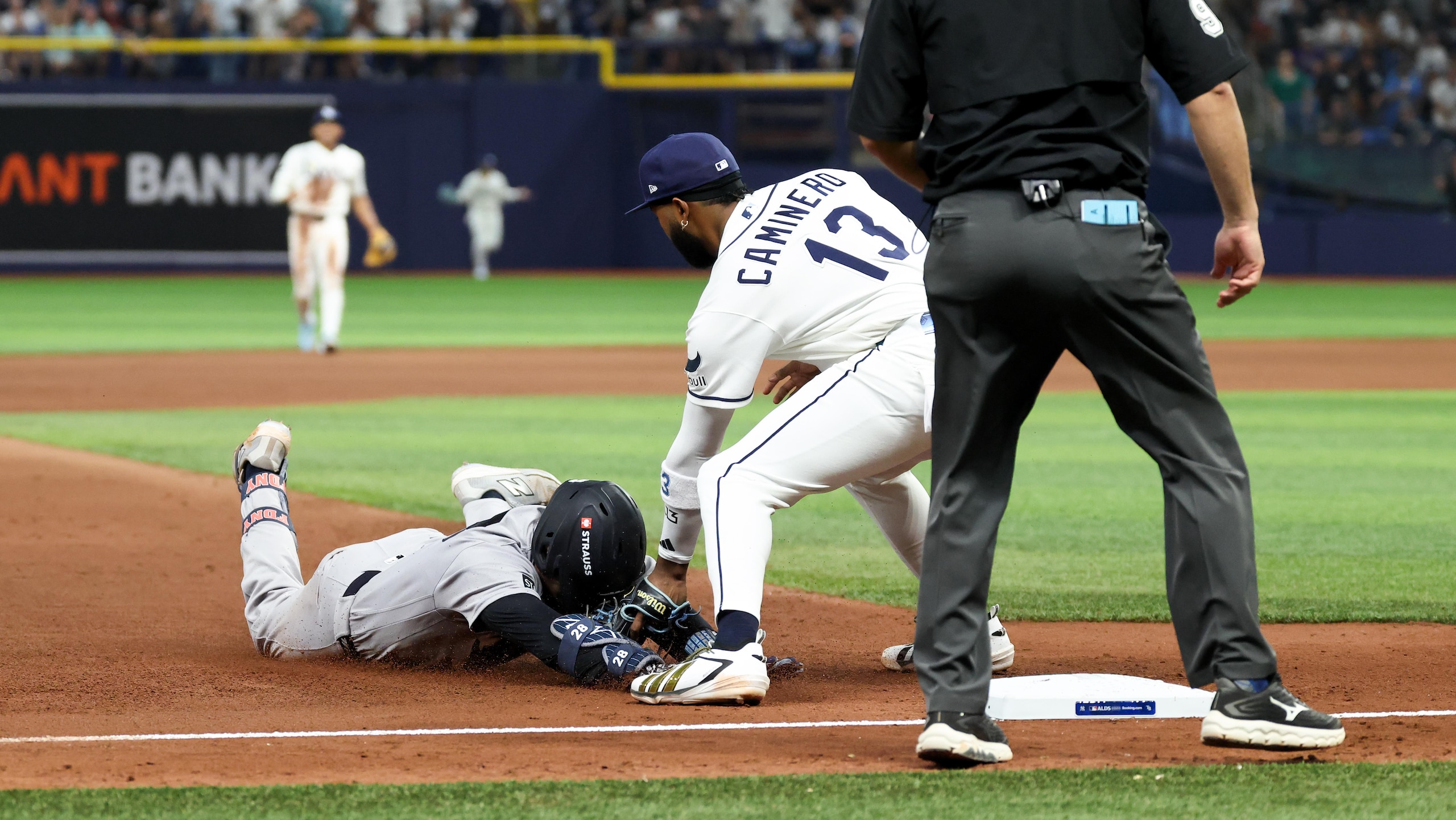
Aaron Boone Calls Out Yankees Catcher 🗣️
.jpg?w=2560 "Saints Lions Football")
Rap: Lions, LaPorta End Contract Talks
.jpg?w=2560 "Titans Giants Football")
OBJ Calls Out Giants After Release
CARLSBAD, NM — “Come one, come all, see if you can beat the amazing girls in a game of volleyball,” said Billie Lynn on the microphone in front of the packed arena full of men waiting for this halftime showcase to end so that they could see the Sul Ross Lobos play some more basketball.
A man dressed in western wear yelled, “What is this crap?”
The cowboy got the attention of Lynn.
“Why don’t you come down here?” Lynn said to the cowboy and his friends. “I tell you what. Get down here and see if you and your five friends can beat these two young ladies in a volleyball match.
“Come on, you’re not afraid of two girls are you?”
The match was set – the cowboy and five other men to play volleyball against two girls, in front of a packed arena in Alpine, Texas.
If only those two girls hadn’t been Marilyn McReavy Nolen and Mary Jo Peppler, two athletes who played volleyball for team U.S in the 1968 Olympics, the proud men wouldn’t have left the court as bruised boys.
Lynn, now an eldely woman, told this story her attempt to get respect in the late 1960’s. She was in the Cavern City for a little while, and only lived a few minutes away on a farm, not unlike where she grew up.
“On the girls playing against the boys – They never lost – never,” Lynn said. “It’s unbelievable to have two skilled athletes play full court, like beach ball. Boy, did the boys love it. I mean the crowd, when (Nolen or Peppler) just goes up and hits that ball right in some cowboys face and knock him to the ground, the crowd goes ‘Yeaaaaaaa!’
The exhibitions lasted for three seasons. Lynn worked tirelessly to generate enough respect for the female athletes and for the sport of Volleyball.
All over the nation women were getting restless as male sports were getting all the attention while lady sports were unable to offer scholarships to highly skilled girls.
The exhibitions might have had been viewed as nothing more than a circus act, but it did accomplish an important goal – it created interest in volleyball.
Enrollment for volleyball classes spiked and even males wanted to join the classes. This sparked an idea — why not have a competitive team at Sul Ross?
For two seasons, the smallest state university in Texas went all over the nation and destroyed any competition.
Led by Lynn, who remodeled a barn in her backyard to house some of the players, scraped up travel expenses by holding garage and bake sales, babysitting and picking up soda bottles for the three-cent deposit.
During the 1969-70 school year, an organization called the American Association for Health, Physical Education and Recreation announced it would be holding a women’s collegiate volleyball tournament in April through its Division of Girls’ and Women’s Sports. The tournament would be open to any two- or four-year college and would be in Long Beach.
Sul Ross was among the 28 teams that attended the tournament in Long Beach in April and that are where the similarities would end. The Lobos didn’t lose a single game in the tournament, not even a match. They beated one of the top programs of the time in UCLA 15-9, 15-4 in the finals.
Sul Ross went undefeated against collegiate competition the next year as well, drawing bigger crowds to games and spurring interest in the sport across campus. Nolen, named a member of the faculty for 1970-71, picked up several extra classes of volleyball after fall registration, and anytime the lights were turned on in the campus gym, students showed up just to play pick-up games.
The Brown Bears were defeated by a university whose girls were wearing handmade jerseys created by Nolen’s mother.
When it came time for the national tournament, this time in February, one of the players’ parents let the team borrow the family station wagon to drive to Lawrence, Kansas. The Lobos won again, this time beating Long Beach State in the final. Later that spring, the team again finished second in the USA Volleyball tournament.
The Lady Lobos’ seasons helped build the momentum toward what would be the seminal moment in women’s sports history in the United States, the adoption of the Education Amendments of 1972.
Title IX of that law states that “No person in the United States shall, on the basis of sex, be excluded from participation in, be denied the benefits of, or be subjected to discrimination under any education program or activity receiving Federal financial assistance.”
Interpreted and debated for more than seven years, it eventually became the basis for equality in funding and facilities in college sports throughout the country. And part of the impetus came from stubbornness, persistence and a get-it-done attitude at places such as Sul Ross in the late ‘60s and early ‘70s.
“It has to start some place and these kids were the pioneers,” said Lynn. “And for girls’ sports at that time it was hard. Back in my day, (girls) played in sports, but it was looked at as ‘fun.’ They had GAA, girls’ athletics as they called it. We had play days. Supposedly, we were not strong enough to compete.”
So games in the late ‘60s and early ‘70s were made to accommodate what doctors said about women at that time. For example, girls weren’t allowed to pla y fullcourt basketball because doctors believed it would be ‘too strenuous’ for them.
“I remember I was in these meetings, when I was in my master’s classes (at Sul Ross State) and I said ‘you’re telling me that these girls are too weak to play these sports,’” Lynn said. “But they can have a baby? I said ‘Have any of you guys had a baby? That’s a heck of a lot harder than running up and down a court.’”
Lynn was a career P.E. teacher, and she always was looking for opportunities for her students, for sports and activities that might be beyond her knowledge, but not beyond her sights.
“I look back and think ‘maybe if we hadn’t of done it some one else would have,’ Lynn said. “Who knows? It was that time in history, I was in P.E. and felt that girls sports were be neglected. I felt that they had more to offer than what was given to them. When I saw these two girls (Peppler and Nolen) were my secret, because they have the knowledge, I didn’t have, in that skill.”
The skills were used to the max and for the benefits of the girls’ transformation to women.
Marilyn McReavy Nolen coached volleyball at various universities, including New Mexico State. In 1967, she was selected to the USA national team and played internationally until 1975. She spent time developing the first national training center for the USA Olympic women’s team in Pasadena, Texas, before it moved to Colorado Springs. Nolen was inducted to the Women’s Sports Foundation Hall of Fame in 1978 and was named a “Leader in Volleyball” in 1992 by USA Volleyball. She was selected as one of the inaugural recipients of USA Volleyball’s All-Time Great Coaches Award in 1996. Nolen was honored with the AVCA Founders Award in 1999. She is currently retied from coaching in 2003.
Mary Jo Peppler was voted the best woman volleyball player in the world at the 1970 international games in Bulgaria despite the fact that her U.S. team finished 11th. As a coach, she formed two of the most powerful women’s teams in the country, the Los Angeles Renegades and the E Pluribus Unum team of Houston. The latter won the U.S. championship in 1972 and ‘73, wresting that title from its Southern California possessors for the first time in 22 years.
These three individuals may have had been trying to find a forum to play their game.
Many women look back at Title XI as a great achievement, but some believe that the program would go too far and with a price.
Lynn was at a convention in the early 1970s, before Title XI. She saw a man stood up on a podium and gave a speech that would stick to her, even in this day.
“Please let me warn you,” said the gentleman, Lynn couldn’t remember his name. “If you come in with us in NCAA, then you will have different rules then you have now. And if you are not careful, you are going to be where we are now. Where there are many things that need to be corrected, such as, under the table payment of stealing athletes. Right now your organization is not paying a kid to come to school, so you can be more careful.”
The gentleman closed his statement asking the riled up crowd, “Do you really want to go where we are?”
Many of the women in attendance were victims of the discrimination in women sports, so naturally they answered the question with a big yes. They were looking for the uniforms, faculties, staff, equipment and money that all the male sports received. In the time of civil rights, it was natural to have one party who felt the discrimination desire vindication.
The frantic crowd dismissed the older gentleman’s warnings, but his words reached Lynn.
When asked if the given by the gentleman in the conference was to be given any validation, Lynn paused for about of couple of seconds in the interview, leaned forward and gave an honest answer.
Look for the second part of this story where the Current-Argus goes in to the impact of what Title IX had on college sports in the August 2 issue of the Current-Argus.
David King of the San Antonio Express News contributed to this report.

.jpg?w=2560 "Report: Baker May Miss Up to 6 Weeks")
.jpg?w=2560 "EVERY Fantasy Football Update")