Why Buffalo Sabres Defenceman Tyler Myers Is a Big-Time Trade Asset in 2014-15
If the old aphorism of smoke indicating the presence of fire is true, there can be no doubt that Buffalo Sabres rearguard Tyler Myers is on the trade market. The NHL rumour mill has been keyed in on the still-young defenceman for months now, and there’s a widespread belief that multiple teams would be interested in his services, with people like Darren Dreger and Bob McKenzie suggesting he could be on the move.
Sabres general manager Tim Murray has already shown a tendency to play hardball in trade talks, and that seems to be the sticking point here, too:
.jpg?w=2560 "NHL Trade Grades Connor Hellebuyck")
Realistically, what should Buffalo be able to fetch in exchange for Myers? First we need to assess the player.
A superficial look shows a player with a lot of points in his favour. Myers is listed at 6’8”, 219 pounds; there isn’t a team in the league that doesn’t covet that kind of size. He’s a right-handed shot, which adds to his value. He has 300-odd NHL games under his belt, but he’s still only 24 years old. He has some history of offensive success; he scored 48 points as a rookie, though his numbers have come down over the years.
He logs a ton of minutes for the Sabres. In 2013-14 he averaged nearly 22 minutes per night and played on both special teams; through the first four games of 2014-15 he’s playing over 26 minutes per night.
It’s difficult to fairly assess a player like Myers who is buried on such a miserable team. He’s outpacing his teammates by a significant margin, but ideally any good player would. Still, it’s hard not to be a little impressed; he and partner Josh Gorges have been on the ice for nearly three defensive-zone faceoffs for every faceoff in the offensive zone and despite this the Sabres’ Corsi rating with the duo on the ice is significantly better than it is with any other combination of players.
Myers’ contract is another factor. That he’s locked up for five seasons (including this one) is a positive. That the rich years on his deal are already paid out is another. His cap hit, however, is a hefty $5.5 million per season, meaning that whoever gets him needs to be reasonably sure that he’s at least a No. 2/3 defenceman.
That's likely where he'd slide in on the depth chart of most teams. There's some risk to the projection, but Myers' size and range of skills means there's a decent chance he can play top-pairing minutes at even-strength successfully with a strong partner or at least anchor the second pairing. He also brings special teams utility, though he isn't the power-play ace that he appeared to be as a rookie.

With all that in mind, what should the Sabres be able to fetch in return? There hasn’t been a player quite like Myers dealt in some time, but one who has some things in common is Nick Leddy, who was dealt to the New York Islanders earlier this month. Leddy was the No. 5 defenceman on a great team as opposed to a No. 1 defenceman on a wretched one, but like Myers he’s a young defender whose rights will stay with his new team for a while.
Leddy, who was dealt with mediocre AHL goalie Kent Simpson, commanded an excellent prospect (Ville Pokka), a useful depth piece (T.J. Brennan) and the rights to a long-shot prospect (Anders Nilsson) in return. Myers will command more, but the question is how much more.
For starters, where Chicago was dumping salary, Buffalo has the ability to take money back and will likely need to if the team is to make a trade work. Those dollars should likely take the form of a useful NHL player, though this player could also be a pending free agent who the Sabres would then flip at the trade deadline (as they did with Matt Moulson in 2013-14).
We’d also expect to see a top prospect as part of the deal. This would be the team’s primary return, though the quality of the prospect would depend to some degree on the quality of the rest of the package. The Sabres have a rich system, so they have the luxury of adding a prospect at virtually any position; they need help everywhere but don’t need a prospect who fills a specific slot.
The core of the deal would centre around a useful NHL player and a top prospect, but could also certainly include more depending on how strong each of those players are. Buffalo is still at the stage where it is hoarding draft picks, so a high second-round selection or mid-first-round selection could certainly be used to sweeten the pot.

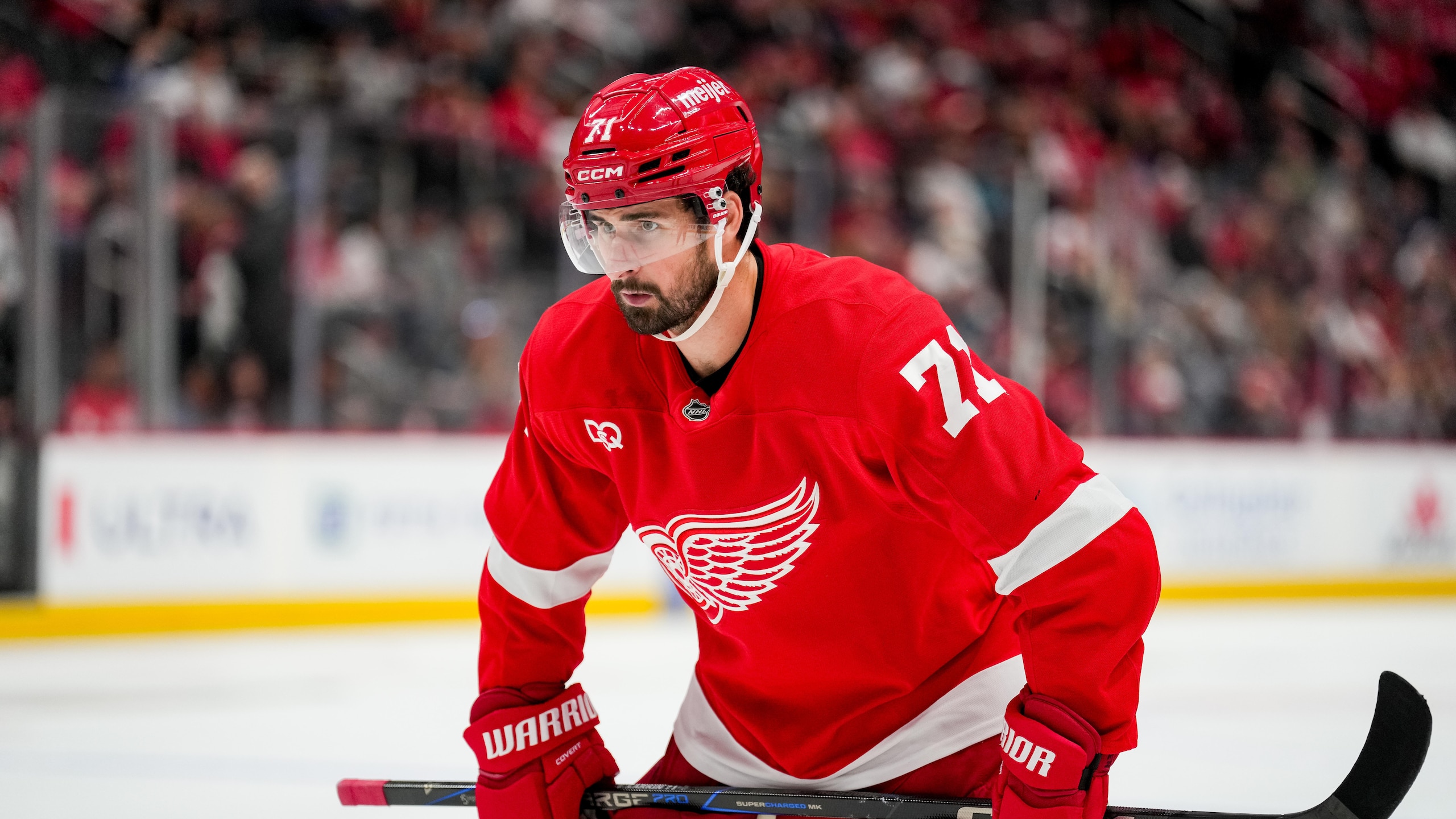
What would that look like? It could look like any number of returns; if we pick on Detroit (often linked to Myers) and specify Jakub Kindl as the NHL player (with the Sabres retaining a small portion of Myers’ deal), a plausible scenario might include a top prospect like Dylan Larkin and a high pick (perhaps the Red Wings’ 2015 second rounder). Detroit could also offer up one of its many good defence prospects (Mattias Backman, Xavier Ouellet and Ryan Sproul are all strong candidates) and substitute a first-round pick for that second rounder to make up the difference.
Detroit isn't the only team that would have interest in Myers, but they're the only team that has been consistently linked to the player publicly. Certainly other clubs would be interested, and they'd likely have to put a similar package together.
That’s all hypothetical, of course, but the above is the kind of trade that might convince Buffalo to make a move and it's probably in the range of what Myers will eventually go for if he is dealt.
Jonathan Willis covers the NHL for Bleacher Report. Follow him on Twitter for more of his work.
Statistics via NHL.com and war-on-ice.com and are current through the start of action on October 17. Salary information courtesy of CapGeek.com.

.jpg?w=2560 "NFL House in Paris Closes for Protests")

.jpg?w=2560 "Trevon Diggs Cut by Seahawks")