Dirt Cheap Brenden Dillon Critical to Dallas Stars' 2015 Stanley Cup Hopes
In a lot of ways, the Dallas Stars look like a team that could be a legitimate Stanley Cup contender.
Up front, the duo of Jamie Benn and Tyler Seguin stacks up well against just about anybody; both players finished inside the top 10 of NHL scorers in 2013-14. A whole layer of secondary scoring the team didn’t have a year ago was gained over the summer with the additions of Jason Spezza and Ales Hemsky. The supporting cast up front is largely made up of proven veterans. In net, Kari Lehtonen provides the team with above-average goaltending.
And then there’s the defence. Only three of the club’s eight rearguards have appeared in more than 150 NHL games, and one of those is Sergei Gonchar, who will turn 41 years old two days after Dallas’ final regular-season game in 2014-15. It’s a group bereft of marquee talent, with Alex Goligoski and Trevor Daley filling the top two slots.

.jpg?w=2560 "NHL Trade Grades Connor Hellebuyck")
That’s why the signing last week of Brenden Dillon to a one-year contract was so crucial for the Stars.
Dallas, a team without an abundance of cap space, forced these negotiations to the 11th hour to get Dillon under contract at a team-friendly price. In an open market, he’s worth a lot more than $1.25 million, but because Dillon was just coming out of his entry-level deal the Stars had all the leverage. They opted to use it, and it’s hard to blame them; this is a team that will probably be looking to upgrade at the deadline and it is close enough to the cap that every dollar counts.
With that said, even before Gonchar’s injury it was imperative that the Stars get Dillon signed before the start of the season.
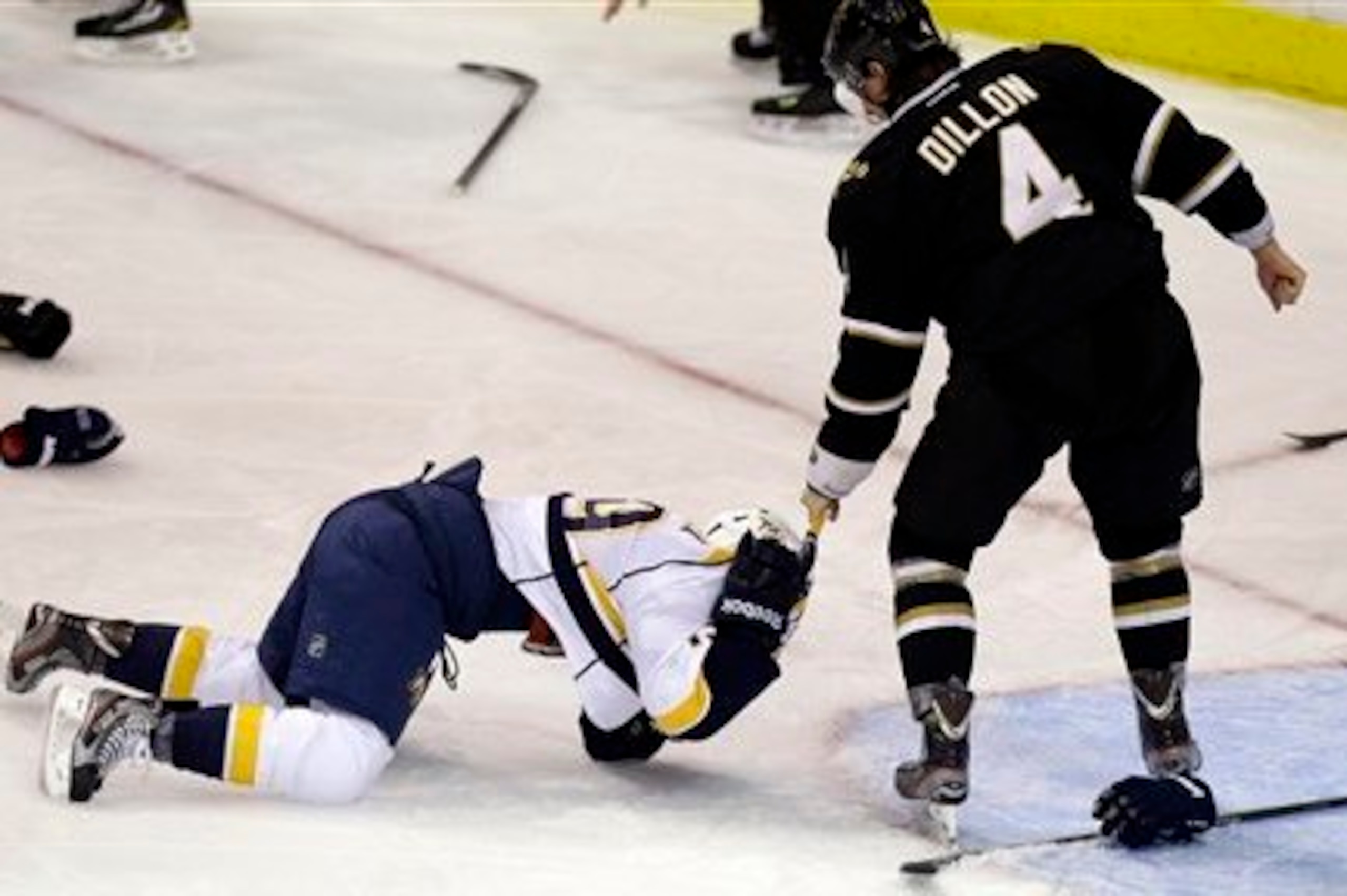
The undrafted 23-year-old adds some important elements to the Dallas blue line. Last year he trailed only Goligoski and Daley in average time on ice per game (21:05), and he was actually the club’s most-used defenceman at even-strength. He also injects some much-needed size on a smallish group; listed at 6’4”, 225 pounds he towers over every other somewhat proven defenceman on the team (rookies Patrik Nemeth and Jamie Oleksiak bring a similar element).
Unsurprisingly, Stars head coach Lindy Ruff opted to deploy his biggest, most physical defender in a primarily defensive role. Dillon had the toughest ratio of defensive-to-offensive zone starts on the team and routinely took on top competition; his most common opponents in 2013-14 were Patrick Sharp and Jonathan Toews.
There is more to Dillon than toughness or even tough assignments, though. He’s a guy who can take and make a pass. He was a late-bloomer, but exploded offensively in his final year in junior and hit the ground running as a pro; as a rookie a guy he topped 15 points just once in the WHL posted 29 in 76 AHL games.
Good things have happened with Dillon on the ice. Despite tough zone starts as a rookie in 2012-13, the Stars posted a better Corsi number with him on the ice than with him off it; in 2013-14 Dillon just underperformed the team average by a hair while doing yeoman’s work in the defensive zone against some pretty good opponents.
He’s a key member of the Stars’ defensive group, a guy with a significant role at even-strength and on the power play whose skill set complements the players around him nicely. He isn’t famous league-wide, and he isn’t getting paid like a difference-maker, but if Dallas is going to compete for a championship it’s only going to be able to because the young defenders on the team are doing far more than their reputations suggest. Few of those young defender are more critical to the cause than Dillon.
Jonathan Willis covers the NHL for Bleacher Report. Follow him on Twitter for more of his work. Statistics via Behindthenet.ca, Stats.HockeyAnalysis.com and NHL.com.

.jpg?w=2560 "NFL House in Paris Closes for Protests")

.jpg?w=2560 "Trevon Diggs Cut by Seahawks")